
Ecological Practice Design: A Tiny Case Study of Affordance Analysis
Three Principles of Affordance Analysis
On May 17, 2022, I edited a book (draft) titled Ecological Practice Design: The Lifesystem Approach to Everyday Life Innovation.
I started developing the Ecological Practice Approach in 2019 and the Lifesystem framework was born in Oct 2020. In the past four years, I wrote several books (in drafts) about the approach:
- Curativity: The Ecological Approach to General Curation Practice (2019)
- After Affordance: The Ecological Approach to Human Action (2020)
- Platform for Development: The Ecology of Adult Development in the 21st Century (2021)
Some readers may know that Creative Design is one of my career themes. My early career was designing newspaper ads and corporate identity. Later, I moved to digital interaction design. Now, I am working on activity analysis and service design.
Though the Ecological Practice Approach and the Lifesystem framework were not developed for discussing Design, they could apply to the field of Design, especially everyday life innovation.
The concept of Affordance is a theoretical concept behind the Lifesysem framework.
What’s Affordance?
The Ecological Practice Approach is inspired by Ecological Psychology. One of the significant ideas of Ecological Psychology is the notion of Affordances which is an important theoretical concept for understanding human — material engagement.
What’s Affordance? Let’s have a look at the original definition made by James J. Gibson:
The affordances of the environment are what it offers the animal, what it provides or furnishes, either for good or ill. The verb to afford is found in the dictionary, but the noun affordance is not. I have made it up. I mean by it something that refers to both the environment and the animal in a way that no existing term does. It implies the complementarity of the animal and the environment. (p.119)
Though the core of Gibson’s theory is visual perception, we can see the whole “Perception-Affordance-Action” loop as a theory of action and apply it to new fields. Perceiving affordances is for taking actions, taking actions has an impact on the environment and changes the affordances of the environment. I draw the diagram below to visualize this loop.
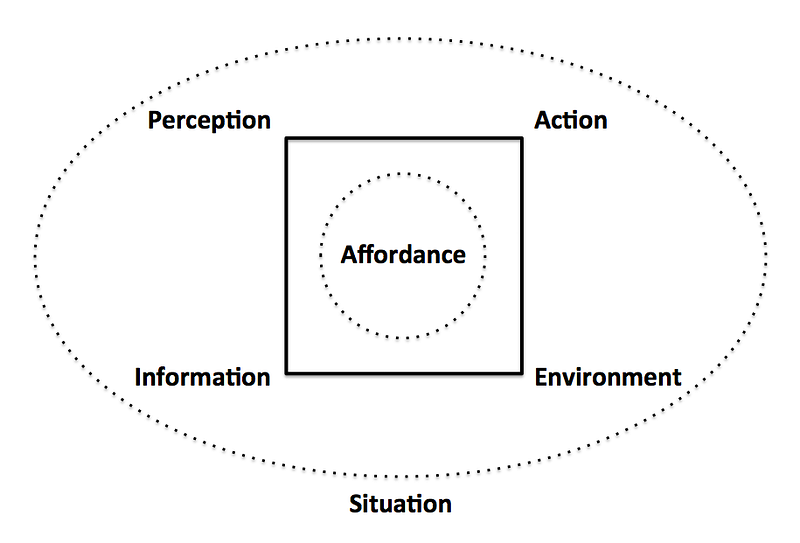
If we adopt Gibson’s version of Affordance, then we can pay attention to the Immediate Experience of human — material engagement. For the Lifesystem framework, we can use the perspective of Affordance to guide our observation of real-life research.
Affordance Analysis
The Lifesystem framework is a practical framework which aims to connect THEORY and PRACTICE.
How can I incorporate the concept of Affordance into the Lifesystem framework? See the diagram below.
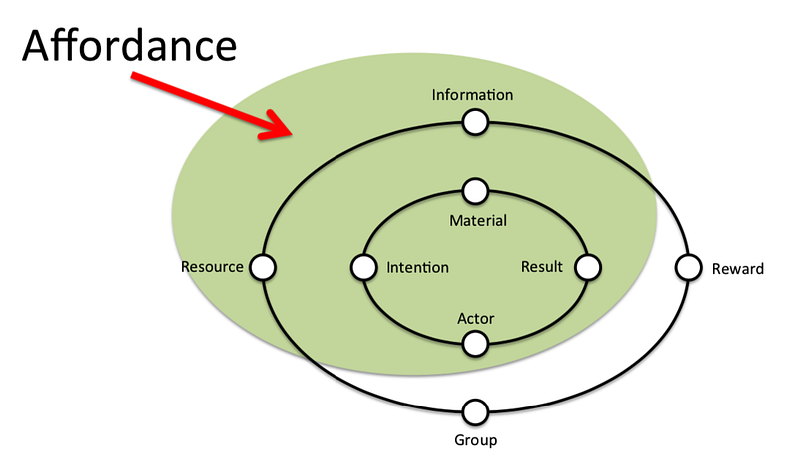
The above diagram shows the perspective of Affordance for Lifesystem study. The perspective focuses on an Actor, not the Group which is defined as the social context of the Actor. It doesn’t consider Reward because Immediate Experience is about a particular moment while Reward is about an outcome of a long-term activity.
We can start with the following simple question:
How does a person use a material thing and act with a particular environment?
I use “material thing” because I want to remove cultural meaning from the thing. This is the essential point of Affordance theory because it is about the Perceive-Affordances-Action loop.
A Tiny Case Study
In the past several years, I spent much time on observing my sons’ daily life activities. Eventually, I realized that this is a great way to learn the concept of Affordance.
Some concepts are not observable in the real world. In contrast, you can see other concepts in your daily life. There are many versions of definitions of the concept of Affordance, if you follow Gibson’s original approach, you can see it in your life.
Let’s conduct a tiny case study about Affordance. See the picture below.
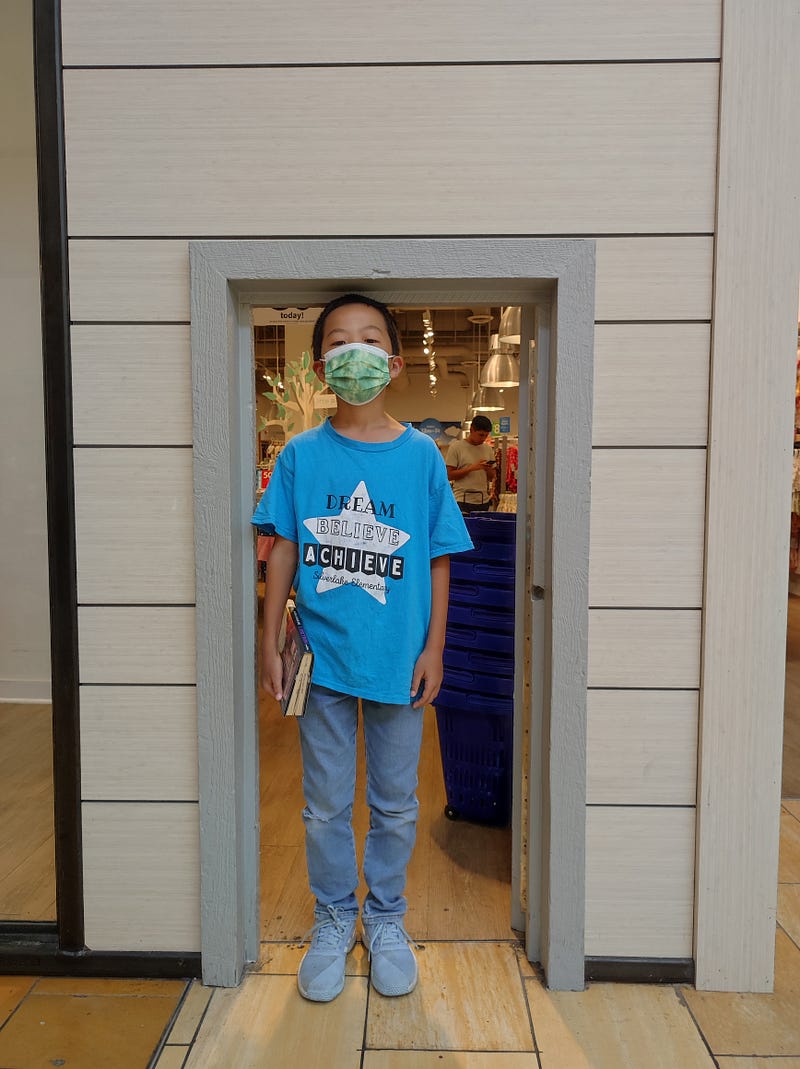
On May 27, 2023, I visited the Galleria, a shopping center in Houston, with my family. I took the above picture in a store.
I realized that this is a great opportunity to make a case study for Affordance Analysis. So, I asked my sons to play with the door.
Then, I took pictures.
Now, let’s look at the picture below.
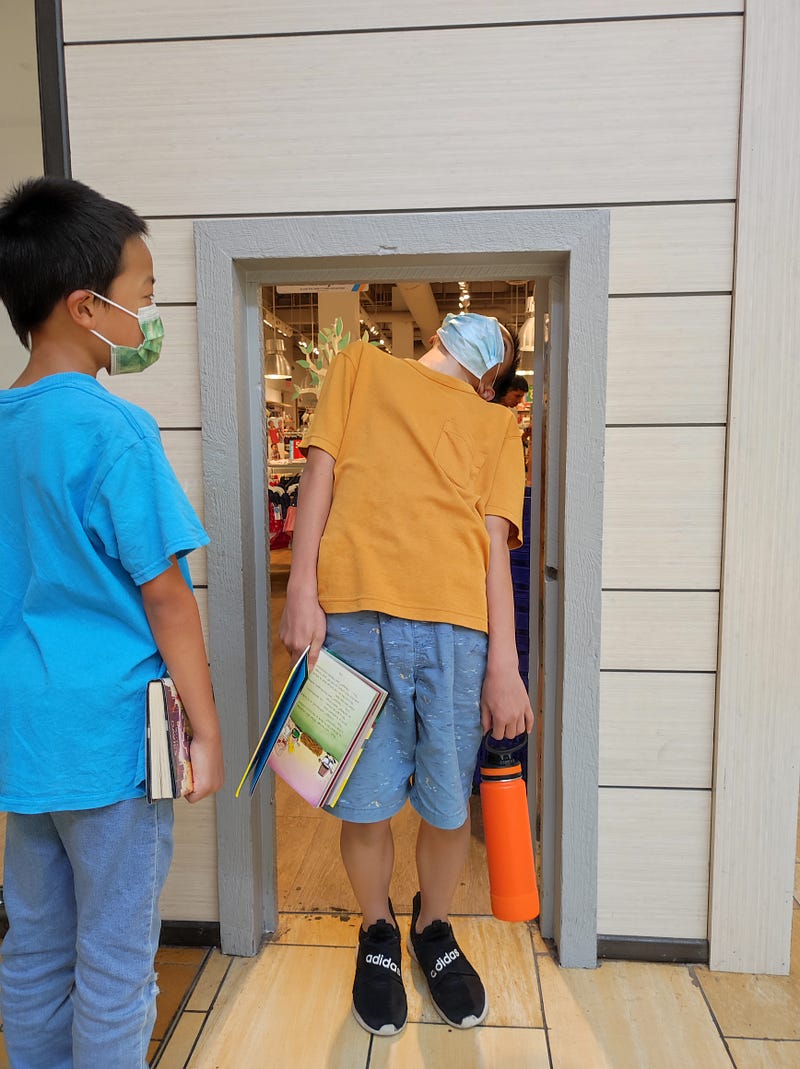
What’s the difference between these two pictures?
My little son was born in 2010 and his brother is 3 years older than him. The particular door offers an affordance for going through to my little son because he is short enough to go through the door.
However, his brother is higher than him. The door doesn’t offer the same Affordance to his brother.
The concept of Affordances doesn’t refer to features of a thing. Affordances are aspects of the environment related to capacities and abilities of agents.
You have to consider both the particular thing and the particular person.
Three Principles of Affordance Analysis
What can we learn from the above tiny case study?
We can discover three principles of Affordance Analysis for further case studies.
- Start with an Immediate Experience
- Focus on a Particular Thing
- Pay attention to Individual Differences
The radical aspect of affordance theory is that it challenges the traditional view on the meaning of objects “concept first” and turns it to “percept first”. The concept is about linguistic meaning and ordinary classes of objects. Gibson argued, “To perceive an affordance is not to classify an object…The theory of affordances rescues us from the philosophical muddle of assuming fixed classes of objects, each defined by its common features and then given a name. As Ludwig Wittgenstein knew, you cannot specify the necessary and sufficient features of the class of things to which a name is given. They have only a ‘family resemblance.’ But this does not mean you cannot learn how to use things and perceive their uses. You do not have to classify and label things in order to perceive what they afford.” (p.126)
In an immediate experience, you should forget the concept of a thing. In this way, you can remove cultural meaning from the thing and only focus on the material aspect of the thing. While Concept and Cultural Meaning are about general description, an immediate experience refers to a particular situation.
A particular situation includes a particular thing, a particular person, a particular space, a particular time, etc. The door is a particular door. If you think about a Door as an abstract concept and apply it to the concept of affordance, you will get a description:
A door offers an affordance to a child for going through.
Sound great. However, you are just doing a Concept Analysis, not an Affordance Analysis.
The value of the concept of Affordance is its unique unit of analysis. An Affordance Analysis requires use to consider individual difference. My two sons have different height, so they have different “aspects of agents”.
Affordances and Creative Actions
The ecological practice approach claims that the original source of all human actions is affordance and imagination. Affordance refers to material engagement while imagination refers to linguistic engagement.
If we accept the ideas from cognitive linguistics which claims that the source of linguistic conceptual metaphor is embodied experience, we can reduce the linguistic engagement (imagination) to material engagement (affordance). In fact, we can learn more from philosophists of embodied cognitive science. They consider affordance as an essential concept for rethinking the mind from the perspective of embodied cognitive science.
My focus is action and practice, not mind and cognition. The goal of the ecological approach is to build a new unit of analysis for discussing action and practice. The “Possible Practice” is just the beginning.
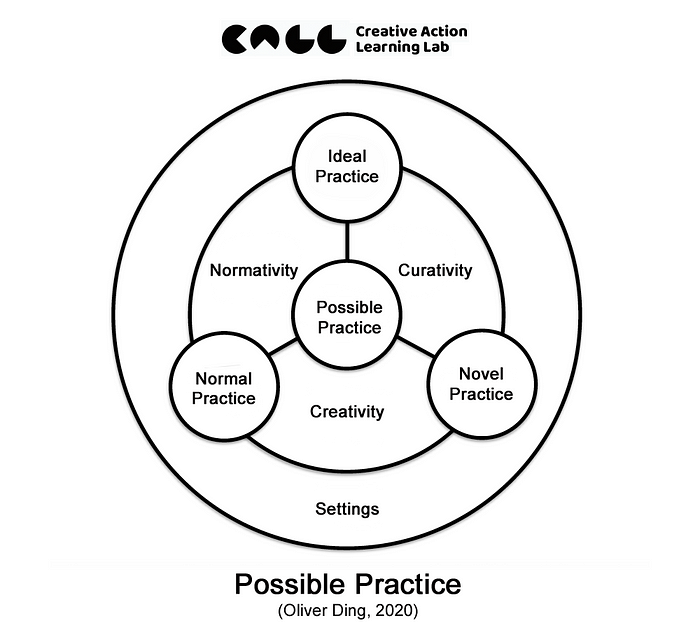
In 2020, I also made a framework for “Possible Practice”. See the above diagram.
I consider actions at the individual level and practice at the collective level. The four types of actions correspond to four types of social practice.
- Possible Practice — Possible Actions
- Normal Practice — Normal Actions
- Novel Practice — Creative actions
- Ideal Practice — Exemplary Actions
Why do I place Possible Practice at the center of the new framework? I consider the possible practice as the origin of all types of practice. If we trace back to the historical development of any social practice. We can always find that their sources are possible actions. In order to build the concept of Possible Practice, I use Possible Actions to replace Imagined Actions. I consider affordance and imagination are two sources of possible actions.
I started using the term “Creative Action” in 2019. My first knowledge center CALL stands for Creative Action Learning Lab.
In 2022, I used “Creative Action” as a unit of analysis for the Creative Life approach which is presented with four possible books.
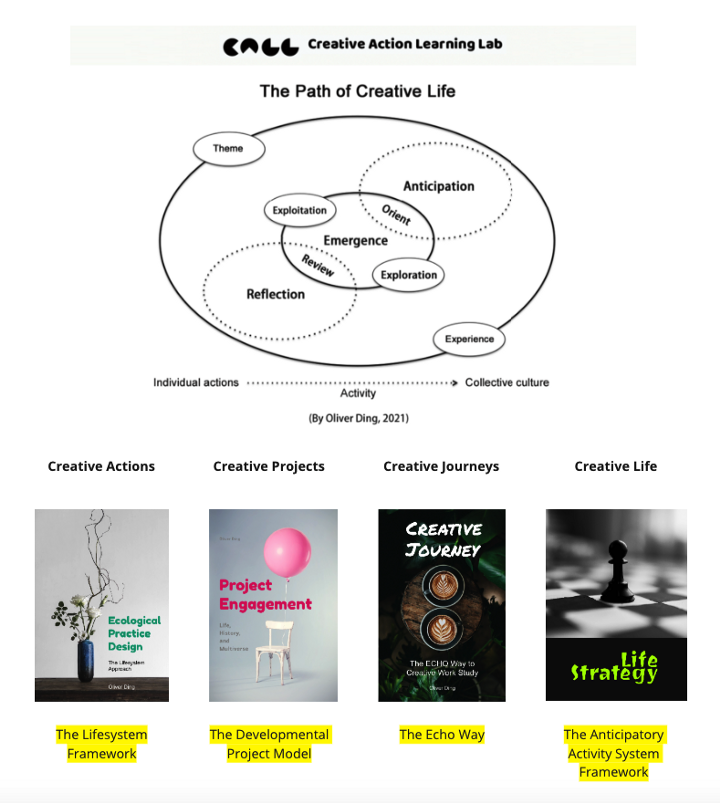
In 2022, I developed several units of analysis for understanding Aspects of Creative Life.
- Creative Actions
- Creative Projects
- Creative Journey
- Creative Landscape
- Creative Lifescope

Each Unit of Analysis refers to a unique time scale, spatial scale, and theoretical focus. The “Action” unit of analysis refers to the Creative Action Analysis Method.
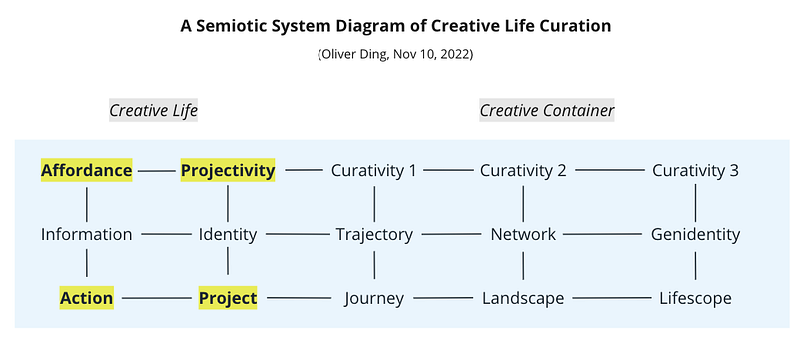
You can find more details in A Semiotic System Diagram for Creative Life Curation.
Each unit of analysis has it its own method for deep exploration. Affordance Analysis is about the “Action” unit of analysis.
References:
- The Affordance U
- TALE: A Possible Theme called “Possible Practice”
- Ecological Practice Design: The Affordances of Mirror and Lifeway
- Ecological Practice Design (Book)
- Lifesystem: Modeling Ice Skating and Other Social Practices
- Creative Actions: Second-order Affordance and Attachance
- Lifesystem: The Notion of Affordance Analysis
- Hammer, Hammering, and Affordance