avatarLucianoSphere (Luciano Abriata, PhD)

Free AI web copilot to create summaries, insights and extended knowledge, download it at here

5882

Abstract

rum, “wavelength” (measured in “nanometers”, abbreviated nm) is the actual physical parameter of light that is related to its color. You can see in the color bar above that the range from 400 to 500 nm corresponds to violet and blue light, which are well absorbed; then there’s not much absorption from 500 to 600–650 nm (mainly green plus also some yellow), and then there’s another strong absorption band well inside the red region.</p><p id="5051">Moving further towards the right in the electromagnetic spectrum we get to the “infrared” region, <i>i.e.</i> lower than red. This energy is too “weak” to assist photosynthesis. On the other end, moving towards the left gets us to the “ultraviolet” region, which is too energetic and its absorption can damage tissue. (Technical note: you see the absorption going up like crazy towards the ultraviolet region, but this is most likely a contribution from slight scattering rather than actual absorption).</p><h2 id="0c52">Now, tell me, why do plants absorb light?</h2><p id="0764">You probably know this, but I will show it to you here in a new way.</p><p id="3f5f">Of course, plants absorb light for photosynthesis, which is the process by which they fix carbon and store energy (plus, as a side product extremely relevant for all superior life, this process creates the oxygen we breathe!). I'm not going here deeper than that, but you can consult WikiPedia’s excellent <a href="https://en.wikipedia.org/wiki/Photosynthesis">article on photosynthesis here</a>.</p><p id="3149"><b>What I will show you is where and how photosynthesis happens. And we’ll do that using augmented reality!</b></p><p id="7926">Take your phone, open Google Chrome and search for “photosynthesis”. Then in the results scroll down until you see this (it shouldn’t be too far down):</p><figure id="31d1"><img src="https://cdn-images-1.readmedium.com/v2/resize:fit:800/1*XSmV4TG0vA8vgFzoFpodsg.png"><figcaption></figcaption></figure><p id="4801">Tap “View in 3D” and then “View in my space". Move your smartphone around pointing at the floor or a table: the phone will recognize the flat horizontal surface and will display a 3D image of a photosynthesizing plant! Here is a shot in which you can see the sunbeams hitting the leave, molecules of CO2 coming into the plant (grey, to be fixed by photosynthesis), and a molecule of oxygen coming out (red, produced by photosynthesis):</p><figure id="2a6b"><img src="https://cdn-images-1.readmedium.com/v2/resize:fit:800/1*A4eJJvrMU1R_RH46i9a9Dg.png"><figcaption></figcaption></figure><p id="a0fd">The augmented reality animation shows you this is all happening inside the green parts of the leaves. But where, more exactly?</p><p id="9518">It turns out that (green) plant cells have special organelles inside of them, the “chloroplasts”, which contain the main parts of the photosynthetic machinery.</p><blockquote id="a087"><p>(Cool side note: it is speculated on serious grounds that chloroplasts were originally isolated photosynthetic, oxygen-producing bacteria that were engulfed by eukaryotic cells as they evolved into plants; just like mitochondria were likely oxygen-consuming bacteria that were engulfed as eukaryotic cells showed up too).</p></blockquote><p id="08a2">To see 3D models of chloroplasts, you can search for “plant cell” in your phone’s Chrome browser and then inspect the model in 3D:</p><figure id="7361"><img src="https://cdn-images-1.readmedium.com/v2/resize:fit:800/1*hk4YOsTB_aZX3prJCzTiGw.png"><figcaption></figcaption></figure><p id="dad2">You’ll see the chloroplast modeled in green. If you get close to it, you’ll see some bag-like structures. These are the thylakoids, whose membranes contain the protein machinery that captures the sunlight (called “photosystems”):</p><figure id="964a"><img src="https://cdn-images-1.readmedium.com/v2/resize:fit:800/1*P2WBqkEoKBofvYYtrUBQVA.png"><figcaption></figcaption></figure><p id="c989">In fact, you can also look at the photosystems themselves, even their chlorophyll molecules! Their chemical structures are known and publicly available. It’s all just a matter of knowing how to look at them… but here I prepared an image for you:</p><figure id="4291"><img src="https://cdn-images-1.readmedium.com/v2/resize:fit:800/1*kAO64GWSopXffn8uhmgIUA.png"><figcaption></figcaption></figure><p id="d860">In the picture above, the black lines represent the thylakoid membrane, the transparent purple cartoons are a simplified representation of the proteins that make up this photosystem, and the molecules shown as sticks are several chlorophyll molecules (I represented their carbon atoms in green). Here you can see just one of these chlorophyll molecules in detail, from two orientations:</p><figure id="487f"><img src="https://cdn-images-1.readmedium.com/v2/resize:fit:800/1*ZY8tXvlpqUXdZ-99z2fOjw.png"><figcaption></figcaption></figure><p id="71f1">The sphere in the center is a Magnesium ion. The peculiar structure of this molecule (essentially a flat ring containing four 5-member rings in the center) is what makes chlorophyll absorb visible light.</p><blockquote id="cc0a"><p><b>Contemplate how I’ve taken you from a daily observation (“plants are green”) to understand why we see them green, and why they need that thing that makes them green, all the way to the atomic level.</b></p></blockquote><blockquote id="c479"><p><b>Yes, each single plant you see has millions of cells each containing lots of chloroplasts whose photosystems anchored to their thylakoid membranes all have this molecule that looks green and is at the heart of life: fixing energy and carbon and producing oxygen that other living creatures breathe. Crazy, isn’t it?</b></p></blockquote><h2 id="490f">But hey, if plants want to maximize energy input, why don’t they just absorb all light?</h2><p id="60cb">(which would make them black!)</p><p id="f16a">Altho

Options

ugh there are photosynthetic pigments other than green, it is believed that when the first green bacteria evolved (before evolving themselves into plants) the seas were infested with purple bacteria that harvested light with a pigment called bacteriorhodopsin (instead of chlorophyll). Bacteriorhodopsin is purple, because it absorbs most of the green and yellow light (letting the violet, blue and red lights pass, whose combination looks purple). The evolving green bacteria then had to adapt to the part of the light that was available, thus gaining a green color that was presumably maintained when they left the waters. Crazy, eh!</p><h1 id="3e88">To know more…</h1><ul><li>About light absorption for photosynthesis, with some more spectra:</li></ul><div id="5869" class="link-block"> <a href="http://hyperphysics.phy-astr.gsu.edu/hbase/Biology/ligabs.html"> <div> <div> <h2>Light Absorption for Photosynthesis</h2> <div><h3>The energy derived from light absorption is used in particular pathways to achieve the final result of synthesis of…</h3></div> <div><p>hyperphysics.phy-astr.gsu.edu</p></div> </div> <div> <div style="background-image: url(https://miro.readmedium.com/v2/resize:fit:320/)"></div> </div> </div> </a> </div><ul><li>About the photosystems, their structure and function (science outreach from the organization that manages protein structures and makes them accessible):</li></ul><div id="181e" class="link-block"> <a href="https://pdb101.rcsb.org/motm/22"> <div> <div> <h2>PDB101: Molecule of the Month: Photosystem I</h2> <div><h3>Look around. Just about everywhere that you go, you will see something green. Plants cover the Earth, and their smaller…</h3></div> <div><p>pdb101.rcsb.org</p></div> </div> <div> <div style="background-image: url(https://miro.readmedium.com/v2/resize:fit:320/0*9snSwQzn6cLOkK5Q)"></div> </div> </div> </a> </div><ul><li>The X-ray structure I used for the molecule views:</li></ul><div id="81fc" class="link-block"> <a href="https://www.rcsb.org/structure/1jb0"> <div> <div> <h2>RCSB PDB - 1JB0: Crystal Structure of Photosystem I: a Photosynthetic Reaction Center and Core…</h2> <div><h3>Crystal Structure of Photosystem I: a Photosynthetic Reaction Center and Core Antenna System from Cyanobacteria</h3></div> <div><p>www.rcsb.org</p></div> </div> <div> <div style="background-image: url(https://miro.readmedium.com/v2/resize:fit:320/0*sfffvKy22-ZrxhEV)"></div> </div> </div> </a> </div><h1 id="0899">Did you like this blend of science outreach and art?</h1><p id="4b22">Then check this out:</p><div id="4828" class="link-block"> <a href="https://readmedium.com/fun-with-chemistry-and-colors-2cdcab566604"> <div> <div> <h2>Fun with colors with at-home chemistry</h2> <div><h3>The color of cabbage extract is very sensitive to pH, so you can get a very rich palette with simple household…</h3></div> <div><p>medium.com</p></div> </div> <div> <div style="background-image: url(https://miro.readmedium.com/v2/resize:fit:320/1*nhR7l7g0CXfkP80r9nndug.png)"></div> </div> </div> </a> </div><div id="d3da" class="link-block"> <a href="https://readmedium.com/shots-of-viruses-in-augmented-reality-8492bd120f56"> <div> <div> <h2>Shots of viruses in augmented reality</h2> <div><h3>Not mere drawings but actual experimental reconstructions. You can view these models in augmented reality with your own…</h3></div> <div><p>medium.com</p></div> </div> <div> <div style="background-image: url(https://miro.readmedium.com/v2/resize:fit:320/1*HY5_hjbNuEhktCkb79Bj5g.png)"></div> </div> </div> </a> </div><div id="9f0f" class="link-block"> <a href="https://readmedium.com/injecting-colors-into-flowers-b9dc5c1c1bb6"> <div> <div> <h2>Injecting colors into flowers</h2> <div><h3>The phenomenon of capillarity enables some cool things such as dying flowers with specific colors. Come and see!</h3></div> <div><p>medium.com</p></div> </div> <div> <div style="background-image: url(https://miro.readmedium.com/v2/resize:fit:320/1*d_s207HZBTIv-zaa_zHmcQ.png)"></div> </div> </div> </a> </div><p id="9581"><a href="https://www.lucianoabriata.com/"><b><i>www.lucianoabriata.com</i></b></a><i> I write and photoshoot about everything that lies in my broad sphere of interests: nature, science, technology, programming, etc. <a href="https://lucianosphere.medium.com/membership"><b>Become a Medium member</b></a> to access all its stories (affiliate links of the platform for which I get small revenues without cost to you) and <a href="https://lucianosphere.medium.com/subscribe"><b>subscribe to get my new stories</b></a><b> by email</b>. To <b>consult about small jobs</b> check my <a href="https://lucianoabriata.altervista.org/services/index.html"><b>services page here</b></a>. You can <a href="https://lucianoabriata.altervista.org/office/contact.html"><b>contact me here</b></a><b>.</b></i></p></article></body>

Science outreach, photography, and reflections on nature

A sudden burst of green prompted some questions and experiments. Why are plants green?

Photographs of the first plants that cover the ground all around here in deep green prompted me to discuss photosynthesis and the science of colors in a new way -with simple experiments and augmented reality that you can run at home too!

I told you already that spring is already here:

But it’s not all about flowery colors. Spring also brings green. A lot of green.

And one of the first wild plants to cover soils in green is the “wild garlic”. Or “bear’s garlic” as the French and German translations say.

This plant, whose leaves smell and taste just like garlic (actually better than it, as they are a bit softer!) is one of the first deep-green plants to burst, covering all the ground of the forest like a green carpet when pretty much all other plants still look rather dead. Wild garlic sprouts usually very late in the winter and at the beginning of the spring. Just look how it all looks when it pops up:
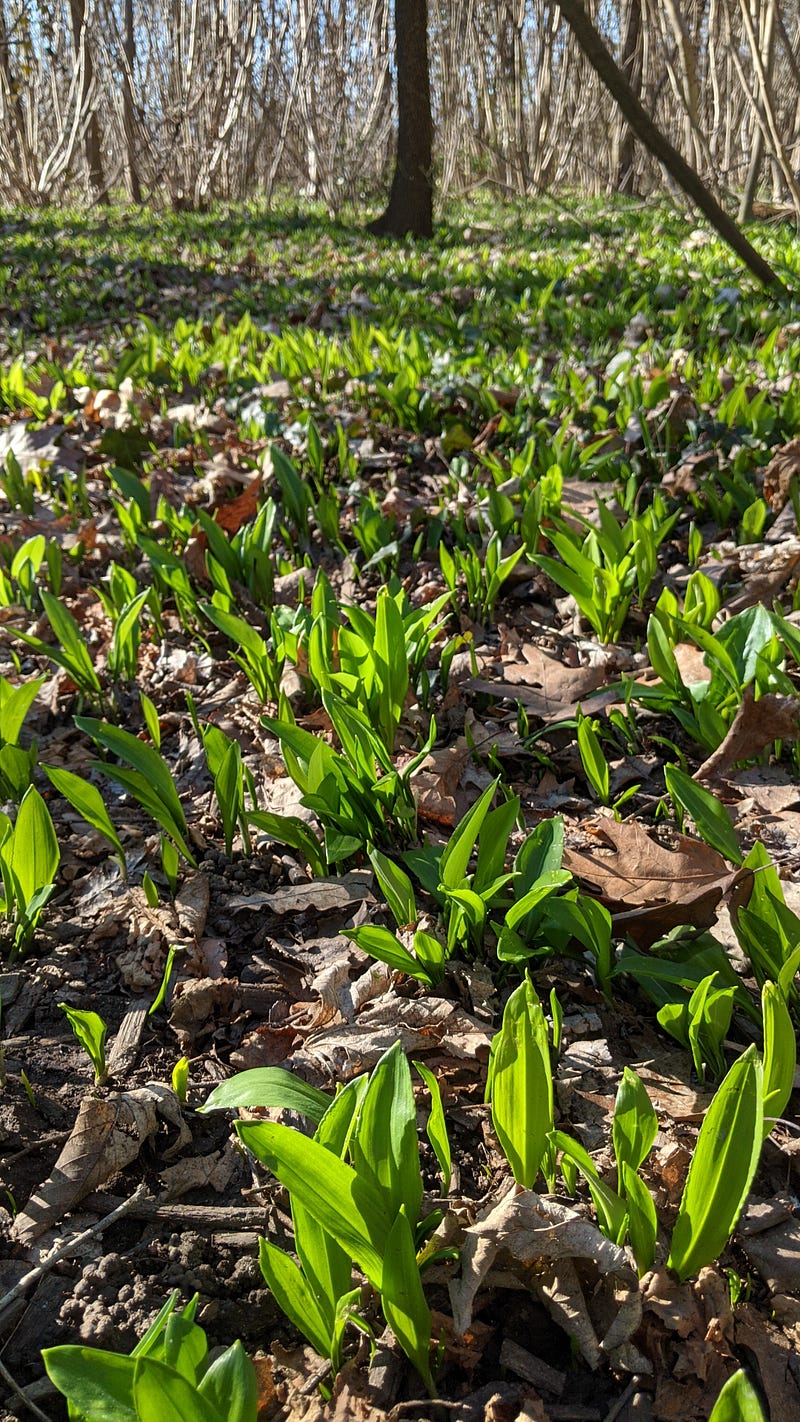
And how it will look within a month from now (shot taken last year!):

Yes, all those green plants on the ground are wild garlic!

By the way, the leaves are edible and you can make a quite good pesto with them. But that will be the subject of another story. This time I’m here to talk about the green color and about why plants are mostly green.

Why are plants green?

Wait, first, what is color?

Plants are green because they contain pigments (most specifically chlorophylls) that absorb light of colors other than green. That’s in fact the main principle why objects have colors: their color is that of the light they do not absorb.

If an object absorbs all but one color, it will look like that color. If it does not absorb say two colors, then it will look like a color that is a combination of the two that are not absorbed. If an object absorbs no light then it looks white. And it absorbs light of all colors, it looks black.

Scientists quantify how much of each color one object absorbs by collecting so-called “absorption spectra”. And “colors” are not just a few tens but rather a virtually infinite palette that goes from red to orange, yellow, green, blue, and violet in very slight increments. Technically, that’s the “electromagnetic spectrum in the visible range”.

The origin of green color in plants

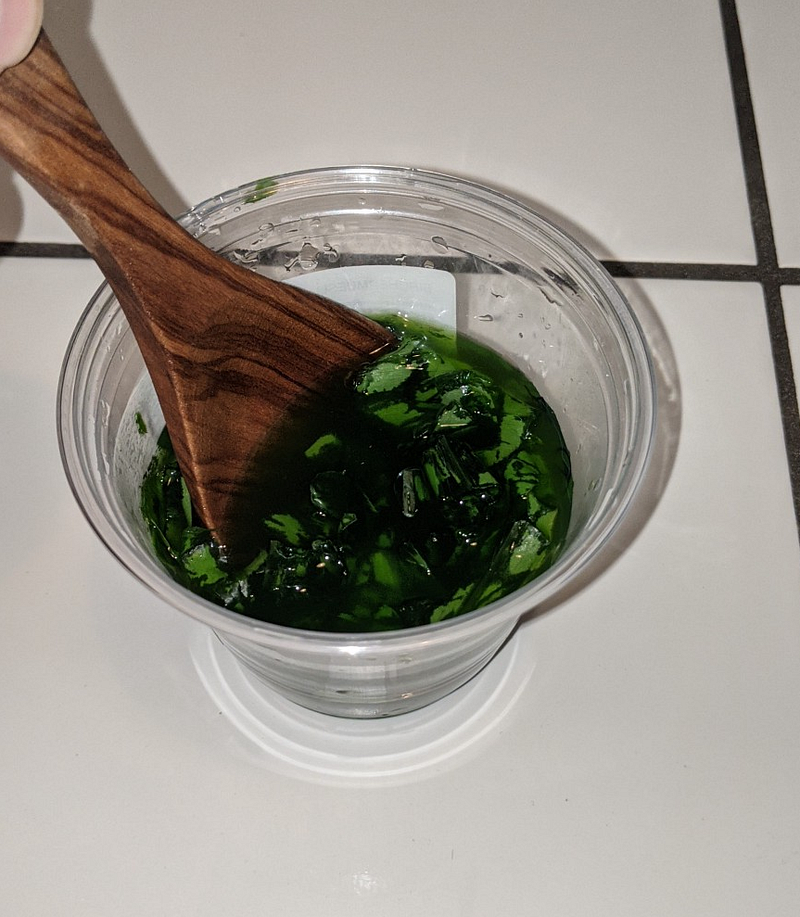
If I crunch some leaves of wild garlic and press them in water to extract its colors, this is what I get:
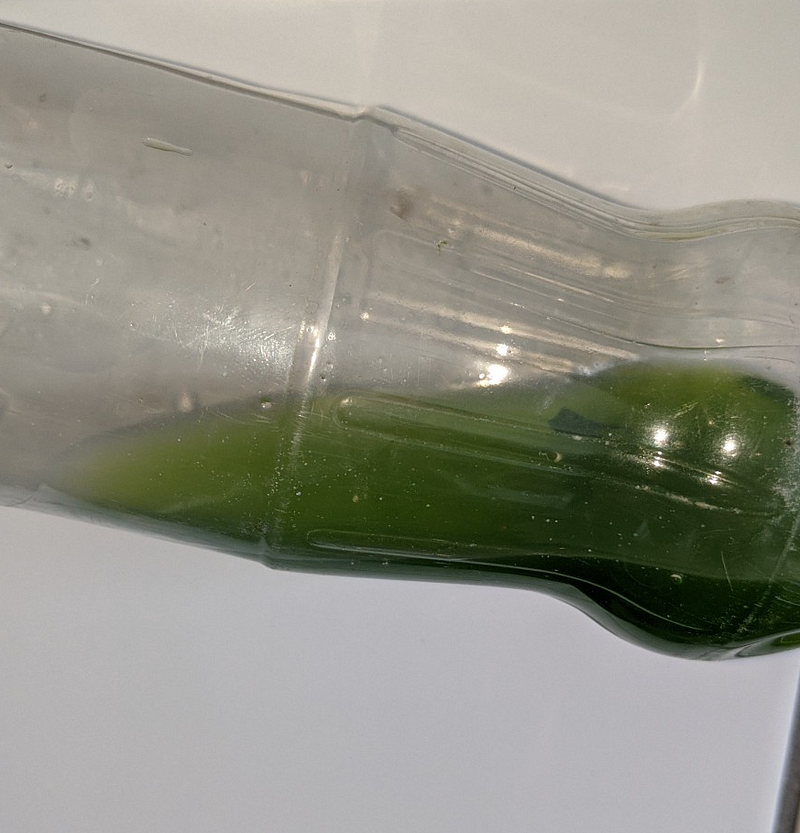
Here I removed the leaves and placed the liquid in a transparent bottle. Green, of course:
Now, this is the absorption spectrum of the wild garlic extract above. I recorded it myself while testing an old spectrophotometer. That’s an instrument that measures light absorption at specific colors (a.k.a. “wavelengths”):
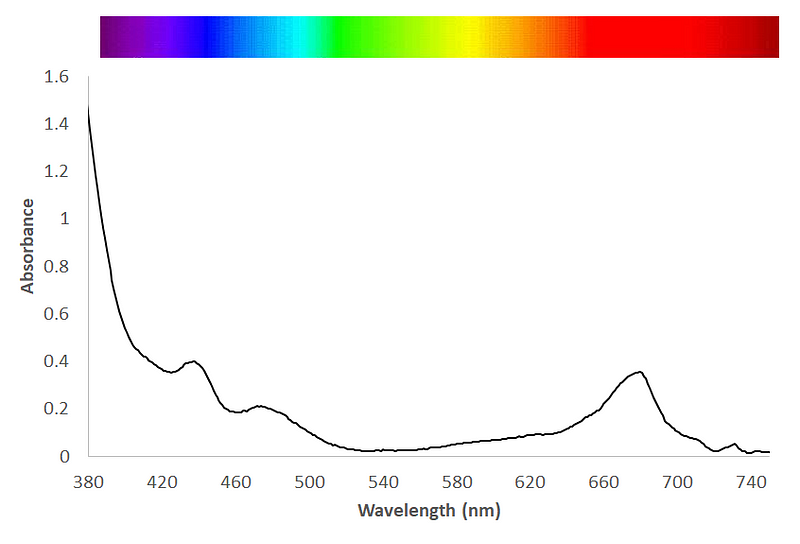
In the spectrum, “wavelength” (measured in “nanometers”, abbreviated nm) is the actual physical parameter of light that is related to its color. You can see in the color bar above that the range from 400 to 500 nm corresponds to violet and blue light, which are well absorbed; then there’s not much absorption from 500 to 600–650 nm (mainly green plus also some yellow), and then there’s another strong absorption band well inside the red region.

Moving further towards the right in the electromagnetic spectrum we get to the “infrared” region, i.e. lower than red. This energy is too “weak” to assist photosynthesis. On the other end, moving towards the left gets us to the “ultraviolet” region, which is too energetic and its absorption can damage tissue. (Technical note: you see the absorption going up like crazy towards the ultraviolet region, but this is most likely a contribution from slight scattering rather than actual absorption).

Now, tell me, why do plants absorb light?

You probably know this, but I will show it to you here in a new way.

Of course, plants absorb light for photosynthesis, which is the process by which they fix carbon and store energy (plus, as a side product extremely relevant for all superior life, this process creates the oxygen we breathe!). I'm not going here deeper than that, but you can consult WikiPedia’s excellent article on photosynthesis here.

What I will show you is where and how photosynthesis happens. And we’ll do that using augmented reality!

Take your phone, open Google Chrome and search for “photosynthesis”. Then in the results scroll down until you see this (it shouldn’t be too far down):
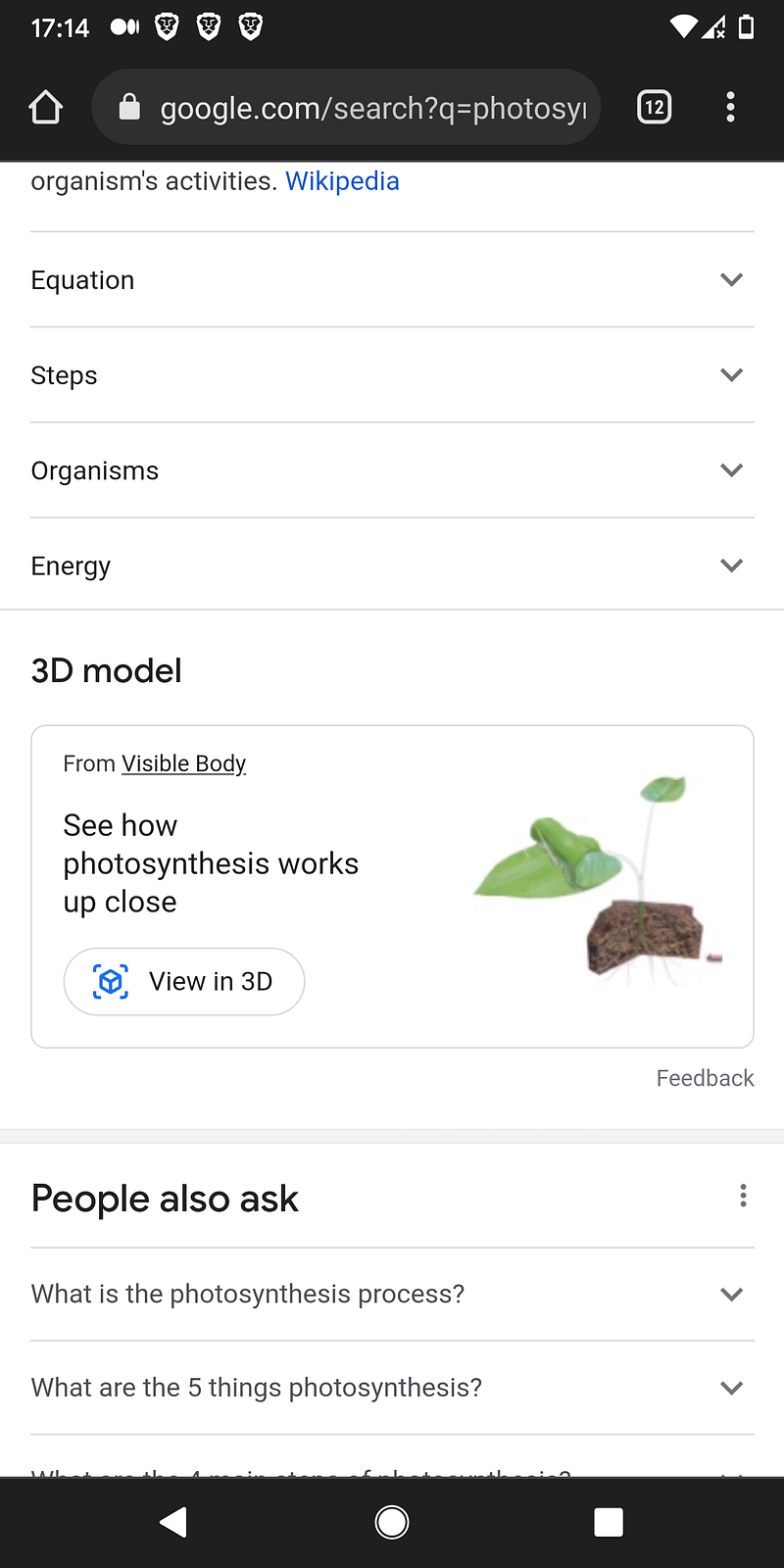
Tap “View in 3D” and then “View in my space". Move your smartphone around pointing at the floor or a table: the phone will recognize the flat horizontal surface and will display a 3D image of a photosynthesizing plant! Here is a shot in which you can see the sunbeams hitting the leave, molecules of CO2 coming into the plant (grey, to be fixed by photosynthesis), and a molecule of oxygen coming out (red, produced by photosynthesis):
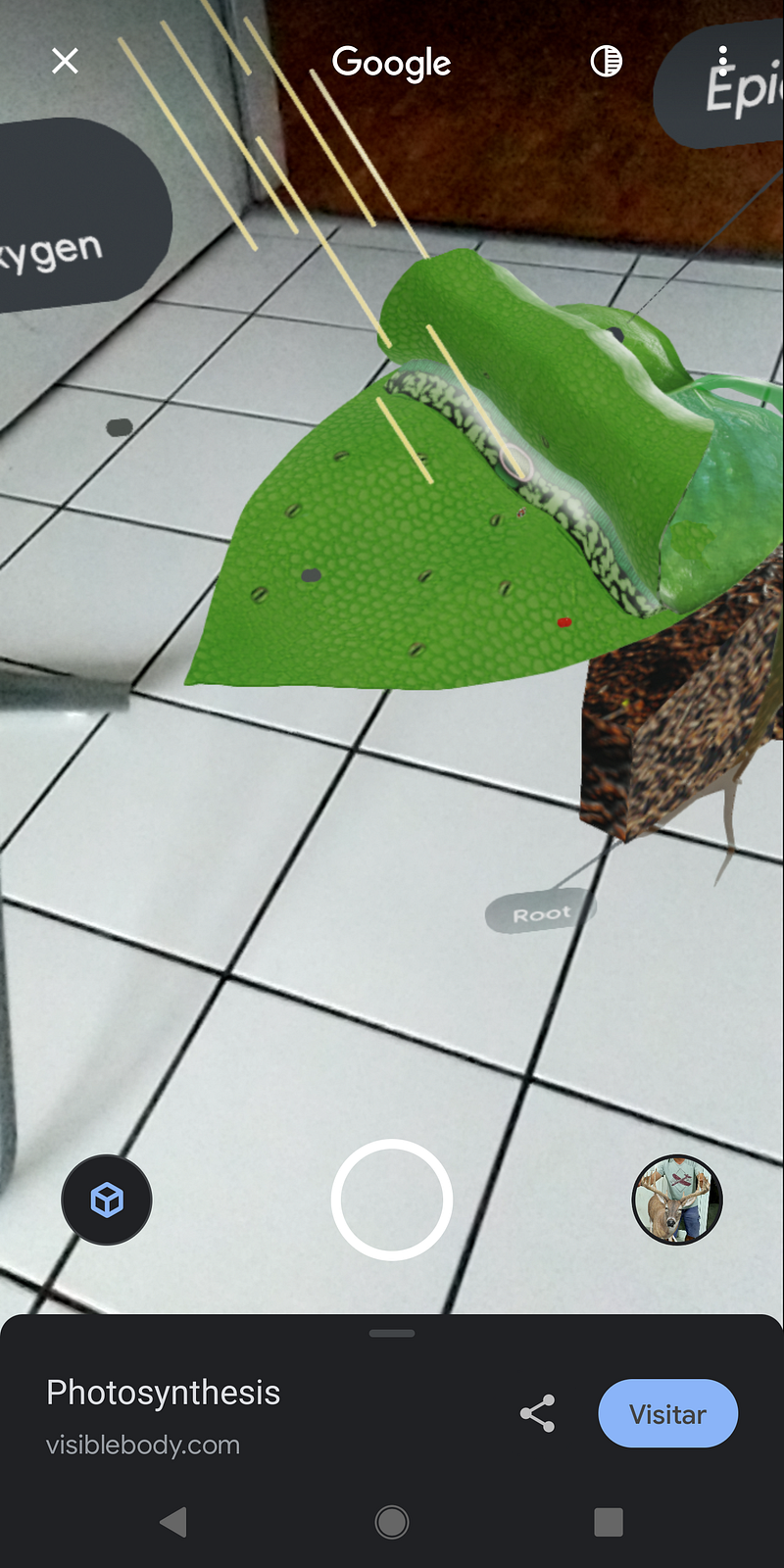
The augmented reality animation shows you this is all happening inside the green parts of the leaves. But where, more exactly?

It turns out that (green) plant cells have special organelles inside of them, the “chloroplasts”, which contain the main parts of the photosynthetic machinery.

(Cool side note: it is speculated on serious grounds that chloroplasts were originally isolated photosynthetic, oxygen-producing bacteria that were engulfed by eukaryotic cells as they evolved into plants; just like mitochondria were likely oxygen-consuming bacteria that were engulfed as eukaryotic cells showed up too).

To see 3D models of chloroplasts, you can search for “plant cell” in your phone’s Chrome browser and then inspect the model in 3D:
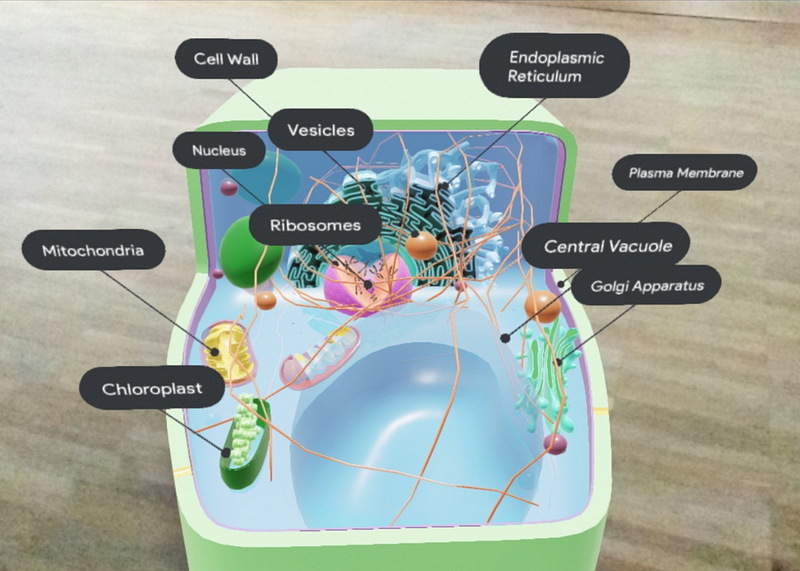
You’ll see the chloroplast modeled in green. If you get close to it, you’ll see some bag-like structures. These are the thylakoids, whose membranes contain the protein machinery that captures the sunlight (called “photosystems”):
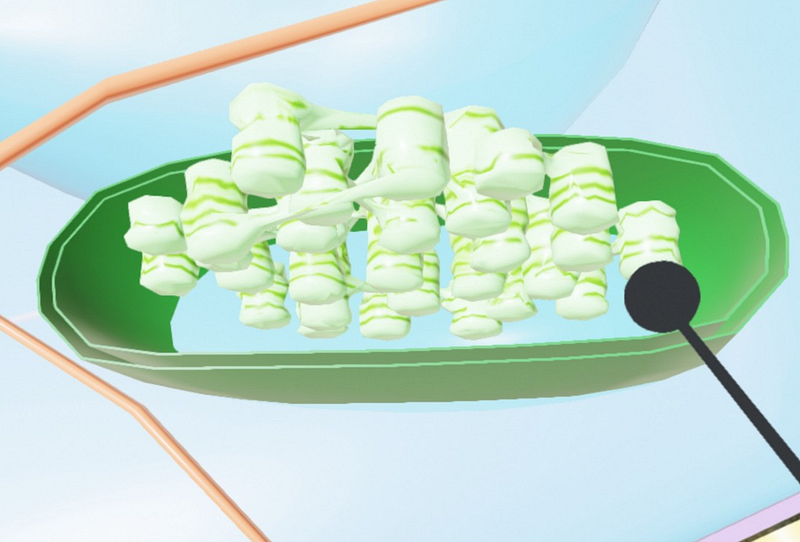
In fact, you can also look at the photosystems themselves, even their chlorophyll molecules! Their chemical structures are known and publicly available. It’s all just a matter of knowing how to look at them… but here I prepared an image for you:
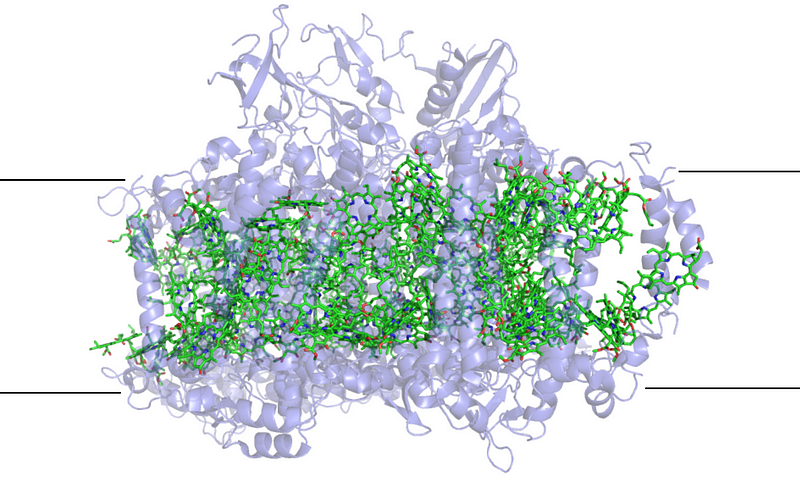
In the picture above, the black lines represent the thylakoid membrane, the transparent purple cartoons are a simplified representation of the proteins that make up this photosystem, and the molecules shown as sticks are several chlorophyll molecules (I represented their carbon atoms in green). Here you can see just one of these chlorophyll molecules in detail, from two orientations:
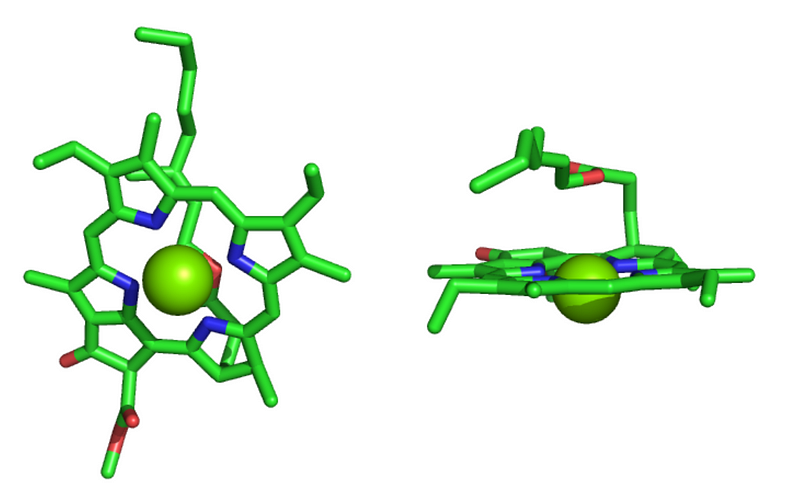
The sphere in the center is a Magnesium ion. The peculiar structure of this molecule (essentially a flat ring containing four 5-member rings in the center) is what makes chlorophyll absorb visible light.

Contemplate how I’ve taken you from a daily observation (“plants are green”) to understand why we see them green, and why they need that thing that makes them green, all the way to the atomic level.

Yes, each single plant you see has millions of cells each containing lots of chloroplasts whose photosystems anchored to their thylakoid membranes all have this molecule that looks green and is at the heart of life: fixing energy and carbon and producing oxygen that other living creatures breathe. Crazy, isn’t it?

But hey, if plants want to maximize energy input, why don’t they just absorb all light?

(which would make them black!)

Although there are photosynthetic pigments other than green, it is believed that when the first green bacteria evolved (before evolving themselves into plants) the seas were infested with purple bacteria that harvested light with a pigment called bacteriorhodopsin (instead of chlorophyll). Bacteriorhodopsin is purple, because it absorbs most of the green and yellow light (letting the violet, blue and red lights pass, whose combination looks purple). The evolving green bacteria then had to adapt to the part of the light that was available, thus gaining a green color that was presumably maintained when they left the waters. Crazy, eh!

To know more…

  • About light absorption for photosynthesis, with some more spectra:
  • About the photosystems, their structure and function (science outreach from the organization that manages protein structures and makes them accessible):
  • The X-ray structure I used for the molecule views:

Did you like this blend of science outreach and art?

Then check this out:

www.lucianoabriata.com I write and photoshoot about everything that lies in my broad sphere of interests: nature, science, technology, programming, etc. Become a Medium member to access all its stories (affiliate links of the platform for which I get small revenues without cost to you) and subscribe to get my new stories by email. To consult about small jobs check my services page here. You can contact me here.

Science
Education
Photography
Augmented Reality
Nature
Recommended from ReadMedium