
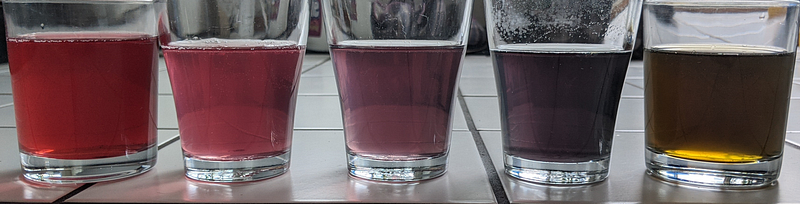
Fun with colors with at-home chemistry
The color of cabbage extract is very sensitive to pH, so you can get a very rich palette with simple household chemicals.
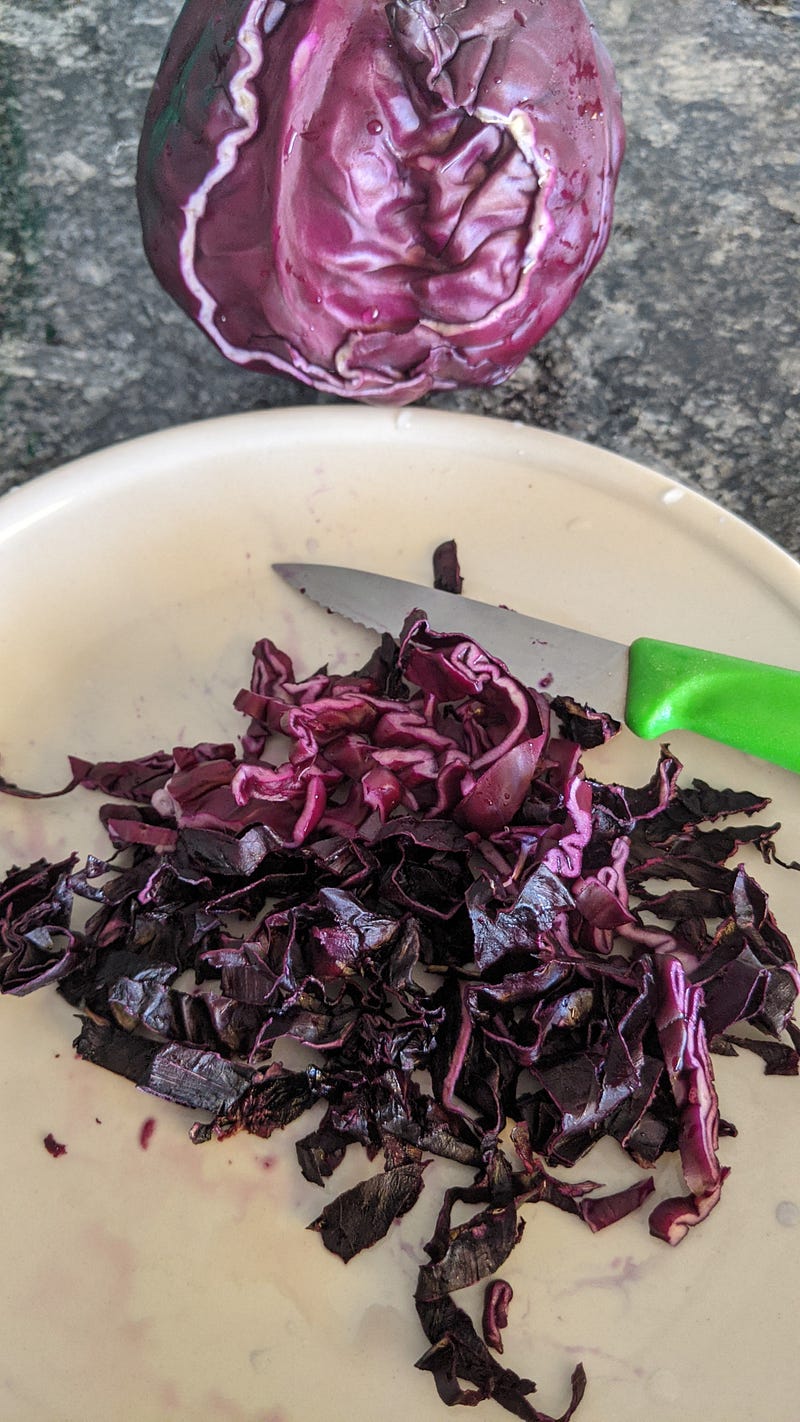
Step 1: Get and chop some red cabbage. For this example, I chopped a quarter of a cabbage, but I’m sure less works too:
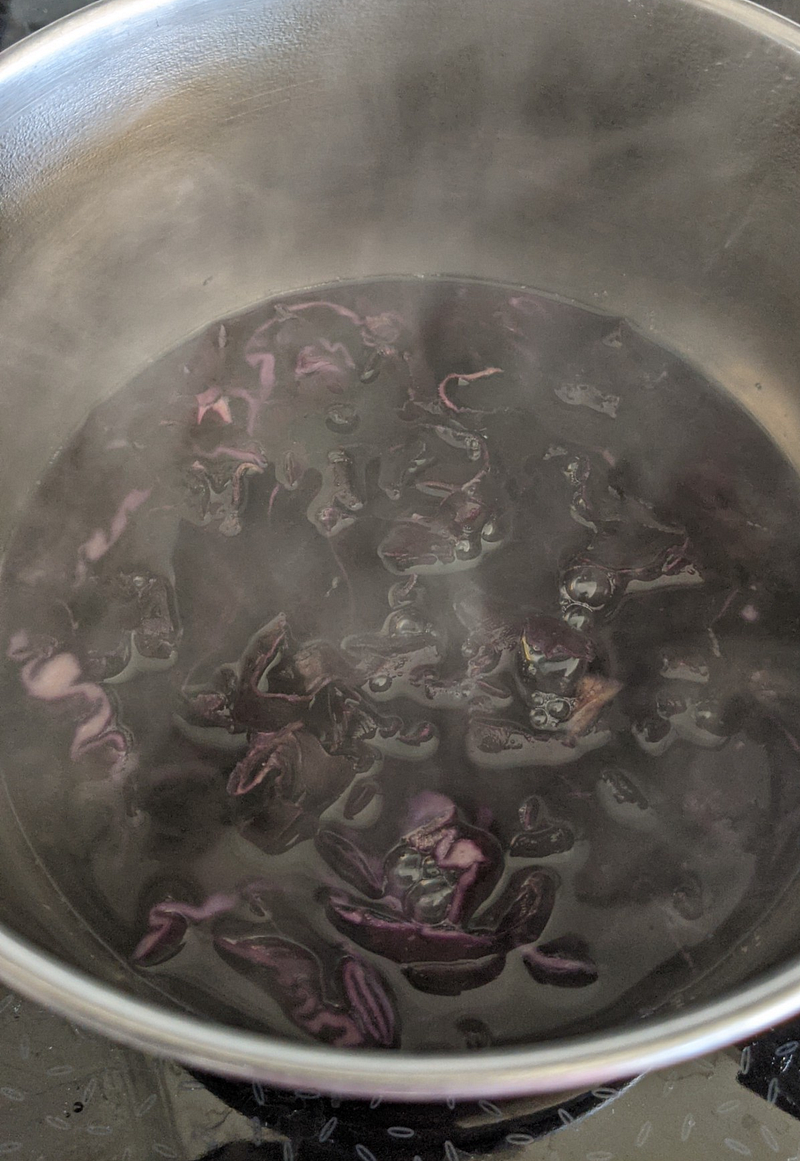
Step 2: Add water and boil. Add just enough water to cover the chopped leaves and boil for 10 minutes or so. Then filter to keep only the solution, which will most likely be dark purple like here (the exact color may vary, as it depends on pH !)
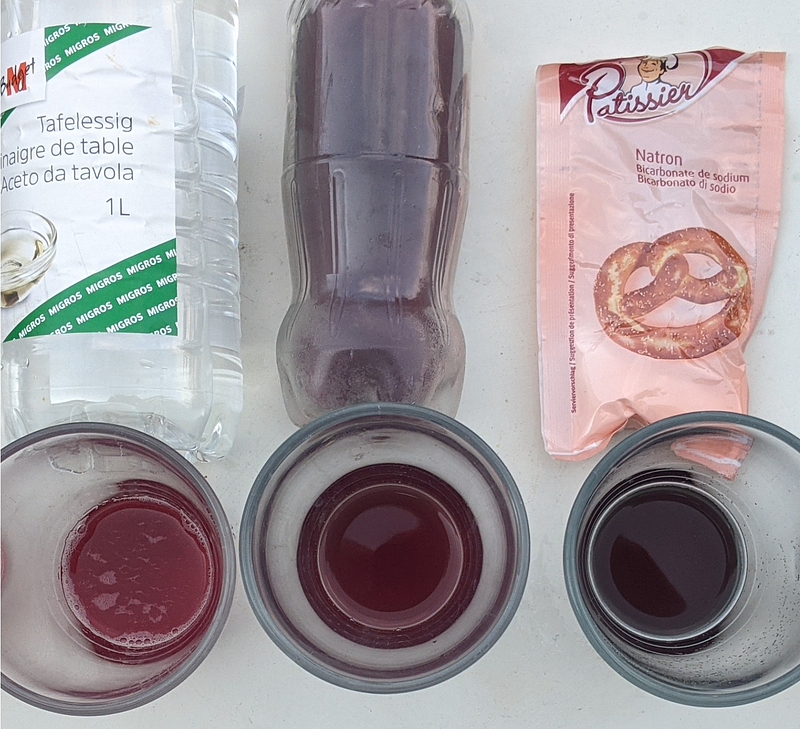
Step 3: Fun with colors using safe household chemicals. Dispense the liquid in flasks, tubes, or just normal glasses; and add various acids or bases. Here in the center you see the solution as prepared, and then with vinegar (acetic acid, which is acidic) on the left and with baking soda (sodium bicarbonate, which is basic) on the right:
I added here two more glasses with solution, plus: hydrochloric acid (HCl) to the leftmost, which results in a solution more acidic (lower pH) than the one containing vinegar; and sodium hydroxyde (NaOH) to the rightmost, which gets more basic (higher pH) than the solution containing sodium bicarbonate:
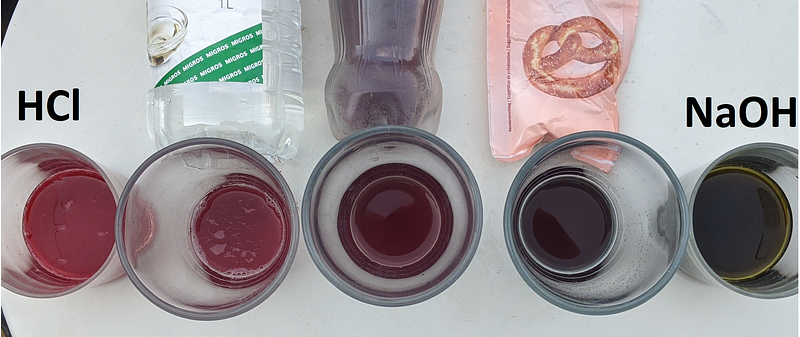
Notice that at the more extreme pH values, the acidic form becomes less purple and more pink/red, while the basic form shifts from blue to green.
To improve colors…
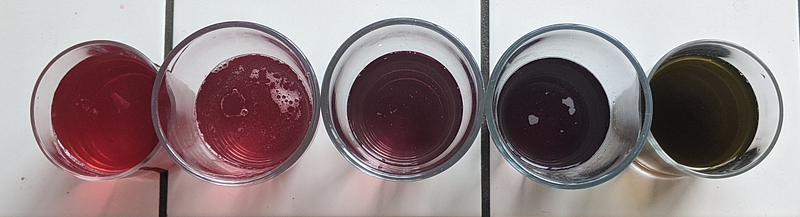
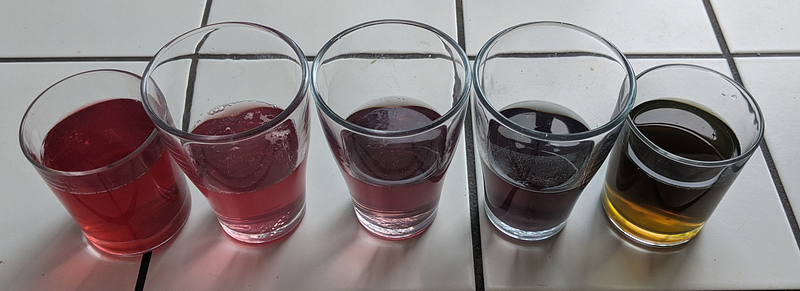
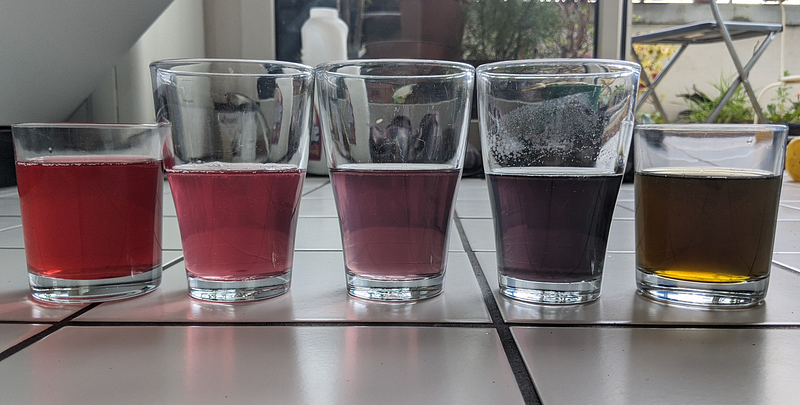
I noticed the solutions were a bit too concentrated, so I added similar amounts of water to all 5 glasses and took photos. The different colors are clearer in this way. These were my best results:
Why does this happen?
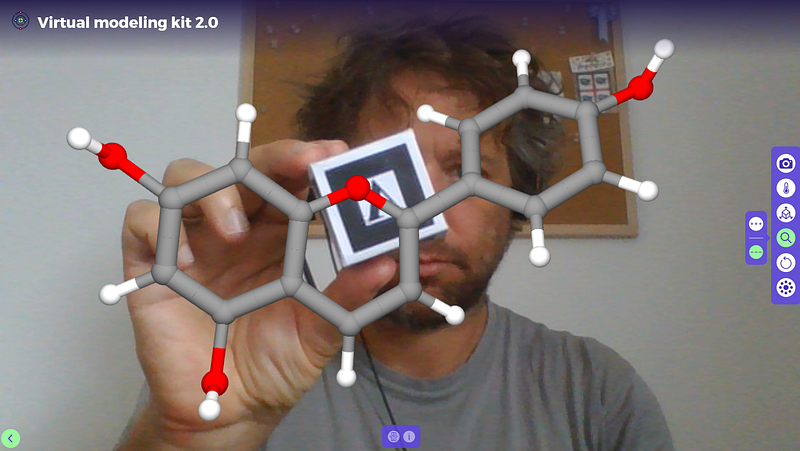
The solution behaves as a pH indicator, thanks to a series of molecules called anthocyanins that exchange some of their H atoms: at low pH (acidic medium) the H atoms “attach” to the molecule, and at high pH (basic medium) they “detach” from the molecule. The forms with and without H atoms have different light absorption properties. There are 4 of these forms: one that is red (at very low pH), another is violet (somewhat acidic pH), another is blue (neutral to slightly basic pH), and the last is yellow (at very high pH). With our solutions we do not reach a very high pH, so we see a mixture of blue and yellow which looks like green.
Storing the solution for later use
The solution works best if you use it right after preparing it, but it can last quite some months in the fridge. Three months is the longest I’ve tried so far, and it was ok. For longer-term storage, you may try freezing cubes of the solution, and thawing them one by one when you want to play.
More color fun with chemistry and cabbage + further reads
If you have access to stronger acids or bases and you know what you are doing, you can produce more extreme pHs. At the low pH extreme not much more will happen (just the red becomes redder), but at high pH you will see another transition from green to yellow. You can see the full scale in this post at compoundchem.com:
A related, very interesting post at compoundchem.com deals with the change in colors of the Christmas plant poinsettia (Euphorbia pulcherrima):
Go have fun!
I am a nature, science, technology, programming, and DIY enthusiast. Biotechnologist and chemist, in the wet lab and in computers. I write about everything that lies within my broad sphere of interests. Check out my lists for more stories. Become a Medium member to access all stories by me and other writers, and subscribe to get my new stories by email (original affiliate links of the platform).