avatarJanice Harayda

Free AI web copilot to create summaries, insights and extended knowledge, download it at here

4564

Abstract

<p id="8b29">At sea, the men faced shipboard epidemics of typhus and the madness induced by scurvy, which a medical expert compared to “the falling down of the whole soul.” Both diseases were rampant by the time the squadron prepared to round Cape Horn, and sailors had to do the dreadful tasks of burying shipmates at sea. Grann writes:</p><blockquote id="558b"><p>“According to tradition, a body buried at sea was wrapped in a hammock, along with at least one cannonball. (When the hammock was sewn together, the final thread was often stitched through the victim’s nose, to ensure that he was dead.) The stiffening corpse was placed on a plank and a Union Jack was draped over it, making it seem less like a mummy.”</p></blockquote><p id="3bd0">The <i>Wager </i>became<i> </i>separated from others in its squadron, and when a storm tore it to pieces, the survivors washed up on a desolate island off what is now Chile. Far worse was to come.</p><figure id="5224"><img src="https://cdn-images-1.readmedium.com/v2/resize:fit:800/1*jfZfMhv_MoijMUqc8Qocww.jpeg"><figcaption>John Byron with Patagonians in 1764 / <a href="https://commons.wikimedia.org/wiki/File:Entrevista_de_Byron_con_los_Patagones,_an%C3%B3nimo.tif">Wikimedia Commons</a></figcaption></figure><p id="7e4a">Sympathetic indigenous people, the Kawésqar, soon arrived by canoe, bringing the castaways sea urchins for food and trading for other items. But the Kawésqar fled, put off by the caddish behavior of the British, which may have included trying to seduce their women.</p><blockquote id="3a3a"><p>“Faced with starvation and freezing temperatures, they built an outpost and tried to re-create naval order,” Grann writes. “But as their situation deteriorated, the <i>Wager</i>’s officers and crew — those supposed apostles of the Enlightenment — descended into a Hobbesian state of depravity. There were warring factions and marauders and abandonments and murders. A few of the men succumbed to cannibalism.”</p></blockquote><p id="3bf2">Starving and with scant hope of rescue, some survivors blamed their plight on their captain, David Cheap, a Scot determined to honor the Admiralty’s wish that they find the Spanish galleon known as “the prize of all the oceans.” Others had seen enough and wanted to go home.</p><p id="bf30">Cheap sparked a mutiny on the island when he fatally shot a midshipman who tried to present his shipmates’ grievances to him, an event his men saw as a point-blank murder.</p><p id="462f"><i>“When they’re on that island, it became almost like a laboratory, testing human nature under extraordinary circumstances,” Grann aptly told the New York Times. “This is a story about the disintegration of a floating civilization.”</i></p><div id="1585" class="link-block"> <a href="https://readmedium.com/why-is-cape-horn-so-treacherous-618a01ee20ad"> <div> <div> <h2>Why Is Cape Horn So Treacherous?</h2> <div><h3>David Grann shows you in ‘The Wager,’ his №1 nonfiction bestseller about a little-known shipwreck</h3></div> <div><p>medium.com</p></div> </div> <div> <div style="background-image: url(https://miro.readmedium.com/v2/resize:fit:320/1*RmYX96rnULVYt54Bss3-5A.jpeg)"></div> </div> </div> </a> </div><p id="9c15">Out of patience after the killing of their mate, some of the stranded men set out for Brazil in smaller boats retrieved from the wreckage of the <i>Wager.</i></p><p id="681d">The fleeing mutineers were led in theory by an officer, Lt. Robert Baynes, but egged on by an angry gunner, John Bulkeley. Those who stayed faced such dire prospects that Cheap later fled with his teenage shipmate John Byron, whose grandson became the famous poet.</p><p id="2035">Near-miraculously, 30 survivors from one group made their way to Brazil and three from the other to Chile, both in miserable, patched-together boats. But their clashing stories led the Admiralty to hold a court-martial to sort out the truth.</p><p id="0a96">Both sides tried to bolster their cases with faded and waterlogged logbooks from the ships that Grann draws on for <i>The Wager</i>, skillfully parsing their potentially evasive or self-serving accounts. The court-martial was inconclusive and with few exceptions — most notably, John Byron — the men faded from view afterward.</p><p id="646d">Yet <i>The Wager</i> remains seductive without the clear resolution typical of disaster narratives and courtroom dramas.</p> # Options <p id="37ce">Grann focuses less on who was right or wrong than on the broader differences the men’s conflicts represented: between madness and sanity, indigenous people and outsiders, and the ideals of empires and of the people they rule. He sticks to the historical record without trying to link the dynamics of the <i>Wager</i> insurrection to those of recent events such as the Jan. 6 Capitol riot.</p><p id="86e7">But parallels exist for anyone who looks for them. The great theme of the <i>Wager </i>disaster is that, as Grann writes: “Just as people tailor their stories to serve their interests — revising, erasing, embroidering — so do nations.” In the dark and conflicting narratives of the <i>Wager</i> disaster, he says, the British empire at last found “its mythic tale of the sea.”</p><p id="967a">Whether Britain and the world have learned from that tale — or whether similar myths are still being played out — is another matter. So is the question of whether men like my great-great-great grandfather found in those myths some of the inspiration they needed to take to the sea.</p><p id="56ea"><i>@janiceharayda is an award-winning journalist and critic who has been a writer and editor for Glamour, the book critic for Ohio’s largest newspaper, and a vice president of the National Book Critics Circle. Her work has appeared in many major media, including the New York Times, the Wall Street Journal, the Washington Post, Newsweek, and Salon.</i></p><p id="5f0b"><b><i>You might like another of my stories about a calamity in the Pacific:</i></b></p><div id="d2d4" class="link-block"> <a href="https://readmedium.com/the-american-nurses-who-became-prisoners-of-war-c8c65bfa1426"> <div> <div> <h2>The American Nurses Who Became Prisoners of War</h2> <div><h3>They tended soldiers as bombs fell. They ate fried weeds after their food ran out. Then they were captured.</h3></div> <div><p>medium.com</p></div> </div> <div> <div style="background-image: url(https://miro.readmedium.com/v2/resize:fit:320/1*NVLlzExLoqr9wiv3mHaTzQ.jpeg)"></div> </div> </div> </a> </div><p id="e579"><b><i>Up for a story about books in a different vein? Try this:</i></b></p><div id="535c" class="link-block"> <a href="https://readmedium.com/why-are-there-so-many-genres-of-fiction-and-nonfiction-a0eeefb8872e"> <div> <div> <h2>Chick Lit. Dick Lit. Brit Lit. Grit Lit. Why Do We Need All These Genres?</h2> <div><h3>Labeling your writing correctly can help you sell your books or stories, but the options can be confusing</h3></div> <div><p>medium.com</p></div> </div> <div> <div style="background-image: url(https://miro.readmedium.com/v2/resize:fit:320/1*AvL7W00cqgvSAsTlmJ0p8A.jpeg)"></div> </div> </div> </a> </div><div id="6bdc" class="link-block"> <a href="https://readmedium.com/dont-cancel-rudyard-kipling-63ebe9b6d5f1"> <div> <div> <h2>Don’t Cancel Rudyard Kipling</h2> <div><h3>He’s been called ‘a right-wing imperialist warmonger,’ but his great ‘Rikki-Tikki-Tavi’ shows why he’s making a…</h3></div> <div><p>medium.com</p></div> </div> <div> <div style="background-image: url(https://miro.readmedium.com/v2/resize:fit:320/1*f_M_ROQEwouexAlbHZj_Xg.jpeg)"></div> </div> </div> </a> </div><p id="c92e"><b><i>Would you like to read all of my reviews of new and classic books without hitting a paywall? You can do it by joining Medium with my referral link:</i></b></p><div id="41d9" class="link-block"> <a href="https://janiceharayda.medium.com/membership"> <div> <div> <h2>Join Medium with my referral link - Janice Harayda</h2> <div><h3>Read all of Jan Harayda's reviews and articles. Your membership fee directly supports Janice Harayda and other writers…</h3></div> <div><p>janiceharayda.medium.com</p></div> </div> <div> <div style="background-image: url(https://miro.readmedium.com/v2/resize:fit:320/0*W7p5Uzu38Y9YGJy7)"></div> </div> </div> </a> </div></article></body>

MURDER, CANNIBALISM, AND MORE

A Real-Life ‘Lord Of The Flies’

David Grann’s ‘The Wager’ shows the power of stories to shape how we see disasters like shipwrecks
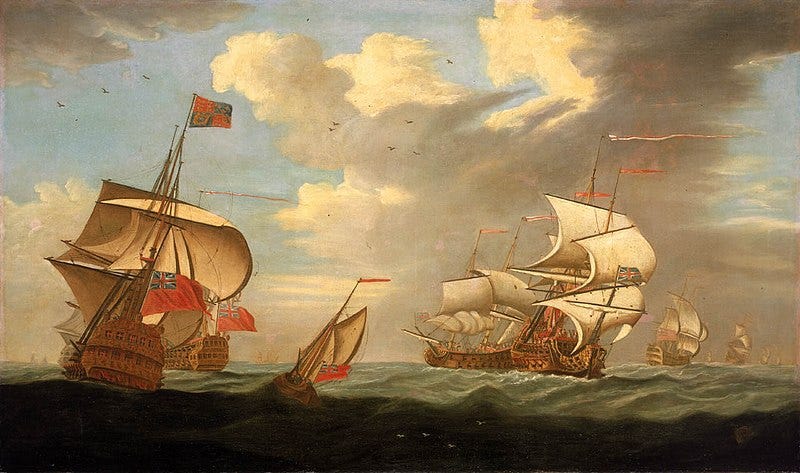
A man-of-war flying the Royal Standard, 1707 / Public Domain via Wikimedia Commons

A haunting note on my family tree involves the sea captain John Fraser, who perished off Holy Isle, Scotland, in the winter of 1863. It says, without further explanation, that he “died at sea.”

Capt. Fraser was my great-great-great-grandfather, and because Fraser is a common Scottish surname and family records don’t identify his ship, I can only speculate about his final days.

Great Britain wasn’t at war, so my seafaring ancestor can’t have died during an enemy attack. Holy Isle is close enough to Glasgow that he’s unlikely to have succumbed to scurvy or another disease that afflicts sailors after weeks at sea. Did he fall overboard and drown or develop hypothermia in icy water? Was he pushed by a mutinous sailor? Were he and his crew shipwrecked on Holy Isle or another sparsely populated island?

I hadn’t imagined the half of it, I realized while reading The Wager, a №1 nonfiction bestseller being adapted for a film directed by Martin Scorsese and starring Leonardo DiCaprio.

David Grann’s seafaring page-turner is a catalog of horrors which might have befallen a mariner like my great-great-great-grandfather: winds strong enough to break a man’s neck, waves high enough to dwarf the tallest mast, a lost tiller that left a vessel out of control.
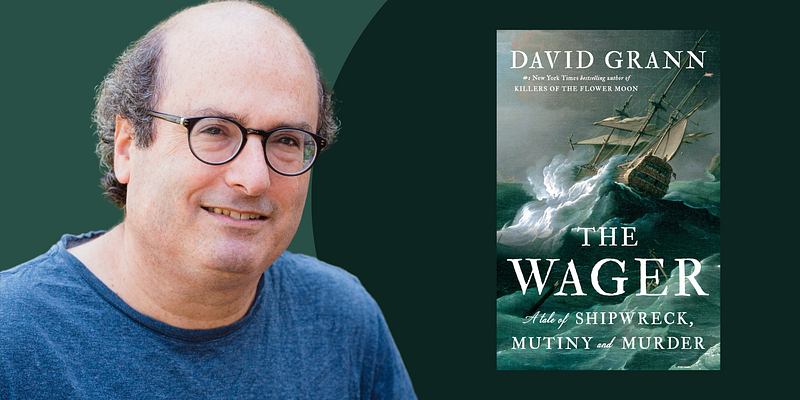
David Grann and the cover of “The Wager” / PenguinRandomHouse

But The Wager is more than a suspenseful tale of disaster — and sometimes survival — at sea. Grann raises to a higher power the well-known story of the HMS Wager, a man-of-war wrecked on a barren island off Chile on May 14, 1741, during the Patagonian winter.

The Wager had left England nine months earlier with a squadron led by Capt. George Anson and hunting for a treasure-laden Spanish galleon in the Pacific during the quaintly titled War of Jenkins’ Ear. Spaniards reportedly had partially cut off the ear of a Welsh captain, and Britain wanted revenge.

If it sounds incredible such an incident could help to spark a war between two empires, Grann’s book only gets more astounding.

Schoolchildren of the pre-feminist era learned that great stories center on one of three conflicts: “man against man, man against nature, or man against himself.” The Wager involves all three.

That breadth sets Grann’s tale apart from books like Sebastian Junger’s The Perfect Storm, which — good as it is — deals chiefly with “man against nature.” In some ways, The Wager has less in common Junger’s narrative than with William Golding’s satirical Lord of the Flies, which depicts a descent into anarchy among British schoolboys marooned on an island.

But The Wager is no satire. Calamities struck before its titular ship had set sail from Plymouth, England, with no understanding of longitude, the risks of which Dava Sobel has described elegantly in Longitude.
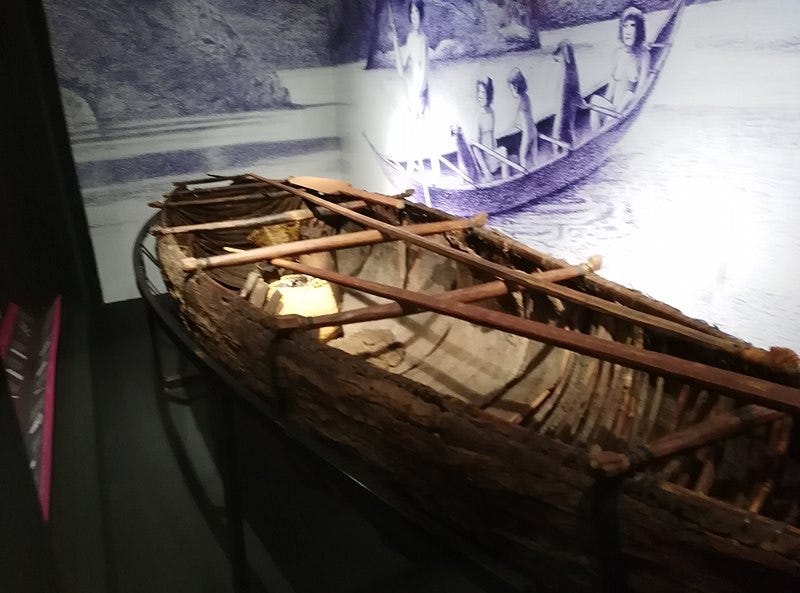
Kawésqar canoe / Museo Nacional de Historia Natural, Santiago via Wikimedia Commons CC

Unable to recruit enough able-bodied seamen for the expedition, the Admiralty “press-ganged” onto ships the old, the infirm, or the unwilling: “in effect, kidnapping them,” Grann writes.

At sea, the men faced shipboard epidemics of typhus and the madness induced by scurvy, which a medical expert compared to “the falling down of the whole soul.” Both diseases were rampant by the time the squadron prepared to round Cape Horn, and sailors had to do the dreadful tasks of burying shipmates at sea. Grann writes:

“According to tradition, a body buried at sea was wrapped in a hammock, along with at least one cannonball. (When the hammock was sewn together, the final thread was often stitched through the victim’s nose, to ensure that he was dead.) The stiffening corpse was placed on a plank and a Union Jack was draped over it, making it seem less like a mummy.”

The Wager became separated from others in its squadron, and when a storm tore it to pieces, the survivors washed up on a desolate island off what is now Chile. Far worse was to come.
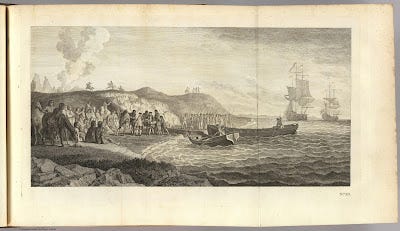
John Byron with Patagonians in 1764 / Wikimedia Commons

Sympathetic indigenous people, the Kawésqar, soon arrived by canoe, bringing the castaways sea urchins for food and trading for other items. But the Kawésqar fled, put off by the caddish behavior of the British, which may have included trying to seduce their women.

“Faced with starvation and freezing temperatures, they built an outpost and tried to re-create naval order,” Grann writes. “But as their situation deteriorated, the Wager’s officers and crew — those supposed apostles of the Enlightenment — descended into a Hobbesian state of depravity. There were warring factions and marauders and abandonments and murders. A few of the men succumbed to cannibalism.”

Starving and with scant hope of rescue, some survivors blamed their plight on their captain, David Cheap, a Scot determined to honor the Admiralty’s wish that they find the Spanish galleon known as “the prize of all the oceans.” Others had seen enough and wanted to go home.

Cheap sparked a mutiny on the island when he fatally shot a midshipman who tried to present his shipmates’ grievances to him, an event his men saw as a point-blank murder.

“When they’re on that island, it became almost like a laboratory, testing human nature under extraordinary circumstances,” Grann aptly told the New York Times. “This is a story about the disintegration of a floating civilization.”

Out of patience after the killing of their mate, some of the stranded men set out for Brazil in smaller boats retrieved from the wreckage of the Wager.

The fleeing mutineers were led in theory by an officer, Lt. Robert Baynes, but egged on by an angry gunner, John Bulkeley. Those who stayed faced such dire prospects that Cheap later fled with his teenage shipmate John Byron, whose grandson became the famous poet.

Near-miraculously, 30 survivors from one group made their way to Brazil and three from the other to Chile, both in miserable, patched-together boats. But their clashing stories led the Admiralty to hold a court-martial to sort out the truth.

Both sides tried to bolster their cases with faded and waterlogged logbooks from the ships that Grann draws on for The Wager, skillfully parsing their potentially evasive or self-serving accounts. The court-martial was inconclusive and with few exceptions — most notably, John Byron — the men faded from view afterward.

Yet The Wager remains seductive without the clear resolution typical of disaster narratives and courtroom dramas.

Grann focuses less on who was right or wrong than on the broader differences the men’s conflicts represented: between madness and sanity, indigenous people and outsiders, and the ideals of empires and of the people they rule. He sticks to the historical record without trying to link the dynamics of the Wager insurrection to those of recent events such as the Jan. 6 Capitol riot.

But parallels exist for anyone who looks for them. The great theme of the Wager disaster is that, as Grann writes: “Just as people tailor their stories to serve their interests — revising, erasing, embroidering — so do nations.” In the dark and conflicting narratives of the Wager disaster, he says, the British empire at last found “its mythic tale of the sea.”

Whether Britain and the world have learned from that tale — or whether similar myths are still being played out — is another matter. So is the question of whether men like my great-great-great grandfather found in those myths some of the inspiration they needed to take to the sea.

@janiceharayda is an award-winning journalist and critic who has been a writer and editor for Glamour, the book critic for Ohio’s largest newspaper, and a vice president of the National Book Critics Circle. Her work has appeared in many major media, including the New York Times, the Wall Street Journal, the Washington Post, Newsweek, and Salon.

You might like another of my stories about a calamity in the Pacific:

Up for a story about books in a different vein? Try this:

Would you like to read all of my reviews of new and classic books without hitting a paywall? You can do it by joining Medium with my referral link:

Literature
Books
History
Indigenous
Maritime
Recommended from ReadMedium