
EXCERPT
Why Is Cape Horn So Treacherous?
David Grann shows you in ‘The Wager,’ his №1 nonfiction bestseller about a little-known shipwreck
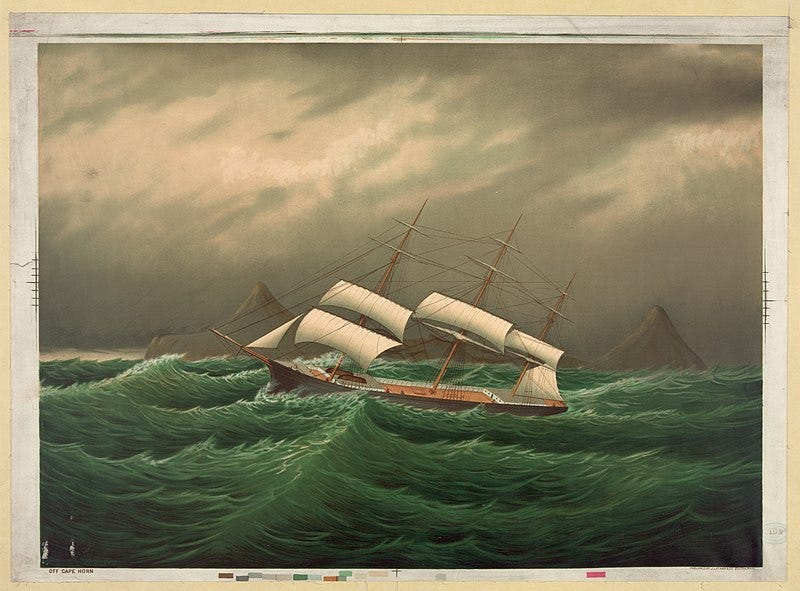
David Grann’s The Wager has stormed up the New York Times nonfiction bestseller list, perhaps fittingly for a book about tempests that led to the wreck of an 18th-century British ship during a war with Spain.
I reserved a copy at my library after reading glowing reviews, some of which left the impression that conflicting accounts of the disaster might give the book “Rashomon”-like quality. Fortunately, my number came up within a few weeks, not the six months I’d waited for a Colleen Hoover novel, and I’ll review it soon in this space.
In the meantime, here’s how Grann describes the treacheries of Cape Horn, a stony, barren island at the southernmost tip of the Americas. The Wager had crossed Atlantic, as part of a squadron pursuing a treasure-filled Spanish galleon, and was approaching the cape, in these paragraphs.
“Because the far-southern seas are the only waters that flow uninterrupted around the globe, they gather enormous power, with waves building over as much as thirteen thousand miles, accumulating strength as they roll through one ocean after another. When they arrive, at last, at Cape Horn, they are squeezed into a narrowing corridor between the southernmost American headlands and the northernmost part of the Antarctic Peninsula. This funnel, known as the Drake Passage, makes the torrent even more pulverizing. The currents are not only the longest-running on earth but also the strongest, transporting more than four billion feet of cubic water per second, more than six hundred times the discharge of the Amazon River. And then there are the winds. Consistently whipping eastward from the Pacific, where no lands obstruct them, they frequently accelerate to hurricane force, and can reach two hundred miles per hour….
“Moreover, a sudden shallowing of the seabed in the region — it goes from thirteen hundred feet deep to barely three hundred — combines with the other brute forces to generate waves of frightening magnitude. These ‘Cape Horn rollers’ can dwarf a ninety-foot mast. Floating on some of these waves are lethal bergs cleaved from pack ice. And the collision of cold fronts from the Antarctic and warm fronts from near the equator produce an endless cycle of rain and fog, sleet and snow, thunder and lightning.”
Interested in other brief excerpts, reviews, or quick takes on books, movies, TV shows, and more? You’ll find them in the Pop Culture Shorts column I write every Monday, Wednesday, and Friday at FanFare on Medium.
If you’d like to read all of my Pop Culture Shorts columns, and my review of The Wager, you can do it by joining Medium with my referral link:
You might like my other stories about books, publishing, and the media:


