The American Nurses Who Became Prisoners of War
They tended soldiers as bombs fell. They ate fried weeds after their food ran out. Then they were captured.
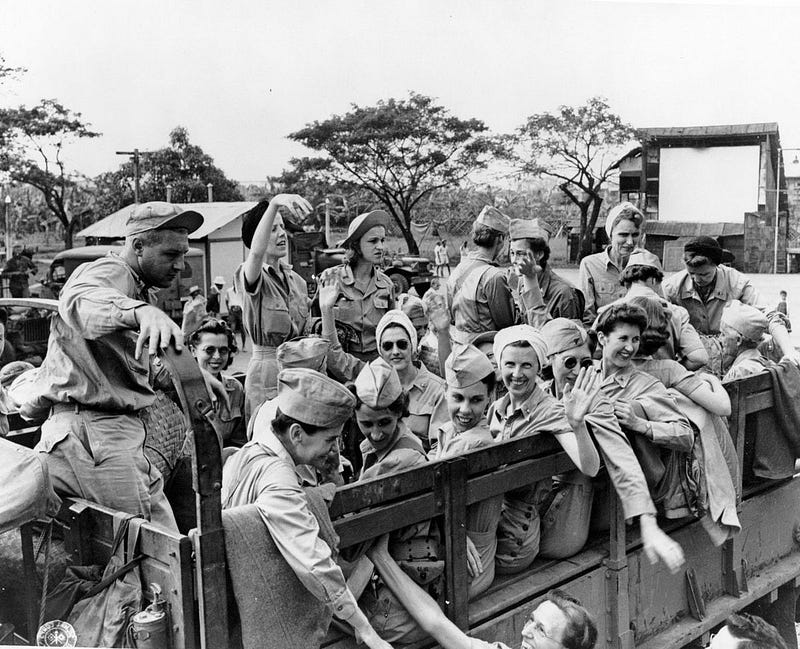
American nurses have worked in military hospitals — and fallen into enemy hands — at least since the Civil War. But until World War II, they had few chances to use their skills on the front lines. That changed when the “Angels of Bataan,” the U.S. military nurses in the Philippines, became first large group to work in battlefield hospitals and to become prisoners of war.
In the days after Pearl Harbor, the Army and Navy “Angels” tended to the sick and wounded who defended Bataan and Corregidor in the first major land battle in the Pacific. They worked beside doctors in malarial open-air jungle hospitals. They dived under operating tables with their hands high, to avoid contaminating sterile gloves, when bombs fell nearby. They ate weeds fried in cold cream that came in Red Cross kits when they had no food. They sharpened needles on rocks.
A nurse was struck in the face by a snake
Then, after Gen. Douglas MacArthur fled to Australia and the Allies surrendered Bataan to the Japanese, the United States abandoned the nurses. They were trapped, along with the U.S. and Filipino troops, on the island of Corregidor. Seventy-seven military nurses were captured by the Japanese and became prisoners of war at Santo Tomas Internment Camp in Manila. All survived their years of captivity owing to factors that included good luck, skilled leadership, and a will to bear witness to horrors they had seen.
Most of the nurses came from modest backgrounds far from the cataclysms of war. They were “self-possessed, ambitious and unattached women” who had signed up not to be heroes but because of patriotism, a thirst for adventure, or the steady work the armed forces promised, according to historian Elizabeth Norman’s definitive book about the nurses, We Band of Angels. Reports from U.S. military bases cast the Philippines as “a place of palm groves, white gardenias and purple bougainvillea” with days of cocktails and bridge games at sunset and white jackets or long gowns at dinner. The nurses would need only “a uniform, a bathing suit, and an evening gown.”
Any hopes they had for an easy posting collapsed on December 8, 1941 (December 7 in the U.S.). But the day brought an early sign of the brisk practicality of the nurses’ leaders that would help all of them survive. At Sternberg Hospital in Manila, Lt. Josephine “Josie” Nesbit, second-in-command to Capt. Maude C. Davison of United States Army Nurse Corps in the Philippines, heard weeping among nurses who had friends stationed in Honolulu. “Girls! Girls!” she shouted. “Girls, you’ve got to sleep today. You can’t weep and wail over this, because you have to work tonight.”
Within weeks, the Army ordered its nurses to move from Manila to Bataan. Davison oversaw their work in setting up two jungle hospitals, where many nurses cared for wounded patients and those with malaria while fighting malarial fevers themselves. One night a nurse was walking among beds when snake dangling from a branch smacked her in the face. To keep their spirits up the women sang songs like “You Are My Sunshine.”
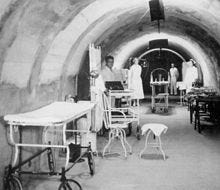
Malinta Tunnel hospital / Photo credit: Armed Forces Institute of Pathology
When the American nurses were ordered to evacuate to Corregidor, Nesbit refused to go unless the Army also evacuated the Filipina nurses, and she received permission to take them, too. On Corregidor Nesbit supervised nurses who worked in fetid bunkerlike conditions in the Malinta Tunnel and, when given a chance to leave the island on the last Allied submarine, she and two other nurses refused to the leave the hospital that needed her.
After Japanese soldiers captured the Malinta Tunnel, the nurses became prisoners of war at the Santo Tomas Internment Camp on Manila. By 1945 the prisoners were receiving one meal a day, such as a cup of gruel. Slowly starving to death, severely malnourished captives came down with diseases like scurvy and beriberi. A camp doctor ate the guinea pig in his lab. Davison and Nesbit worked to maintain morale and discipline by requiring the nurses to work a four-hour shift a day. Nesbit often took the shift of nurses too weak to finish the job. She also fought for small mercies for her nurses, such as an ounce or two of meat per week.
When the Allies liberated the camp in February 1945, as their tanks crashed through its gates the crowd broke into a chorus of “God Bless America.”
Some nurses returned to hometown parades, praise in local newspapers, and other recognition. Eleanor Roosevelt invited them to tea, where she moved them deeply by calling them “Lieutenant” instead of “Miss.” Ann Bernatitus, the only Navy nurse to serve on Bataan, received the Legion of Merit, as did Davison and Nesbit (though on a technicality Davison was denied the Distinguished Service Medal, later given to her posthumously). Nurse Ruby Bradley served in the Korean War, rose to the rank of colonel, and became the most decorated nurse in U.S. history.
Experts ignored the nurses’ postwar pain
But the hoopla faded, and as a group, the nurses remain unknown to most Americans. A soapy 1943 movie, So Proudly We Hail, trivialized their experiences. Some nurses suffered throughout their lives from the disabling effects of wartime illnesses like dysentery, tuberculosis, or dental problems caused by diets low in calcium. Mental health experts slighted their woes. Norman writes:
“Psychiatrists seemed to assume that the nurses’ training and experience had somehow left them immune to the psychological ravages of combat and imprisonment. In a study of women in the military, one researcher postulated that nurses’ emotional problems would be ‘less complex’ in many ways than those of other veterans.”
Decades after leaving Bataan, nurse Madeline Ullon testified before the U.S. Senate about the trouble the nurses had in claiming Veterans Administration benefits: She knew of dozens of former nursing companions “who met with nothing but opposition” when they asked the VA for help.
Norman suggests that for all their bravery and sacrifice, the nurses didn’t want to be called “heroes.” “The women on Bataan and Corregidor simply did what they had to do, no more and no less than the men who fought alongside them,” she writes. “They were not heroes, but their service was considered extraordinary because no one expected them to do what they did.”
Ordinary Americans may find it hard to see the Bataan nurses as anything but heroes. They may have been doing “what they had to do,” but it is by no means certain that others could have done it, or done it as well. They deserve our gratitude — for what they did for our nation, for its women, and for its armed forces — on July 4 and all days. If the nurses disliked being called “heroes,” few would have been likely to object to the words of Brig. Gen. Raymond Bliss, who told them in a welcome-home ceremony: “You have fought the good fight.”
Quotations in this story come from We Band of Angels, highly recommended to anyone who wants to learn more about the Bataan and Corregidor nurses. Other helpful sources about the women include the National WW II Museum and the many newspaper obituaries of the nurses, all of whom have died.
@janiceharayda is a journalist and the daughter of a U.S. Army interpreter at a POW camp.