
Don’t Cancel Rudyard Kipling
He’s been called ‘a right-wing imperialist warmonger,’ but his great ‘Rikki-Tikki-Tavi’ shows why he’s making a comeback

Not long ago, students at a large British university painted over Rudyard Kipling’s poem “If” on a wall mural. They apparently objected not to its sentiments but to other works by its author that they saw as endorsements of their country’s past empire-building.
There you have, in a nutshell, a central problem with what’s become known as the “cancel culture.” It’s indiscriminate.
Once you run afoul of its thought police — whether you’re a writer, an artist, or a musician — all of your work becomes tainted by association with the offending part. An across-the-board condemnation denies that anything you do might have merit for anyone.
The first English-language Nobel laureate in literature
Perhaps no great author’s work shows harms of that approach better than that of Rudyard Kipling, who in 1907 became the first English-language winner of the Nobel Prize for Literature.
For more than 150 years, his fiction and poetry were rightly among the world’s most admired.
Kipling thrilled generations with his novel Kim, with the children’s stories in The Jungle Book, and with poems like “If.” He found worldwide fans not just among ordinary readers but among literary titans like T.S. Eliot, another Nobel laureate, who called him “a writer impossible to wholly understand and quite impossible to belittle.”
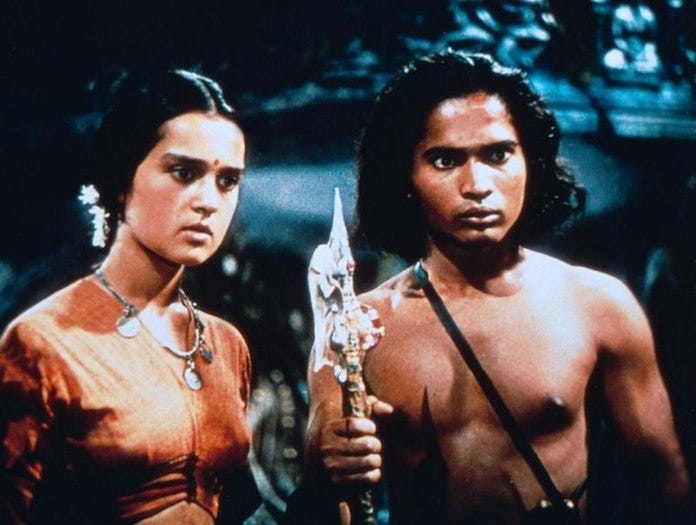
But some of his work has always chafed. Kipling lived in British-ruled India for 13 years and saw his country’s colonialism as a benevolent force. That view is nowhere clearer than in his “The White Man’s Burden,” “the most tone-deaf and offensive” of all his poems, as the literary critic Charles McGrath aptly wrote in The New Yorker. McGrath said:
“Kipling intended it as a sort of imperial spine-stiffener, urging America to colonize the Philippines and join England in the task of ‘civilizing’ supposedly backward nations.”
“The White Man’s Burden” came to stand for almost everything Kipling’s critics saw as wrong with him. He was labeled racist, misogynistic, and “a right-wing imperialist warmonger,” as McGrath summed up a few of the charges against him. Kipling was effectively canceled.
The problem is that if some of his work deserves its mark down, not all of it does. That’s especially true of his exciting “Rikki-Tikki-Tavi,” a story inspired by an Indian fable and among the most popular in his 1894 collection, The Jungle Book.
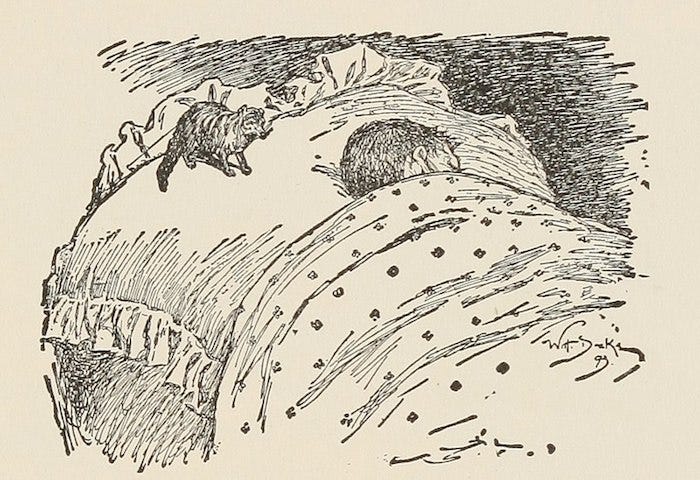
Rikki-tikki-tavi is a brave and curious young mongoose rescued from his flooded burrow by an English family in India, who open their home and hearts to him. He repays them for their kindness by saving their young son, Teddy, from a highly venomous krait in their extravagant garden.
But another threat looms. A pair of villainous king cobras, Nag and Nagaina, also inhabit the garden and, at full height, tower over Rikki-tikki-tavi. The mongoose hears them plotting to kill his adopted human family and attacks Nag, who has slithered into a bathroom, planning an ambush.
The ruckus attracts Teddy’s father, who fatally shoots Nag. Nagaina and her eggs remain at large, and before she can avenge Nag’s death, Rikki-tikki-tavi protects the family again. He destroys her eggs and chases Nagaina into her hole, where he kills her, too.
What’s controversial about all this?
The violence isn’t gratuitous: Anyone who lives in the American South or Southwest has probably heard of someone who had to kill a rattlesnake or water moccasin to avoid injury or death. And who objects to the dark implications of the “Let’s go hunt” lyrics in Pinkfong’s “Baby Shark”?
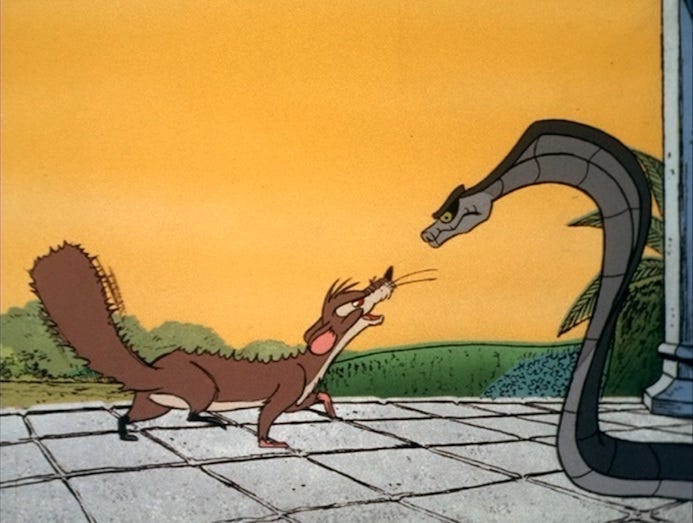
“Rikki-Tikki-Tavi” has drawn fire not for its reptilian body count because of allegorical readings that cast Teddy and his parents as benevolent symbols of Britain’s occupation of India. Rikki-tikki-tavi is a “good” Indian — who submits to the rules of his white masters — while the “bad” cobras try to disrupt it.
That’s a valid interpretation. But the story wears its symbolism so lightly even adults might miss it, and never mind the preteens who tend to gravitate to it.
To cancel it would deprive young readers of a suspenseful, fast-paced tale of one of great animal characters in children’s fiction. Kipling makes you see, hear, and feel for Rikki-tikki-tavi:
“He was a mongoose, rather like a little cat in his fur and his tail, but quite like a weasel in his head and his habits. His eyes and the end of his restless nose were pink….And his war-cry, as he scuttled through the long grass, was: ‘Rikki-tikk-tikki-tikki-tchk!’ ”
In his quest to save himself and his adopted human family, the intrepid mongoose gets help from a bird who warns him of the dangers of the cobras and a muskrat who shows him how to listen for their sounds.
In that sense, Kipling tells a story not just of animal heroism but of interspecies cooperation. It celebrates virtues most parents hope to instill in their offspring: courage, kindness, loyalty, curiosity, and persistence in the face of steep odds. And it has more than high drama going for it
Without becoming didactic, the story develops a theme eternally appealing to young readers: If they cooperate, small creatures can hold their own against — and sometimes triumph over — larger ones.
Perhaps that helps to explain why Kipling, at last, may be coming back into fashion. A few years ago, the Los Angeles Public Library blog noted:
“The most recent critical thinking seems to be swinging back in Kipling’s favor, and he is praised for the skill with which he spins a thrilling yarn and the musical flow of his best verse.”
That’s good news not just for his fans but for anyone who dislikes seeing great authors shunned for reflecting the views of their day. Everyone benefits from a culture broad enough to make room for endearing animals as different as Pinkfong’s Baby Shark and Kipling’s Rikki-tikki-tavi.
Further resources:
- An outstanding animated musical version by the great Chuck Jones, narrated by Orson Welles, superbly reflects the important aspects of the story while adding musical enhancements such as birdsong celebrating Rikki-tikki-tavi’s heroism.
- You can read the full text of the story here.
@JaniceHarayda is an award-winning critic and journalist who has been a writer and editor for Glamour, the book editor of Ohio’s largest newspaper, and a vice president of the National Book Critics Circle. Her work has appeared in many major media, including the New York Times, the Wall Street Journal, the Washington Post, Newsweek, and Salon.
You might like my story about another classic:


.jpg)

