
A Few Thoughts on Conscious Time
“How do I make more conscious decisions about my time?”

The percentage of product managers (or anyone working in a fast-paced environment, which is most people these days) that do not feel overwhelmed during the workweek is very low.
There’s another subset of us that also feel overwhelmed on the weekends because of “THE TIME SQUISH”: The constant feeling that there is not enough time — not enough time to think about X, to get Y done, etc.
At my worst, I was working 12 hour workdays, in back-to-back meetings across three time zones, working with an insane number of stakeholders, constantly feeling behind, and, most importantly, not enjoying any of it.
I’ve made a ton of changes in how I operate and am still actively iterating. Have I figured it all out? Heck no.
Am I a lot happier and do I feel like I am making more conscious decisions about what I am putting my time and energy into inside and outside of work?
Here are a few of my thoughts on how to be more conscious of your time:
1) Figure out what matters most to you and define WHY.
I just listened to a great episode of the How to Build A Happy Life podcast on the secret to meaningful work. There was a quote in it along the lines of, “most people live with purpose by accident”, meaning, instead of starting with Why like Simon Sinek articulates, we start from the top down — looking at patterns and experiences and weaving those together to explain our why retroactively. I believe this is one of the main drivers behind so many of us being unhappy.
There are two types of hard here:
- The type of hard that comes with not being conscious of what we’re focusing on in life, and then having a wake up moment and realizing that we are misaligned and not focusing on the right things and need to change…something or else continue feeling this, deep in our soul.
- The type of hard that comes with doing the work up front — not being afraid to go inside yourself to understand what you value most and why, what your North Star is, and what makes you feel good in life.
Both are hard. You can choose either or.
2) Understand how you think about time.
For most of my life, I considered time an infinite resource.
It’s only been in the last decade (and past few years specifically) that I have realized:
- Money has the potential to be abundant* (*Cognizant of financial challenges, inequality, biases and privilege playing a big role here).
- Our time and energy are finite.
If you think of time as a resource, how do you want to use that resource to get the most bang for your buck?
Thinking of it in a tangible way has really helped me — I’ve got a specific number of blocks of it. I can put those specific blocks in a calendar and actually manipulate them physically. I know that I can’t run on empty forever and I know that I need to have guardrails set up to protect my focus so I’m not wasting this resource. It’s the most important one we’ve all got!
I’m a superfan of Shreyas Doshi and Linda Zhang in general, and specifically love their insights on time.
Doshi’s LNO Effectiveness Framework draws lines between types of tasks, bucketing them into:
- Leverage: Do a great job. Let your inner perfectionist shine.
- Neutral: Do a strictly good job. No better.
- Overhead: Just get it done. Actively try to do a bad job.
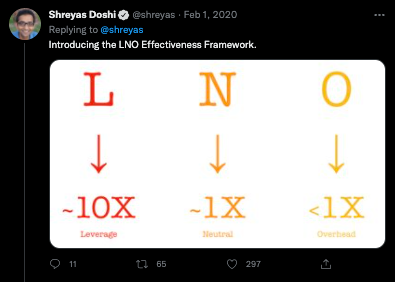
Deciding which tasks deserve which fidelity of energy can help greatly in helping to take the reins on your time.
Zhang’s Opportunity Cost Mindset, and thinking more along the lines of “Is this the best possible use of my time?” vs. “As long as I can be helpful, I should do it.” is another great way to reframe time. Which bucket do you fall into most often?
3) Understand how you operate best.
This one is tough and I don’t think it’s fixed for any one person. The way I think of it is, “How can I iteratively test how I operate best and skew towards the things that have shown noticeable improvements in my outputs?” Whether that’s simply how I feel during a day or the quality of my decisions or quality of my work.
There is an abundance of noise here and generalizations made. For instance, there are many books and articles that focus on waking up super early being “optimal” for a human (i.e. The 5 AM Club), but I think what a lot of these pieces miss is that everyone lives within different contexts and has different constraints.
I’m a big fan of taking some of the science, and some of the data around creativity and the parts of your brain you need to be functioning optimally to be aligned with your, specific WHY, and conducting mini time experiments to find what works best for you.
For instance, what worked best for me when I was a single person, living on my own in a new city and working for a startup is not what works best for me now, as a mom and partner and owning my own business.
Doing retrospectives with yourself is a great way to keep what sticks and throw out what doesn’t so you can keep making iterative improvements. At the end of a week, look back at your calendar and ask yourself, “When did I feel my best? Why?” “When did I feel my worst? Why?” “What did I actually do (output) this week and how did these feelings impact this?”
Some of the places I’ve gleaned a ton of insights from have been the Huberman Lab Podcast, Whealth, & Wim Hof. Nathaniel Drew’s also got a great YouTube series where he tries out the daily routines of famous people throughout history — here’s Maya Angelou’s typical day.
Creating a list of learnings has been valuable (and actionable) for me. Asking questions like:
- When do I focus best? When am I in a state of flow?
- What do I typically do leading up to this?
- How can I prioritize this and organize my schedule around this?
- What are my guardrails? (When do I max out, mentally, doing certain things? What guardrails can I put in place to prevent this?)
- How can I reduce context switching?
- How can I reduce boredom?
Doing a time reconciliation has also helped me when I am feeling particularly overwhelmed. I try to track the things I’m focused on in blocks in my calendar. I’ll sometimes even go back after the fact and update a past block if it took me more time than I expected. At the end of the week, I look at the breakdown and dissect:
- What % of my time was proactive vs. reactive?
- How can I organize things differently going forward to avoid feeling overwhelmed?
- For the things I can’t actually do anything about (i.e. a weekly meeting that someone else has scheduled that is crucial and involves many stakeholders), how can I approach this differently so I feel better about it? Can I control what my before and after look like? Can I put less energy into this meeting to really put it into higher leverage tasks? Can I listen in while walking or doing something more active that makes me feel good?
4) Prioritize for protection.
I hate the term, “Ruthless prioritization” because it implies showing no compassion for yourself or for others. I think that’s the opposite of what you should do, with one twist — you should prioritize with utmost compassion for yourself first.
Understanding what works best for you, and what your “Hell Nos!” are, you can use this to prioritize the blocks of time you’ve got in a given day or week.
Some unique takes on this:
- Batching tasks to reduce friction (i.e. Atomic Habits) — this includes things that we often do subconsciously, like “Responding to that 1 slack message” or “Writing that 1 Tweet” that can switch our context and automating time suck tasks, like using Calendly or Savvycal to reduce the time we’re spending to coordinate meeting with people.
- Creating more focus by organizing your day into themes (i.e. Like Jack Dorsey does to run two businesses).
- “Unclogging the pipe” to get to better ideas (i.e. As Ed Sheeran does to get to the good stuff when he’s writing songs)
- Saying “No” more often if something doesn’t mesh with your priorities. Here are some “Saying no” examples to help you from Starterstory and from The Muse.
5) Consciously include “blank space” in your calendar.
I have a love-hate relationship with my calendar. I need it to keep my priorities as my priorities, but I also need to know that I have room to adapt as my context changes. Most importantly, however, I know that I need to include space to discover new things.
If we don’t leave space or any buffer for this, it means we will miss out on potential opportunities that could make our journey easier, more impactful, more meaningful, and more fun.
It’s not a coincidence that many people talk about getting their best ideas in the shower. Letting your brain wander while you are alone connects our inner and outer worlds in ways I believe we are just starting to scratch the surface of understanding.
What else have I learned?
- Most tech products need better DND settings. i.e. It should be just as easy to turn notifications off as it is to keep them on.
- I do better when I front-load my priorities — that way if anything unexpected happens in my day (which almost always happens), I can do most of the most important things.
- Thinking about the scope of my tasks helps me — if I define the scope early, I can usually feel less overwhelmed and better about my results vs. going in with the widest net and then feeling frustrated.
- I need more buffers. Building in time between meetings. Considering how long it will take me to get places and being more generous about this. Knowing how I will feel after, say, a therapy appointment and knowing I shouldn’t schedule an important meeting directly after, etc.
My mindset on this is fundamentally different than most and ultimately boils down to asking myself, “Am I prioritizing for productivity? Or am I prioritizing for value and meaning?”
I can tell you that while I’m still plugging away and finding what works best, prioritizing for value and meaning first has not only felt better, but also improved the quality of what I output.
How do you make conscious time decisions?
I would love to know!
Thanks for reading ✨
-Lisa
Follow me on Twitter: @lisazane15
🧠 Join 800+ people interested in building products and their product careers more consciously: https://www.consciousproductdevelopment.com/newsletter
🧭 If you’re ready for a role transition or just want to make more conscious career moves going forward, check out The Product Manager’s Career Guide that I just launched: https://www.consciousproductdevelopment.com/the-product-managers-career-guide