avatarLisa Zane

Free AI web copilot to create summaries, insights and extended knowledge, download it at here

9034

Abstract

th an invisible disability</li></ul><p id="232f">The truth is, most systems weren’t designed for people like me.</p><p id="3755">So, I’ve had to come up with creative approaches and alternate ways of thinking to spend my life aligned with my values and doing what I want to be doing.</p><p id="c302">It took me hitting rock bottom to decide to think of myself like a product.</p><p id="f6a7">I’m still a major work in progress, constantly under iteration, but I have been able to improve my situation by <b>defining my why, understanding my own common underlying thread, knowing where I want to go, and owning my story.</b></p><h1 id="9025">Parallels between product and life development</h1><p id="417e">This is generally how I approach developing a new product from scratch and all the pieces that are involved, starting with the foundation at the bottom of the pyramid and moving upwards.</p><p id="bd3d">Everything above should fit into the context that is below it.</p><figure id="db6f"><img src="https://cdn-images-1.readmedium.com/v2/resize:fit:800/1*678_ken7bg3xwcwtdpUc4g.png"><figcaption></figcaption></figure><p id="fab8">This can also be applied to a way of thinking about your career development:</p><figure id="1557"><img src="https://cdn-images-1.readmedium.com/v2/resize:fit:800/1*538Af2Yy8-vpc_K_Al5MGg.png"><figcaption></figcaption></figure><h1 id="0f40">1. Find the problem</h1><p id="4cab">If we want to make big things happen, it’s important to think small and ask really basic questions that can have a dramatic impact on the design of the end-solution.</p><ul><li>What is the problem?</li><li>Why is it a problem?</li><li>How big of a problem is it?</li></ul><p id="d8d8">It sounds so simple yet so most people don’t start here and when they spin their wheels or end up with a solution that’s not great.</p><p id="e46c">Try to look inside and outside. Pay attention to how you’re feeling. Instead of reacting right away, try to create space and be curious.</p><p id="ec19">For me it was looking inside and asking questions like, “Why am I unhappy?”, “What feels misaligned right now?”, “What isn’t working vs. what is?”, “What, specifically are the problems here?”, “What is impacting me the most?”, “What are other people’s experiences like?”</p><p id="6de9">It’s REALLY easy to skip this step and jump right into a solution. And a lot of people do.</p><h1 id="af91">2. Frame the problem</h1><p id="1f4d">Albert Einstein once said, “If I were given one hour to save the planet, I would spend 59 minutes defining the problem and one minute resolving it.”</p><p id="20f1">I think that this is <b>how the most elegant solutions come to life.</b></p><p id="7cb8">Problems can be defined by asking questions to understand and challenge constraints and to conduct pre-mortems to understand all the things that could possibly go wrong along the way so that a plan can be in place to prevent those things from happening.</p><p id="95be">Career-wise, I think it’s important to ask questions like, “What’s not working?”, “Why, specifically am I feeling stuck?”, “Do I feel blocked or like I am on the complete wrong track?”, “Should I solve this problem now?”, “Who has already tried to solve a similar problem and what has worked vs. has not worked for them?”</p><p id="d9bb">For me, the biggest thing I tried to focus on was WHO I AM (now) vs. WHO I WANT TO BE (future).</p><p id="6230">To fill in this gap, I read. A lot. I wanted to know how others had approached this and figured out the person they wanted to be.</p><figure id="15ea"><img src="https://cdn-images-1.readmedium.com/v2/resize:fit:800/1*OyBi5Q8TVlv6goVd_awBVA.png"><figcaption></figcaption></figure><p id="d222">I asked questions like, “What does my ideal day look like?”, “What do I really care about and why?” and “What are my values?”.</p><p id="cadd">I talked to others who had gone through similar transitions. I contacted everyone that was interviewed in <a href="https://www.thesocialdilemma.com/">The Social Dilemma</a> and met with some of them 1:1. Those conversations were EXTREMELY helpful.</p><p id="f20d">I watched a documentary about people that had made big life changes and something someone said really stuck out that was along the lines of , “Notice when you feel contracted vs. expansive, and when you feel totally like yourself vs. guarded. Keep track of those things. They are clues.”</p><h1 id="36da">3. Define your North Star</h1><p id="15a0">Clearly articulate THE WHY of what you are trying to do in a narrative way: What is your North Star? Your purpose? What do you believe in? What do you do what you do every day? What are you trying to achieve and why are you trying to achieve this? What problem is it solving?</p><p id="51a7">For example:</p><ul><li>Google’s purpose is: “To organize the world’s information and make it universally accessible and useful.”</li><li>LinkedIn’s is: “To connect the world’s professionals to make them more productive and successful.”</li><li>NASA’s is: “To advance and communicate scientific knowledge and understanding of the Earth, the solar system, and the universe.”</li></ul><p id="1348">While I was thinking about this, my friend Siobhan sent me this Ted talk by JP Michel:</p> <figure id="eca2"> <div> <div> <img class="ratio" src="http://placehold.it/16x9"> <iframe class="" src="https://cdn.embedly.com/widgets/media.html?src=https%3A%2F%2Fwww.youtube.com%2Fembed%2F38AcJB983TQ%3Fstart%3D184%26feature%3Doembed%26start%3D184&amp;display_name=YouTube&amp;url=https%3A%2F%2Fwww.youtube.com%2Fwatch%3Fv%3D38AcJB983TQ&amp;image=https%3A%2F%2Fi.ytimg.com%2Fvi%2F38AcJB983TQ%2Fhqdefault.jpg&amp;key=a19fcc184b9711e1b4764040d3dc5c07&amp;type=text%2Fhtml&amp;schema=youtube" allowfullscreen="" frameborder="0" height="480" width="854"> </div> </div> </figure></iframe></div></div></figure><p id="b015">In it, Michel talks about a different approach to figuring out “What you want to do when you grow up.”</p><p id="2fa6">Rather than focus on what you want to do and picking one thing for the rest of your life, choose a problem you really care about solving. Having a challenge mindset can help clarify your purpose and understand how your array of skills can make an impact that is aligned with this. It also provides room to grow in unrestricted ways. The main question for you is — what problems do you really care about solving? Make a list. Prioritize this. Make it as tangible as possible.</p><p id="8fbc">Are you moved by what’s happening in the environment? How our healthcare system works? Vaccines, transportation, access to food, or mental health challenges?</p><p id="003a">I created some resources to help myself answer these questions that you can use here:</p><ul><li><a href="https://lzane.gumroad.com/l/problemfinding">Finding Meaningful Problems to Solve</a></li><li><a href="https://docs.google.com/document/d/1BMRF3AYl3DYHSAfAxB57aHyCE1s7ngHTVImpHBYDCkA/edit?usp=sharing">Problem Finding and Framing Resources</a></li></ul><p id="7dc4">After doing the work, I landed on this for myself:</p><p id="9789"><b>My purpose is to help teams solve the right problems for the right reasons and develop products that make people’s lives better.</b></p><p id="297d">I want to emphasize that this is my purpose RIGHT NOW. This will adapt and change over time as I learn more about myself and what I want to do.</p><figure id="c6d1"><img src="https://cdn-images-1.readmedium.com/v2/resize:fit:800/1*yfeq8rD7fhBHlYVwzXHQPA.png"><figcaption></figcaption></figure><h1 id="3e61">4. Goals and Performance Metrics</h1><p id="8d70">What does success look like for YOU?</p><p id="2e50">How can you define your goals?</p><p id="de32">What are your most important milestones to hit and why?</p><p id="8399">Start with a maximum of three that can be easily measured, however you want to define and measure them (i.e. V2MOMs, OKRs, or <a href="http://nutritionrx.ca/a-year-without-goals/">value-based goals</a>).</p><p id="6c4f">These should feed directly into your North Star and serve as a way to communicate goals, measure progress and adapt on the fly, and create more alignment in your life.</p><h1 id="9421">5. Career Vision</h1><p id="db53">Your vision is the answer to the question, “What is the future you are trying to create?”</p><p id="e690">This should be ambitious, emotional, meaningful, should leverage your skillset and the things you naturally gravitate towards, and should answer, “What is your endgame and how is what you are doing every day contributing to this larger goal?”</p><p id="5ac6">Do you want to be in a director role? Do you want to start your own company? Do you want to get to a point where you can invest in others who are solving problems you deeply care about?</p><p id="059d">Think hard about what you want your future to look like.</p><p id="8443"><a href="https://svpg.com/examples/">Here are some great examples</a> of how you can articulate this from

Options

Marty Cagan/SVPG.</p><p id="84df">I also really like the idea of using a life mixboard, that Bill Burnett and Dave Evans introduce in their book, “<a href="https://designingyour.life/designing-your-work-life-book/">Design Your Work Life</a>”. Essentially, you’ve got 3 levers — Money, Impact, and Expression — and you can have a percentage of each at any given time in your career. What does your ideal mix look like?</p><figure id="132e"><img src="https://cdn-images-1.readmedium.com/v2/resize:fit:800/1*pGYpJ4Dh2Wl-LdjhGYTNuQ.png"><figcaption></figcaption></figure><h1 id="cf20">6. Career Strategy</h1><p id="09f3"><a href="https://www.google.com/url?q=https://svpg.com/vision-vs-strategy/&amp;sa=D&amp;source=editors&amp;ust=1643321081758764&amp;usg=AOvVaw3ZSwVfILDNt1JGeW3TGB60">If the vision is the WHAT (what you’re trying to accomplish), the product strategy is the HOW (how you are going to accomplish this goal).</a></p><p id="8078">My strategy was four-pronged and looked something like this:</p><figure id="4c7d"><img src="https://cdn-images-1.readmedium.com/v2/resize:fit:800/1*Hq6bA4uEwncEdg10jYuvqw.png"><figcaption></figcaption></figure><p id="fe1c"><b>Step 1:</b> Conduct 360 degree feedback to understand, objectively, where I’m at right now. I talked to a set of my close friends and family members and also a set of colleagues at work and asked the following questions, <a href="https://www.consciousproductdevelopment.com/resources/p/productmanager-career-north-star">described in this guide I created to help you define your career North Star</a>.</p><figure id="ed28"><img src="https://cdn-images-1.readmedium.com/v2/resize:fit:800/1*fs7ZRS9yTTYNDXesydMRzA.png"><figcaption></figcaption></figure><p id="12b2"><b>Step 2:</b> Draft a set of skills that I will likely need to reach my North Star. I looked at job postings for my ideal future roles, connected with people in those roles now, and did a lot of reading to create this list.</p><p id="a82b"><b>Step 3:</b> Consolidate the two lists and flag all of the gaps.</p><p id="ecf3"><b>Step 4: </b>Create a roadmap to fill in those gaps, focused on 3–6 month learning increments that leave space for continuous discovery and exploration, with buffer in between projects so I can debrief with myself, make sure I’m on the right track, and adjust as needed.</p><h1 id="ebb5">7. Define your pillars</h1><p id="4d11">Pillars/tenants/principles are the things that describe the nature of what you do, identify what you believe in, and what you think is most important. They can help you make decisions faster, more easily understand what is in and out of your scope (read: what you should say, “No” to), and help to reduce churn and decision fatigue.</p><p id="3637">I love how Slack articulates their product pillars (<a href="https://slack.design/articles/why-your-organization-needs-product-principles/">read this awesome article</a> by Slack’s VP of Product Design, Ethan Eismann, for more on why it’s crucial to define pillars):</p><figure id="7def"><img src="https://cdn-images-1.readmedium.com/v2/resize:fit:800/1*VqyDvW-LBKnlkPhvQRkOAQ.png"><figcaption></figcaption></figure><p id="c1e9">For me this boiled down to the following, which govern projects I say yes or no to, and also my approaches to working:</p><figure id="65ef"><img src="https://cdn-images-1.readmedium.com/v2/resize:fit:800/1*T0mn2WidPo_o7w2QAPBwOQ.png"><figcaption></figcaption></figure><h1 id="efed">8. Define your roadmap</h1><p id="3dce">What is the path to getting to your North Star? What will it take to get there? What are your guardrails? What are the key challenges you will likely need to overcome? MOST IMPORTANTLY — How can you learn as quickly as possible to turn unknowns into knowns?</p><p id="62e1">My roadmap approach is largely influenced by <a href="https://readmedium.com/how-to-build-a-product-roadmap-everyone-understands-522b36270e5#.vfqn861xd">Andrea Saez’s and Janna Barstow’s thinking on this</a> — separating chunks of time into “Now”, “Next” and “Later”, where the “Now” items are the most clearly defined, tangible, and understood things that you will do immediately, the “Later” items are the most broad, abstract, longer-tail items that need more fleshing out, and the “Next” items fall somewhere in between.</p><p id="43cd">You should be able to answer these questions for everything in your own roadmap:</p><ul><li>What are you doing?</li><li>Why are you doing it?</li><li>How does this tie into your purpose, goals and vision?</li></ul><p id="ec54">I created a template for this after doing it for myself that <a href="https://www.consciousproductdevelopment.com/resources/p/productmanager-career-north-star">you can find here</a>.</p><h1 id="d4d9">9. Build a team</h1><p id="ea4b">Just as you would build a team if you were developing a product, build a team around you to support developing YOU.</p><p id="f33d">Try to find others who are doing the thing you want to be doing. Leverage tools like Twitter, LinkedIn, reaching out to people after reading their blog posts after they resonated with you and what you are going through, etc.</p><p id="ccb6">Think about this as if you are building your own support system from scratch in the way that you want it to look to best help you.</p><p id="b3d0">Don’t be afraid to reach out to people that you don’t know in order to do this. You’d be surprised how many respond.</p><h1 id="c061">10. Develop processes</h1><p id="eab7">Create processes that help you iterate to keep moving towards your North Star, but with room for continuous discovery.</p><p id="4890">There are SO MANY processes out there — <a href="https://www.interaction-design.org/literature/article/5-stages-in-the-design-thinking-process">Design Thinking</a>, <a href="https://medium.com/@vishal.marakana/agile-scrum-methodology-c1dbd7425dcf">Scrum</a>, <a href="https://www.inflectra.com/methodologies/kanban.aspx">Kanban</a>, <a href="https://www.thesprintbook.com/book">Sprint</a>, <a href="https://basecamp.com/shapeup">Shape Up</a>, and the list goes on.</p><p id="461f">Ultimately, what they all have in common is that they facilitate BUILD → TEST → LEARN cycles to further your own understanding in both your problem space and the effectiveness of your solutions.</p><p id="81b4">These processes can be applied to your own development, just as they can to developing products.</p><figure id="750e"><img src="https://cdn-images-1.readmedium.com/v2/resize:fit:800/1*ySvV2nP2ZEG6JgM1vgAC-w.png"><figcaption></figcaption></figure><p id="87b7">Don’t be afraid to do the work. Think deeply about what you want and why you want it, but don’t take yourself too seriously — leave room for fun and to learn and grow and explore. Be authentically you along the way and use these steps to write your own story, your way.</p><p id="5336">If you enjoyed reading and this resonated with you, <a href="https://www.consciousproductdevelopment.com/">subscribe to my weekly newsletter</a> where I write about developing products in more conscious, inclusive, accessible, and sustainable ways, and share helpful tips and resources.</p><p id="b5d7"><b>Resources Referenced:</b></p><ul><li><a href="https://docs.google.com/document/d/1wy4uWuprbjs5b9QqtDM-m1CPuKGrHbw5oMVhGPsqbQs/edit?usp=sharing">Here is a link</a> to the resource list I mention in the talk</li><li><a href="https://lzane.gumroad.com/l/pmcareernorthstar">Define Your Career North Star Template</a></li><li><a href="https://lzane.gumroad.com/l/problemfinding">Finding Meaningful Problems to Solve Guide</a></li><li><a href="https://topstartups.io/">Topstartups.io</a></li></ul><p id="9617">Follow me on Twitter: <a href="https://twitter.com/LisaZane15"><b>@lisazane15</b></a></p><p id="2158">🧠 Join 800+ people interested in building products and their product careers more consciously: <a href="https://www.consciousproductdevelopment.com/newsletter"><b>https://www.consciousproductdevelopment.com/newsletter</b></a></p><p id="dab1">🧭 If you’re ready for a role transition or just want to make more conscious career moves going forward, check out The Product Manager’s Career Guide that I just launched: <a href="https://www.consciousproductdevelopment.com/the-product-managers-career-guide"><b>https://www.consciousproductdevelopment.com/the-product-managers-career-guide</b></a></p><h1 id="6a42">Related:</h1><ul><li><a href="https://readmedium.com/a-call-for-more-conscious-products-6eb4c62124a6"><b>A Call for More Conscious Products</b></a></li><li><a href="https://readmedium.com/cultivating-an-exceptional-team-211c27bd4edb"><b>Cultivating an Exceptional Team</b></a></li><li><a href="https://readmedium.com/my-5-criteria-for-meaningful-sustainable-work-and-3-companies-that-fit-all-of-them-ae612d57f16b"><b>My 5 Criteria for Meaningful Sustainable Work (And 3 Companies That Fit All of Them)</b></a></li><li><a href="https://readmedium.com/reimagining-the-term-stakeholder-management-1a7a29a817c5"><b>Reimagining the Term Stakeholder Management</b></a></li></ul></article></body>

Creative Ways to Find Your Own Product Market Fit

Write your own story, your way.
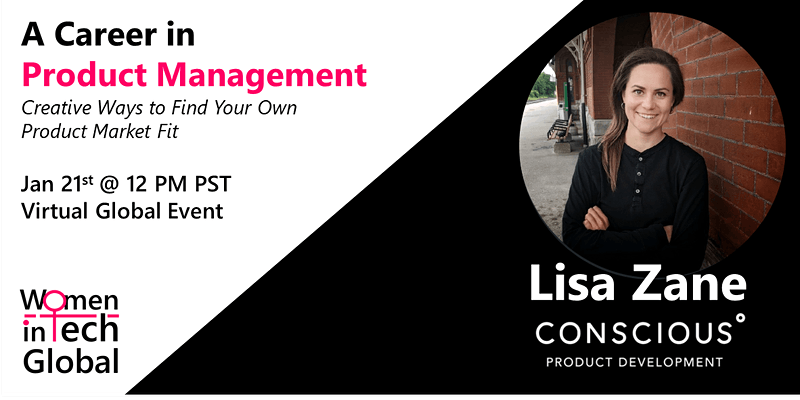
If my time working in product development has taught me anything, it’s to iterate. Find a process that helps you learn as quickly as possible what your users need, and enables you to integrate those learnings into your existing resources and constraints to move in the direction of your vision.

If we can do this really well for products, why can’t we apply this same thinking to our lives and careers?

I recently spoke about this with Women in Tech Global virtually last week — you can watch the hour-long lunchtime talk and Q&A below or keep reading for the gist.

“What do you want to be when you grow up?”

I’m willing to bet you have been asked this question at some point during your childhood.

I HATE this question now and have always hated it. It gives kids a message that they are defined by what they do (not who they are) and doesn’t leave much space for exploration and discovery.

The way in which the question is asked is very narrow — it implies that kids must pick ONE static thing and stick with that forever. It’s not phrased, “Who do you want to be?” and implies that doing is valued by society more than being.

And what the heck does “growing up” mean anyways? At what point do you become a grown up? When do you cross the line? Is it when you leave home? Have the ability to vote or drive? When you pay your first bill?

More than anything, I hate this question because it forces kids to think in boxes — boxes that they wouldn’t naturally impose on themselves.

Not fitting into boxes

I have never fit in any boxes.

I had a mushroom cut and a rat tail growing up.

I loved sports and was playing them competitively since I was pretty young — mostly hockey and soccer — but it was clear to me then that being a professional athlete and a woman wasn’t an option because I didn’t see it happening in the world around me.

When I was 10 we had to answer this question in an essay. I wrote that I wanted to work as a video game tester, at a tech company (I think I said IBM at the time because this was the only brand of computer we had at school), and that I also that I wanted to be a mascot for a professional sports team. My teacher wrote a message in response telling me that I should re-assess my goals.
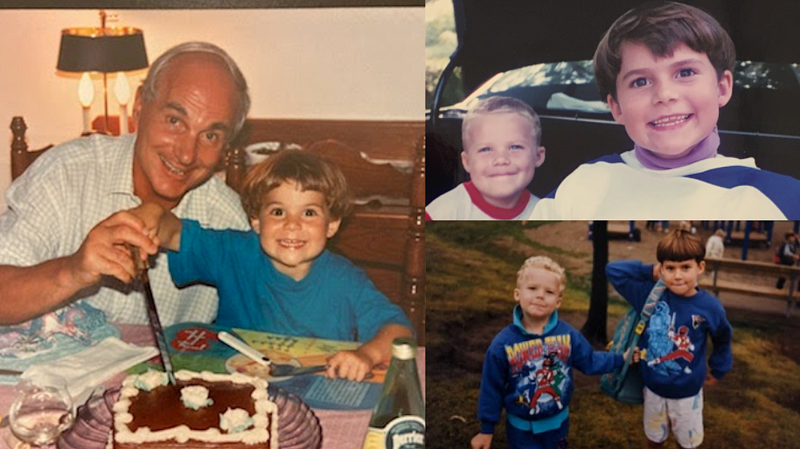
With my Nonno (grandfather), and younger brother, wearing hockey equipment in the trunk of our car and on the first day of school.

I didn’t know what a product manager was then, or what the world would be like in 2022. So I followed my gut. I tried lots of different things. I gravitated towards the things that made me excited and subconsciously started constructing a framework to understand how these experiences made me feel and what I needed to change to feel more aligned.

I ended up studying kinesiology, playing hockey for five years at McGill University in Montreal, and being lucky enough to win three national championships while playing with some of the best players on the planet at the time (who had been part of the women’s olympic team). I then got into a biomechanics program for my Master’s degree and was able to focus on ice hockey biomechanics specifically, working in partnership with Bauer Hockey — a major hockey equipment developer — and their stick department to develop a piezoresistive force sensing system to measure grip force during slap and wrist shots (basically a way of measuring how much force is applied, when on the stick during a shot).

Bauer had a major budget cut right before I graduated, so I ended up segueing into studying journalism at Concordia University in Montreal (all of my jobs through school had been related to media and journalism while I studied science). After graduating, I ended up working with a production company and freelance writing. I’ve developed original content for CBC, the CrossFit Games, Discovery Channel, and National Geographic.
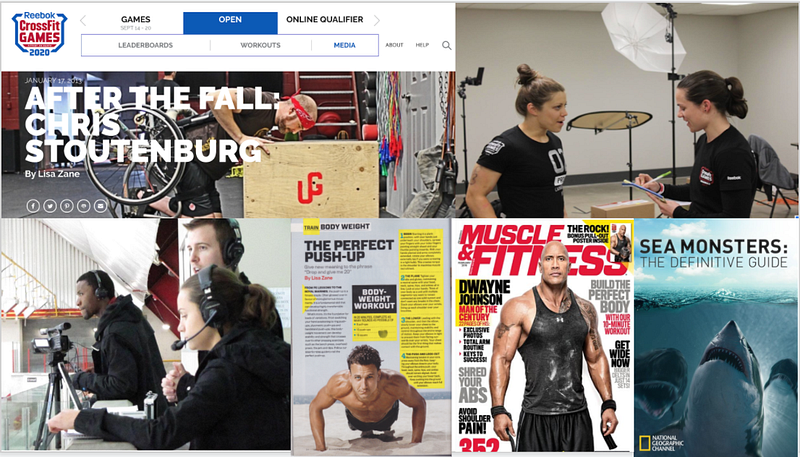
And as everyone knows, when you work really, really hard as a journalist…you become a product manager.

Becoming a Product Manager
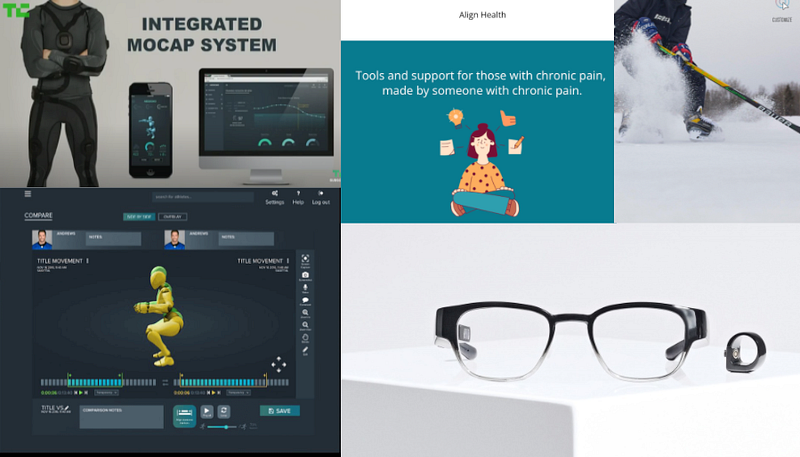
I joined a startup called Heddoko as their Biomechanics Lead and one of the first full-time employees. We developed an IMU-based motion capture suit to prevent sports and workplace injuries. This evolved into me becoming their first product manager before I really even know what a product manager was or did.

From then on, I have worked almost exclusively at startups.

I was part of the team at North that brought Focals, the first smart glasses that look like regular glasses to market. North was acquired by Google last year and I joined the Google AR/VR team.

I left Google founded my own company, Conscious Product Development and am coaching product managers, writing, creating resources, and working on my own products including, most recently, Align.

Along the way, I’ve also been part of several incubator and accelerator programs — District 3 Innovation Center in Montreal and I went through Techstars as part of their 2016 cohort in Boston.

I’ve worked almost predominately on moonshot types of projects, creating somethings from nothings.

“Life slapping me in the face”

This period of time has also been full of challenges and what I call, “Life slapping me in the face moments” that I am now incredibly grateful for.

These things, which were quite traumatic at the time, like living through a shooting, being in a bus accident, my aunt passing away after being hit by a car while cycling in Toronto, having my partner of eight years at the time contract lyme disease that caused bilateral facial paralysis, finding out my dad had cancer, my mother-in-law passing away after being diagnosed with pancreatic cancer, herniating 3 discs in my back, and being diagnosed with a genetic condition called Ehlers-Danlos Syndrome, really forced me to get my ducks in a row and figure out what is the most important to me in life and why.

I am:

  • Someone who has changed careers multiple times
  • A female PM working in tech
  • A business owner
  • Gay
  • A step-parent in a blended family
  • Living with an invisible disability

The truth is, most systems weren’t designed for people like me.

So, I’ve had to come up with creative approaches and alternate ways of thinking to spend my life aligned with my values and doing what I want to be doing.

It took me hitting rock bottom to decide to think of myself like a product.

I’m still a major work in progress, constantly under iteration, but I have been able to improve my situation by defining my why, understanding my own common underlying thread, knowing where I want to go, and owning my story.

Parallels between product and life development

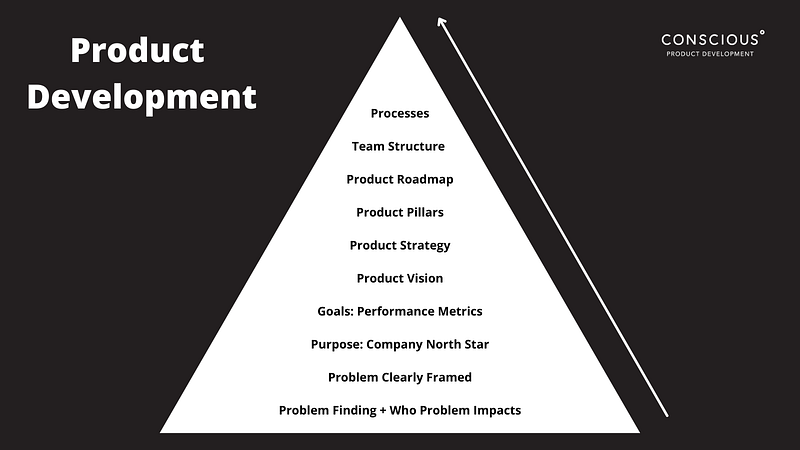
This is generally how I approach developing a new product from scratch and all the pieces that are involved, starting with the foundation at the bottom of the pyramid and moving upwards.

Everything above should fit into the context that is below it.
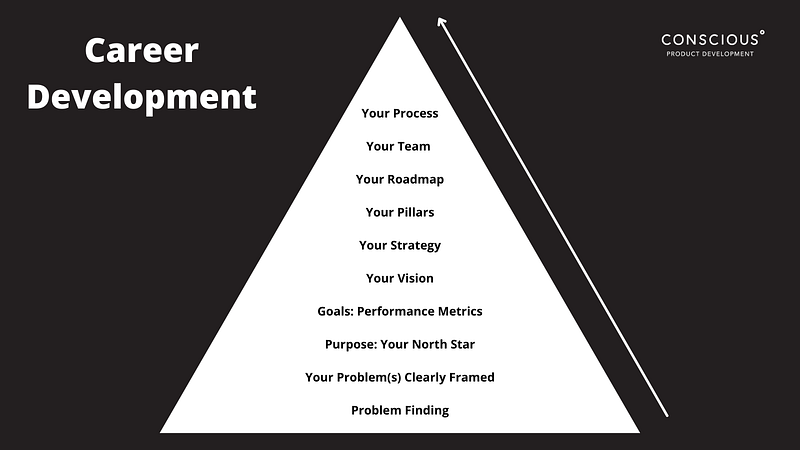
This can also be applied to a way of thinking about your career development:
1. Find the problem

If we want to make big things happen, it’s important to think small and ask really basic questions that can have a dramatic impact on the design of the end-solution.

  • What is the problem?
  • Why is it a problem?
  • How big of a problem is it?

It sounds so simple yet so most people don’t start here and when they spin their wheels or end up with a solution that’s not great.

Try to look inside and outside. Pay attention to how you’re feeling. Instead of reacting right away, try to create space and be curious.

For me it was looking inside and asking questions like, “Why am I unhappy?”, “What feels misaligned right now?”, “What isn’t working vs. what is?”, “What, specifically are the problems here?”, “What is impacting me the most?”, “What are other people’s experiences like?”

It’s REALLY easy to skip this step and jump right into a solution. And a lot of people do.

2. Frame the problem

Albert Einstein once said, “If I were given one hour to save the planet, I would spend 59 minutes defining the problem and one minute resolving it.”

I think that this is how the most elegant solutions come to life.

Problems can be defined by asking questions to understand and challenge constraints and to conduct pre-mortems to understand all the things that could possibly go wrong along the way so that a plan can be in place to prevent those things from happening.

Career-wise, I think it’s important to ask questions like, “What’s not working?”, “Why, specifically am I feeling stuck?”, “Do I feel blocked or like I am on the complete wrong track?”, “Should I solve this problem now?”, “Who has already tried to solve a similar problem and what has worked vs. has not worked for them?”

For me, the biggest thing I tried to focus on was WHO I AM (now) vs. WHO I WANT TO BE (future).

To fill in this gap, I read. A lot. I wanted to know how others had approached this and figured out the person they wanted to be.
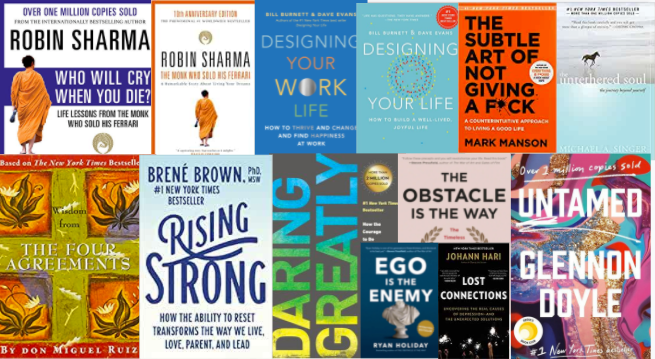
I asked questions like, “What does my ideal day look like?”, “What do I really care about and why?” and “What are my values?”.

I talked to others who had gone through similar transitions. I contacted everyone that was interviewed in The Social Dilemma and met with some of them 1:1. Those conversations were EXTREMELY helpful.

I watched a documentary about people that had made big life changes and something someone said really stuck out that was along the lines of , “Notice when you feel contracted vs. expansive, and when you feel totally like yourself vs. guarded. Keep track of those things. They are clues.”

3. Define your North Star

Clearly articulate THE WHY of what you are trying to do in a narrative way: What is your North Star? Your purpose? What do you believe in? What do you do what you do every day? What are you trying to achieve and why are you trying to achieve this? What problem is it solving?

For example:

  • Google’s purpose is: “To organize the world’s information and make it universally accessible and useful.”
  • LinkedIn’s is: “To connect the world’s professionals to make them more productive and successful.”
  • NASA’s is: “To advance and communicate scientific knowledge and understanding of the Earth, the solar system, and the universe.”

While I was thinking about this, my friend Siobhan sent me this Ted talk by JP Michel:

In it, Michel talks about a different approach to figuring out “What you want to do when you grow up.”

Rather than focus on what you want to do and picking one thing for the rest of your life, choose a problem you really care about solving. Having a challenge mindset can help clarify your purpose and understand how your array of skills can make an impact that is aligned with this. It also provides room to grow in unrestricted ways. The main question for you is — what problems do you really care about solving? Make a list. Prioritize this. Make it as tangible as possible.

Are you moved by what’s happening in the environment? How our healthcare system works? Vaccines, transportation, access to food, or mental health challenges?

I created some resources to help myself answer these questions that you can use here:

After doing the work, I landed on this for myself:

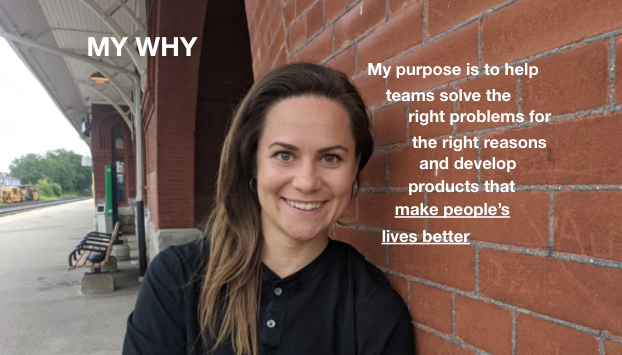
My purpose is to help teams solve the right problems for the right reasons and develop products that make people’s lives better.

I want to emphasize that this is my purpose RIGHT NOW. This will adapt and change over time as I learn more about myself and what I want to do.
4. Goals and Performance Metrics

What does success look like for YOU?

How can you define your goals?

What are your most important milestones to hit and why?

Start with a maximum of three that can be easily measured, however you want to define and measure them (i.e. V2MOMs, OKRs, or value-based goals).

These should feed directly into your North Star and serve as a way to communicate goals, measure progress and adapt on the fly, and create more alignment in your life.

5. Career Vision

Your vision is the answer to the question, “What is the future you are trying to create?”

This should be ambitious, emotional, meaningful, should leverage your skillset and the things you naturally gravitate towards, and should answer, “What is your endgame and how is what you are doing every day contributing to this larger goal?”

Do you want to be in a director role? Do you want to start your own company? Do you want to get to a point where you can invest in others who are solving problems you deeply care about?

Think hard about what you want your future to look like.

Here are some great examples of how you can articulate this from Marty Cagan/SVPG.

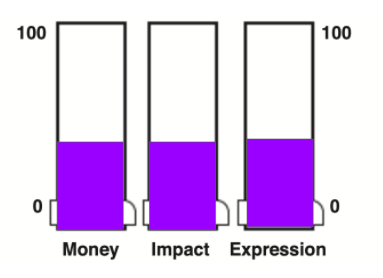
I also really like the idea of using a life mixboard, that Bill Burnett and Dave Evans introduce in their book, “Design Your Work Life”. Essentially, you’ve got 3 levers — Money, Impact, and Expression — and you can have a percentage of each at any given time in your career. What does your ideal mix look like?
6. Career Strategy

If the vision is the WHAT (what you’re trying to accomplish), the product strategy is the HOW (how you are going to accomplish this goal).

My strategy was four-pronged and looked something like this:
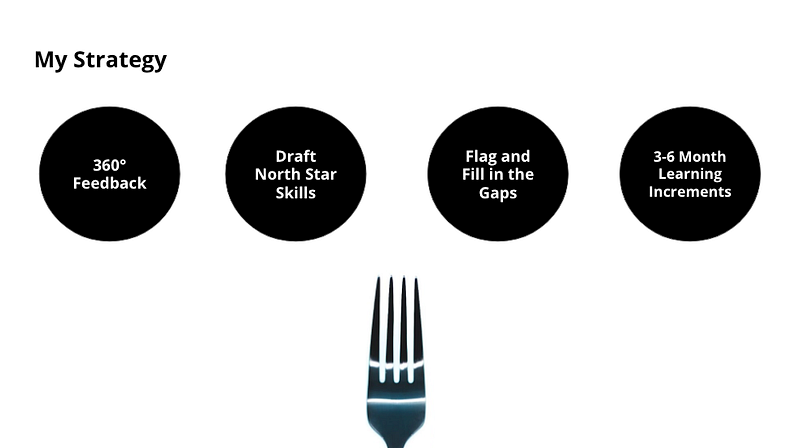
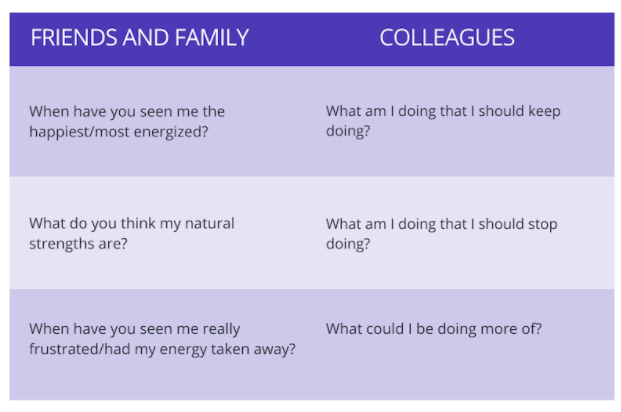
Step 1: Conduct 360 degree feedback to understand, objectively, where I’m at right now. I talked to a set of my close friends and family members and also a set of colleagues at work and asked the following questions, described in this guide I created to help you define your career North Star.
Step 2: Draft a set of skills that I will likely need to reach my North Star. I looked at job postings for my ideal future roles, connected with people in those roles now, and did a lot of reading to create this list.

Step 3: Consolidate the two lists and flag all of the gaps.

Step 4: Create a roadmap to fill in those gaps, focused on 3–6 month learning increments that leave space for continuous discovery and exploration, with buffer in between projects so I can debrief with myself, make sure I’m on the right track, and adjust as needed.

7. Define your pillars

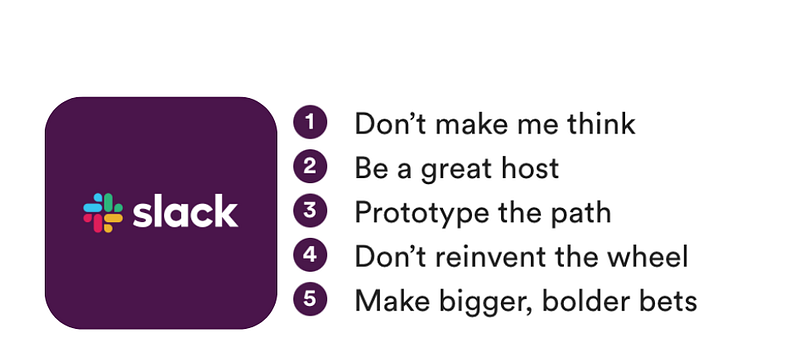
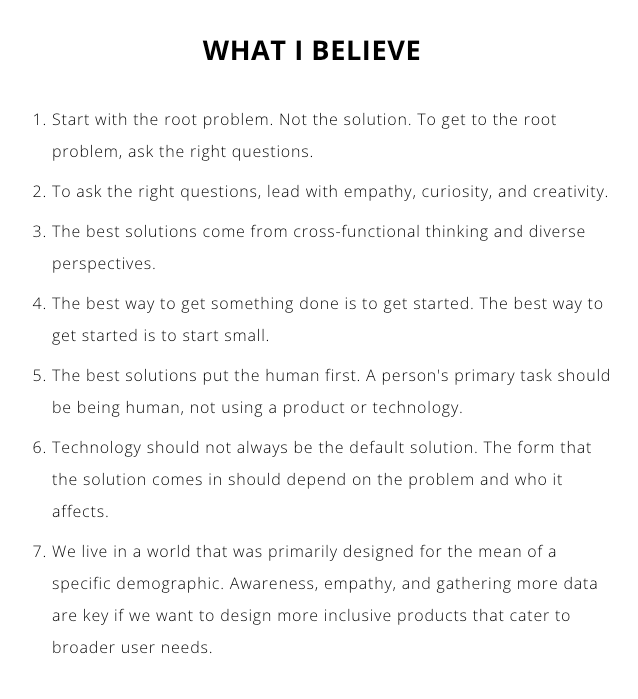
Pillars/tenants/principles are the things that describe the nature of what you do, identify what you believe in, and what you think is most important. They can help you make decisions faster, more easily understand what is in and out of your scope (read: what you should say, “No” to), and help to reduce churn and decision fatigue.

I love how Slack articulates their product pillars (read this awesome article by Slack’s VP of Product Design, Ethan Eismann, for more on why it’s crucial to define pillars):
For me this boiled down to the following, which govern projects I say yes or no to, and also my approaches to working:
8. Define your roadmap

What is the path to getting to your North Star? What will it take to get there? What are your guardrails? What are the key challenges you will likely need to overcome? MOST IMPORTANTLY — How can you learn as quickly as possible to turn unknowns into knowns?

My roadmap approach is largely influenced by Andrea Saez’s and Janna Barstow’s thinking on this — separating chunks of time into “Now”, “Next” and “Later”, where the “Now” items are the most clearly defined, tangible, and understood things that you will do immediately, the “Later” items are the most broad, abstract, longer-tail items that need more fleshing out, and the “Next” items fall somewhere in between.

You should be able to answer these questions for everything in your own roadmap:

  • What are you doing?
  • Why are you doing it?
  • How does this tie into your purpose, goals and vision?

I created a template for this after doing it for myself that you can find here.

9. Build a team

Just as you would build a team if you were developing a product, build a team around you to support developing YOU.

Try to find others who are doing the thing you want to be doing. Leverage tools like Twitter, LinkedIn, reaching out to people after reading their blog posts after they resonated with you and what you are going through, etc.

Think about this as if you are building your own support system from scratch in the way that you want it to look to best help you.

Don’t be afraid to reach out to people that you don’t know in order to do this. You’d be surprised how many respond.

10. Develop processes

Create processes that help you iterate to keep moving towards your North Star, but with room for continuous discovery.

There are SO MANY processes out there — Design Thinking, Scrum, Kanban, Sprint, Shape Up, and the list goes on.

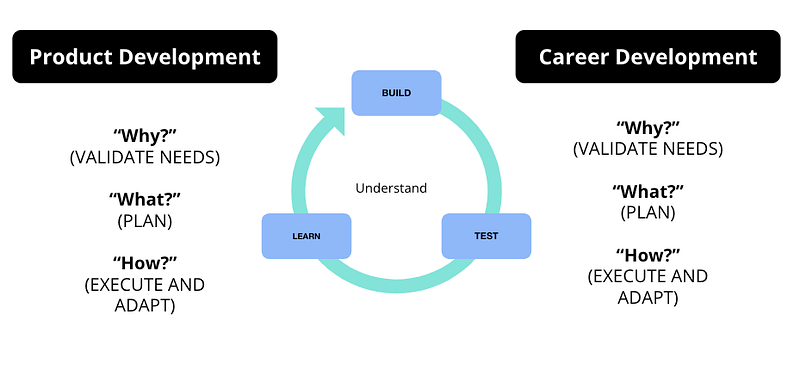
Ultimately, what they all have in common is that they facilitate BUILD → TEST → LEARN cycles to further your own understanding in both your problem space and the effectiveness of your solutions.

These processes can be applied to your own development, just as they can to developing products.
Don’t be afraid to do the work. Think deeply about what you want and why you want it, but don’t take yourself too seriously — leave room for fun and to learn and grow and explore. Be authentically you along the way and use these steps to write your own story, your way.

If you enjoyed reading and this resonated with you, subscribe to my weekly newsletter where I write about developing products in more conscious, inclusive, accessible, and sustainable ways, and share helpful tips and resources.

Resources Referenced:

Follow me on Twitter: @lisazane15

🧠 Join 800+ people interested in building products and their product careers more consciously: https://www.consciousproductdevelopment.com/newsletter

🧭 If you’re ready for a role transition or just want to make more conscious career moves going forward, check out The Product Manager’s Career Guide that I just launched: https://www.consciousproductdevelopment.com/the-product-managers-career-guide

Related:

Careers
Career Advice
Career Development
Product Management
Business
Recommended from ReadMedium