
“How Do I Improve My Storytelling Skills as a PM?”
How to apply golden storytelling advice like putting the cat in the tree, the hero’s journey, and advice from TED to your day-to-day life as a product manager
Author and coach Lisa Cron once said, “Story, as it turns out, was crucial to our evolution — more so than opposable thumbs. Opposable thumbs let us hang on; story told us what to hang on to.”
Being an exceptional product manager involves doing a lot of things really, really well. One of the skills that often gets overlooked while sifting through line items like Product Requirements, Roadmapping, and Stakeholder Alignment is one’s ability to tell a damn good story.
I recently posed this question on Twitter and got a lot of great responses — click below to see what people said and add your own thoughts to the conversation:
Here’s my breakdown of what it takes to improve your storytelling skills as a product manager:
- Context
- Goals
- Development
- Execution and Delivery
- Debrief
Let’s dive in.
PART 1: CONTEXT
Do your homework
Get really good at noticing. When you hear a story that really sticks with you, ask yourself why it resonated, specifically? What was the structure? How was it delivered? What was it that made you care?
Stories are everywhere, all the time. You can glean something from every story you read/hear/watch and break it down to detect patterns in what works and what doesn’t.
That standup comedy show you loved? Why did you love it so much? That book you hated — why was it so bad? TED talks, theatre, songs, movies, podcasts — across all mediums, what do the stories that stick with you the most have in common?
Find great storytellers and watch them. Listen to them. Learn from them.
Get outside yourself often
Understand the world from many different perspectives. I can’t emphasize this enough. For me, some of the worst stories are entirely flat — there’s only one perspective that went into it.
The best way to gather multiple perspectives is by talking to people. In your personal life, talk to strangers. Say hi to the person beside you at the bar, waiting next to in line, or sitting next to on the bus. You can learn something new from everyone you meet.
On the job — speak with your customers. They will not only give you stories to tell, but also different perspectives to think about when telling your own stories. What do they care about? Why do they care about these things? What are their challenges and struggles? What makes them motivated, inspired, and feel alive? What do they hate?
As a product manager, the most important part of your job is empathizing with and understanding your customers. The most powerful stories I have included in pitch decks to investors, added to website landing pages, and used to drive product vision and roadmap conversations all came directly from customers.
Know and understand your audience
Who do you need to tell a story to? Who are they? What do they care about most? What do they struggle with? What context do they have right now? What’s interesting to them?
This is crucial. The way to tell a story to a classroom of kindergarteners is going to be different than the way you tell a story to a room full of software developers or a boardroom of investors.
Identify your audience prior to putting together your story. Empathize with them.
If you put together a story that the audience can’t relate to, you’re dead in the water.
Screenwriter Lena Waithe once said, “I’m writing my story so that others might see fragments of themselves.”
Tell stories that your audience can see themselves in.
PART 2: GOALS
What is the desired outcome?
What are you trying to prove?
Whether you’re putting together a pitch, telling the story of your product vision, trying to come to an important decision, or needing alignment on roadmap updates, figure out the ending first. This is the hardest part. Why is this a story that you need to tell?
Figure out what you want your audience to feel
When you remember a story, you may not always remember the specific words that were used or the exact sequence of delivery, but you always, always remember how it made you feel.
That joke you heard last night that made you laugh to yourself while at your computer at work today when you thought about it, the story you remember about the athlete who succeeded against all odds and inspired you to get out of bed at 6 am and head to the gym, or the speech you heard that made you view life differently — it wasn’t about the perfect structure, delivery, or topic. It was about the emotional connection that formed when you heard the story, and that remained afterwards.
Do you want your audience to feel inspired? To feel the pain of the user in order to spring into action? To feel connected to other teams or people in the company?
Whatever the feeling you are trying to incite is, thinking about it up front can help inform how you structure and deliver the story you want to tell.
What are the stakes?
Why should your audience root for the desired outcome for the people involved? What happens if that doesn’t happen? What is at stake? What are the risks and rewards?
Outlining these things up front helps to create a necessary tension to keep people invested in your story.
PART 3: DEVELOPMENT
Grab attention quickly
When I was in journalism school, one of the things they hammered into us from day 1 is your story is nothing without a good lead.
This is probably more true than ever before with how fractured out attention is and how quickly we need to find value in order to stay hooked.
Some of the best ways to grab attention quickly are:
- Say something that invites more questions (i.e. The first sentence of “The Martian” by Andy Weir: “I’m pretty much f*cked.” or the first sentence of “Farenheit 451” by Ray Bradbury: “It was a pleasure to burn.”)
- Say something that makes you feel what someone is going through first-hand (i.e. The winner of the best Pulitzer Prize lead for 2018 below)

- Say something that people can easily relate to (i.e. The first line of the Movie “Stand By Me”: “I was 12 going on 13 the first time I saw a dead human being.”)
- Ask a question that your audience would love to know the answer to (i.e. Simon Sinek’s TED Talk, “How Great Leaders Inspire Action”: “How do you explain when things don’t go as we assume? Or better, how do you explain when others are able to achieve things that seem to defy all of the assumptions?”)
- Give people an idea of how important the story is and what it means in the context of the world (i.e. The first line of Martin Luther King Jr.’s “I Have A Dream” speech: “I am happy to join with you today in what will go down in history as the greatest demonstration of freedom in the history of our nation.”
- Make the audience feel seen (i.e. The lead of Teddy Rosevelt’s “The Man in the Arena” speech below)

I love how co-founder of altMBA Wes Kao frames this:
- Make your audience’s eyes light up
- Stack as many eyes light up moments as you can
Make it personal and emotional
People care about people.
Focus on people — not things, or circumstances or situations. You can talk about these things, but at the epicenter of every story should be a person.
Talk about yourself. Your customers. Your team. The people in your company.
Connect the dots for them so they don’t have to do the work.
Rather than focus on fulfilling a checklist of items, make it emotional. Make it human.
The best way to do that is to find your own personal connection to the story and use that to drive the emotion behind it.
A good story feels natural, personal, and emotional vs. robotic, distant, and staged.
Take the audience on a journey
You’ve probably heard of the Hero’s Journey, where the protagonist (the hero) goes on an adventure, is confronted with a challenge, grows personally to overcome this challenge, and returns home transformed.

There’s also the classic “Save The Cat” writing structure that focuses on a character arc of introducing the cat (protagonist), putting the cat in a tree (life changing event), and then figuring out how to get the cat out of the tree (turning point → protagonist hits rock bottom → resolution).
There’s a lot of advice about story structure floating around on Twitter as well:
There’s no right answer here but generally a good story includes a good story arc with a beginning, middle and end that includes:
Person → Context/Stakes → Problem → Impact.
Keep it simple
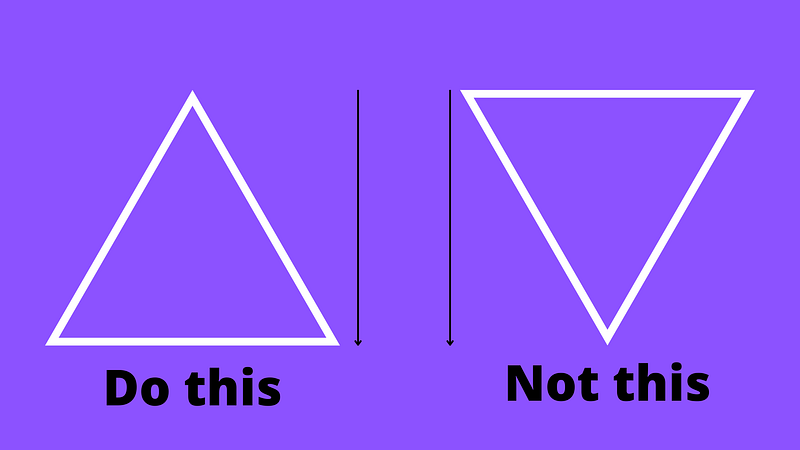
When I was starting out as a product manager, I faced a lot of assumptions. I look a lot younger than I am, and am small in stature and I spent time working in hardware where I was even more of a minority than I was in software. As a defence mechanism, I would proactively think about all of the questions anyone could possibly have about what I was presenting and front-load my presentations with these to get them out of the way. While it may have helped me feel better initially, it was a mistake. It resulted in confusing, information-heavy presentations that didn’t feel like stories and that had a convoluted underlying thread that was difficult to pull out. I was telling my stories like an inverted triangle (image on the right).
A better way is to start with the end in mind, take the reader on a journey with a clear underlying thread that ties your key points together, mapped to a tangible desired outcome. Do the work to understand important details but reveal them strategically throughout the presentation if they are crucial. If they are not, keep them under the hood (i.e. In an Appendix that people can access if they want further information). If anyone asks questions, you’ve done the work to be able to answer them. Top-down stories (image on the left) are simpler and make a lot more sense to the audience.
Write things out first
Writing is one of the best ways to organize thoughts. We’ve got so many storytelling mediums now that the medium itself can often create more confusion and chaos and detract from the value and impact of a story.
By starting with writing and making sure the story arc makes sense, you can use the benefits that other mediums offer (i.e. video, audio, slide decks) to add icing to your story.
The “Rule of 3s”
Our short-term memory doesn’t have the greatest capacity to retain large amounts of information and can only remember about three or four things at a time.
There’s a lot more on why “3” is a golden number for remembering things in this Forbes article, but in the spirit of keeping it simple, if you can group information into groups of three, it makes things much easier for the audience to understand and retain.
PART 4: EXECUTION AND DELIVERY
Have a genuine conversation
You can probably remember seeing presentations where the presenter seemed disinterested, nervous, overly sales-y, or just plain fake. Overthinking hitting specific markers on a stage, reading off of presentation notes word for word in a robotic and monotonous way, or the presenter moving their hands in a way that did not seem authentic or comfortable and appeared overly tactical.
If your story is one that needs to be delivered, try to be yourself as much as possible — people can very easily detect BS or overthinking and makes them feel disconnected from the story you are trying to tell.
Tell your story from your heart, in a conversational tone, with confidence.
One of the best ways to improve confidence is to think about how your story is serving people and focus on that vs. what they are thinking about you or how they are judging you. Think service (personal and communal growth) vs. fear bias.
This is one of the best videos I’ve seen that describes this shift in mindset (it’s in the context of a job interview, which is a specific kind of storytelling, but can also apply to presentations, podcasts, written narratives, and more).
Practice. A lot.
Practice makes progress.
Think creatively about this — you can practice telling stories in so many non-traditional ways. Telling bedtime stories to your kids. Meeting new people at a bar or an event. Recording yourself talking. Give yourself feedback. Ask others for feedback.
Last year, I did a talk at the Grace Hopper Conference. The format was new for me as the conference was virtual and they asked speakers to record their sessions with a production crew in advance of the event. Some of the things that helped me practice were doing the talk in person to my partner and asking for feedback, and setting up my exact recording environment, recording myself, and making notes on what felt off and where I needed to improve.
The important thing here is to treat your stories like a product — do iterative testing and incorporate feedback to keep improving.
Don’t take yourself too seriously
We’re all a work in progress and trying to figure things out.
Everybody makes mistakes and nobody knows everything.
Try to enjoy telling stories. Laugh at yourself. And most importantly, have fun.
PART 5: DEBRIEF
Create a feedback loop
Once you tell your story in public, ask for feedback openly. You can ask some close colleagues to tell you what they thought, honestly and objectively. Create a space that lets them know you want this feedback and that what they say will help you vs. hurt your feelings.
Look for both qualitative and quantitative markers here.
Qualitative being things like, did the audience look like they were sleeping? Did you ask if anyone had questions and no one raised their hand? Did you create many “eyes lighting up” moments?
Quantitative being things like what the read ratio was on a story you wrote on Medium or how many comments you got in response to something you shared.
Telling Stories About Your Career
As a Product Manager, a major part of your career trajectory is telling your own story to get a new job, or listening to other product managers’ stories to figure out if you want to hire them to join your team.
I’m a huge fan of using all of the suggestions above to apply to putting together your cover letter, portfolio, resume, LinkedIn profile, and also interviewing.
I recently created an eBook, “Own Your Narrative” to help you write your own story your way by giving you a clear lens through which to view product management (vs. spending hundreds of hours Googling), a framework for how to tell your story, your way and stand out to recruiters and hiring teams (vs. stumbling and feeling overwhelmed during the hiring and interviewing process), and a method to focus your efforts to get the best ROI (vs. many headaches and time spent spinning your wheels trying to figure out the best way to get to where you want to go) that you can download here:
Storytelling is one of the foundational human skills that transfers across job titles, industries, stages of life, demographics, locations, and has the ability to connect us.
What tips would you give product managers looking to improve their storytelling skills?
Leave a comment below!
-Lisa ✨
P.S. I’ve included some helpful storytelling resources below:
Storytelling Resources:
- The Most Popular TED Talks of All Time
- Toastmasters Public Speaking Tips
- The 15 Best First Lines in Movie History
- 83 Opening Lines Of Famous Books That Will Make You Want To Read Them Now
- Save the Cat! By Blake Snyder
- The Hero’s Journey (Wikipedia page)
- Resonate by Nancy Duarte
- Just Listen: Discover the Secret to Getting Through to Absolutely Anyone by Mark Goulston
- On Writing by Stephen King
- TED TALKS: The Official TED Guide to Public Speaking by Chris J. Anderson
- Storytelling Twitter threads (special thank you to Jasper Polak for sharing some of these with me):
Follow me on Twitter: @lisazane15
🧠 Join 800+ people interested in building products and their product careers more consciously: https://www.consciousproductdevelopment.com/newsletter
🧭 If you’re ready for a role transition or just want to make more conscious career moves going forward, check out The Product Manager’s Career Guide that I just launched: https://www.consciousproductdevelopment.com/the-product-managers-career-guide
Related:
- What It Takes To Be An Exceptional Product Manager
- “How Can I Build Tech Knowledge In A Specific Domain as a PM?”
- What It Takes to Bring A New Product From 0 to 1
- What Product Teams Can Learn From The Mayo Clinic’s Care Model
- A Call for More Conscious Products
- “How Should I Approach Product Strategy?”
- A Few Thoughts on Conscious Time


