
“How Do I Lead Meetings People Actually Look Forward To And That Fit My Schedule?”

TL;DR
- You don’t have to be stuck in back-to-back meetings all day
- Ideal Day: Write down a % breakdown of how you want to spend your time to do your job well. Be proactive about organizing your time based on this.
- Purpose: Always start with what needs to be communicated and why. If it is not absolutely essential to be scheduling a meeting, don’t do it!
- Invitees: Keep this list as small as possible. Think of the ROI of a meeting — how much is it costing the company vs. the output?
- Structure: Before creating an invite, you should know why the meeting is required, what each person’s role is, what the goal of the meeting is, what is expected of invitees, what invitees should expect, the minimal amount of time required to achieve the meeting goal, what needs to be communicated before the meeting and what needs to happen after the meeting is over (i.e. share relevant notes or decision points).
- Approach: Approach leading meetings as a servant leader and give people a clear reason to want to be in the meeting — to feel valued, included, driven, and engaged.
- Tech Considerations: If handled remotely, include walking and movement breaks, encourage team members to shrink the size of their own face and turn their camera off occasionally for breaks, and encourage walking phone meetings if video is not crucial
- Fun: The secret sauce. Make a communal playlist. Include 5 minutes of hellos in the agenda to ask how everyone is doing, ask for Netflix or book recommendations, wear a fun outfit or a funny wig to shake things up — find creative ways to keep meetings personal and engaging.
As a Product Manager, my least favourite part of my job is “too many meetings”. A lot of people assume it comes with the territory as a PM — that it’s something we just need to accept with the role and need to “suck it up” and get through them. This Twitter thread sums up how a lot of folks feel about this overall:
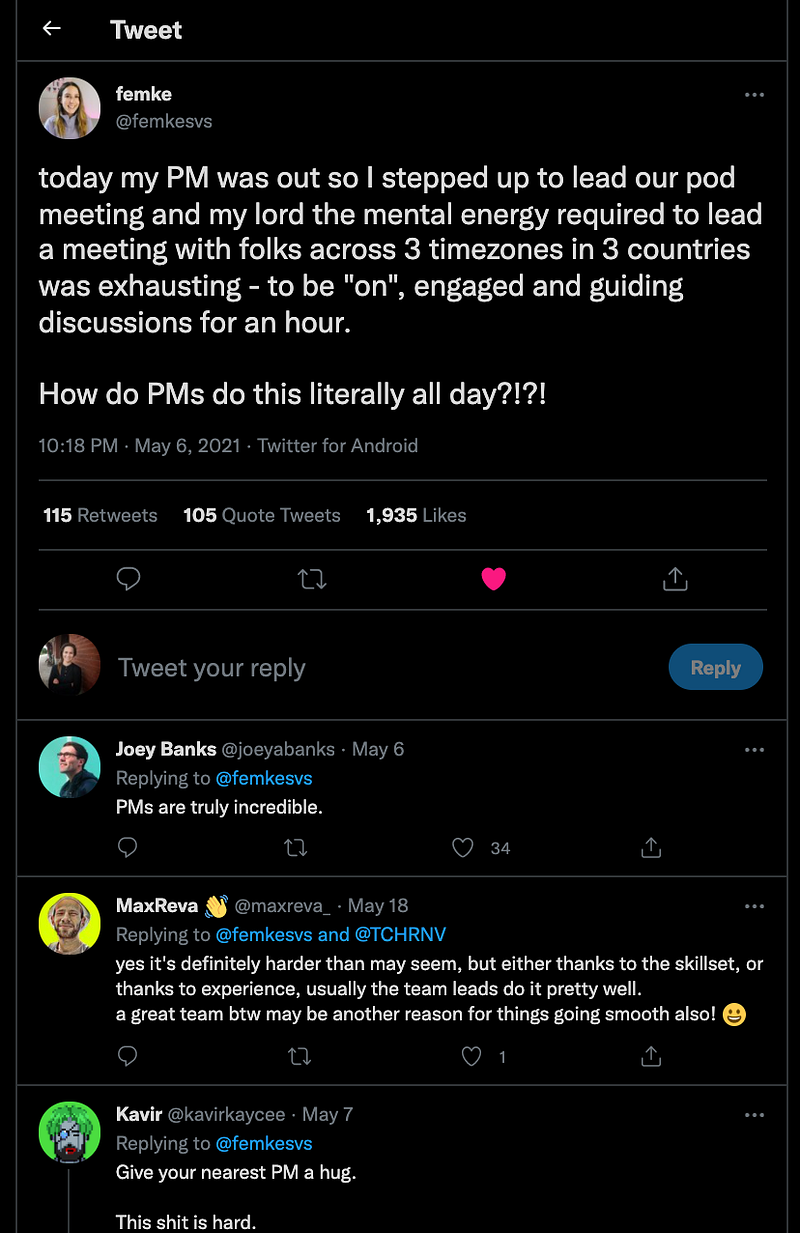
I have felt this SO many times. At my worst, I was working across three time zones and going through a remote acquisition that was confusing and messy. I have been part of many recurring meetings that had 0 agenda, always ran over time, had no follow-ups or minutes shared, with the primary output being causing more confusion. I was context switching to the max and losing my voice almost every meeting-heavy day. It felt like my brain had morphed into a web browser with a gazillion tabs constantly opening in a single window.
But it doesn’t need to be like this. And this isn’t just about meetings. It’s about how we communicate with each other when we are on a team.
I’m still working on this, and have tried to make a lot of small, conscious choices to improve that have resulted in better outcomes. It’s been really challenging, especially when you are a PM at a small-yet-fast-growing start-up where the ground seems to constantly be shifting and the org structure is changing all the time. I remember when I went through Techstars’ Boston 2016 Cohort, many founders and mentors spoke about how every time a company grows x2, everything breaks. In these situations, and also in very large organizations, the way that teams communicate is critical to the company’s success.
This has been made even more challenging with the pandemic, the shift to working remotely, companies having to make some very difficult choices about how they want to structure their teams in terms of physical location, and also how communication happens within and across teams.
Here is a breakdown of some of the specific things that have helped me:
1) Ideal Day
What do YOU, personally, need to do your job well? What would a % time breakdown look like between heads down work, writing product narratives, briefs, requirements, supporting documentation, thinking through the larger product strategy and vision, creating roadmaps, and the like vs. working with the development and design teams on execution vs. working with leadership and all of the other stakeholders that feed into your project?
A lot of the time we walk into new roles and let whatever situation currently exists in the job and environment we have just walked into dictate how things need to be but this doesn’t need to happen. Thinking about these things, in a tangible way, and writing them down so you can see what your goal is to do your job well will help you be proactive in scheduling your own time. You can’t control everything but there are some things you can control.
When new or unexpected things come up, you can bounce them off of this list that you made when you were in a much different headspace and make better decisions based on this. I often feel a lot of guilt around this because my default is to put the team first and be flexible enough to accommodate everyone; however, what I realized (the hard way) is that if I can operate in a way that lets me do my job well, it will help the team the most. It’s an “oxygen mask on a plane” situation.
When you do have meetings and know they are critical, and you’ve taken care of your needs, you will come into those meetings in a much better state and that will ripple throughout the team.
Innovation also rarely happens within a meeting — great ideas usually strike in the shower, on a walk, making coffee, or in nature. It’s important to leave space for your mind to wander vs. being stuck on a loop of back-to-back meetings, day in and day out.
2) Purpose
What needs to be communicated? Why does this need to be communicated? Who are the essential people that need to be involved? Often when these questions are not asked internally before sending a meeting invite, a domino-effect of hours of meetings and churn and confusion ensues. Always start with these questions.
Some messages that are fairly simple and straightforward to understand and require limited context to do so can be handled outside of a meeting and in a memo format asynchronously via email or Slack. Sometimes, it can be a desk-side or water cooler conversion with an individual in person.
If the message requires more context or active participants in a decision that needs to be made, then a meeting is often required. If you are unsure if it’s absolutely essential to schedule a meeting, you should not schedule it!
3) Invitees
When the invite list is too large, everybody suffers. The book Sprint: How to Solve Big Problems and Test New Ideas in Just Five Days talks about a seven-person limit in order to make Design Sprints more effective. Jeff Bezos had a famous two-pizza rule for meetings — no team meeting should be larger than the number of people that can be adequately fed by two large pizzas. A lot of people talk and read about this but when it actually comes down to adding invitees to a meeting it can be daunting.
I often think of the ROI of a meeting. I will calculate, roughly, the amount of money the meeting is “costing” the company, and what the intended output is. For example, if you are inviting someone to the meeting who makes $200K/year, the cost of having them in a meeting for an hour is around $100, give or take how many hours they work on average in a week. Multiply this by the number of people in the room and you can quickly see how much money is being used for the purpose of the meeting.
I also often think about it in the inverse for messages that need to be communicated and shared throughout the larger team — “If I didn’t invite X person, what would happen?” If it is really critical that they be there, this will surface in the answer. This can be tricky in some situations where everyone wants to feel included. It’s important to use empathy as a guide for how to manage a lot of the communication around this. “How would I feel if I was in X person’s situation?”. “If I am not inviting them for very objective reasons, how can I articulate why (i.e. I’m saving them time and still want to keep them in the loop)?” “How can we maintain a great relationship going forward?” Reaching out personally, 1:1 before/after a meeting to a team member that you thought of but wasn’t included on the invite often goes a long way.
If a decision is required and stakeholders need to provide input to make this decision, this sometimes gets more complicated. There are a lot of frameworks available to help with this — i.e. DACI, RACI, ARCI, RASCI — where the PM can identify key individuals and their unique roles in making the decision. Using the DACI framework, for example, stakeholders are identified as “D = Driver (person responsible for making the project happen), A = Approver (decision-maker), C = Contributor (subject area experts who the Driver should include in the decision-making process and context sharing), and I = Informed” (those who need to know about the project status and any decisions made but don’t need to contribute to the decision being made).
There’s no binary answer here — the main thing is to think critically about who needs to be invited and why they should be invited before creating the meeting invite.
4) Structure
The structure of a meeting should be determined based on:
- Why the meeting is happening (what is the purpose of it?)
- The people attending the meeting (what does the presence of these, specific people, need to contribute to the meeting?)
- The desired outcome
- How much estimated time is required, minimally, to achieve this outcome
Meetings shouldn’t last for periods of time that Google Meet or Zoom are set up to schedule as defaults, and every single person should know, before accepting the invite, why the meeting is happening, why they need to be there (what their role is), what the goal of the meeting is (i.e. to decide on X, or to answer employee questions about Y competitor event that occurred that impacts the entire company), what is expected of invitees (i.e. reading a brief prior to the meeting), and what invitees should expect (agenda). Set up your defaults for shorter vs. longer periods of time.
A sample structure could look like this:
Purpose: To align on our product objectives for the upcoming quarter.
Goal: To leave the meeting with a clear list of the 3 OKRs we will focus on this upcoming quarter that we are aligned on and can communicate with the broader team.
Relevant Context (prepared in a single linkable document that you attach to the meeting invite):
- Previous quarter objectives
- Suggestions from X teams for upcoming OKRs
- Current product strategy and vision
- Latest user research learnings
- Data Analytics and Reporting update
- Financial update
Please read the attached Brief in advance of the meeting.
Agenda:
The meeting will run no longer than 1 hour. The agenda is as follows:
11:50–12 Open time to say hello
12:00–12:30 Walk through suggestions for updated OKRs and accept feedback from the group to improve and align on these
12:30–12:40: Coffee/Movement break
12:40–1:00 Address open questions from the team
If you are moderating the meeting, it is your job to ensure:
- Relevant information is thought about and included in advance of the meeting
- The objectives of the meeting are met
- The meeting runs on time
- Stakeholders feel that they all have a voice and are not interrupted or frequently overpowered by the HIPPO (Highest Paid Person’s Opinion) or the loudest person in the group. Asking people that haven’t spoken what they think in a way that makes them feel included and safe can help greatly with this. It can be as simple as, “Hey Nancy, you’re an expert in this area — it would be really valuable to hear what you think about X”.)
- Relevant notes are shared out after the meeting (i.e. decisions that were made and relevant context to explain why those decisions were made).
5) Approach
Approach leading meetings as a servant leader vs. a person of authority trying to control the meeting. Your main goal is to provide service to the team. Give people a reason to want to be in the meeting — to feel valued, included, driven, and engaged.
Encourage the team to do the following, and actively do these things yourself if you are leading the meeting:
- Ask people how they are doing
- Listen when others are speaking
- Use language that approaches everyone on the same level
- Actively make team members feel included and recognize individual contributions
- If tough conversations need to be had, approach them in an objective way and lay out the common goal that is trying to be achieved so everyone knows they are headed in the same direction even if there are differing opinions or data
- Bring your weird self to the table to let others know that this is not only accepted, but welcomed, and that it is a safe psychological space
6) Technical Considerations
Zoom Fatigue has been talked about all over the place with the transition to remote work during the Pandemic. Some considerations to help avoid or limit Zoom fatigue include:
- Making some meetings “walking meetings” — if nothing needs to be presented visually or if it’s a 1:1, try making it into a walking phone call
- If it has to be via video, shrinking the size of your own face can help avoid some of the psychological stress this induces. You could also consider making it OK and explicitly clear to participants that if they need a break from their own face it’s OK to turn of the camera for brief periods of time
- Encourage attendees not to multitask
- Schedule standup and/or coffee and/or bathroom breaks every 30 minutes
7) Team Alignment
Communication is not only required, it is absolutely essential to teams functioning and setting and achieving objectives. The best way to proactively avoid needing to over communicate, put out fires, and having your calendar be filled with back-to-back meetings is having good top-down and bottom-up alignment. The best practical, step-by-step way I have seen to establish this is outlined by Marty Cagan and Chris Jones in Empowered: Ordinary People. Extraordinary Products.
Setting a company mission, objectives, and scorecard to understand how to track progress, creating a product vision and principles that are inspiring, informed, and explained in a tangible way, setting up the team topology and makeup to support these, having a very clear product strategy that fits in with the higher objectives and what the team’s skills are, and setting individual objectives with each product team can help to greatly improve communication by addressing a plethora of issues that could arise downstream if these pillars are not aligned on.
8) Fun
Outside of all of these things, one often overlooked secret weapon is FUN. Having someone “DJ” the beginning of the meeting with a communal team playlist, having movement or dance breaks throughout meetings to make them less monotonous, asking everyone to come into the meeting with a joke to share or a silly story, asking for Netflix or book recommendations, using words like, “Happy Tuesday!” to kick-off the meeting by creating a positive atmosphere, asking everyone to bring one random personally-selected item to the beginning of the meeting for “Show and Tell”, showing up to regularly scheduled meetings with a fun wig or outfit on to switch things up or having something funny in the background (I once did a company-wide talk with a ridiculous mannequin head on a shelf behind me) — these are all really small, simple things that can go a long way. Even though it’s work, at the end of the day everyone is human. If you can inject each meeting with a little bit of fun, you can help make them something people actually look forward to vs. dread.
-Lisa
What are some strategies that have worked for you to help make meetings less poopy? I’d love to hear your take.
Follow me on Twitter: @lisazane15
🧠 Join 800+ people interested in building products and their product careers more consciously: https://www.consciousproductdevelopment.com/newsletter
🧭 If you’re ready for a role transition or just want to make more conscious career moves going forward, check out The Product Manager’s Career Guide that I just launched: https://www.consciousproductdevelopment.com/the-product-managers-career-guide