
A book project: Designing Instruction Using Layering Services
I want to try something new here. In 2020, I wrote a Kindle book titled “Designing Instruction Using Layering Services: Educators and students guiding learning”. I priced the book at $3 which is as low a price as I think Amazon allowed for a book of that length. It is time for a new edition. Because the motive was never to make much money on the book in the first place, I decided this update could very likely find a larger audience on Medium.
We spend the winter months in Hawaii and this has been my time to work on my longer works. The location is irrelevant to the project, but we live in Minnesota and the winter gets long. My plan is to serialize the content by uploading the chapters as they are revised. I can edit published chapters so I can add a “Previous chapter” and “Continue to next chapter” link to connect the material as it is uploaded. The Forward that should offer an overview is included in this post. The intended audience was originally K-12 educators, college instructors, and those who work to assist educators in the development of instructional materials. Others may find individual chapters of value.
The outline that follows will also be linked to indicate my progress and provide a single location for accessing topics. The outline follows:
Forward
Background & Boundary Conditions
Educator as Instructional Designer
Forward
This is the third edition of my Primer focused on layering. The word layering is intended to provoke an image of a relationship between the content being studied and either a) content added by a teacher/designer to guide the processing of the material being studied or b) content added by the learner to improve the understanding or retention of this material. The title of the first edition of this book was “Layering for learning” and was changed because I decided at first glance the phrase was too unfamiliar to educators and because I decided to put more emphasis on the relationship between the design of learning content and learning. I am not certain the new title is much better at communicating what the content covers, but it is descriptive of how the blend of content and instructional tactics happens. Despite my struggle to communicate my goals in a few words, I believe most focused on teaching and learning are interested in the topics covered here and hope the following brief introduction will motivate them to continue.
The term teacher/designer purposefully implies a role educators assume when improving raw content to make it more suitable as a learning resource. The general process of teaching involves adding value to information and pretty much everyone does this from time to time. Much of the content we encounter online is raw content (information) rather than educational content. Raw content is also most of what we encounter when we are not involved in an educational endeavor so processing such content for understanding and as we now understand more and more for truthfulness are essential life skills. Individual learners can also use digital tools to apply tactics to such content to understand and apply more successfully.
An example of layering
The Forward is seldom the location for examples, but I fear unless I demonstrate the relevance of my topic, I will be unable to readers to see the potential of the technologies I eventually want them to consider. This ebook is intended to focus on specific technology tools applied to online content. but I thought the description of a different type of digital tool the readers of this book could find useful themselves might be a persuasive introduction to layering. SoundNote is a tool for simultaneously taking notes and recording audio. There are several tools of this type for tablets and laptops and SoundNote happens to be my personal favorite. I propose you would find this tool most useful if you are a college student sitting
in classes that involve extended presentations (lectures). If your college days are behind you, you probably participate in professional development experiences such as conferences. Conference sessions are a similar situation in which I find it useful to take notes and save the audio from what I consider high-value presentations.
1.1 SoundNote iOS app
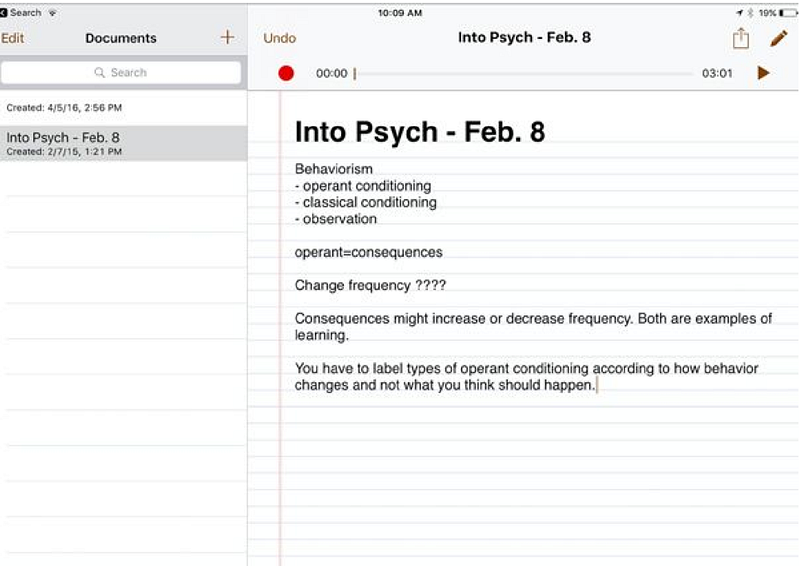
Why is the recording of audio while taking notes valuable and why is it an example of layering? What is important to understand about SoundNote is that the notes and audio are linked. If you have this tool on your laptop or tablet, after a note-taking session, you can listen to the recorded audio. You can reread your notes and possibly add additional information. In addition, you can also click at a point within your notes and listen to the audio recorded beginning slightly before the point in time at which you originally entered that text. So the notes taken can be imagined as being layered on top of and linked to the recorded audio.
Consider this. How many of the lectures from your college days would you want to listen to multiple times? Even assuming the presentations were really interesting, the time required to study by listening multiple times to a recorded lecture would be very inefficient. Reviewing your notes would take far less time and would allow you greater control to think, repeat by rereading, or maybe add additional comments that came to mind. The audio could still have great value. How often did a presentation move faster than you preferred and perhaps you found yourself failing to understand certain important ideas? How often have you returned to examine your notes only to find that something you stored as text now makes little sense or seems to be missing specific information you did not have time to record? The redundancy between the audio and the notes allows a way to compensate for failures of understanding or failed insight into the adequacy of what you recorded. The layered nature of the two information sources allows an efficient way to revisit the original source when necessary. Technology as a tool allowed the recording and linkages between two information sources allowing the source that would be best for different needs to be accessed. The technology tool also allows you more flexibility in the tactics that can be applied during class and during study.
Defining a focus
This book takes an unapologetic advocacy position and differs in ways I recognize from my other writing for educators. My wife and I have long written a textbook we describe as targeting the “technology for teachers” college course. This is a far more focused effort and the length and the purchase price reflect the narrow focus of this Primer.
This book focuses on learning from digital content, examines theoretical perspectives and related research sparingly, and assumes the reader agrees with some core positions on how educators and learners function and interact to facilitate learning. The intent is to bring ways of thinking and practices to your attention that you may not have considered and provide a description of some tools and tactics you can use to implement these ideas and practices in your own learning or instruction. I do intend to be more specific about the core assumptions and support on which these recommendations are based. The two chapters that follow will identify these positions for those who desire to place the recommendations that follow into perspective. These chapters combine theory, some research, and descriptions of specific instructional and learning strategies. The next chapter identifies several categories of layering tools that are available for the reading and study of text content. The final two chapters describe the use of specific tools for layering online web content and online video. These two chapters are intended as tutorials for how to use the tools that serve as examples of layering.
What I describe here will probably not be the newest or shiniest thing about the educational application of technology you will encounter. One thing you quickly discover when writing about technology is that some other author will always be more current than you. What I think I can describe here are tactics that have roots in the facilitation of reading and studying that go back decades and that predict future opportunities just beginning to emerge. The connections between the past and the potential for the future are partly what I hope to establish. I think there is something in the educational potential of layering that any educator or learner can use and develop starting immediately.
About the author
Just for the record, my personal background is that of an educational psychologist who spent the past twenty or so years of an academic career focused on the applications of technology in education. In the mid-1990s, my wife and I authored a textbook for what we described as the “technology for teachers” college course.
This Primer is not the same type of textbook and it is not an all-purpose introduction to technology in the classroom. This effort is far more focused and has more easily described goals. This book is about improving how learners process online content.
Acknowledgment
I would like to acknowledge the companies allowing me to make use of screen captures of their products in this ebook. The products are listed below. The company permissions and some extended discussions about their products and future plans were helpful to me and I hope my comments were helpful to them. This area is new enough that there is still an opportunity to interact directly with the individuals developing these new services and to share insights.
I am more of a writer than video producer, but I have created some basic videos that describe the types of digital tools this “book” emphasizes. The video descriptions are easy to access.
One more important point. I will put the rest of this book behind the Medium paywall. If you pay to become a Medium subscriber this would mean that reading the rest of this book I would receive a quarter or so. Medium requires that readers pay a subscription fee for pay-walled content and then reimburses authors when someone reads what they have written. With a subscription, you can read as much from all authors as you want. I like the micropayment approach which is what Medium uses.