
DECENTRALIZED FINANCE
A Beginner’s Guide to Staking — How to Beat Inflation With Blockchain
Web 3, made easy enough for grandma

This article contains affiliate links you can use to earn bonuses from $10 to $25 when you sign up. It is a mutually beneficial way for you to support the author, so thank you for your consideration.
I won’t go into much depth about the technological details for Proof of Stake (PoS) blockchains like Algorand, CRO, Solana, or their merits compared to Proof of Work (Pow) blockchains like Bitcoin and Ethereum. You can read the articles linked above if you’re interested in going deep on my research and perspective about any of these topics.
Instead, this is going to simply be a how-to guide that helps you get started at putting your crypto to work for you. Why let it just it sit there in a Robinhood wallet doing nothing?
That’s right. If you have crypto, you can safely and easily use it to compound and generate you more.
The key is about putting time on your side and then just allowing it to work its magic. You don’t have to take big risks, you don’t have to do tons of research, you just have to get everything set up, regularly contribute over time to dollar-cost-average, and then be patient.
I’ll also show you how to spend your crypto with a debit card once you’re less focused on growth and decide you have enough to start spending it.
Safety First
Before we start, let me warn you with a few safety precautions that will prevent you from losing all of your money in this digital Wild West. Crypto is potentially lucrative, but it’s no safe space. That’s especially true for NFTs and self-custody on a DeFi (Decentralized Finance) wallets, but we’ll get into that another time.
- Activate 2 factor authentication with the Google Authenticator App on all exchanges.
- Write down your 12 word seed phrases on a piece of paper (maybe have multiple copies too) and keep them in a fireproof safe. If you lose access to those seed phrases, you won’t be able to access your accounts on a new device or reload it if the app is deleted. The important things are to have no images or files containing them that are connected to the internet, and never say the seed phrases out loud near a smartphone or any other potentially hackable recording device (Alexa, Siri, etc…).
- Anyone you don’t know that contacts you about an “opportunity” by private messages on any platform — Telegram, Twitter, etc… is always a scam. 100% of the time. When they want money, seed phrases, or whatever else, do not give it to them. I don’t know why I have to put this in because it seems so obvious and common sense, but scammers keep on scamming because people keep on falling for it. And even if you do think you recognize the person, it can still be a scam. I and some of my friends have already had imposters contacting people and pretending to be us, and we’re not even that big yet. I will never contact you asking for anything. The only thing I’ll contact you about is if I’ve noticed the work you’re doing for the blockchain community and just want to say “thanks”.
Okay, enough primer. Let’s get into it.
Coinbase (It’s Easy Enough for Grandma)
I’m not exaggerating. I literally held Nona’s hand and walked her through the process of hooking her bank account to Coinbase and buying a few hundred bucks worth of her first cryptos (I think I had her put $50 into Bitcoin, Matic, Ethereum, Chainlink, Algorand, and Enjin). The fees are relatively high on Coinbase, but they’re one of the largest exchanges, they’re publicly traded, and highly regulated. This gives people new to crypto a higher degree of trust and a willingness to take the plunge. For these reasons, Coinbase is my recommended starting point and is also where I began.
If you want to save a ton on your trading fees, you need to download the Coinbase Pro app and connect that to your Coinbase account. It adds a level of complexity that I don’t burden Nona with, but you should be aware that it’s the difference between paying $2.99 on Coinbase for a trade, and paying $.30 on Coinbase Pro for the same trade. It adds up quick if you’re as active as I am.
What I recommend as your easiest way to get staking rewards is simply to buy Algorand (ALGO), Tezos (XTZ), Cosmos (ATOM), and Ethereum (ETH) on Coinbase Pro, and then move those to regular Coinbase where they’ll automatically compound. The yields and terms for each of those are different, but they’re effort-free. You don’t have to actively do anything, run nodes, get a PhD in computer science… none of that. Coinbase completely takes care of the technical stuff for you because they take a cut for themselves. Just leave your staking rewards on, and you’re good.
While you’re on Coinbase, be sure to check out their rewards, because you can sometimes watch videos and receive free crypto for it. Unless you value your time at greater than $1/minute, then these rewards are well worth it.
To get $10 worth of free Bitcoin on Coinbase, use this link. Once you buy or sell $100 worth of crypto, we’ll both receive the bonus.
Voyager
Another very easy, user-friendly platform to use is Voyager. You automatically stake and receive rewards on your crypto as long as you maintain the minimum balance. The yield percentages are unimpressive for most coins, but some are quite good. For example, you only need 100 USDC (a “stablecoin”) to get started at earning a 9% yield. That’s an extremely safe type of crypto to hold, as far as it goes, because it’s backed by and pegged to a dollar. Historically, USDC fluctuates only a fraction of a cent away from a dollar at any given time, so you can pretty much just think 1 USDC = $1.
Voyager’s 9% rate is a lot better than the 0.5% rate your bank will offer you on dollars. Banks don’t even keep up with inflation!
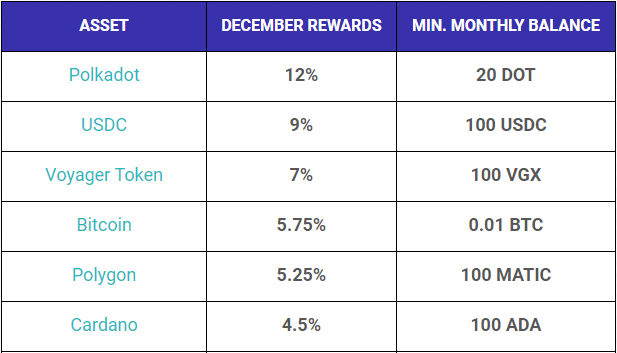
If you want to use Voyager, download the app and trade $100 to get $25 of free Bitcoin. Use code JES5F0 or this link to get started.
Crypto.Com
Even if you don’t follow crypto markets very closely, you may have heard about the recent name change from Staples Center to Crypto.com Arena. $700 million naming rights and corporate partnerships at this scale do tend to turn a few heads and raise a few eyebrows.
In addition to a sleek looking app, Crypto.com has their own lightning-fast blockchain with ultra-low transaction fees. The native token is CRO, which can be very easily staked for periods ranging up to a 3 month commitment, with increasing rewards as you stake more.
You can get even better rates if you take personal custody of your CRO and stake it on their DeFi app. I’ve done that for a few months, but I’m not going to delve that deep in this tutorial. An easier way is to get the Crypto.com debit card and spend with it to earn rewards. As I alluded to earlier, Crypto.com offers the best and easiest way that I know of to easily spend crypto in the real world. My friend Rich Casada does this regularly, although I personally still avoid spending my crypto at this phase of my journey.
Sign up with this link and we’ll both get $25 of free CRO once you stake enough to get at least the Ruby card. The video below walks you through the process in a little over one minute.
How to Compare Exchanges and Find Tokens
There are two main sites that rank exchanges, tokens, NFT collections, and all things blockchain: Coin Gecko and CoinMarketCap. A token doesn’t even stand a chance of seeming respectable until it has listings on these sites.
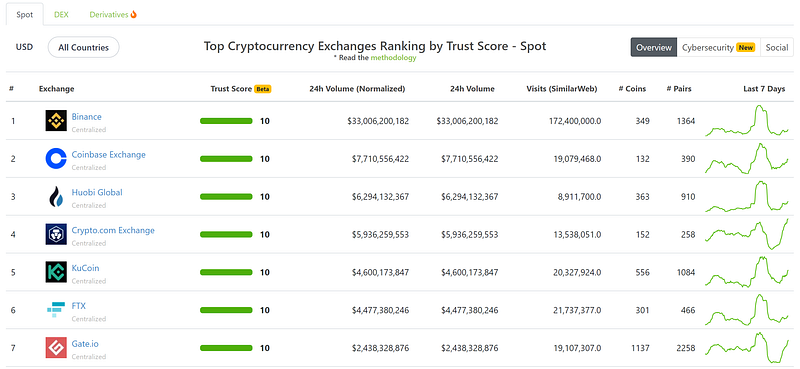
If you’ve become a degenerate gambler like I have, you can sift through the trash looking for moon gems at PooCoin. But as I explain in the next section, y’all ain’t ready for that if you’re reading this far into an article with “Beginner’s Guide” in the title. To win at spotting microcap gems, you need the kind of risk tolerance that James Bond has at a poker table.
How to Get MASSIVE yields (100% APR+)
Mark Cuban, the billionaire Shark Tank investor and Mavericks Owner, is a huge fan of DeFi. He’s incredibly insightful and you can learn a lot from what he writes and speaks about in interviews.
However, even a shark as savvy as Cuban gets burned when crypto projects and smart contracts don’t work quite the way we hope.
His well publicized investment in Titan Finance was earning him an annualized yield of 206%, which seems impossible. In this case, it was. The price collapsed quite suddenly from about $65 per token to essentially $0.00, where it has remained.
I’m not telling you that every high yield DeFi project is a scam or a failure that you’ll lose money on. There are a few gems here and there. I’ve personally turned a $40 investment (or bet?) into about $15,000 before. But even I held on too long and walked away with closer to $5k.
But for each time that I’ve had a 100x win like that, there are dozens more times that my high-risk plays have stagnated or lost me 90+% of the value I put in.
The difference between staking blue chip coins on the exchanges for a % yield in the single digits and chasing microcaps for a % yield in the 100’s that I’ve described above is sort of like the difference between riding Space Mountain and piloting a rocket into space.

They’re both exciting rides. But in the second case you’ve really got to know what you’re doing or else you can land yourself in a lot of trouble. Stay on the exchanges that offer customer service and take a few spins on the crypto rollercoaster first, grandma. Eventually, you’ll get desensitized and can just shrug like I do when the portfolio loses -20% in a day. That’s when you’re finally ready to come talk with ol’ Hogefather about DeFi, and how we plan to completely disrupt banking as you know it.
Until then, just relax, take it slow, and remember that slow and steady wins the race. Patience is the name of the game. Choose the right platforms and use them in the right ways to get compounding yield on solid crypto coins.
ALGO, ATOM, XTZ, USDC, BTC, DOT, and CRO are all legitimate projects with serious teams, so if your stash of these is growing over the next several years, then you’re putting time on your side.
Not financial advice. For educational and entertainment purposes only.
If you enjoyed this article, please consider subscribing to Medium, where you’ll be able to read unlimited articles like this one. Sign up here to support the author.


