
Cryptocurrency
Is Algorand the Future of Finance?
A weakening dollar combined with high gas fees on Ethereum’s network opens the door for alternatives like ALGO
On October 21, 2018, I bought a little more than 1.2 Ethereum costing me $203.27 per token.
Now I know what you’re thinking, and it’s true — I’m such a wild man! That’s a lot of cash to gamble away, right?
I’m a math tutor, but this isn’t calculus so I was way out of my element and didn’t understand any of this stuff. Warren Buffet says to only invest in things you understand, and he also claims that crypto is “rat poison squared”. So by his conventional wisdom, what I did was foolish.
I reasoned that the price of Bitcoin had reached around $20,000 and then collapsed, but maybe the worst of it was behind us. Maybe BTC could claw its way back up, and bring Ethereum with it.
Although I didn’t know much about cryptocurrency, I did know that my wife would be pretty upset if she knew I did this, since she’s even more risk-averse than I am. So shhh! Don’t tell her! Don’t tell Warren either.
I didn’t look at my Coinbase account again for around 2 years.
Fast forward to Feb 14, 2021, and an ETH token is worth $1800. I’ve 9x’d my return on that initial $250. Instead of making the mistake of jumping in too heavy, clearly, I made the mistake of being far too cautious (yet again, the story of my life!). Even though I did pull the trigger and got in the game, my regret at putting in such a measly investment is real, fam.
If I knew then what I know now, I’d have taken out a second mortgage on my house, forgone every meal that wasn’t ramen noodles, and put every penny I had into crypto. I’d have stuck to my guns no matter how many arguments it caused with my wife.
This had been a once in a lifetime opportunity to make a life-changing wad of cash. And I blew it.
Or did I?…
Chaos is a Ladder
One of the most fascinating and clever characters in Game of Thrones was Littlefinger, who observed that “chaos is a ladder”.
That’s the perfect description of how I see our current economic reality. It’s all chaos. Nothing feels stable to me. My Spidey-senses scream that everything’s a bubble. Housing feels overpriced. Stocks feel overpriced. Gold feels overpriced. BTC feels overpriced. Everything feels overpriced except the price of an hour of our labor, which isn’t that much different than it was when I started working 25 years ago.
Why is that happening? If you ask me, it’s because we all get paid in dollars, but dollars are basically inconvenient low-tech paper Dogecoins. They’re backed by nothing. An infinite number can be printed. We all know that the Fed is going to continue to print bills like Monopoly money to fund government spending. They’ll keep funding bailouts for corporations that layoff their workers anyway. You’ve gotta wonder: by the end of the year, will the dollar in your pocket be worth even half of what it is today? Maybe. But I wonder.
For historical reference, you can check out this graphic that shows the erosion of the value of a dollar over the past 100 years. The dollar is a truly terrible instrument to hold as a reserve in the long run.
And here’s something big to keep in mind: the dollar is the best and most trusted of the fiat currencies. Its inflation rate is only 1–3%. By contrast, Venezuela’s inflation rate is somewhere between 500%-3000%. Everything else is somewhere in between. No matter what country you’re reading this from, the structure of the game is always the same: holding currency means your value is eroding.
Government-backed fiat currency is still useful for buying things, but its value as a reserve to store wealth is not good. Paper money is a hot potato of declining value, and so I don’t want to be caught holding it for longer than a millisecond.
But there hasn’t been a great alternative so far. Assets like gold or land are cumbersome, have their own holding costs, and are difficult to sell.
Plus, we all have to keep some amount of money in our wallets or accounts because most stores only take dollars. That’s frustrating because it is difficult, slow, and expensive to move value back and forth. Especially if you have to wire money across country borders.
Paypal, credit, and debit cards have made things easier. But there are still fees, inconveniences, and vulnerabilities to censorship with most banking options. Plus, banks make a ton of money off us.
Flipping the equation in our favor is what the Decentralized Finance (DeFi) revolution is all about. Unlike centrally controlled fiat currency, DeFi is genuinely a type of money that is of The People, by The People, and for The People.
Decentralized Finance
Bitcoin (BTC) and Ethereum (ETH) are the two most famous DeFi projects, but there are others, collectively called “altcoins”.
These systems don’t have a central authority like a Federal Reserve, in much the same way that the internet doesn’t have any single central node. Every computer connected to the network is a part of the process for verifying a “ledger” that lists how many coins there are in each “digital wallet”. The ledger is periodically finalized on something called a “blockchain”. How much there is in each wallet is transparent to everyone. “Coins” can be sent from one wallet to another for a fee, called “gas”, which is paid to the “miners” for verifying the ledger.
I realize that is a lot of new vocabulary terms for one paragraph. Sorry!
Anyway, Ethereum adds an exciting new dimension that Bitcoin doesn’t have. ETH is not just a currency, it is also a platform that provides the foundation for a whole new ecosystem of tokens and smart contracts. Many teams and developers are working on a wide range of tools to solve a variety of problems that used to be difficult and expensive. There are strange new opportunities too, like a Basic Attention Token (BAT) that pays you for watching ads. This extra feature of creating smart contracts and tokens is why I invested my $250 in ETH instead of the more famous BTC.
I think of BTC as being like digital gold, and Ethereum as being like a new layer of the internet. But let’s be real, I’m still just as confused as you are about most of this. I have a lot to learn.
Still, I’m not afraid because I see this whole thing the same way that I see driving (or using any other aspect of the modern world, for that matter). I can accept that my car will get me where I want to go even though I don’t understand every detail of how an internal combustion engine works. I just accept that it works. I abide by what experts tell me I need to do to maintain the engine, but I don’t need to know every detail of what happens under the hood.
One thing you do need to understand is that the price of gas is going through the roof for Ethereum because demand is overheating. The word is out that this is going to be a thing, and FOMO (fear of missing out) is running rampant. FOMO is the reason you’re reading this in the first place. You know that I and a lot of other people are making crazy money on crypto, and you want to know how to do it too.
After all, on Jan 1 of this year, you could pick up an Ethereum for only $730. Now, less than three months later, you have to pay $1800 to get the same thing. You snooze, you lose big. That’s the game we’re in.
In truth, that’s the game we’ve always been in. But for the first time, regular people like you and I get to participate. This time we don’t have to get left behind while the accredited investors who are already rich make most of the big gains and leave us with scraps.
ALGO
As Guy explains in this fantastic video by Coin Bureau, there’s a trilemma of challenges faced by cryptocurrencies. They have to be 1) decentralized, 2) secure, and 3) scalable. Proof of Work protocols like the type used by BTC and ETH have managed all three, but with tradeoffs.
Scalability, in particular, is suffering for BTC and ETH as demand is driving gas prices up. But cryptographers have now developed a second-generation protocol called Proof of Stake. Proof of Stake is very popular with users because you can stake your own coins to help secure the network, and earn coins for yourself as a reward.
Ethereum 2.0 is in the works, and the community is switching to Proof of Stake as quickly as they can. But the demand is already here now, bogging down the transaction process.
As an alternative, the first pure Proof of Stake network, called Algorand, is already in place ready to meet the need. Transaction costs on the network are .001 ALGO, which is currently around a tenth of a penny.
Algorand was created by one of the cryptographers who invented Proof of Stake, an MIT professor named Silvio Micali. The Algorand team not only has an excellent academic pedigree using top-notch tech. After several rounds of fundraising, they also have more than $200 million of investor backing.
Despite these advantages, when it first went to market, ALGO was priced at more than $3, but quickly plummeted due to oversupply, and not enough demand. It was still a slump in crypto-markets at the time of release, so value dipped to less than $.50. This delivered stunning losses to early investors. In an integrity move, the Algorand team bought coins back at 90% of the purchased value.
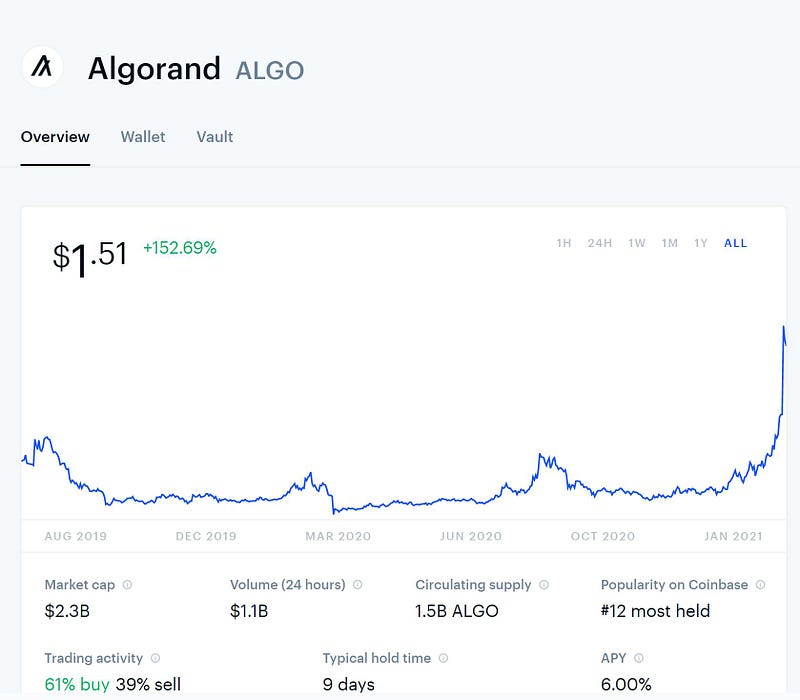
When I first took notice of ALGO it was around $.30. As you can see from the chart at the top of this article, those first coins I bought are now worth 5x that amount. This all happened in only about 2 or 3 months. I strongly believe this is only the beginning. If you feel like you missed the boat when Bitcoin skyrocketed from $100 to $50,000 in just a few short years, consider the possibility that BTC was only a harbinger of even bigger things to come.
That isn’t to say that I have any doubts about either Bitcoin or Ethereum’s success. I’m currently holding a little bit of all of these. I think there is room for dozens or even hundreds of big players.
There are admittedly some winner-take-all network effects to consider. But for the most part, crypto seems to have the kind of dynamic of a mall, a food court, or an app store, where competitors are a good thing. You wouldn’t want to do business in a mall where you’re the only store. That would be a depressing place. Sure, there will be niche players in niche markets that are in fierce competition with each other. But broadly speaking, more projects and tokens is a good thing for everyone involved. Each good-faith participant in the crypto space boosts the value to each other project even if aspects of those projects compete with each other the way Algorand, Bitcoin, and Ethereum do.
The future of crypto, but particularly Algorand, looks extremely bright to me. So I’m all-in on Algorand. Well, not literally… I diversify by holding about $100-$300 worth of every coin I can get my hands on in Coinbase. But I plan to keep at least 20% of it staked for the next several years, compounding daily and earning me more and more ALGOs.
In my experience, by far the biggest risk is to do nothing. So do your research. Diversify. But whatever you do, don’t sit this out. Get your money working for you instead of it only ever being you working for your money.
Here’s the latest episode of the podcast, where my buddy Rich Casada breaks down his comparison of Algorand to other alternatives.
If you’re new to crypto, the best place to start your journey is by reading the article below before taking any other action.