
CRYPTOCURRENCY
Is Bitcoin a Pyramid Scheme With No Real Substance?
Or are you missing out on the dawning of a new financial epoch?

“But where’s it at?” asks my friend, a retired accountant who is a smart guy but watches a little too much Fox News. “You can’t even hold it, some guy just made it up. What, is it air, in the cloud somewhere!” He writes “Bitcoin” on a piece of paper and hands it to me. “Here, have a Bitcoin!”
The year was 2017 and Bitcoin (BTC) mania was in full swing. The price was probably around $10,000 back then. By 2018, the price had jumped to $20,00.
There were many people chasing the trend who bought in at the very top, only to see it crash down to $3,000 and the value of most of their investment evaporate.
Those who sold because of panic lost big. Bitcoin was dead, so said the experts on TV.
My friend wasn’t the only doubter who felt vindicated. Bitcoin has been declared dead more than 404 times so far, according to 99 Bitcoins.
But for those who held on even during the major dips, the rewards were great. Those folks have been rewarded for their faith by a tripling of their investment, meaning an annualized rate of return of around 45%.
Let me say that once more.
The people who screwed up their timing the worst — as long as they didn’t make the fatal mistake of selling — still tripled their money in only 3 years.
This is in a context where “safe” instruments like government treasury bonds offer 2.45% APR to keep money locked up for 30 years. That doesn’t even keep up with inflation.
But not everyone is convinced. Even though I’m not generally a fan of Ben Shapiro, in a recent video he did talk about Bitcoin in a fair and unbiased way. I posted the video, and one of my longtime friends, a very smart Medium writer and professional technologist, surprised me by saying this.
No, Bitcoin is not just like gold. If nobody wants your gold anymore, you still have a piece of soft, highly conductive metal.
Crypto enthusiasts are constantly telling other people to buy crypto. But owners of things with more value don’t tend to be so desperate to recruit others into buying.
It’s hard to stay friends with someone who keeps trying to recruit you into their pyramid scheme.
And I know he’s not the only one who believes that. Okay. So let’s talk about it.
Too Good to Be True?
Too-good-to-be-true rewards like those from investing in Bitcoin instinctively triggers a psychological red flag in all of us, and rightly so. Humans are very well-adapted for survival in a scarcity-based world filled with predators. Our ancestors had to deal with snakes, crocodiles, and tigers. We in the modern world have to deal with thieves, frauds, and scammers. But the nature of the game is still the same: for one to win, the other must lose. Either we eat the snake, or the snake eats us.
Even though we lack claws and fangs, one way humans got an edge over our stronger predator rivals was by using clever traps and bait. Humans are still great at this. That is vital to remember when you feel fear of missing out (FOMO). There might be a hook on the end of that prize.
Anyway, that zero-sum mentality is how most of us are subconsciously taught to process reality from early in childhood.
As an aside, I still remember crying inconsolably at about 7 years old after I played my first game of Monopoly. My parents couldn’t understand why I took the loss so hard. What they didn’t realize was that I wasn’t crying for myself.
“You’re telling me that in order for me to win, I have to make everyone else lose and leave them with nothing?”
I wept.
Okay then, so in the grown-up world, who are the losers that are funding all of this enormous accumulation of wealth that we’re seeing flow into the hands of Bitcoin billionaires?
Patience. We’ll get to that. I’m still working on my backstory here, don’t interrupt.
So by my late teens, I realized that I didn’t have to play that predatory game of real-world Monopoly. I became a math tutor because I finally had a way to both contribute and make money. No one was hurt, and everyone was better off. I’ve played that game for fifteen years now.
In that time I’ve come to realize that most work is like that. Commerce is a fundamentally win-win game. Sure, there are elements of zero-sum games in tournaments, politics, sports, and other competitive endeavors where in order for one side to win the other must lose. But for the most part, no matter what your job is, chances are good that your efforts are providing something of value and making both you and the people you transact with better off.
The problem is that so much of the fruit of our labor is not enjoyed by us, the workers.
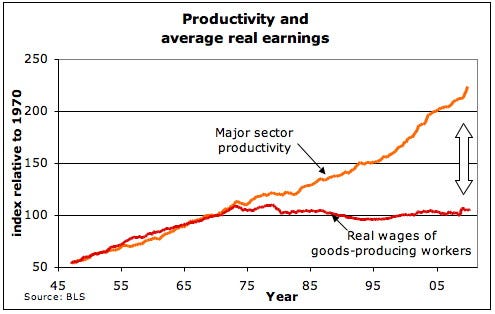
Between taxes, banking fees, interest on our debt, and profits for our employers, somehow, the value of our labor keeps eroding. No matter how productive we get, it keeps getting stripped away from us. Just look at how much separation has occurred between wages and productivity since the 1970s.
It winds up in the hands of the powerful elites.
Once upon a time, these elites were kings and nobles, today they are the heads of corporations and banks. But in each era, We The People have always been left with very little remaining to show for our efforts. Life feels like a treadmill. A mouse wheel. We can’t get ahead.
Or at least we can’t with the 0.05% interest rates the bank offers us! Gosh, look at how happy she is to get those pennies in the picture on their website. Thanks, Bank of America!
0.5%? Goodness.
Some people have figured out that the problem with saving fiat money is its perpetually declining value. And so they don’t store their money away in savings accounts, they invest it.
So where does the smart money store value?
A lot of places, but one of those is the very same place that people have since the beginning of time.
Gold
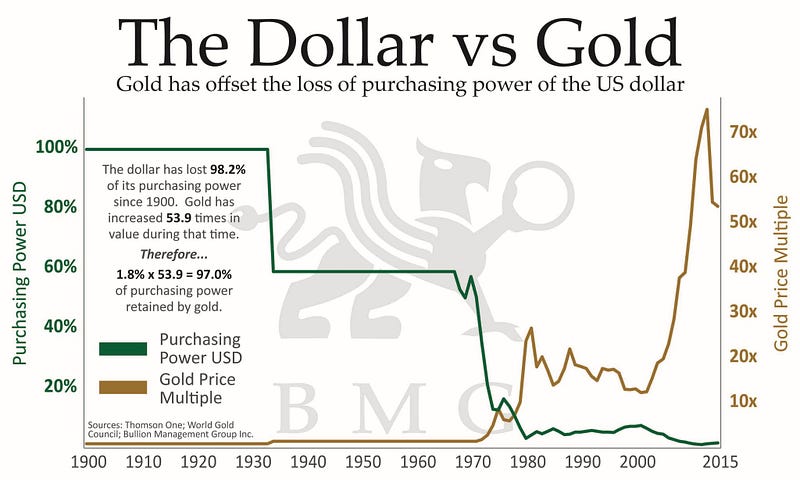
And now for a brief history of gold in America.
You used to be able to exchange dollars for gold, so there wasn’t much difference between the two, at least in theory.
But do you see that big dip in the chart above during 1933? That was FDR working out the problem of the Great Depression by seizing the whole nation’s gold supply, forcing owners to sell at the point of a gun, and achieving a monopoly on being a store of value on behalf of the government. Talk about executive overreach!
The government could now print lots of cash and claim that they’re still backed by gold. What exactly are you going to do about it? Since you couldn’t trade your dollars in to exchange for gold yourself, you had to simply take the government’s word for it. Unless you’re physically holding the gold, you don’t have gold. What you have is a promise, not gold. It is not unlike the piece of paper with “Bitcoin” written on it that my friend handed to me in the opening paragraph. Remember that. Make a mental note because we’re coming back to this. Unless the gold is physically in your possession, you don’t really have it. Someone else has it and you’re taking their word for it.
Anyway, even though Americans couldn’t hold gold, foreign governments were still able to exchange dollars for gold if they wanted to. Until 1971, that is. The rising economic strength of Japan caused demand for dollars to sag. It became impossible to maintain the post-war financial system, called Bretton Woods. Under President Nixon, the government went off the gold standard. In plain English, this was essentially admitting that the dollars were not backed by anything at all, other than faith in the government of the United States.
That’s a big problem because every fiat currency in history eventually fails.
Remember that graph above that shows a divergence between productivity and worker’s wages, starting in the 1970s? There’s a very good reason why wages decoupled from productivity.
“According to a study of 775 fiat currencies by DollarDaze.org, there is no historical precedence for a fiat currency that has succeeded in holding its value. Twenty percent failed through hyperinflation, 21% were destroyed by war, 12% destroyed by independence, 24% were monetarily reformed, and 23% are still in circulation approaching one of the other outcomes.
The average life expectancy for a fiat currency is 27 years, with the shortest life span being one month. Founded in 1694, the British pound Sterling is the oldest fiat currency in existence. At a ripe old age of 317 years it must be considered a highly successful fiat currency. However, success is relative. The British pound was defined as 12 ounces of silver, so it’s worth less than 1/200 or 0.5% of its original value. In other words, the most successful long standing currency in existence has lost 99.5% of its value.”
This is far from the first time in history that currency got debased.
Roman emperors diluted the percentage of silver that was in each coin. Instead of having one coin that was genuinely 100% silver, they could mint two coins that were each 50% silver and get them to be treated as if they were both legitimately two silver coins. That’s great for the emperor! This increased their personal wealth and allowed them to pay off debts by essentially stealing value from those who accepted the coins as though they were fully silver.
But the currency kept getting more and more debased until only 0.02% of late Roman silver coins were actual silver. By that point, no one would even use them.
This is essentially the problem of inflation in a nutshell. In the case of silver, you can easily see the problem of “double-spending” in a tangible way. With paper, it is a little more abstract, but it is the same concept. Printing fiat currency is a way for the government (in cooperation with the central bank) to bail itself out of debt, but it does so at the expense of the users who accept the inflated currency under the false impression that it still has the same value that they’re used to.
Blockchain Technology
Satoshi Nakamoto, the mysterious and still unknown programmer and mathematician who created Bitcoin and started the first block, designed a system that would make double-spending in the Bitcoin ledger an impossibility.
All the computers in the network have a copy of every transaction since the original block. Every ten minutes or so, they reach a consensus. A new block is finalized and all the new transactions are verified.
A Bitcoin can only be in one wallet at a time. There’s no way to double spend it. No one can dilute it. No one can debase it.
He’s removed the ability to cheat out of the system. Nakamoto solved the problem which the Romans, the Mongols, the British, and now the Americans had not been able to.
Are there still risks? Sure. With 51% of the world’s computing power, a malicious actor would be able to hijack the chain.
But good luck with that.
Plus, someone who could do that would much more easily be able to hack into centralized data stores like the Federal Reserve or any other bank or government too. So don’t compare Bitcoin to a hypothetical perfect monetary system that could never go down. Compare it to the faulty system that we actually possess.
Just as the internet itself was set up by the military to be decentralized and thus able to survive a nuclear attack because it has no single point of failure, so too is Bitcoin. Centralized crypto exchanges can of course still be hacked in just the same way that banks can. But the underlying asset of Bitcoin cannot be counterfeited, diluted, or messed with in any way.
Bitcoin Dominance
As the first cryptocurrency, Bitcoin remains unique. Even though copycats have billions of dollars in value, none of them compares to the original thing, just like there are many precious metals but there is only one that is gold.
Below is a visualization of the current crypto ecosystem, with Bitcoin holding more than 60% dominance.
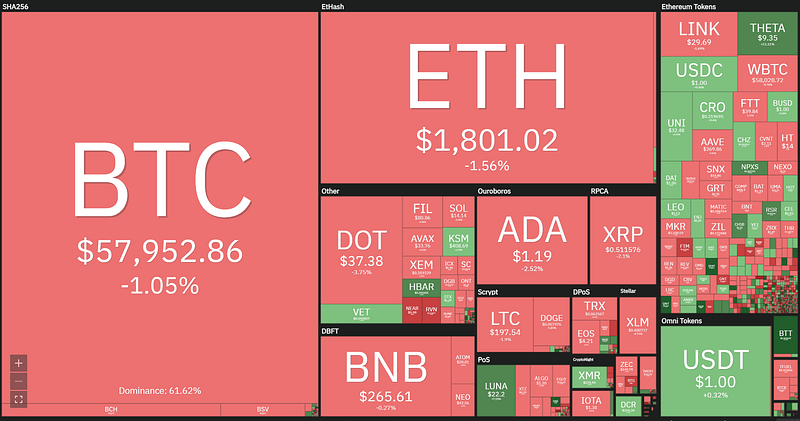
So think of Bitcoin as digital gold for the internet era. All those other coins carry value in part because they are “Bitcoin backed”. That is, they can easily and instantly be transformed into BTC in a permissionless way. It is much like how the dollar before 1933 used to be convertible into gold, except that no government has to allow it. No bank needs to approve it. In fact, there is simply no stopping you if you wish to send your BTC to someone else. No central authority has the ability to confiscate anything, dilute anything, or arbitrarily change the rules as FDR did. And yes, of course, you can easily turn it back into cash and put the money back into your account if you need to for some reason.
Pyramid Scheme, or Real Value?
So now, with that context fleshed out, let’s return to the original question about pyramid schemes. What happens if adoption slows and new money doesn’t enter the market? Would Bitcoin survive? Or does it constantly need new money pumped into it in order to maintain its value?
Well, as you know, many people have declared it dead many times before. But Bitcoin’s value doesn’t erode the way currency does because no one can make more of them than the code allows for. BTC can’t be diluted. They can’t be counterfeited. Can’t be endlessly inflated at the printing press.
Everyone has an up-to-date ledger of how much everyone has. Encrypted, of course. Only the person who owns the wallet has the access keys to send money out.
And good luck confiscating BTC when it isn’t difficult to store and transport the way gold is.
So even if the price dips low for a period of time, the Bitcoin holder is under no pressure to sell. They can simply wait for the price to move up again in their favor, which it eventually must because of supply and demand. Fiat currencies are always inflating. Even the gold supply continually expands as mining technology improves. But the supply of Bitcoin expands at an ever-slowing rate and cannot grow larger than the code allows for.
If you agree with me that Bitcoin is going to continue growing in value and if you have the patience to hold out through the dips (HODL, or “hold on for dear life”), then you might want to get some for yourself. If so, here’s the article you need to read next before you take any other steps.


