avatarLori Ballen

Free AI web copilot to create summaries, insights and extended knowledge, download it at here

9969

Abstract

for getting more clicks because they tell readers precisely what you will teach them if they click on your post.</p><p id="38b5">Using this type of title is also a good idea because people typically want quick, easy solutions to their problems, so they won’t have to spend too much time reading posts unless it’s vital.</p><p id="2c66">Here’s a how-to story created by <a href="undefined">Mridul Chakraborty</a></p><div id="04b6" class="link-block"> <a href="https://readmedium.com/how-to-mange-monthly-budget-of-a-middle-class-family-today-everyone-agrees-that-our-expectations-ff3a3ddd3be0"> <div> <div> <h2>How to manage the monthly budget of a middle-class family</h2> <div><h3>undefined</h3></div> <div><p>undefined</p></div> </div> <div> <div style="background-image: url(https://miro.readmedium.com/v2/resize:fit:320/1*L6M6sOq2uOOGayq3wXtmsA.jpeg)"></div> </div> </div> </a> </div><h1 id="df9e">Pique Curiosity</h1><p id="d74b">People often share articles with titles that make them curious in some way or another, whether it’s about something funny, bizarre, or outrageous.</p><p id="40a1">For example, instead of writing a blog post about how to use hashtags on Twitter, you could create a more attention-grabbing title like 10 Pikachu Fan Theories Guaranteed To WTF Everyone or Things You Never Knew About Pizza.</p><p id="365d"><a href="undefined">Barry Davret</a> has made us curious about the middle-class millionaire.</p><div id="28de" class="link-block"> <a href="https://entrepreneurshandbook.co/how-i-slowly-became-a-middle-class-millionaire-bd621529fb0f"> <div> <div> <h2>How I Slowly Became A “Middle-Class” Millionaire</h2> <div><h3>Learn the rules of the game</h3></div> <div><p>entrepreneurshandbook.co</p></div> </div> <div> <div style="background-image: url(https://miro.readmedium.com/v2/resize:fit:320/1*PtaiSt4gy7g1DRZPhaStBg.jpeg)"></div> </div> </div> </a> </div><h1 id="ac0a">User Power words</h1><p id="ab88">Use Power Words Power words are some of the most effective tools copywriters use when creating compelling headlines. They include shocking, new, secret, discover, proven, instant, and improved words.</p><p id="46d3">Using power words in your headline makes it easier for readers to get excited about clicking on your post, encouraging them to share it with their friends on social media.</p><p id="2b0b"><a href="undefined">Sharone T James</a> bring us an example of this with her word “Proven” in the title.</p><div id="1774" class="link-block"> <a href="https://themakingofamillionaire.com/passive-incomes-that-have-been-the-most-effective-f0917a2a8305"> <div> <div> <h2>Passive Incomes That Have Been Proven Most Effective</h2> <div><h3>You generally have more time on your hands but less money, so you have to make do with what you have!</h3></div> <div><p>themakingofamillionaire.com</p></div> </div> <div> <div style="background-image: url(https://miro.readmedium.com/v2/resize:fit:320/1*_tNWJMqfuo9Js13Ax6tHxw.jpeg)"></div> </div> </div> </a> </div><h1 id="6f77">Add Brackets or Parenthesis</h1><p id="c5a0">Adding brackets around a word or phrase in your title can make it stand out so people will read it.</p><p id="49ed">For example, instead of writing a title “25 Ways to Get More Clicks with Your Blog Titles,” another writer might use 25 Ways to Get More Clicks with Your Blog Titles [Proven].</p><p id="9889">Writing a good headline for an article takes time and effort because you have to put yourself in your readers’ shoes and think about what they would want to read.</p><div id="9ef9" class="link-block"> <a href="https://readmedium.com/21-quotes-that-if-applied-change-boys-into-men-3e124aff36f8"> <div> <div> <h2>21 Quotes That (If Applied) Change You Into a Better Person</h2> <div><h3>As long as man has been alive, he has been collecting little sayings about how to live. We find them carved in the rock…</h3></div> <div><p>medium.com</p></div> </div> <div> <div style="background-image: url(https://miro.readmedium.com/v2/resize:fit:320/1*Vf-uXq7AZEF_mf3rRUE-Sg.jpeg)"></div> </div> </div> </a> </div><h1 id="9eb1">Use Trigger Words</h1><p id="69c8">Trigger words are commonly used to attract attention and get people interested in clicking through to a page. The most common words include free, you, new, discover, how-to, instant, and secret.</p><p id="46b2"><a href="undefined">Shaunta Grimes</a> includes the power word ‘Discover’ in this example.</p><div id="8afd" class="link-block"> <a href="https://forge.medium.com/barbara-shers-perfect-day-exercise-8b79205d489f"> <div> <div> <h2>To Discover Your Goals, Imagine Your Perfect Day</h2> <div><h3>My life is better because I’ve done Barbara Sher’s ‘Perfect Day’ exercise every year</h3></div> <div><p>forge.medium.com</p></div> </div> <div> <div style="background-image: url(https://miro.readmedium.com/v2/resize:fit:320/1*67Thg5fdaUPedpbV5JRNGQ.jpeg)"></div> </div> </div> </a> </div><h1 id="7db4">Move Your Keyword To The Front</h1><p id="9178">Pushing your keyword to the front of your title can make it more effective because you’ll be able to attract search engine traffic easier.</p><p id="ab7c">If you use alliteration or another technique that requires repeating your keyword, try using the same keyword throughout the title for consistency.</p><p id="9034">Here’s an example of a front-loaded keyword by <a href="undefined">MyConstant</a>.</p><div id="b0b8" class="link-block"> <a href="https://myconstantp2p.medium.com/compound-finance-discover-the-interest-earning-tech-behind-flex-dcbb1decc835"> <div> <div> <h2>Compound Finance: discover the interest-earning tech behind Flex</h2> <div><h3>How an open-source technology is beating the returns of our centuries-old banking system.</h3></div> <div><p>myconstantp2p.medium.com</p></div> </div> <div> <div style="background-image: url(https://miro.readmedium.com/v2/resize:fit:320/1*s_pD-q5O-kY2rhY4sUjqyw.jpeg)"></div> </div> </div> </a> </div><h1 id="0202">Use an AI Writing Tool</h1><p id="786f"><a href="https://ballenblogger.com/blogging/ai-content/">Artificial Intelligence (AI) writing tools </a>are great for creating headlines because they give you the option to use trigger words, power words, and other phrases that will help increase your chances of getting clicks.</p><p id="98b9">Enter a few lines about the article or paste an excerpt from the intro paragraph, and the AI writing assistant will give you 15 titles to choose from.</p><figure id="165d"><img src="https://cdn-images-1.readmedium.com/v2/resize:fit:800/1*uG2z71WseLn4yg48gq5sDg.png"><figcaption></figcaption></figure><h1 id="5eb8">Use the Word You</h1><p id="fa85">The word you is a great way to draw attention because it makes readers feel like the writer is directly addressing them.</p><p id="40ab">For example, instead of writing a post with the title “25 Ways to Get More Clicks,” another title could be 25 Ways to Get More Clicks For You.</p><p id="feb2"><a href="undefined">Calum James</a> covered several of the strategies I talk about in this article, including using the word ‘You’.</p><div id="b5a7" class="link-block"> <a href="https://readmedium.com/you-will-not-believe-how-much-money-i-made-from-1-2k-views-4fb76ff1fbd1"> <div> <div> <h2>You Will Not Believe How Much Money I Made From 1.2K Views</h2> <div><h3>It will shock you</h3></div> <div><p>medium.com</p></div> </div> <div> <div style="background-image: url(https://miro.readmedium.com/v2/resize:fit:320/0*SEQlfEyESrrBaDcy)"></div> </div> </div> </a> </div><h1 id="b338">Use “W” Words</h1><p id="0641">The words when, where, why, and how are considered “w” words because they can create a sense of curiosity when used correctly in titles.</p><p id="388a">For example, instead of writing a post with the title “25 Ways to Get More Clicks,” another title could be 25 Ways to Get More Clicks When You’re Short on Time.</p><p id="4b81">Thank You to <a href="undefined">Zeus Philosophy</a> for the example using the word WHY.</p><div id="18f4" class="link-block"> <a href="https://readmedium.com/why-a-life-purpose-is-important-e6833c8281ee"> <div> <div> <h2>Why a life purpose is important.</h2> <div><h3>That ego-mind wants a sense of meaning and purpose to its life. It’s not just going to sit around and be aimless. It’s…</h3></div> <div><p>medium.com</p></div> </div> <div> <div style="background-image: url(https://miro.readmedium.com/v2/resize:fit:320/1*9vx-RrxJSNL_NcP1tsOCng.jpeg)"></div> </div> </div> </a> </div><h1 id="b5c8">Write with Colons and Hyphens</h1><p id="82ae">Writing titles that include colons and hyphens can make your title more interesting b

Options

ecause it makes it easier for readers to visualize what the post is about.</p><p id="d850">For example, instead of writing a title “25 Ways to Get More Clicks,” another title could be 25 (Brilliant) Ways to Get More Clicks: When You’re Short on Time.</p><p id="f4d1"><a href="undefined">David Gerken</a> did just that in this article.</p><div id="0b2c" class="link-block"> <a href="https://readmedium.com/to-try-or-not-to-try-that-is-the-question-with-spiritual-work-bfda3f86a18c"> <div> <div> <h2>To Try or Not to Try: That is the Question With Spiritual Work</h2> <div><h3>The answer: It’s a balance.</h3></div> <div><p>medium.com</p></div> </div> <div> <div style="background-image: url(https://miro.readmedium.com/v2/resize:fit:320/0*Yh_qY0DGXrznIVJ4)"></div> </div> </div> </a> </div><h1 id="5b0b">Add a Negative Spin</h1><p id="24b7">Using a negative spin can motivate readers to click on your post because it makes them curious about what you’re saying.</p><p id="1363">So, for example, instead of writing a title “25 Ways to Get More Clicks,” another title could be Your blog titles are awful, and here’s why.</p><p id="8901"><a href="undefined">Frank T Bird</a> added a negative tone to this story.</p><div id="df78" class="link-block"> <a href="https://readmedium.com/why-i-cant-stand-reading-about-peoples-spiritual-awakenings-4b66887298b9"> <div> <div> <h2>Why I Can't Stand Reading About People’s Spiritual Awakenings</h2> <div><h3>I don’t care what spiritual influencers say. What gets me is the fundamentalist tone they take (Like they are the…</h3></div> <div><p>medium.com</p></div> </div> <div> <div style="background-image: url(https://miro.readmedium.com/v2/resize:fit:320/1*A7igqihUFCxe-EFgY3PQ5g.jpeg)"></div> </div> </div> </a> </div><h1 id="0204">Use Strong Expressions</h1><p id="f25f">Writing titles that use strong expressions can get your readers more interested in what you have to say.</p><p id="3b0c"><a href="undefined">Samra</a> does that here and adds the negative spin as well.</p><div id="90b9" class="link-block"> <a href="https://readmedium.com/say-goodbye-to-the-medium-partner-program-earn-100-a-day-without-it-1e9656e62c73"> <div> <div> <h2>Say Goodbye To The Medium Partner Program — Earn $100 A Day Without It</h2> <div><h3>Advice for writers who can’t get their content monetized</h3></div> <div><p>medium.com</p></div> </div> <div> <div style="background-image: url(https://miro.readmedium.com/v2/resize:fit:320/0*8k0SmDE1CGV5wj5o)"></div> </div> </div> </a> </div><h1 id="8c25">I Tried X and Y Happened Titles</h1><p id="8955">I Tried X and Y Happened Titles are great for getting people to click on your case study-style blog post. For example, instead of writing a story with the title “25 Ways to Get More Clicks,” another title could be I Tried 25 Different Headlines, and Here's What Happened.</p><div id="4b1e" class="link-block"> <a href="https://readmedium.com/i-tried-living-like-a-stereotypical-french-girl-it-changed-my-life-6d35f4096915"> <div> <div> <h2>I Tried Living Like A Stereotypical “French Girl” & It Changed My Life</h2> <div><h3>By Judy Kim</h3></div> <div><p>medium.com</p></div> </div> <div> <div style="background-image: url(https://miro.readmedium.com/v2/resize:fit:320/0*lixY-Cg6EZbIT2sT.jpg)"></div> </div> </div> </a> </div><h1 id="3791">Create Urgency</h1><p id="d511">Creating a sense of urgency in your titles can help you get more clicks, especially if you’re writing about an event that’s about to happen.</p><p id="984d">For example, instead of writing an article with the title “25 Ways to Get More Clicks,” another title could be 25 Ways to Get More Clicks Before Your Competition Outdoes you.</p><p id="f7ac">If you catch this title at age 29, it’s the perfect example of urgency by <a href="undefined">Nicolas Cole</a>.</p><div id="f771" class="link-block"> <a href="https://readmedium.com/30-things-you-should-know-about-life-before-you-turn-30-1c6cf11f3ab1"> <div> <div> <h2>30 Things You Should Know About Life Before You Turn 30</h2> <div><h3>The picture of me on the left was taken when I was 21 years old. I was on a Meditation retreat with 12 other college…</h3></div> <div><p>medium.com</p></div> </div> <div> <div style="background-image: url(https://miro.readmedium.com/v2/resize:fit:320/1*F96q2g5g6YlFoiw37VmJgQ.png)"></div> </div> </div> </a> </div><h1 id="dccb">Use Percentages</h1><p id="026d">Using percentages in your blog posts titles can give readers an idea of how large or small something is, making them more likely to click on it and see what it’s about.</p><p id="ad32">For example, instead of writing an article titled “25 Ways to Get More Clicks,” another title could be Increase Your Click-Through Rate by 5% with These 25 Headline Hacks.</p><p id="3d40"><a href="undefined">Dew Langrial</a> created double the effect with her spot-on headline.</p><div id="6747" class="link-block"> <a href="https://readmedium.com/you-need-5-motivation-and-95-routine-and-direction-for-success-3e074c129323"> <div> <div> <h2>You Need 5% Motivation and 95% Routine and Direction For Success</h2> <div><h3>We live better when we follow a well-directed routine</h3></div> <div><p>medium.com</p></div> </div> <div> <div style="background-image: url(https://miro.readmedium.com/v2/resize:fit:320/1*fEXwnGhas8hEUS05mdIxkw.png)"></div> </div> </div> </a> </div><h1 id="dd43">Make an Offer</h1><p id="9354">Offering something to readers in your article title is a great way to make them more interested in clicking on it. For example, instead of writing a blog post with the title “25 Ways to Get More Clicks,” another title could be 25 Genius Ways to Get More Clicks: A PDF Guide.</p><p id="7f44">In this example, <a href="undefined">Wendi Lady</a> nails the offer in the headline.</p><div id="a336" class="link-block"> <a href="https://wendilady.medium.com/the-ultimate-beginners-guide-to-learning-how-to-read-tarot-cards-bf05b2e37af2"> <div> <div> <h2>The Ultimate Beginner’s Guide to Learning How to Read Tarot Cards</h2> <div><h3>Based on the Rider-Waite Tarot Deck</h3></div> <div><p>wendilady.medium.com</p></div> </div> <div> <div style="background-image: url(https://miro.readmedium.com/v2/resize:fit:320/1*Lq-50Xkq_xY8V1tFJT8mwQ.jpeg)"></div> </div> </div> </a> </div><h1 id="6dc7">Disclose a Secret</h1><p id="c43f">Disclosing a secret on your article is a great way to get readers’ attention because it makes them feel like they’re in on something that other people don’t know about.</p><p id="246b">For example, instead of writing a blog post titled “25 Ways to Get More Clicks,” another title could be 25 Little Known Strategies to Improve Your Blog Headline.</p><p id="9a53">Titles are an essential part of your marketing strategy because they make readers decide whether or not to click on the article.</p><p id="0f5b">If you want more people clicking through to read your posts, try using power words and other strategies listed above — and experimenting until you find the right combination that works for your website or blog.</p><p id="d3db"><a href="undefined">Letters from E.K.</a> understands the power of a secret.</p><div id="a87e" class="link-block"> <a href="https://readmedium.com/3-secret-habits-of-people-who-never-fail-to-enjoy-life-549da20d19a9"> <div> <div> <h2>3 Secret Habits of People Who Never Fail to Enjoy Life</h2> <div><h3>A recipe for lifelong serenity</h3></div> <div><p>medium.com</p></div> </div> <div> <div style="background-image: url(https://miro.readmedium.com/v2/resize:fit:320/1*DK1ys3Z5rvVBwqY8qX0z9g.jpeg)"></div> </div> </div> </a> </div><h2 id="1189">Create a Challenge</h2><p id="d9a1">Everyone loves a good challenge. You can include it as a call to action to join a challenge, share the results of a challenge (case study), or share a current challenge.</p><p id="0afd"><a href="undefined">Pamela J. Nikodem, MSED</a> did just that with her 7 days Mood Lift challenge.</p><div id="d9e5" class="link-block"> <a href="https://readmedium.com/mood-lift-a-7-day-challenge-7cdb6a440f7a"> <div> <div> <h2>Mood Lift: A 7 Day Challenge</h2> <div><h3>Can you change your emotional state without medication? I discovered a few tips, which helped me after I stopped an…</h3></div> <div><p>medium.com</p></div> </div> <div> <div style="background-image: url(https://miro.readmedium.com/v2/resize:fit:320/1*qIQJeLrvNs56CgGcpAL8Uw.jpeg)"></div> </div> </div> </a> </div></article></body>

25 Little Known Ways to Get More Views

These headline hacks are a game-changer.

Photo by Danielle MacInnes on Unsplash

Every writer knows the importance of choosing an engaging title. However, if your title is dull or unprofessional, you will lose traffic to other stories with more enticing titles. This article offers 25 tips for crafting a perfect story title to increase traffic and help you stand out among competitors on social media platforms like Facebook and Twitter.

Start with a Number

Using a number in your title is easy to grab readers’ attention. Readers are more likely to click on something that includes a number than click on anything else. It’s the same idea behind the old marketing adage “sex sells.”

In addition, numbers give you great opportunities for article titles like 18 Ways to Increase Your Instagram Followers or 50 Things You Didn’t Know About Corgis.

Here’s an example of a top story by Jackson Dahl

End with a Year

Using the current year in your story title is a great way to make your posts more topical and relevant.

For example, if you pin a new story to the top of your profile every week, using the current year for your titles will remind people that they haven’t seen all your posts even if they only check out your Facebook page once a month.

Putting the current year at the end of a title makes it easier for search engines to see which keywords relate to that content.

Here’s an example of this from Mathias Barra.

Use Action Verbs

Action verbs describe what people or things do rather than what they are. Examples include saying, create, help, know and read.

Using action verbs in headlines makes them stronger and draws readers’ attention because it makes readers feel like they are doing something when they read them.

Titles with action verbs include How to Get More Facebook Likes, 10 Ways to Create a Killer LinkedIn Profile and 5 Essential Steps for Hiring an Expert Freelancer.

Here’s an example from Tim Denning.

Use 6 to 13 Words

According to research by Hubspot, articles with titles that are 6–13 words long get the most social media shares. People only have time to read short titles before sharing content on social media sites like Facebook and Twitter.

Creating attention-grabbing titles in this word range will help you get more traffic from social media sites.

Test your headline with eight words, and see if it’s the sweet spot.

Thanks to Lauren Como for this example.

Create a Question

Titles that ask a question work nicely because it makes readers feel like there is information missing from the article they have to click over to fill in the blank.

Using questions in your headlines can also make them more readable and force you to think about what you want your readers to know when they click through.

For example, instead of writing a title about how to use hashtags on Twitter, you could create a more attention-grabbing title like How to Use Hashtags Effectively on Twitter.

You can see how Mike Meyer used a question in his story.

Use high-value keywords

To make titles easier for Google and other search engines to see which keywords relate to your content, try combining two or more words by using hyphens when appropriate.

For example, instead of writing a title that only uses the keyword “LinkedIn,” it would be better to write 5 Essential Steps for Hiring an Expert Freelancer.

Having both essential keywords in the same title will give readers an idea of what they can expect if they read your article and improve your chances of appearing higher in internet searches.

In this article, I focused on the phrase “traffic from google” coupled with the target keyword “Medium”

Write with Emotion

Using language that includes feelings and emotions is a great way to grab readers’ attention. For example, using words related to fear, curiosity, desire, anger, happiness, and sadness will make your titles more compelling.

Using this type of language also makes it easier for writers to connect with their audience because they can better understand what their readers want and expect to read when they visit your blog.

Christopher Boyd did clearly understands how to invoke emotion in a headline.

Use ‘How-To’ Titles

Titles that include the words “how-to” are great for getting more clicks because they tell readers precisely what you will teach them if they click on your post.

Using this type of title is also a good idea because people typically want quick, easy solutions to their problems, so they won’t have to spend too much time reading posts unless it’s vital.

Here’s a how-to story created by Mridul Chakraborty

Pique Curiosity

People often share articles with titles that make them curious in some way or another, whether it’s about something funny, bizarre, or outrageous.

For example, instead of writing a blog post about how to use hashtags on Twitter, you could create a more attention-grabbing title like 10 Pikachu Fan Theories Guaranteed To WTF Everyone or Things You Never Knew About Pizza.

Barry Davret has made us curious about the middle-class millionaire.

User Power words

Use Power Words Power words are some of the most effective tools copywriters use when creating compelling headlines. They include shocking, new, secret, discover, proven, instant, and improved words.

Using power words in your headline makes it easier for readers to get excited about clicking on your post, encouraging them to share it with their friends on social media.

Sharone T James bring us an example of this with her word “Proven” in the title.

Add Brackets or Parenthesis

Adding brackets around a word or phrase in your title can make it stand out so people will read it.

For example, instead of writing a title “25 Ways to Get More Clicks with Your Blog Titles,” another writer might use 25 Ways to Get More Clicks with Your Blog Titles [Proven].

Writing a good headline for an article takes time and effort because you have to put yourself in your readers’ shoes and think about what they would want to read.

Use Trigger Words

Trigger words are commonly used to attract attention and get people interested in clicking through to a page. The most common words include free, you, new, discover, how-to, instant, and secret.

Shaunta Grimes includes the power word ‘Discover’ in this example.

Move Your Keyword To The Front

Pushing your keyword to the front of your title can make it more effective because you’ll be able to attract search engine traffic easier.

If you use alliteration or another technique that requires repeating your keyword, try using the same keyword throughout the title for consistency.

Here’s an example of a front-loaded keyword by MyConstant.

Use an AI Writing Tool

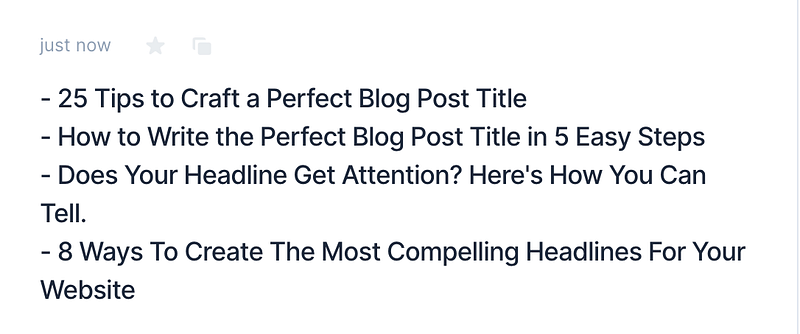
Artificial Intelligence (AI) writing tools are great for creating headlines because they give you the option to use trigger words, power words, and other phrases that will help increase your chances of getting clicks.

Enter a few lines about the article or paste an excerpt from the intro paragraph, and the AI writing assistant will give you 15 titles to choose from.
Use the Word You

The word you is a great way to draw attention because it makes readers feel like the writer is directly addressing them.

For example, instead of writing a post with the title “25 Ways to Get More Clicks,” another title could be 25 Ways to Get More Clicks For You.

Calum James covered several of the strategies I talk about in this article, including using the word ‘You’.

Use “W” Words

The words when, where, why, and how are considered “w” words because they can create a sense of curiosity when used correctly in titles.

For example, instead of writing a post with the title “25 Ways to Get More Clicks,” another title could be 25 Ways to Get More Clicks When You’re Short on Time.

Thank You to Zeus Philosophy for the example using the word WHY.

Write with Colons and Hyphens

Writing titles that include colons and hyphens can make your title more interesting because it makes it easier for readers to visualize what the post is about.

For example, instead of writing a title “25 Ways to Get More Clicks,” another title could be 25 (Brilliant) Ways to Get More Clicks: When You’re Short on Time.

David Gerken did just that in this article.

Add a Negative Spin

Using a negative spin can motivate readers to click on your post because it makes them curious about what you’re saying.

So, for example, instead of writing a title “25 Ways to Get More Clicks,” another title could be Your blog titles are awful, and here’s why.

Frank T Bird added a negative tone to this story.

Use Strong Expressions

Writing titles that use strong expressions can get your readers more interested in what you have to say.

Samra does that here and adds the negative spin as well.

I Tried X and Y Happened Titles

I Tried X and Y Happened Titles are great for getting people to click on your case study-style blog post. For example, instead of writing a story with the title “25 Ways to Get More Clicks,” another title could be I Tried 25 Different Headlines, and Here's What Happened.

Create Urgency

Creating a sense of urgency in your titles can help you get more clicks, especially if you’re writing about an event that’s about to happen.

For example, instead of writing an article with the title “25 Ways to Get More Clicks,” another title could be 25 Ways to Get More Clicks Before Your Competition Outdoes you.

If you catch this title at age 29, it’s the perfect example of urgency by Nicolas Cole.

Use Percentages

Using percentages in your blog posts titles can give readers an idea of how large or small something is, making them more likely to click on it and see what it’s about.

For example, instead of writing an article titled “25 Ways to Get More Clicks,” another title could be Increase Your Click-Through Rate by 5% with These 25 Headline Hacks.

Dew Langrial created double the effect with her spot-on headline.

Make an Offer

Offering something to readers in your article title is a great way to make them more interested in clicking on it. For example, instead of writing a blog post with the title “25 Ways to Get More Clicks,” another title could be 25 Genius Ways to Get More Clicks: A PDF Guide.

In this example, Wendi Lady nails the offer in the headline.

Disclose a Secret

Disclosing a secret on your article is a great way to get readers’ attention because it makes them feel like they’re in on something that other people don’t know about.

For example, instead of writing a blog post titled “25 Ways to Get More Clicks,” another title could be 25 Little Known Strategies to Improve Your Blog Headline.

Titles are an essential part of your marketing strategy because they make readers decide whether or not to click on the article.

If you want more people clicking through to read your posts, try using power words and other strategies listed above — and experimenting until you find the right combination that works for your website or blog.

Letters from E.K. understands the power of a secret.

Create a Challenge

Everyone loves a good challenge. You can include it as a call to action to join a challenge, share the results of a challenge (case study), or share a current challenge.

Pamela J. Nikodem, MSED did just that with her 7 days Mood Lift challenge.

Writing
Marketing
Content Marketing
Blogging
SEO
Recommended from ReadMedium