
You’ve got to be Kidding: Wrinkles as a Reward?
Has this writer gone off the deep end or did she accidentally stumble onto an unlikely antidote to looks-shaming?
The Well-Meaning TV Producer and Me
You were wonderful!” oozed the producer of the Hallmark Channel morning show, ushering me into her private office after we’d taped a 10-minute segment on disappointment. “We definitely want to have you back, but…
“…next time, wear a turtleneck or at least use some neck cream.”
Granted, the producer, a woman who appeared to be almost my age, believed she was being helpful, even kind.
No, let me take that back. Kind would have been to stop the taping when she noticed my chicken neck.
I asked why she hadn’t. Didn’t she see that my red sweater was a turtleneck but — in an effort to look alluring — I’d unzipped it almost down to my cleavage?
“You were doing such a great job,” she explained, sweet as could be, bless her heart. “I didn’t want to interrupt you.”
When later I watched the video with friends, they agreed: I was good on the segment. All I saw was my neck.
This incident happened in 1995, before Nora Ephron wrote about feeling bad about her neck. I was 62, just on the cusp of becoming old enough to understand ageism.
Looks-Shaming
Ageism is all around us. Names we call old people. Assumptions we make about their capabilities and their sex lives. And worst of all, especially if you’re a women,* the looks-shaming.
(* Thank you, Joe Luca, for sharing in a response that it’s worse for your wife.)
Oh, and by the way, it’s not just at the hands of others. We do it to ourselves.
Marie Bailey, a fellow Medium writer, responded to my neck woes with worries of her own:
This reminds me of when I was in my late 30s and started “freaking out” about my neck. I knew it was inevitable that eventually the skin on my neck (and definitely elsewhere) would lose its elasticity. I didn’t worry about wrinkles; I worried about sag ;-) Now I don’t worry about it because sagging skin is just part of my life.
One gift of aging is the ability to glimpse in the rear view mirror to see where we’ve come from. If we’re lucky, and we live long enough, time and distance can confer wisdom and fresh perspective, as it has for Marie.
Still, it takes strength to battle the culture.
We’re In This Together, Ladies!
Ten years ago, I stood naked in front of my bathroom mirror. I stared, looking at — and not liking — my 68-year-old body. What alien force landed in my bedroom when I was asleep and attached this body to my head?
My friend Marge, now 104, had a similar fright a few years ago when she tried on a bathing suit and looked in the mirror. “It was horrifying,” she recalls.
Who among us hasn’t had such a moment?
This size 6 must be mismarked. Oh, God! Look at those hips! I look like my older sister. I look like my mother. Was that red mark there yesterday? Is that a furrow or a wrinkle? Is that what they mean by laugh lines? I’m not laughing.
Then there’s this: the inner twentysomething who hijacks your thoughts, imploring you to do something about your deplorable condition. As I’ve eased into my old ladyhood, I’ve gotten better at telling her to shut up and, “Get real!”
The seeds of ageism are planted in childhood. Marie Bailey grew up hearing the women in her family criticize other women: “Not looking their age was considered scandalous.” At 62, Marie wonders…
Anti-ageist activists says we should leave age out of every equation — work, skills, sexual appetites but, especially, appearance. As Ashton Applewhite writes in This Chair Rocks, her “manifesto” against ageism:
When someone says, “You look great for your age,” I no longer mutter an awkward thanks. I say brightly, “You look great for your age too!”
(Applewhite’s 2017 TED talk is an eye-opening 11-minute crash course on ageism.)
Patricia Ross had her first ageist epiphany in her forties. In charge of photos for the high school year book, she was shocked by how many of her fellow faculty members “hated” theirs. Then she realized she was no different! She didn’t like to look at pictures of herself either.
Luckily, “God” stepped in and chastised her:
“How DARE you! How dare you be critical and ungrateful for this miracle of divine engineering I’ve given you; a body that’s relatively pain free; that has blood that circulates and a heart that beats predictably; and eyes that see; ears that hear; and a voice that can hum to a baby and scream against injustice and offer thanks for this incredible gift. How dare you!”
So What’s the Alternative?
The sting of looks-shaming starts early. My daughter’s friends, some younger than she is, have already had Botox, peels and other procedures.
“I told them my mother would kill me,” Jen said one day, only half-joking, “if I had anything done.”
True, I’d rather take my chances with Mother Nature than a plastic surgeon. I’m also vocal (annoyingly so at times) about how many celebrities look worse (in my eyes) because of what they’ve “done to themselves.”
But what Jen decides is hers to live with. I know she’ll weigh the risks against her reasons. I hasten to point out, though, that only in ageist cultures (ours is one of many) do women believe that wrinkles are ugly and that faces must be lifted.
Full disclosure: I’m not immune. I have Olay Regenerist in every bathroom. My grey hair is currently blondish brown, courtesy of Goldwell, one part 8NN, one part 9NN. Last fall, my dermatologist lasered a few sun spots. And to be perfectly honest, I still like it when people tell me I look good for my age!
But at least I know better. At least I’m trying. I’m “telling” on ageism in my writing. And talking people’s ears off whenever I get the chance.
The truth is, our looks change from the time we’re born until we die. Instead of railing against aging — and (fruitlessly) spending money and time trying to stop it — let’s celebrate that we’re still alive. Let’s remember how lucky we are to be aging now and to be aging at all. Consider the alternative.
Today, at 83, Patricia Ross worries more about what her body can do than how it looks.
In front of my bathroom mirror ten years ago, I had a choice: Chose the road of negativity, which would become windier and more dangerous every year or take the road of self-acceptance. My body was aging, with or without my permission.
My choice was to look at the woman in the mirror whose body I didn’t recognize and say, “Wow! You look damned good for 68!”
Likewise, my friend Marge knew better than to stand at her mirror pining for a younger bathing-beauty self. Instead, she threw her bathing suit in the trash.
As a rule, Marge tends toward the practical and the pressing. She often reminds me that it’s more important to pay attention to my feet than my face. “You’ll need them more!”
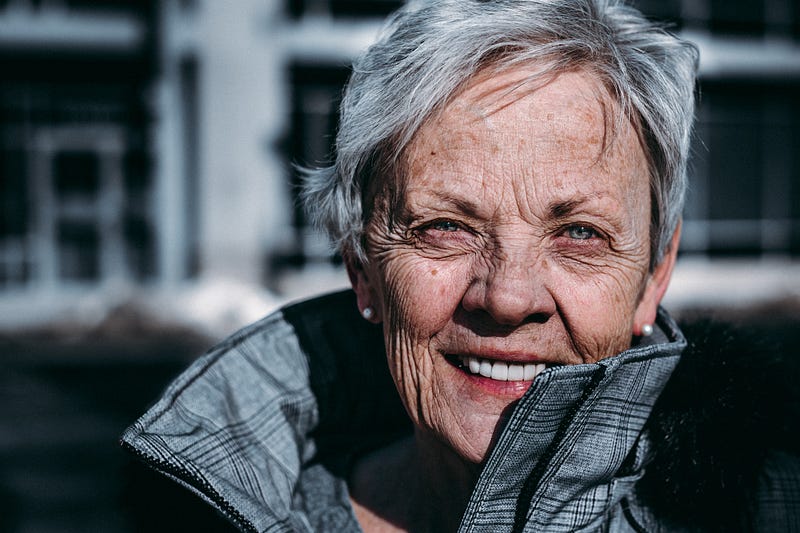
The bottom line: We can’t choose our fate, but we can re-set our attitude. You don’t have to view wrinkles and sagging skin as good or bad. Instead, see them as part of a natural — and welcome — prospect: aging.
We can also chose to look at what experts now conclude after decades of research: that what we believe about aging — even more than what befalls us — ultimately determines how well and how long we live.
So rather than fretting about your face, focus on your feet; Allow them to keep you moving, learning, meeting people.
And instead of worrying over the spots and blemishes that weren’t there yesterday, take a page from my new acquaintance Donna’s playbook. See each new wrinkle as a reward, a sign that you’re still here.
Donna’s mother and older sister both died young. Donna of course misses them. But she also enjoys the unexpected gift they bequeathed her.
When I look at my face in the mirror, I am aware that my mother and sister didn’t live long enough to see wrinkles on their faces. I feel fortunate to have them.
Thank you for reading me…
Subscribe to my Medium articles — you’ll get an email when I publish. Join Medium with my referral link
Follow me on social media via LinkTree.


