
Have You Unintentionally Internalized Ageism?
Every read is a Rorschach test. This one just might tell you something about yourself — and your future

A few days ago a handful of people read this:
Not that I planned or expected this, but “When I’m an Old Lady” — not only garnered more attention than many pieces I’ve written — it is like a Rorschach test: What you read into the piece reveals something about you and about the culture that affects your beliefs and attitudes.
If you haven’t read it, please do. Then, wait a beat to experience what the idea of becoming “an old lady” (or man) brings up for you.
Below, I explore what that 3-minute story evoked in others — and how important it is to become aware of, and rethink, your own ageist inclinations. (Yes, you, too; we’re also susceptible.)
The Range of Responses
This, in an email from a close friend whose 78th birthday is six weeks before mine:
Uh oh, from reading this post, sounds like you might need a big hug. Tough turning 78? Honestly you and I are a far cry from being old ladies!! When can we talk again?
How odd, I think. I celebrated my 78th; it wasn’t “tough” at all. In fact, some of the possibilities I ponder in the piece — like finding my wallet next to the wasabi — have already happened. I laugh about them.
“I got the weirdest email,” I later say to my partner. When I read it aloud to her, she says…
I feel the same way.
Really?
The next evening at dinner with our French friend — a loyal and frequent reader — I ask for her reaction.
Une Parisienne elegante, she’s pushing 72, is fit, active, and intellectually curious. There’s nothing “old” about her. I expect her read to be different from my American intimates.
It isn’t.
I didn’t like reading it; it was depressing.
Not everyone “sees” the piece as a lament or cause for concern.
Several Medium contributors read hope, even “coolness,” into “When I’m An Old Lady” — and are quick to identify.
Camilla Krone: Melinda, I hope that, like you, I won’t be an “old lady” at 78.
Audrey Bittman: I found myself being able to relate to so many of these thoughts.
Bruce Murray: A password for Speedo! I’m a swimmer, about six months older than you and I don’t have one of those! You must be really cool! Keep looking forward to getting old. You’re not there yet!
What’s going on? Why do some readers embrace my rumination on what might happen when I age while others are sorry they read it?
Ageism — at Us and in Us
At first, I thought it was this: The Medium contributors know me only through my writing. In contrast, my friends and partner are concerned for me. Their comments are a measure of our close relationships and their caring.
But that’s not all: The worry and negativity they read into the piece also reflect distress over the possibilities of aging — mine and theirs.
Ageism — avoiding, pitying, dismissing, and/or thinking the worst about older people — is in the air we breath.
We sometimes don’t even notice the everyday insults and slights. Why is forgetfulness dubbed a senior moment? Why assume every 80-year-old should turn over the car keys? Why is it okay to talk to a 99-year-old as if she’s a child?
Like other isms and phobias, ageism creeps into our psyches. The message is pervasive: it’s bad to be old. So why talk about it? And, certainly, let’s not see ourselves as “old.”
And yet, we absorb the messages anyway.
We all unconsciously harbor what social psychologists Mahzarin Banaji and Tony Greenwald in 1995 dubbed implicit bias: associations, beliefs, or attitudes towards various social groups.
While people might like to believe that they are not susceptible to these biases and stereotypes, the reality is that everyone engages in them whether they like it or not. This reality, however, does not mean that you are necessarily prejudiced or inclined to discriminate against other people. It simply means that your brain is working in a way that makes associations and generalizations. — “How Does Implicit Bias Influence Behavior?”
It’s bad enough that in a youth-obsessed culture — as the Implicit Bias Project has found — we value young over old. We also choose white over dark faces, male over female, and straight over gay. Even worse, we sometimes turn these biases inward.
Belonging to a non-preferred group — in this case, “the elderly” — offers no immunity against the stress and dangers of internalizing the negative stereotypes. The insults and slurs unconsciously inform our self-talk and color our choices.
The default posture in an ageist society is to defend against getting “old” — deny it, refuse to talk about it, make cosmetic changes for fear of being found out as one of the marginalized.
No wonder… even we who are pushing 80 are convinced that we’re “still young.” We struggle not to internalize ageist messages, not to “self-stereotype.”
No wonder… a fellow writer on Facebook doubts if she’ll “ever” think of herself as “old.”
I read this twice and although I am that old, I can’t relate. I run three businesses, have my own podcast (eight years strong), post two YouTube teaching videos per week, and much more. I doubt if I will ever regard myself as old.
No wonder… when I say I’m writing a book about what I’ve learned from women in their 90s and beyond, I’m urged to “call them something else.”
No one wants to read a book about old ladies!
Don’t get me wrong; I’m not immune to internalized ageism myself. I dye my grey hair. I wear makeup when I go out. I don’t want to be seen as old.
Afterthought, added 1/6/22:
If my own ageism hadn’t gotten in the way, I would have said that I wear make up because “I still want to be noticed.” I realized this after reading my dear friend’s comment that she wears make up to look pretty, not to look young!)
Why else has it taken me 10 years to be an “out” and proud old person? to pitch a book titled My Old Ladies? to put my age in print?
(The joke’s on me, of course: my birth year appears on the copyright page of each of the 15 books I’ve authored or co-authored!)
The enemy is not age or getting old. It’s ageism.
Age is not “just a number.” Aging is a process that continually ushers in new realities.
Becoming “old” is not necessarily something to dread or deny. It’s just a different stage, a next “passage,” as Gail Sheehy famously dubbed the various segments of adulthood in her 1976 book.
Yes, it’s the last passage. But what if, for some of us, it’s also the best?
Patricia Ross says that being old “feels great.” At 83, she describes herself as “old but not done.” Her response to my piece suggests that she regards her life now (and perhaps always has) through a prism of confidence and contentment, adventure and appreciation — qualities seen in my old ladies:
Poignant and thought provoking, Melinda. At 83 I’m still working, living alone. taking care of my dog and have a handsome “occasional “ beau who somehow unbelievably makes me feel like I have the body of a teenager (I don’t). Life is good even with a new right hip, carotid artery surgery and a cardiovascular stent. I’m careful not to do the things I used to be able to do (like climbing on counters to reach something) and I am a little deaf around the edges, but being “old” feels great and I am enjoying all that life has to offer, the most valuable being connected relationships and family. Thank you for your insights — fear not!
Patricia’s comment tells us that aging itself — especially if you’re relatively healthy, energetic, productive and don’t miss the thrill of climbing counters — can be good news, the better alternative.
Marge, my old lady who’s currently pushing 104, says of those who want to “stay young”…
Don’t they realize that the only way to stay young is to die before you’re old?
Granted, many of us who have already hit 70, or 60, or even 50 experience a discomfiting dissonance: A younger self resides inside us forever, no matter how our outsides change — and no matter how old we are.
Marge: “I feel like 110 when I walk down the street, but I still see through 25-year-old eyes.”
What Would Marge Say About “When I’m an Old Lady…”?
Marge is the old lady currently in my life, still around if I have specific questions. I call her from Paris to ask if I can read the piece to her.
“I have gotten different reactions from people,” I explain, “and I’m curious to know what you think.”
“Of course,” she says immediately. We’ve done this before. She doesn’t have a computer and isn’t interested in reading on the iPad her great-granchildren gave her.
She chuckles in appropriate places as I read, and when I take a breath between paragraphs, interjects “Ooh! that’s good.” At the end, she says…
It’s beautiful — and very true.
I tell her that some people think the article is “depressing.”
“Well too bad for them,” she says in her characteristic no-nonsense tone. “It’s real life. Those things happen.”
The Luck of Aging Now
Shortly before her 100th birthday, I ask Zelda her “secret.”
She is quick to answer: “Luck.”
Zelda’s luck held out until almost 105!
I have been lucky (so far!). Lucky to be born into a life of resources. Lucky to be in good health. Lucky to be someone who keeps learning, moving, and meeting new people.
I’m lucky to be aging now, in solidarity with other paradigm-changing Boomers, each engaged in life, doing her thing.
I’m lucky to be living at a time when a burgeoning longevity industry is working on ways to improve physical and mental health.
I’m lucky to be alive in the age of “lifelong learning” and “retirement jobs” — a time when the traditional life cycle of learn/work/enjoy leisure is being questioned and revised.
Most of all, I’m lucky to have my old ladies — some past, some still here, all living in my head (which is why I use the present tense regardless). They guide me and, sometimes, goad me.
When I’d rather not exercise (often), I picture Zelda at the dinner parties I held in her honor, on the floor showing my friends and me the sit-ups and stretches she does every day. She plays tennis until she is 99 and walks three miles a day well into her 100s.
I also hear Marge’s voice in my head: “Walk while you can.” So I do.
Of course, none of us can know what our old(er) age will look like. As the World Health Organization notes:
Some 80-year-olds have physical and mental capacities similar to many 30-year-olds. Other people experience significant declines in capacities at much younger ages.
I threaten my “kids” — now 49 and 52 — that I’m going to try to make it to 100, to witness their old age.
Hearing this, friends and acquaintances who have internalized the negative messages of an ageist culture, insist, “I don’t want to live that long!”
Why not? If I you are healthy? If I you can still use your brain? If you can still be productive?
My old ladies live with limitations and navigate a treacherous territory all of us, if we’re lucky, will someday traverse. At 78, I’m already there. Why wouldn’t I want to keep going?
Old Lady Strategies
When I ask Marge the secret of her longevity, she quips, “I keep breathing.”
We have this conversation often. Invariably, I come back with, “And I hope you keep it up.”
Aging is about loss, says Zelda — loss of people you love, loss of some faculties and certain abilities, of agility and mobility, and, sometimes, loss of visibility. Not an uplifting outlook, but Zelda keeps adjusting, taking steps to let everyone know she’s still here:
The key is acceptance. You move on. You keep loving and laughing. You feel grateful that you’re alive.
Zelda stresses as well that we must do whatever it takes — and whatever is possible — to correct, alleviate, or get around each loss. When her son-in-law had a stroke and tells her, “At least, Mom, I can still talk,” she is hopeful.
That’s when I knew he’d be okay. He found the silver lining — the one good thing out of the bad. That’s all you need — one positive step in a new direction.
Finding a silver lining and taking a next positive step doesn’t help you avoid death. But in that space between getting old and dying, it keeps you going.
Each of my old ladies is different. But one thing they have in common is an unrelenting focus on living.
Sylvia is a social butterfly. Judy retires at 90. Marge has a personal trainer. And Lois bops around Paris, walking less at 90 than when she was younger, but walking nonetheless.
Like Holly, a fellow condo-resident in Florida, my old ladies don’t give up.
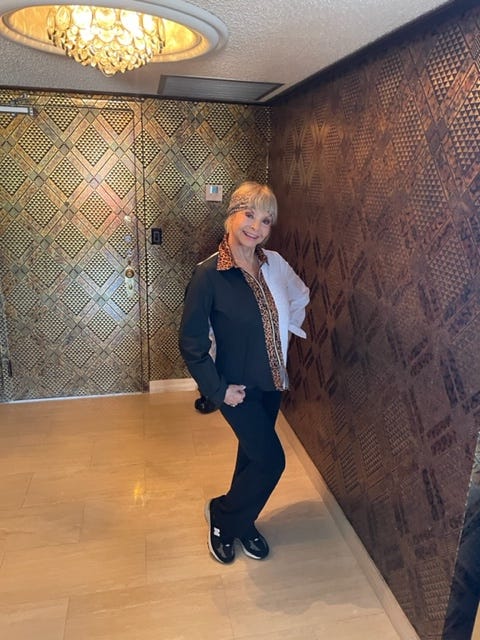
On December 20th 2021, I shall officially become an ”Old Lady.” Older than thee. It’s not so bad. I’m still shaking my tush in Zumba, partying, eating, reading, gathering with friends, playing games on my iPhone and doing lots of other things.
Sure some of the other things are going to doctors (especially after shaking my tush in Zumba), looking for the misplaced item, forgetting to do an errand unless I’ve made an errands list.
ln all, I’m happy to face my eighth decade even if the face I’m facing it with isn’t as smooth as before.
When I saw Shirley McClain — as Carrie Fisher’s mother in the movie Postcards from the Edge — I was 47; Shirley was 65. But only now, watching the video of Shirley belting out “I’m Still Here,” do I really appreciate Sondheim’s spot-on lyrics!
I’m still here.
If you like what you’ve read, by all means:
- Subscribe to my Medium articles — you’ll get an email when I publish.
- Become a member of Medium using this link, and I will earn half of your membership fee: $5/month, or $50/year — a small price to pay to support a favorite writer and get unlimited access to a world of great thinking and writing.
- Contact me if you have a friend in her 90s and 100s who’s aging well and is willing (and able) to talk about it.


