
FITNESS
8 Strategies for Exercising When You Don’t Want To
From someone who likes to work out only when she’s paid to do it.
When I consider what can go wrong, I’ll take the malady I just developed: a strange, manageable, pain in my knee that came out of nowhere.
A new doctor, who specializes in sports medicine, prescribes physical therapy. If there’s no change, he’ll order an MRI and, possibly, suggest a cortisone shot. Not a road I want to take, so I grudgingly comply with the PT order.
How can I not? The facility is downstairs, in my apartment building.
Besides, having a doctor prescribe exercise is like getting a free gym membership. I secretly hope that this time, I’ll like it.
I’m just not a fan of working out
I’m a good swimmer, but my most consistent “sport” is walking. The Avon Walk, eight years ago, got me started. It was the first time I ever “trained” — in this case, for a 2-day, 39-mile walk. I clocked thirty miles at the event—19, the first day; 11, the next.
That preceding paragraph makes me sound athletic. I look fit, too. That’s probably because, except when I’m writing, I’m in motion, doing something. No doubt, it’s also genes. But it’s not because I “work out.”
I often say — joking, but telling the truth — that I prefer exercise done while talking. Yes, I know one should be in “the zone” during a workout. Feel the burn; be in the experience. But I’m sorry. Conversation soothes the boredom.
You can see why I prefer walking.
I’ve joined gyms over the years; never liked any. Not the machines, the trainers, nor the other patrons. I join; I quit, I feel guilty.
Knowing I should strengthen my core, my upper body, my bones, I make attempts to do it on my own. Treat it like an appointment, my inner coach suggests. Stretch after you walk. Just do a few girlie push-ups. Anything is better than nothing. I’ve taken enough classes to know what to do. I’ve written about fitness regimens.
Despite all this failure, I read the sports doctor’s report on my aching knee and dare to speculate: Maybe this time will be different. Maybe the quail-egg-sized sac below my knee is not just a sign of pes anserine bursitis. It’s a warning.
Turns out, this time is NOT different.
I won’t keep you in suspense. After a month of physical therapy twice a week, no magical transformation occurs.
Chris, the first therapist, is more like a personal trainer. Years earlier, I did a few sessions with him to ease lower back pain. Then I disappeared. I remind him that I’m a reluctant client.
Chris pokes around and massages my sore knee a bit. For most of the session, though, he puts me through a series of basic, mind-numbing strengthening exercises — leg lifts, bridge, sit ups — to build muscle. He sends me home with illustrations, pointing out that some I can “just do in bed.”
It takes me two days to start. The full routine is easy, doesn’t take much time, but I feel sore on Day 3. By Day 5, I am barely doing any of the exercises.
Chris goes on vacation and passes me to Dave, who — to my delight — spends more time on healing modalities (massage, ultrasound, ice) than on muscle-building. Naturally, I stick with Dave, even after Chris returns. Dave doesn’t lecture me when I fess up about not exercising at home.
I continue to not exercise, with the exception of toe and leg lifts. I can do those while cooking. I also don’t ache afterward, probably because they’re muscles used for walking. Eventually, I forget to do them, too.
My wiser self wags a finger at me: You HAVE to make time to at least stretch. But I don’t.
After weeks of berating myself, I reluctantly unroll my red yoga mat and set it down in sunlight on my living room floor. My intention is to at least do a few bridges and stretches, but within moments my inner brat rebels. I hate this. It’s not fun, not relaxing.
Yes, I know, I know, my wiser self interrupts, trying to be reason with the brat. But you need to do it. So you’d better come up with a Plan B.
Exercising on Assignment
This battle is nothing new. It started in my mid-20s.
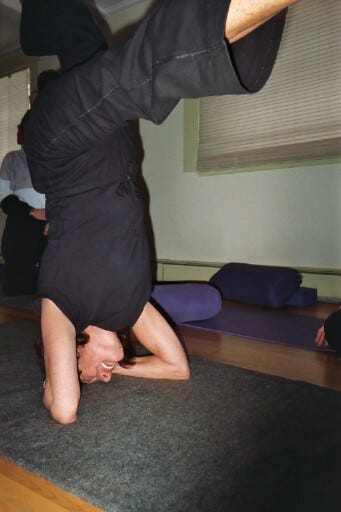
A new mother, I join Alex and Walter’s gym to regain my shape. I am shocked at what I can do after a few weeks: rings, trapeze, uneven bars, floor exercises. I even learn to do a headstand!
I stay with it because of the novelty and because I go with a close friend. We have fun before and after. Sometimes, I bring Jen, who rolls around on the floor while we exercise.
I also keep coming back because the journalist in me loves the scene:
In 1969, The Times declared that exercise studios, particularly those run by a certain Russian émigré, had become as modish as restaurants. Women who were attuned to aspirational signifiers like the right hairdresser or, as the article said, “that little jewel of a manicurist” — these included a copywriter from Cosmopolitan, a filmmaker’s assistant and the wife of a television personality — were drawn to places like Alex & Walter on West 57th Street, where they might hang from rings like circus performers or real gymnasts. — The Eternal Treadmill of Fitness Trends: From Hot Pants to Hot Mess
Alex & Walter’s eventually wears thin, as other regimens will over the next many decades. I like everything for a little while. But once I learn the routine, an internal voice breaks in halfway through the session: When is this class going to end?
The rare exception occurs when I am paid to attend. In 1979, Self magazine sends my then husband and me to Rancho La Puerta, a tony spa on the Baja peninsula. The editors want me to show readers how to plan a “Health Weekend to Change Your Life and His.”
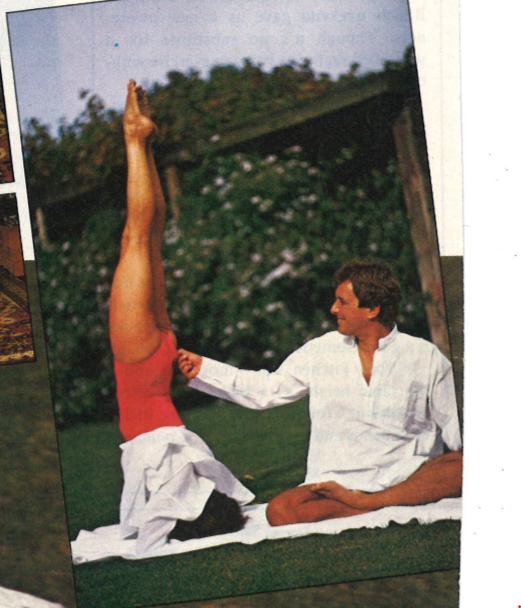
I dive in: do the 6 a.m. hike, take a medley of fitness classes, stretching, and yoga. We play basketball, do partner exercises, have wraps and baths. A photographer follows us almost everywhere.
In the early 80s, when American Health is born, I am sent to Los Angeles by the editor-in-chief — and my mentor — the late T. George Harris. He instructs me to “find out what the celebrities are doing to stay healthy.” The rich, he maintains, are always on the cutting edge of new ideas and practices, because they have access and can afford them.
I interview and sample the philosophies and practices of psychics, healers, nutritionists, aura photographers, personal trainers, and assorted gurus to the stars — among them, yogi master Alan Finger. He will later establish yoga studios all over the country, but when I meet him, he is giving private lessons to James Taylor, Barbra Streisand, Joni Mitchell, and — thanks to T. George — me!
Yoga and Me
I revisit yoga in the early 90s when I move to Northampton, Massachusetts. My friend Margaret introduces me. She is disciplined about exercise — loves it, in fact.

My yoga superpower is flexibility. Put me in a pose that requires reaching, folding, or twisting, and I’m in heaven. The teacher dubs me “Gumby” and adds a 4"-high rubbery replica to the altar that faces us as we move through the various poses. I feel like I belong.
In 2003, I turn sixty and invite my closest friends from New York to celebrate in a country inn in Massachusetts. Our agenda includes a private yoga class with my teacher who, to my delight, has me demonstrate that I can still stand on my head.
In retrospect, I stay with yoga longer than any exercise philosophy or regimen because of that teacher. Aptly named Susan Valentine, she personifies sweetness and love. She is a born teacher (and also a phenomenal artist).
When I leave Northampton, I abandon yoga, too. But it is the practice, thanks to Susan, that I know best and that (I think) my body still remembers.
And so, as I unroll my red yoga mat…instead of beating myself up for not doing the exercises I’ve been “prescribed,” I say to myself, well at least do a little yoga. It will come back to you…
My Plan B: Accountability
If I haven’t been able to shame myself or scare myself into exercising lo these many years, what makes me think I can do it now?
Time might not be “running out,” but it isn’t on my side. I refuse to accept that I cannot change. I’d rather believe I just haven’t figured out how…yet.
Oh, wait, I’ve spent decades writing advice. Here’s what I’d tell you:
- Tattle on yourself. That’s why I wrote this. Research on willpower, self-control, and motivation suggests that we’re more likely to follow through when we build in accountability. Start by owning up. I admitted to two physical therapists that I don’t exercise. Now, you know, too. Perhaps if you bear witness, see my plight, maybe even identify with my struggle, that will inspire both of us!
- Actively seek an exercise buddy. Alcoholics Anonymous works because you say outloud what you did that caused your life to become unmanageable. You check in with others. You take stock of and report what you’re doing today to live better. An exercise buddy — not unlike an AA “sponsor” —is someone who helps hold you accountable. Interested parties: Feel free to apply!
- Do five minutes of anything. My daughter, who has a masters in health promotion (and recently became a nurse), is forever reminding me to (a) do something I like and (b) start by doing it for a short time. Yoga is my go-to. I know that even a few stretching and strengthening poses a day will do wonders. Just do it, Melinda. Take a break right now, while you’re putting the finishing touches on this piece…
- Say “yes” to friends who exercise regularly. Good habits are infectious. And at least for exercise-phobic me, it’s the humans who get me there and keep me coming back. My long-departed friend Bonnie dragged me to Alex and Walter’s, Margaret to yoga. My teacher Susan and our fellow “yoginis” kept me there. And now perhaps Françoise, my Paris partner in crime (who calls us the “twin dwarfs,” TD for short) will get me “back” to Pilates, which I picked up in 2010 and dropped a year later. TD and I recently celebrated my return to her city over a chocolat chaud, and I promised I’ll accompany her next week. Committing to a friend tends to make me follow through. I’m a little skittish about taking the metro to Neuilly, but I’ll mask up. I will get myself there at least once. Remember: start small.
- “Bookend” your efforts. When you face a difficult or distasteful task, it helps to “bookend” it — that is, reward yourself by doing something more desirable before and after. A few years ago, in one of my many attempts to swim regularly, I joined a gym in New York, for its sky-lit pool — and, if I’m being honest — for the adjacent sundeck. I didn’t consciously bookend my swim, but on the way to the gym, I’d buy a favorite sandwich or salad, maybe a sweet treat. As I swam laps (talk about boring), I kept going because of the after: sauna, shower, sun and snacks. I swam almost every day and continued to enjoy it until I left the country.
- Commit and count, but don’t compare. My friend Jill set a goal of doing 90 days of cycling and posts her progress on social media. In twelve-step programs, newcomers are similarly advised to attended 90 meetings in 90 days. Accountability meets habit formation —or “automaticity,” in psych jargon. James Clear, author of Atomic Habits, claims that the average time to get into a new groove is 66 days. But “average” is not everyone. The 2009 study Clear references notes that some participants took as little as 18 days and others as many as 254, “indicating considerable variation in how long it takes people to reach their limit of automaticity and highlighting that [habit-formation]it can take a very long time.”
- Say “no” to yourself when an action (or lack of) is not in your best interest. I “feel the breath of old age on my neck,” as Landon Jones aptly described Baby Boomers moving beyond midlife. I take good care of myself; I love life. And yet, I (metaphorically) shuffle my feet when it comes to exercise. Most days, I’m not feeling it. But I fight it: I walk anyway. I walk faster when I find myself slowing down. And when I realize my shoulders are drooping, I straighten up. I ignore the odd stab in my knee, the kink in my back, the catch in my hip. If my old ladies have taught me anything, it’s keep moving.
- Keep what you have. When I joined a NYC gym for its pool, I was given a free session with a trainer. All I had to do was send them an email outlining my “goals.” I didn’t have a clue, so I asked my then 101-year-old friend Marge for advice. She didn’t miss a beat. “Just tell them your goal is to keep what you have!” Truth was, I didn’t need to get stronger, just to be strong enough. I was in my mid-70s then and, as Popeye said, I yam what I yam.” I reckon that’s good advice at any age.
If you like what you’ve read, by all means:
- Subscribe to my Medium articles — you’ll get an email when I publish.
- Subscribe to my blog. (I won’t charge you or share your info.)
- Follow me on social media via LinkTree
- Subscribe to Medium using this link, and I will earn half of your membership fee: $5/month, or $50/year — a small price to pay to support a favorite writer and unlimited access to a world of great thinking and writing.