
World Politics
You Don’t Have to Live Like a Refugee
And yet millions do.
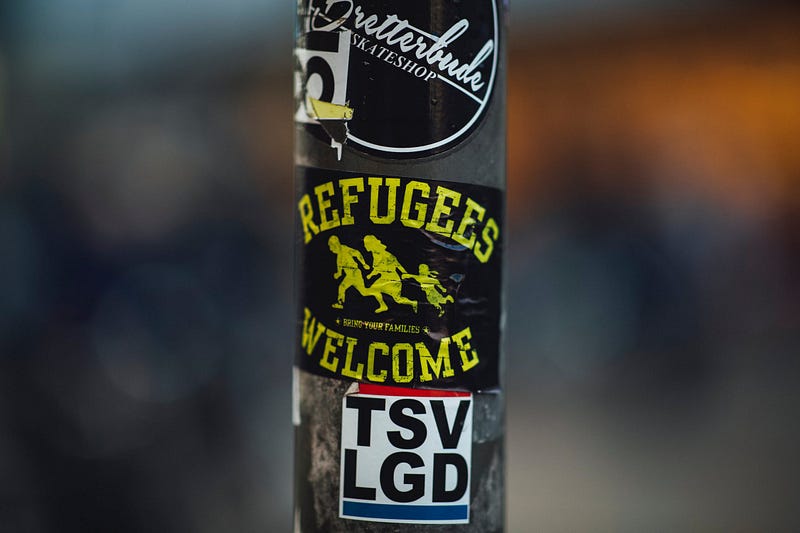
I think Mike Campbell was referring to the emotional kind of refugee when he wrote that song for Tom Petty and the Heartbreakers in 1980. It’s about somebody who had been abandoned or violated or generally done dirt to. “Somewhere, somehow, somebody must have kicked you around some.”
But it doesn’t have to be this way and Campbell seems to be saying that “revelling in your abandon” is a choice and it’s time to pick yourself up and dust yourself off and stop living like a refugee. Stop being a victim.
Nobody reading this will need telling that for millions of people around the world — and in the last 3 weeks, 3 million or so more so far — it’s not a choice at all.
Let’s face it. There are refugees and then there are refugees. It’s clear that there is a hierarchy of suffering that we base our attitude and actions on, as to which unfortunate people get our support, sympathy and attention and which don’t.
It’s fascinating how quick we are to assign victimhood to some people, while others around the world escape our notice almost entirely.
Ukrainians are currently battling heroically to save their independent country from the evil, ruthless dictator next door. The scenes we see are unimaginable for us, as I am sure they would have been for them not all that long ago. Even if they manage to survive and defeat Russia — with or without Western help — their society and its infrastructure will be destroyed, if they ever manage to get home. They will be refugees long after this war is mercifully over.
But from the look of things, neighbouring countries — Poland, Slovakia, Hungary, Romania and even Moldova — have taken in somewhere around 2 million Ukrainians so far and more are surely to come. The way these countries have opened their borders and provided safety and shelter for their Slavic brethren and sistren is impressive and inspiring.
However, this is quite different from the welcome that refugees from Africa and the Middle East have received in Europe, especially when trying to cross borders and certainly when they are trying to get settled in their new homes. The boats coming across the Mediterranean for Italy, many of which, overloaded, have sunk and led to the drowning deaths of thousands, barely rate a raised eyebrow anymore.
Africans who are still in Africa don’t get much notice either. For example, a civil war in the northern province of Tigray in Ethiopia has been going on for a year. Thousands have been killed and there are an estimated 16 million displaced people. Neighbouring countries such as Eritrea and Sudan are not viable options for the refugees in this conflict. It is an unmitigated horror. But you’d be hard pressed to find much information about it on the front page of newspapers or the home page of mainstream internet sources.
One wonders where the weapons to pursue this conflict are coming from.
In the Middle East, Palestinians have been living as refugees in camps in Jordan and Egypt for 75 years. That’s three generations. This is not to say that they are in the right and their oppressors are in the wrong — that’s another article entirely. It is to say that this is reality for millions of Palestinians and nobody is concerning themselves with their plight anymore, if they ever did.
Saudi Arabia has been pursuing a vicious American-backed campaign against the Houthis in Yemen for a few years now and are now using food insecurity as a weapon. Twenty million people are facing starvation. When and if this war ends, that society will not receive our support and attention. That society will never be able to recover.
Syria is destroyed and millions have fled. Warring factions have been at each other’s throats for a decade now and that society, too, is destroyed. In some western countries, refugees got a warm welcome, in others, less so. They did make easy targets for right wing fascists to identify what is wrong with their own societies and gain electoral support from the xenophobic in their midst.
Again, one wonders where the weapons to fight these conflicts come from. I can probably stop asking this question, we know the answers by now.
People from Central America and the Caribbean at the US-Mexico border are another set of people whose very existence has played a role what has irreparably divided the United States. Their migration has been mined by the far right expertly. None of them wanted to leave their home in Guatemala or Honduras. They would have much rather been able to stay with their families and friends, working in meaningful and well paying jobs and providing a happy future for their children. They didn’t choose to leave, they left because they had no choice. They migrated for economic reasons or to escape corrupt governments or the untenable violence of gangs who fight over control of a drug trade that we are an insatiable market for.
And what do we do? Welcome them with open arms? Help them realise a better life? Nope. A wall. And if they manage to get past that, menial low paying jobs that we refuse to do, is the best that many can hope for.
The climate refugees are coming too, if they have not already arrived. Bangladesh is underwater for part of each year due to monsoons. Where are 140 million people going to go? India? It doesn’t want them, it has a billion of its own people to deal with. Myanmar? Bangladeshis don’t want to go there — it’s horribly repressive against Muslims.
The Marshall Islands and Kiribati, two developing Pacific Island nations, with high points at 2 metres will surely be underwater in our lifetimes. Where will these people go? What kind of welcome will they receive?
Yes, those places are far away. But the funny thing about sea level is that it’s at exactly the same height everywhere in the world.
Ukrainians are not the first refugees to have misery inflicted upon them. In fact, it’s not even the first time that they’ve been refugees or victims of murderous oppression. Nobody seriously thinks that they will be the last.
What will this look like in coming years? What boxes will someone need to be able to tick on a list of arbitrary criteria to receive the world’s outpouring of support, nevermind some degree of physical security? Where one finds oneself on the hierarchy of human suffering will go a long way to determining one’s own survival.
We come back, in the end to Tom Petty and the Heartbreakers. “Everybody’s had to fight to be free”, he belts out in his trademark North Florida twang. It’s the truth alright, Tom….just some far more than others.
I really appreciate that you’ve enjoyed reading my writing enough to make it to the end. Here are a few more recent articles on the topic, if you have the time / inclination:
One about our quickly shifted attention:
One about why Putin knows he can’t lose this war:
One that wonders aloud where the Scorpions are in all of this:
One that asks why we don’t pay attention to other wars the same way:
One on the nature of selling war:
And finally, one that asks about why we always have an enemy?:
If you like what you are reading here and want unlimited access to thousands of writers, please consider a subscription to Medium. It will set you back $5 a month and if you use this link, then I get a slice of that. I’ll use it to buy Tom Petty’s Greatest Hits.


