
World Events / War
There Is a War On
But actually, there are a lot of wars on. What makes this one so special?
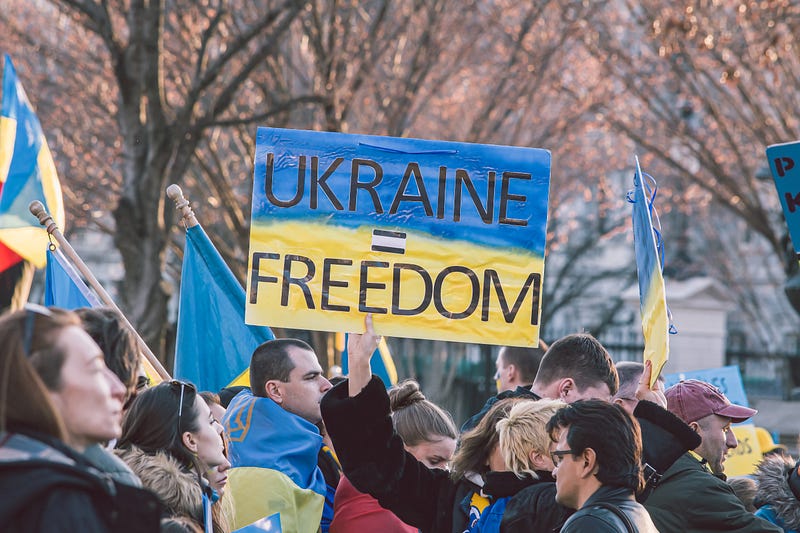
In the week and a half since Russia invaded Ukraine, the world has watched in rapt attention to the varying versions of the conflict that have been presented. Horror, destruction, relocation, death right there on screen.
Or, at least on our screens.
In the West, in particular, the narrative is the classic David and Goliath story of good versus evil. Big bad Russia has invaded weak and defenceless Ukraine and the future of the planet hangs in the balance. You really can’t help but root for the yellow and blue on this one.
However, there is no shortage of other places where armed conflict is a daily feature of life, yet most people in the West would be hard pressed to identify them, let alone understand the background or the different factions and who leads them, never mind find the places on a map.
Syria, Yemen, Ethiopia, Myanmar, the DRC, Palestine, Mali, Cameroon, South Sudan — the list could go on and on. Those are just the ones that spring quickest to mind. These are the perpetually cursed of the world. If we are aware of them, it is mostly on a surface level and they register but briefly. They are complex and we are not all that interested in complex these days.
This Russia-Ukraine conflict has grabbed the world’s attention while the others make barely a blip in our consciousnesses, even though they are still raging and will probably continue to, after this one is over.
The reasons behind our fascination are several:
It’s not that far away. Most of us have not been to Damascus. Most of us have also not been to Kyiv. But Kyiv is close to places we have been to. Vienna is a 15 hour drive, Berlin just over 16. Two hour flights, both of them. You could be in Paris the next day, if you drove without stopping. These places are known to us in ways that Aleppo, Addis Ababa, Bamako and Boma are not.
The people look like many of us. They are White and Christian. They are a part of what we consider the civilised and modern world and when things go wrong for them, then let’s face it, we have a soft spot that we might not have for people who do not possess those two characteristics.
We can imagine ourselves as refugees in a similar or widening conflict, in ways that we can’t in other conflicts. It would be hard to envision living in a camp on the DRC-Rwanda border. It would be hard to imagine living in a bombed out desert town in Yemen.
But crossing the border from Ukraine to Poland, that’s a bit more realistic. Hell, my own grandparents did that trek in 1941. Furthermore, if this war spreads further into central and western Europe, then it won’t just be peoples’ imaginations involved here.
It has upset the global financial order in ways that other conflicts don’t. No multinational corporation has made a media display of their pullout from, and cessation of business with Myanmar, South Sudan, Cameroon or Azerbaijan. At least not one that anyone paid attention to.
But they sure have in Russia. The government of Syria didn’t have its access to the global SWIFT banking system blocked by western governments, but the Russian government sure has. Russian money is everywhere. The public seizures of the yachts of the oligarchs around the world is barely the tip of the iceberg.
Resource availability and stock market volatility. If the Saudis, with their American supplied weaponry want to bomb the hell out of the Houthis in Yemen, the world’s financial system will not skip a beat. We get nothing from Yemen in terms of resources or manufactured goods, so we don’t let ourselves be bothered too much about that place.
But Russia at war means that the supply of oil and gas resources for Europe is unstable and even more importantly, oil and gas resources for China are too. As our friend Umair quite correctly points out, it is with Russian raw resources that the Chinese manufacture all the cheap plastics and electronics that they sell to us. It’ll be important to keep that in mind on your next trip to Walmart, never mind the next time you check your investment portfolio.
It upsets both the post WW2 order and the post Cold War order. The recovery and subsequent stability of Europe after the Second World War was determined by the relationship between the US and its allies, versus the Soviets and their allies. This lasted from 1945 to 1991. Sure, there were US and Soviet backed conflicts on the other side of the world, but Europe was at peace, possibly its longest ever period as such. The fall of the Soviet Union in 1991 and the end of the Cold War seemed to give hope that this would now be the perpetual circumstance. The Russians were no longer taken seriously as a threat by the West and it has taken them until now to correct this, from their perspective.
We thought we left this stuff behind in the last century. Naked land grabs, genocides, destruction of European cities in the name of the superiority of ideology seemed to be a thing of the past. The borders were set and diplomacy would be the way out of difficulties between countries.
Not any more. That “war is just the continuation of diplomacy by other means” shows that for all the talking about cooperating instead of competing as rational, logical humans, how quick we are to devolve to our basest human reactions when dealing with problems. Violence wins out again.
The notion and actual reality of progress has underpinned thought in western society since at least the Enlightenment, if not earlier. Europe has long thought of itself as the location and apex of human achievement. This calls these beliefs, myths and assumptions into question.
With this, now it feels like we are actually moving backwards and it really could be the last straw, in conjunction with Covid and climate disaster and myriad other issues that we are facing as a species.
Conflicts in developing countries feed the narrative that those places are backwards and can’t figure it out without our help. A coup in Burkina Faso, civil war in Tigray or genocide in Myanmar is really just part of the furniture of our worldview at this point.
But this place is different. Ukrainians, at least those in the western part of the country, seemed to be eager to move towards a quality of life not too different from ours. Even though these places are considered by us as the edge of civilization, the images showed Muscovites queuing up in front of Ikea for some last minute purchases of furniture made of sawdust, as opposed to standing in bread lines or languishing in African refugee camps, grip us. That could be us.
The black and white nature of the conflict, as it is presented. Good guys versus bad guys is easy for us. So is country versus country. Putin vs Zelenskyy. Freedom vs dictatorship. Human rights vs government oppression. Western prosperity vs Eastern misery. Civilization versus barbarism. The screenplay is basically writing itself here.
Russia has always been the enemy, and the narrative is easy to sell. Diving under our desks at school for nuclear bomb drills is not all that distant of a memory for many people reading this. We know these guys and we thought we knew what they were capable of. The new wrinkle is that they are not playing by our rules, rather by their own. Putin is calling the tune and his goal has long been to keep us on the back foot and therefore, disunited in our response.
The mistrust between Russia and the West is nothing new and goes back centuries. The Crimean War in the 1850s that Russia lost pitted the Russian Empire against the European powers. The Great Game was between Britain and Russia in the late 19th century over control of Central Asia and the land routes to India. The Russo Japanese War which Russia lost in 1904 was a humiliation for them in the eyes of the Great Powers.
In World War I the Russians did ally themselves with the British and the French against the Germans, Austro Hungarians and Ottomans due to their treaty obligations. But it was a marriage of self preservation, since beyond their common enemy, they had little to do with each other.
During the Civil War that engulfed Revolutionary Russia from 1918–1921, Britain, Canada and the US sent troops to Russia to support the White anti-Bolshevik armies. The start of World War 2 had the Soviets on board with the Germans in the dismemberment of Poland in 1939 and it was only the Nazi invasion in 1941 that drove them into the arms of the Western Allies, all wary of the intentions of each for the duration of their unholy alliance.
The Cold War was nothing but formalised mistrust and suspicion between the USSR and the USA. The Cuban Missile Crisis in 1962 was the apex of this, but this time in the form of tense nuclear charged standoff between the two. The Soviet war in Afghanistan saw the Americans training and supplying the anti-Soviet Mujahideen, eventually leading to the Soviet defeat. The continued expansion of the European Union and of NATO to the doorstep of Russia is just a continuation of this history, in their eyes.
The threat of nuclear war. It’s been a while, but here we are again. The Cold War was a time that featured the very real possibility of nuclear annihilation for both sides. It never came to that, with the principle of Mutually Assured Destruction, comforting us that the other side would never be that crazy and to guarantee their own demise by creating ours. But as I said, we don’t really know what Putin is capable of in this case. It’s entirely possible that he may be fighting for his own survival at some point and see the use of these weapons as the only way out.
The fact that a week and half into this, we are still watching as engrossed and as attentively as when it began means that we know that this is something. What, we are not sure. When and how it ends, we also don’t know. We see ourselves with far more at stake here than with what happens in Ethiopia or in Syria and so we are directed to watch with heightened interest. But whatever the outcome, it’s almost like we don’t need to be told that this is one that might actually have an impact on our own far away lives, hopefully for the better, but possibly for the worse.
So we’ll keep watching, but from a safe yet shrinking distance.
If you like what you are reading here and want unlimited access to thousands of writers, consider a subscription to Medium. It’s $5 a month and if you use this link, then I get a piece of that. I promise to turn off the corporate media.