
World Politics
The Russians are Coming. Again.
Meet the new enemy. Same as the old enemy.
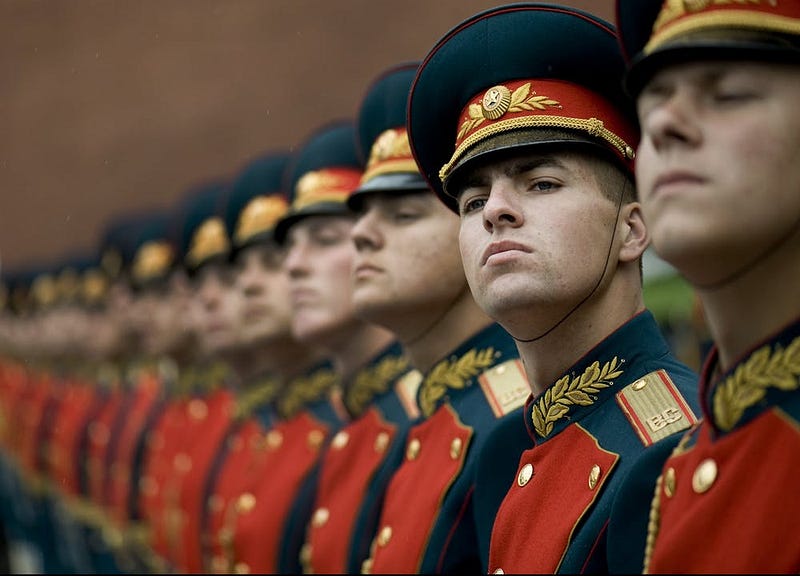
War, again.
Russia, we are told by our news media, is on the verge of invading Ukraine — an independent state with a democratically elected government that had ideas about joining NATO. We should be afraid of them, they tell us.
In Russia, media consumers are being told a different version of events. Their brave leader is seeking to restore their country’s stolen glory in the face of certain national danger. It is straight out of the Strongman Playbook and I’m sure Russians are being led to believe that it is they who should be afraid of us.
Who’s right? Who’s wrong? Who knows.
What is clear is that our governments are once again prepared to settle problems with another country by resorting to the threat of potential violence and the actual use of it. We shall prevail, we think. The Russians think the same thing too.
Go back for a moment to the last good war, World War 2. The righteous of the world allied themselves to defeat evil and ensure that Nazi Germany and Imperial Japan would never be a threat again.
Once that conflict was over, the two erstwhile allies — The Western Democracies, lead by the US and the Communist Bloc, by the Soviet Union, went their separate ways without a common enemy to unite them.
Actually, check that. The Cold War that I refer to started well before the end of the Second World War and was already underway by the middle of 1945. It was almost as though military leaders on both sides, realizing that they could suddenly become irrelevant in a peaceful world, thought of a way to keep conflict going, perpetually.
It went on for decades and became part of the fabric of the lives of all of us living during that era.
Ok, that’s a bit simplistic, but we practised nuclear bomb drills and built fall out bunkers in our backyards. Our governments helped overthrow elected governments and supported brutal dictatorships around the world (Guatemala, Chile, Iran, Zaire, Haiti, the Philippines and on and on) as long as they weren’t Communists and were safe for our interests to operate with impunity.
The Soviets did the very same in Cuba, Ethiopia, Vietnam, their Eastern European clients and on and on.
It all wrapped very neatly with the fall of the Berlin Wall in 1989 and the collapse of the USSR in 1991. Democracy, of the 3 prevailing ideologies available just 45 years previous, was the one left standing. A new era of peace and prosperity ensued,
Right?
Wrong.
No sooner was the Soviet Union neutralized (or neutralized itself) as the evil enemy, than Saddam Hussein arrived to keep us all on continued high alert. As if on schedule, the same Saddam Hussein that we had supported in a lesser of two evils scenario against the even more evil Iranians in the brutal and destructive war between the two in the 1980s, showed up to give us a new place to direct our fear and hatred.
I’ve always wondered where he got the idea that the invasion of Kuwait would be a good idea.
It turned out to be an easy victory, but for various reasons the US did not capture Hussein, nor occupy the country, nor replace his government, as they might have in days gone past. Instead they cleared out and let him continue to terrorize his people, with the hope that crippling sanctions would motivate them to rise up and do it themselves. That day never came. Maybe it was about oil, maybe it was about saving him for a rainy day.
Once we arrived in the 21st century, the rainy day finally came. 9/11, the invasion of Afghanistan, the invasion of Iraq, the capture, trial and killing of Hussein and the rise of ISIS, gave us a new, visible enemy who spoke a language we didn’t understand. Meanwhile, US military contractors snatched their opportunities and took great pains to ensure that hay was made while the sun shone.
But now, here we are two decades into the century and we have grown weary of the Middle East and dealing with Islamic Fundamentalism. We certainly aren’t constantly being reminded to be frightened of brown people with bombs who speak unintelligbly in execution videos anymore. The chaos in the evacuation of Afghanistan may have been shocking, but it certainly wasn’t a surprise.
But as US foreign policy since 1945 has shown the world over and over again, where one problem is solved, another can be created. And we still need an enemy.
No sooner have the previous wars of our most recent memory been wrapped up — for us, anyway — that our decision makers are ready to plunge us into another one.
And so we find ourselves facing down the big, bad, scary Russians who are rattling their sabres, making untenable demands and threatening the civilization of the free world. Again.
Everyone knows by now that it is a failure of humanity to avoid war. And yet, we are again being pushed into another one. Somebody, the rational mind says, must be gaining from this.
So, who is it and how do they do it?
Governments
- Distraction. Most governments in the world are not on the steadiest ground right now and the American government perhaps gets the most attention. Climate disaster, endless Covid pandemic, vaccine battles, gun violence, racial unrest, culture wars, potential coups, massive wealth disparities and a government that can’t or won’t do anything about them. A successful war would certainly change the focus on the evening news.
- Manufactured unity. War creates unity, or it is supposed to. But it is artificial. It involves the inviolable symbolism of the flag, the founding and present myths about the place and righteousness of the cause. Liberty, justice and blah blah blah.
- Patriotism. Support the troops. Thank you for your service. Gold Star families. U-S-A, U-S-A! Flying the flag in your front yard and on your bumper sticker, convinced you’ve done your bit.
- Suppression of dissent. You are either with us or you are against us. George Bush II really did say it best. There is no room for nuance, no room for reasoned debate, no room for respectful disagreement or questioning of motives and policies. Black and white. You are either for this war or you hate your country. There is no in between.
- The others. We are not the cause of problems in the world. They are. And if we could just defeat them, then everything will be great.
Weapons Manufacturers
There is not a military in the world that produces its own weapons. They have to come from somewhere and that’s where corporations come in. In the capitalist system, the goal of these is profit. In fact, in some countries it is the law that they must do everything they can to produce a profit and do nothing to impede it. Shareholders in such companies certainly approve of this set of circumstances. Profit can be made to increase with increased demand for weapons, which conflict certainly produces. It stands to reason that weapons manufacturers have something to gain through the existence of more conflict.
A quick aside here, the United States exports more weapons than the next 6 highest exporting nations, combined.
The Elites
We know, or think we know, what Bezos, Musk, Zuckerberg, Gates and the rest of the trillionaires are up to. For one reason or another they have chosen the spotlight and are using it, in part, to gallantly further the cause of humanity by blasting off into space every chance they get.
They don’t concern me too much.
It is the strata directly below them that worry me most. I don’t know their names, but I could look them up, I suppose. I can’t say I know their names, because they are going about their business without too much fanfare. On purpose. For every Mackenzie Scott, there are ten Betsy DeVos’. I wonder what she’s up to these days.
What they seem to be interested in is making sure that their wealth will insulate and protect them from whatever is coming. Therefore, their focus is on increasing it. They appear to believe this can only be done with a compliant populace that will do the work, willingly or otherwise. People that are just trying to keep all their plates spinning and have neither the time nor the energy to get off their hamster wheels to take a look around at what is really going on.
The Culture Wars that they created to distract us haven’t quite worked out as planned. Maybe a quick war can help keep a lid on anyone getting any funny ideas about class struggle.
The Media
The mainstream media in Western society is owned by corporations, the goal and legal duty of which, as mentioned, is to generate a profit for shareholders. A media organization sells itself as explainer of truth, but the media doesn’t need to tell the truth any more than huge food conglomerates need to make nutritious food for people to eat.
We don’t even expect them to tell it anymore, because we know that for them to produce a profit, they need to have advertisers who are willing to pay for space. Advertisers will only do that if they know there are consumers. There can only be consumers where traffic is created. Traffic can only be created with headlines that cause people to tune in or, more accurately these days, click. In a world weary of a pandemic, climate crisis, supply chain chaos, a good old fashioned black and white war might just do the trick.
But who will suffer? Well, the people of Ukraine, for one. The people and soldiers on both sides who will inevitably die. The families of all soldiers who go to war and don’t come back, or who do, but are mentally and physically damaged for life.
And what about individual members of the media, who are sent to the front lines, the war correspondents who are trying to talk about what is true and trying to describe the truth as they see it, are also putting themselves in the way, knowing that they could be killed in the lines of their duty.
We know that it will never be the powers that be who make the decision to go to war who ever face the pain of it. They are well insulated, and this probably makes it easier for them to make such decisions. They know what the impact of that decision will be and the risk to individual lives, in an abstract sense, but they will never have to experience it themselves.
However, I am sure that the people in those positions are well aware that the working class youth of their respective countries have far more in common with each other, than with the elites above them that are pulling the strings. That realization needs to be discouraged and that’s why these things are always wrapped in flags.
You know who will neither benefit nor directly suffer from this? You and me. A Russian invasion and occupation of Ukraine would be another failure of humanity, sure. But whether Russia goes through with this or the West stands up for its principles, most of us will still get up and do whatever we are going to do tomorrow morning.
But hold on. Since no man is an island, aren’t we all going to be diminished by more violence on this planet?
One could make the claim that it is all the democratic countries of the world, who may or may not lift a finger to “save” Ukraine, who will suffer. They didn’t, during the Invasion of Crimea in 2014, but perhaps now they will. I am sure people in Taiwan are watching with interest.
But what if they don’t? The West took upon itself the role of keeping everything in check the past 75 years. Making all the right noises about everyone having rights and freedoms, and that there was some kind of organizational framework in the world that suited them. NATO, the UN, the US, the European Union, the G20 are all examples of this. If it fails to live up to that role, this will have an immeasurable impact on the collective psyche of the democratic world, especially its smaller members.
Can we take another war right now? Will we survive if we don’t have one? Who knows.
What’s clear is that there is always going to be an enemy. But, for many of us in this part of the world, it’s fine because death and destruction at the hands of our perpetual enemies continues to be arranged somewhere else. It could never happen here.
If you like what you are reading here and want unlimited access to thousands of writers, consider a subscription to Medium. It’s $5 a month and if you use this link, then I get a piece of that. I’ll use it to finally finish the film of my trip on the Trans Siberian.


