
GEEKY | POLITICS | ANCIENT GREECE | EUROPE | XI | CHINA
Xi Divides and Conquers Europe
An uncommon (geo)political-historical article
The tactic of divide and conquer has been often considered a scheme adopted by the Brits, mainly over their splitting India apart via sowing religious divisions.
The conflicts between Hindus and Muslims continue to this day, and not just between India and Pakistan. But divide and conquer is a much older scheme. It goes back to at least the 5th century BC, and I’m sure it’s even older than that.
The Ancient Greece vs Persia Precedent
After the ancient Greeks united to defeat a common enemy, the Persians, in the Battle of Marathon in 490 BC and the naval Battle of Salamis in 480 BC, the Persians withdrew toward the East.
While the Persians forgot their dreams of conquering Europe, at least temporarily, they switched to playing Sparta and Athens -the two superpowers of the era- against each other.
They employed spies, propaganda, bribes, direct funding, recruited exiled generals and used other nefarious tactics to weaken Greece from the inside. They either hoped to weaken them enough to invade again -they didn’t- or simply take revenge. Or both.
Sparta won the subsequent civil Peloponnesian War (431–404 BC) partly because they were funded by the Persians to build a large navy, partly due to some disastrous military decisions by Athens and partly due to a major plague that hit Athens.
The Present Analogies
Why do I write about ancient Greece in an article about Xi and Europe? Because the analogies with the present day are striking. The ancient Greek historian Thucydides commented that the war between Sparta and Athens “was inevitable” -even without Persia interfering- because “Sparta was threatened by the rise of Athens.”
This is the infamous “Thucydides trap.” Thucydides is taught in the best military schools of the world, most notably the American ones. If Sun Tzu’s Art of War is largely about military tactics then Thucydides’ History of the Peloponnesian War is largely about (geo)strategy. The bigger picture. Not just how, but also why.
In the current analogy, despite the opposing political systems, Sparta is the United States and China is Athens. And just like Sparta and Athens had their colonies, tributaries and allies back in the day, so do USA and China today.
USA has the countries of NATO and allies like Japan and Australia. China has Russia and some poor countries they have bought out with massive “investments”, largely in Africa.
The countries of NATO are almost exclusively in Europe, the EU in particular. The EU is a far easier target for Xi than USA because it is -currently- less unified.
The United States are (still) a federation, while the EU is a loose confederation at best. Most of the countries might have a common currency but in just about everything else they are different. Including foreign policy, security, and their stance against China.
What Xi Did at G20
Xi shamelessly exploited that in G20. After publicly humiliating the Canadian PM Justin Trudeau Xi shunned both the European Council President Charles Michel and the European Commission President Ursula Von Der Leyen (two Brussels bigwigs - symbols of a unified Europe) and pulled his little Persian-like stunts.
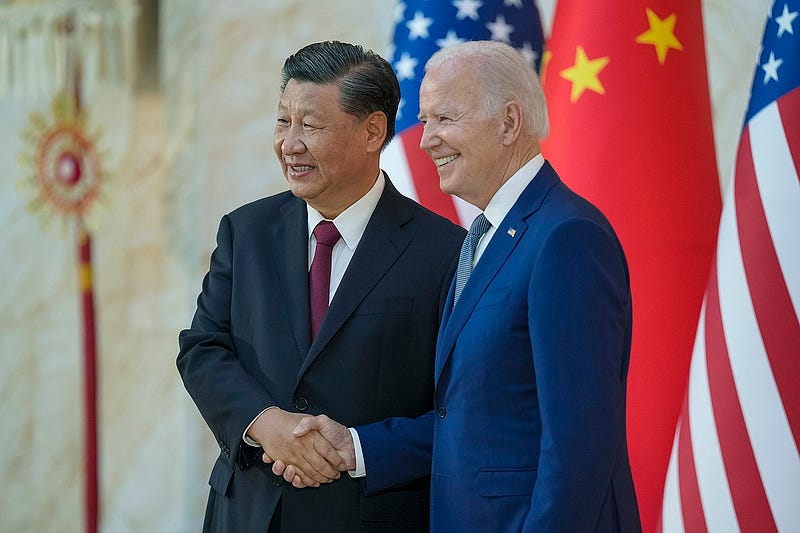
He met for 3.5 hours with Biden, leaving only scraps for European leaders. The second leader he met (for 43 minutes) was the French President Emmanuel Macron, and the rest made do with leftovers.
Many European leaders wanted to push their own countries’ interests in terms of trade and other business, not of Europe as a whole. Xi did what Trump had been doing to the EU -and even NATO- for 4 years. The difference is that he is far more effective at it, because he is not an impulsive fool with daddy issues.
He is a calm, composed calculator. And thus he is very dangerous. Xi, just like Putin, wants the status quo of Europe to remain as it is. A loose confederation is weaker and can be easily divided. Better to have to deal only with the United States than with a strong unified Europe on top of that.
Promise France a better deal for their wines or Germany a better deal for their cars and the next day they’ll both lobby Brussels to chill out on their China stance. United Europe, indeed.
Macron made a fool of himself with his risible praises of Xi at G20. If he thinks Xi is a narcissist like Trump who can be manipulated with compliments he is sorely mistaken.
Concluding Remarks and Sources
Divide and conquer. An ancient, very effective strategy. I strongly suspect Xi has studied -perhaps even memorized- both Sun Tzu and Thucydides.
China will be the No1 financial power in roughly a decade, in terms of total GDP output. The United States will fall to No2.
Apart from declaring actual war on them -not just a commercial or cyber one- there is nothing the United States can do to prevent that. Unlike Sparta and Athens though, a war between USA and China would turn nuclear. Thus I strongly doubt it will happen.
That will be all fellow history students and current observers. I publish this on Geeky too, until I join a more appropriate pub for my historical articles.
Let me know in the comments if the prospect of China becoming the world’s largest economy worries you or not. And do you think Xi will still be in power by 2032?
sources: As Xi reemerges, Europe again falls prey to China’s divide-and-rule tactics | POLITICO History of the Peloponnesian War, by Thycydides
A historical - contemporary article by Nikolaos Skordilis Another article about ancient Greece:
I also recommend this article about Napoloeon, by Purple History


