
X____Y: The Basic Form of “Creative Dialogue” (4)
More examples of the Basic Form of “Creative Dialogue”
This post is part of the Creative Dialogue project which aims to
The article is part of the Creative Dialogue project which aims to introduce “Creative Dialogue” as a new Unit of Analysis of Creative Life Theory by curating relevant frameworks and articles.
From 2022 to 2023, I worked on developing the Creative Life Curation project and the Knowledge Engagement project. The outcome is a new theoretical approach to knowledge creators’ life course: Creative Life Theory.
In the book (draft) titled Creative Life Curation, I developed Creative Life Theory (v1.0) which considers the following five units of analysis.

1. Creative Actions 2. Creative Projects 3. Creative Journey 4. Creative Landscape 5. Creative Lifescope
The framework also highlights the following three types of “Curativity”:
- Curativity 1: Turning pieces of Projects into a Journey as a meaningful whole
- Curativity 2: Turning pieces of Projects into a Landscape as a meaningful whole
- Curativity 3: Turning pieces of Actions and Projects into a Lifescope as a meaningful whole
It’s an open framework!
If we can discover a new significant aspect of Creative Life and develop a corresponding method, we can add Curativity 4 and related keywords to the diagram.
Or, we can add Curativity 1.5 or Curativity 2.5 to the diagram.
In the past several weeks, I realized that “Creative Dialogue” is a significant aspect of Creative Life. For example, I developed the Mapping Thematic Dialogue method in Sept 2022. From 2020 to 2022, I worked on Activity Theory and Ecological Psychology. I faced the challenge of maintaining a boundary between these two theoretical approaches. However, I found the zone of boundary is a great creative space for developing new ideas. Eventually, I used the WXMY model to develop a thematic dialogue between two theories.
So I decided to add “Creative Dialogue” as a new unit of analysis to Creative Life Theory.
In the past several years, I developed a set of concepts, diagrams, knowledge frameworks, and metaphors to discuss a family of topics such as boundary innovation, opposite themes, thematic conversation, creative dialogue, etc.
The Creative Dialogue project adopts the Ecological Formism Framework as a meta-framework to curate these tools and topics into a meaningful whole.
You can find more details in two previous articles:
- The ECHO Way: Waterfall, Bridge, and Creative Life
- ARCH: Interpersonal Interactions, Collaborative Projects, and Creative Life
- TALK: Two Cups of Coffee and Activity Circle
The Basic Form of “Creative Dialogue”
From the perspective of the Ecological Formism Framework, the basic form of “Creative Dialogue” is very simple:
X____Y
What does it mean?
It means 1) there are two objects or entities, and 2) there is a gap or distance between them.
That’s all!
How do we get several derived forms from a basic form? There are many ways to expand a basic form to a derived form.
In the previous three articles, I introduce a technique called Ecological Metaphor.
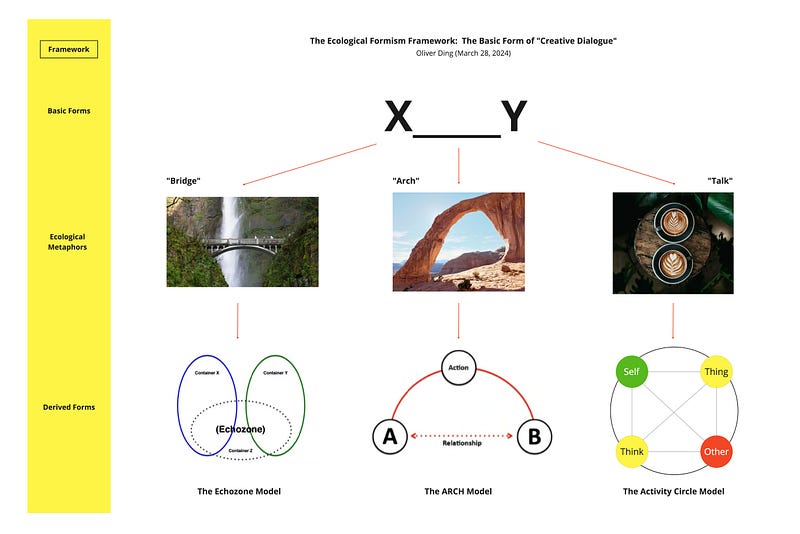
In The ECHO Way: Waterfall, Bridge, and Creative Life, I introduced an ecological metaphor called “Bridge+Waterfall” and used it to associate with the ECHO Way framework.
In ARCH: Interpersonal Interactions, Collaborative Projects, and Creative Life, I introduced an ecological metaphor called “ARCH” and used it to associate with the ARCH model.
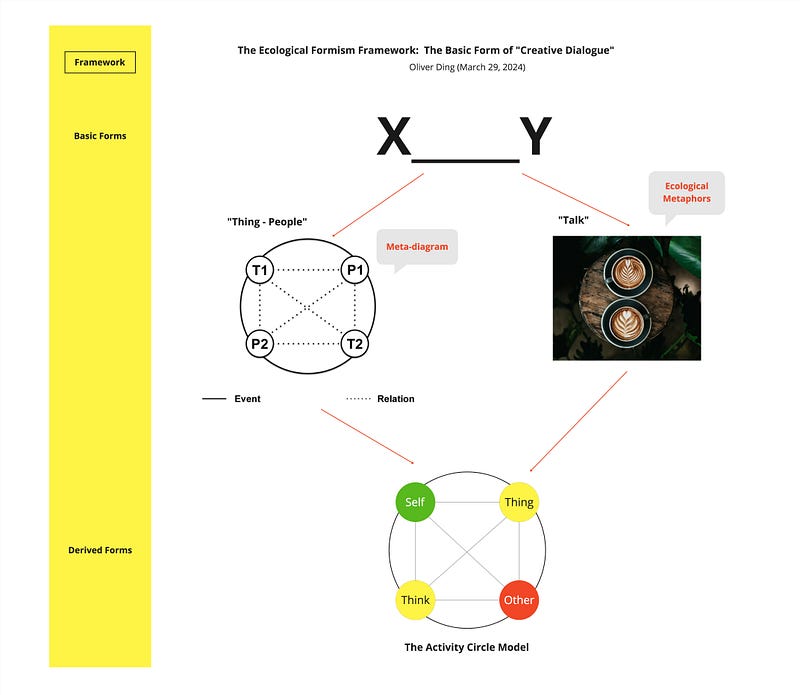
In TALK: Two Cups of Coffee and Activity Circle, I introduced an ecological metaphor called “TALK” and used it to associate with the Activity Circle model.
I also mentioned that we can use a Meta-diagram to expand a Basic Form to a Derived Form. See the example below.
After sorting my tools and articles about the “Creative Dialogue” unit of analysis, I realized there are three categories behind these works:
- Subjects are Objects such as knowledge themes, career themes, etc.
- Subjects are People
- Subjects are Social Entities or People inside a Social Entity
I also found that the three models I developed match these three categories.
- The Echozone model: Subjects are Objects
- The ARCH Model: Subjects are People
- The Activity Circle Model: Subjects are Social Entities
It’s also easy to find three metaphors that represent these models.
- “Bridge”
- “Arch”
- “Talk”
This is not an ideal classification. Some tools and articles are about knowledge themes, but the ECHO Way model does not represent them.
This article aims to introduce some examples outside the above three metaphors. See the diagram below.
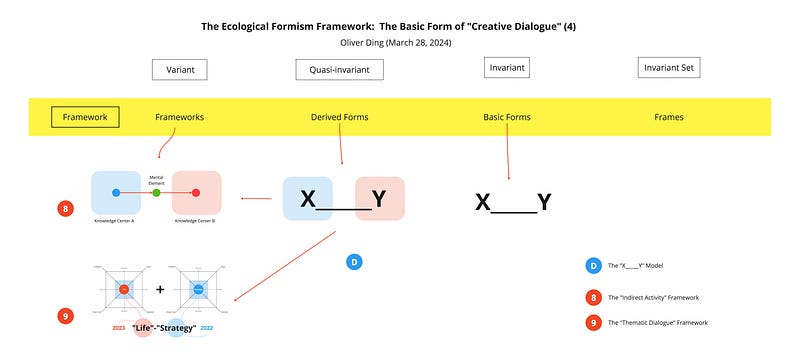
The above diagram uses the “X____Y” model as a Derived Form.
Since “X____Y” is the Basic Form, the “X____Y” model is not an ideal Derived Form because there is no difference between the Basic Form and the Derived Form.
Where is the derived part?
To be honest, I use just it as a trick.
We don’t have to classify every framework into a category. For example, #8 The “Indirect Activity” Framework, and #9 The “Thematic Dialogue” Framework are not classified into the above three categories.
The “Indirect Activity” Framework
The “Indirect Activity” Framework was developed for the Value Circle project.
The Value Circle project aims to reflect on the development of several knowledge centers and explore the dynamics of networked knowledge centers.
In 2023, Platform Ecology Center and Life Strategy Center were inactive knowledge centers. However, I made progress in Platform Ecology Center and Life Strategy Center by working on knowledge projects belonging to other knowledge centers.
In order to highlight such a type of Synergy Effects of Networked Knowledge Centers, I used the following terms for the Value Circle project:
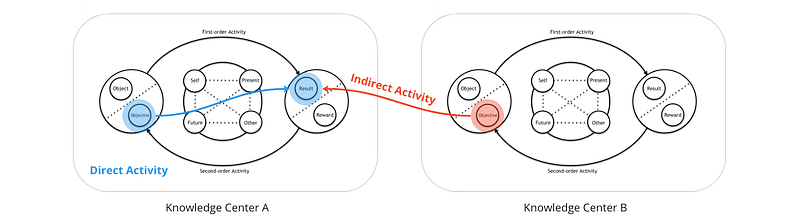
- Direct Activity
- Indirect Activity
If the objective of a knowledge project is defined by a particular knowledge center and its outcome contributes to the progress of the knowledge center, then the project belongs to the category of Direct Activity of the knowledge center.
If the objective of a knowledge project is defined by a particular knowledge center and its outcome contributes to the progress of other knowledge centers, then the project belongs to the category of Indirect Activity of the other knowledge centers.
The diagram below is the basic model of the “Indirect Activity” Framework.
Based on the above basic model, I made several case studies. The diagram below is an example.
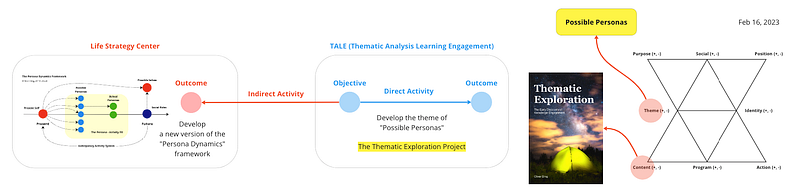
You can find more details in the links below:
- Value Circle #6: The Indirect Activity of Platform Ecology Center
- Value Circle #7: The Indirect Activity of Life Strategy Center
The “Thematic Dialogue” Framework
The “Thematic Dialogue” Framework was based on the “Double Theme” Strategy.
The “Double Theme” Strategy means connecting two Knowledge Discovery Canvases and forming a new process of developing tacit knowledge. You can find more details in Knowledge Discovery: The “Double Theme” Strategy.
From 2022 to 2023, I used the strategy to develop the concept of “Life Strategy”.
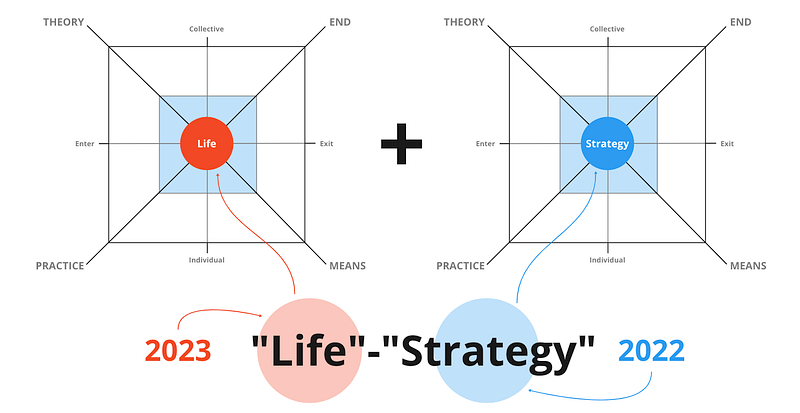
On Feb 3, 2022, I published Thematic Space: The “Strategy” thematic space and mentioned my focus on the “Toolkit” and the “Dialogue”.
Originally, I was busy dealing with friends’ requests about practical suggestions about strategy. So, I framed the notion of “Life Strategy” as a practical toolkit. However, I realized that I could detach from the “toolkit” and attach to the “dialogue” which is mentioned above.
What is the dialogue?
My notion of “Life Strategy” can be understood as a dialogue between my “Life” thematic space and my “Strategy” thematic space.
If we jump out of my thematic spaces, we can consider the concept of “Life Strategy” as a dialogue between the field of “Developmental Psychology” and the field of “Strategic Management”.
I called this method Double Dialogues which is a technique of the Knowledge Curation framework.
On Feb 4, 2022, I shared the Life Strategy Framework (v1.0) and a knowledge curation canvas about the framework on Linkedin.
On Feb 17, 2022, I wrote a post titled Mapping Thematic Space #6: The “Life” thematic space.
Later, I made a mini-site to host the “Life — Strategy” Thematic Dialogue on Coda.
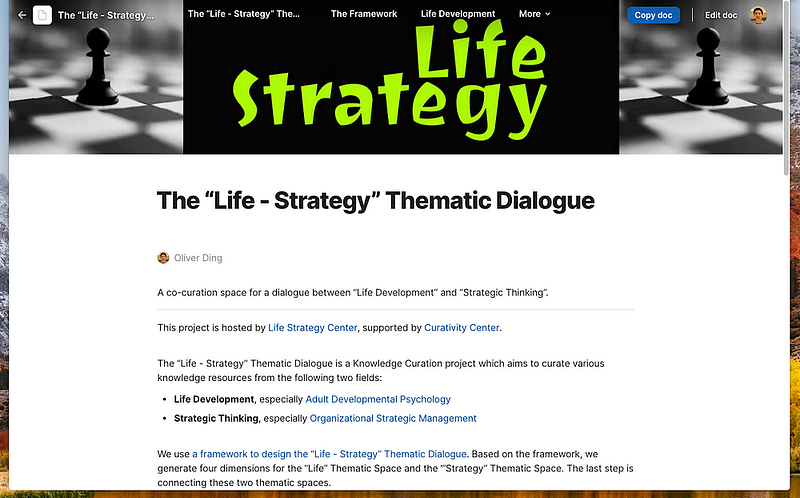
From June 2022 to Dec 2023, I focused on applying the Anticipatory Activity System (AAS) framework to study Life Strategy. The outcome was the book Advanced Life Strategy.
Related Articles
Indirect Activity
- Value Circle #6: The Indirect Activity of Platform Ecology Center
- Value Circle #7: The Indirect Activity of Life Strategy Center
Thematic Dialogue
- Feb 3, 2022 — Mapping Thematic Space: The “Strategy” thematic space
- Feb 17, 2023 — Mapping Thematic Space #6: The “Life” thematic space
- April 2, 2022 — Knowledge Discovery: The “Double Theme” Strategy
- Minisite: The “Life — Strategy” Thematic Dialogue
- A List of Opposite Themes