
TALK: Two Cups of Coffee and Activity Circle
An ecological metaphor for thematic conversation

The article is part of the Creative Dialogue project which aims to introduce “Creative Dialogue” as a new Unit of Analysis of Creative Life Theory by curating relevant frameworks and articles.
From 2022 to 2023, I worked on developing the Creative Life Curation project and the Knowledge Engagement project. The outcome is a new theoretical approach to knowledge creators’ life course: Creative Life Theory.
In the book (draft) titled Creative Life Curation, I developed Creative Life Theory (v1.0) which considers the following five units of analysis.

1. Creative Actions 2. Creative Projects 3. Creative Journey 4. Creative Landscape 5. Creative Lifescope
The framework also highlights the following three types of “Curativity”:
- Curativity 1: Turning pieces of Projects into a Journey as a meaningful whole
- Curativity 2: Turning pieces of Projects into a Landscape as a meaningful whole
- Curativity 3: Turning pieces of Actions and Projects into a Lifescope as a meaningful whole
It’s an open framework!
If we can discover a new significant aspect of Creative Life and develop a corresponding method, we can add Curativity 4 and related keywords to the diagram.
Or, we can add Curativity 1.5 or Curativity 2.5 to the diagram.
In the past several weeks, I realized that “Creative Dialogue” is a significant aspect of Creative Life. For example, I developed the Mapping Thematic Dialogue method in Sept 2022. From 2020 to 2022, I worked on Activity Theory and Ecological Psychology. I faced the challenge of maintaining a boundary between these two theoretical approaches. However, I found the zone of boundary is a great creative space for developing new ideas. Eventually, I used the WXMY model to develop a thematic dialogue between two theories.
So I decided to add “Creative Dialogue” as a new unit of analysis to Creative Life Theory.
In the past several years, I developed a set of concepts, diagrams, knowledge frameworks, and metaphors to discuss a family of topics such as boundary innovation, opposite themes, thematic conversation, creative dialogue, etc.
The Creative Dialogue project adopts the Ecological Formism Framework as a meta-framework to curate these tools and topics into a meaningful whole.
You can find more details in two previous articles:
- The ECHO Way: Waterfall, Bridge, and Creative Life
- ARCH: Interpersonal Interactions, Collaborative Projects, and Creative Life
The Basic Form of “Creative Dialogue”
From the perspective of the Ecological Formism Framework, the basic form of “Creative Dialogue” is very simple:
X____Y
What does it mean?
It means 1) there are two objects or entities, and 2) there is a gap or distance between them.
That’s all!
How do we get several derived forms from a basic form? There are many ways to expand a basic form to a derived form. In this article, I’d like to recommend a simple technique:
Ecological Metaphor
In The ECHO Way: Waterfall, Bridge, and Creative Life, I introduced an ecological metaphor called “Bridge+Waterfall” and used it to associate with the ECHO Way framework.
I use the term “ecological metaphor” to refer to a metaphor including two types of meanings: 1) subjective experiences, and 2) objective conditions.
- Bridge: it refers to a gap which is an objective condition
- Waterfall: it refers to an activity which is a subjective experience
The ECHO Way framework was formed with Theme U and Project I.
Bridge can be seen as a metaphor for Theme U while Waterfall can be seen as a metaphor for Project I.
We can start with the basic form of “Creative Dialogue”, discover several ecological metaphors that represent the basic form, and develop abstract models from these ecological metaphors.
The reverse process is also acceptable. In fact, I just started from a set of knowledge frameworks and used ecological metaphors to discover the basic form.
The diagram below shows the map of creative thought.
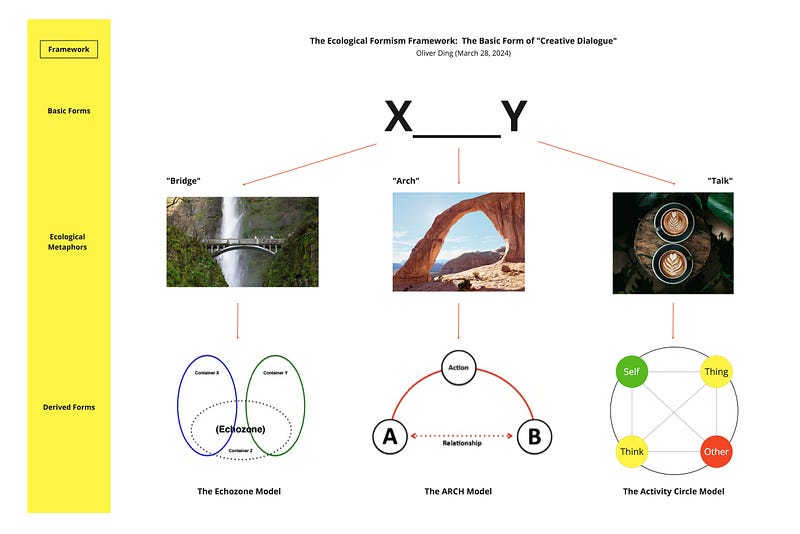
After sorting my tools and articles about the “Creative Dialogue” unit of analysis, I realized there are three categories behind these works:
- Subjects are Objects such as knowledge themes, career themes, etc.
- Subjects are People
- Subjects are Social Entities or People inside a Social Entity
I also found that the three models I developed match these three categories.
- The Echozone model: Subjects are Objects
- The ARCH Model: Subjects are People
- The Activity Circle Model: Subjects are Social Entities
It’s also easy to find three metaphors that represent these models.
- “Bridge”
- “Arch”
- “Talk”
This is not an ideal classification. Some tools and articles are about knowledge themes, but the ECHO Way model does not represent them.
This article focuses on the “Talk” metaphor and the Activity Circle model.
Talk: Two Cups of Coffee
I have used several pictures for the ECHO Way and Creative Dialogue.
On Oct 1, 2022, I wrote a short note about Creative Journey and designed the following picture.
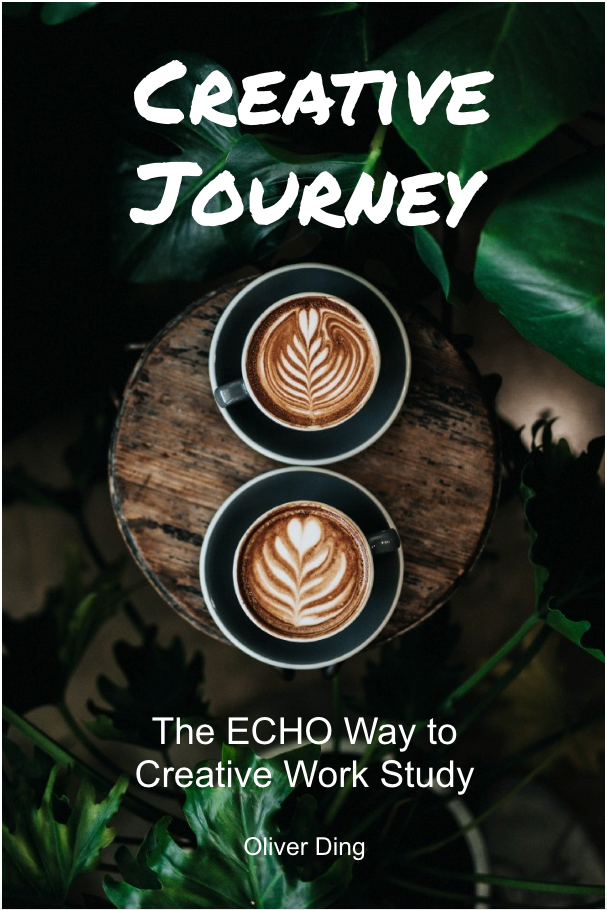
The picture shows two cups of coffee. I realized that there is an ecological metaphor behind the picture.
I use the term “ecological metaphor” to refer to a metaphor including two types of meanings: 1) subjective experiences, and 2) objective conditions.
For example, the “Bridge+Waterfall” metaphor echoes the ECHO Way model. Bridge can be seen as a metaphor for Theme U while Waterfall can be seen as a metaphor for Project I.
- Bridge: it refers to a gap which is an objective condition
- Waterfall: it refers to an activity which is a subjective experience
What’s the ecological metaphor behind the above picture?
- Objective condition: two people stay in one place
- Subjective experience: a conversation between two people
I use the word “Talk” to name this ecological metaphor.
Several days ago, I redesigned the picture for the Creative Dialogue project.
Later, I realized three ecological metaphors are behind the basic form of “Creative Dialogue”, so I decided to use the picture for the “Talk” metaphor associated with the Activity Circle model.
The Activity Circle Model and Related Frameworks
The Activity Circle focuses on “Self, Other, Thing, and Think”. It is perfect for discussing a special object with double properties: material property and mental property. This idea was inspired by cultural-historical psychologist Lev Vygotsky’s two types of mediating tools: technological tools and psychological tools.
The original idea of the Activity Circle is called the “Activity — Relationship” perspective which was developed in 2017.
In 2021, I used it to connect Activity Theory with Relevance Theory. The model was named The Relevance of Zone.
In 2022, I rediscovered it with several new triggers and decided to rename it Activity Circle.
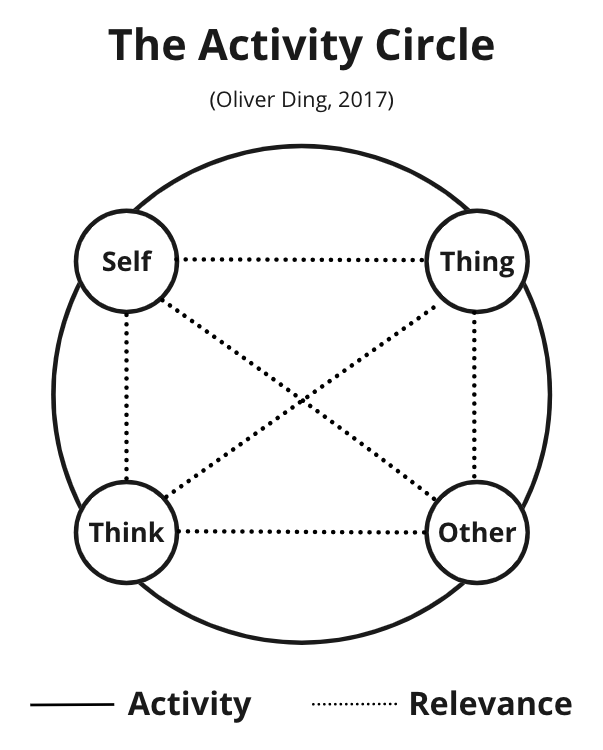
In this article, our focus is not Diagrams, but Frameworks. We use “Activity Circle” to name a Derived Form that represents the “Subjects are Social Entities or People inside a Social Entity” category.
The diagram below shows the structure of the Ecological Formism Framework.
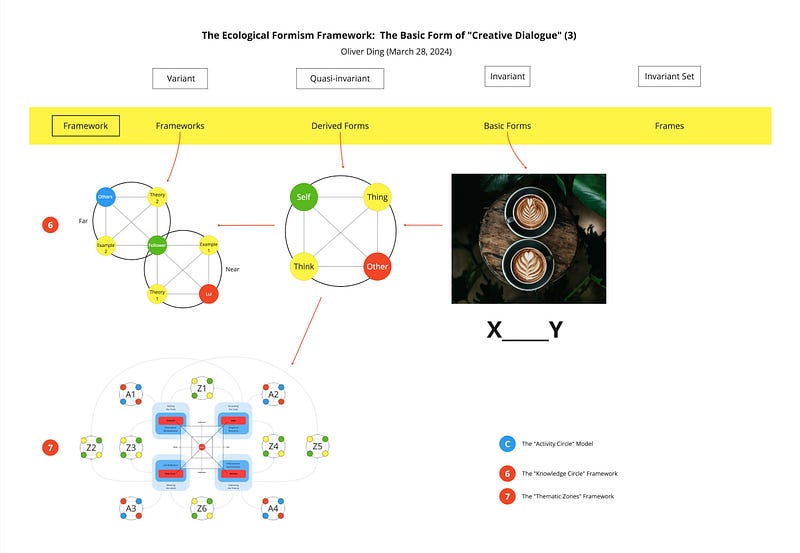
The above diagram also highlights two examples of frameworks:
- The “Knowledge Circle” Framework
- The “Thematic Zones” Framework
The rest of the article will share more details of these frameworks.
The “Knowledge Circle” Framework
From May 2022 to Dec 2023, I worked on developing the concept of “Knowledge Center” through running several knowledge projects.
I used several theoretical approaches for these knowledge projects and developed different perspectives on the concept of “Knowledge Center”.
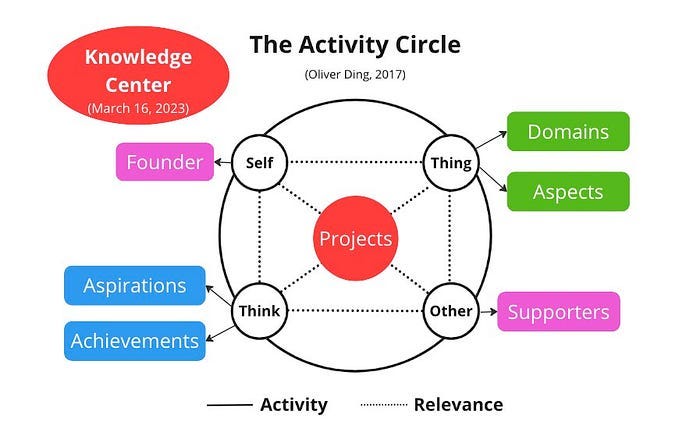
In March 2023, I applied the Activity Circle model to develop a new model for understanding Knowledge Center in general. See the diagram below.
In April 2024, I started studying Ping-keung Lui’s creative life.
Ping-keung Lui is a theoretical sociological theorist. He was the Principal Lecturer (retired) at the Department of Applied Social Science at The Hong Kong Polytechnic University.
Lui aims to build a brand new theoretical sociology as a candidate for the paradigm of sociology. According to Lui, “There are three kinds of theories in sociology, namely, social theory, sociological theory, and theoretical sociology. ” In 2007, Lui published a Chinese book titled Gaze, Action, and the Social World in which he presented his account of theoretical sociology.
Later, he established the Trojan Society for Theoretical Sociology and continuously developed his account of Theoretical Sociology. We can roughly see his activities about Building Theoretical Sociology as a Knowledge Center.
From 2012 to 2017, Lui used email and WeChat to host a small academic group to discuss his Theoretical Sociology. After reading the archive of their discussions, I used double activity circles to represent a typical pattern of the discussions.
I found the above model is not suitable for Lui’s knowledge center’s activities. Thus, I used a different version of the Activity Circle model to make a diagram of Lui’s knowledge center.
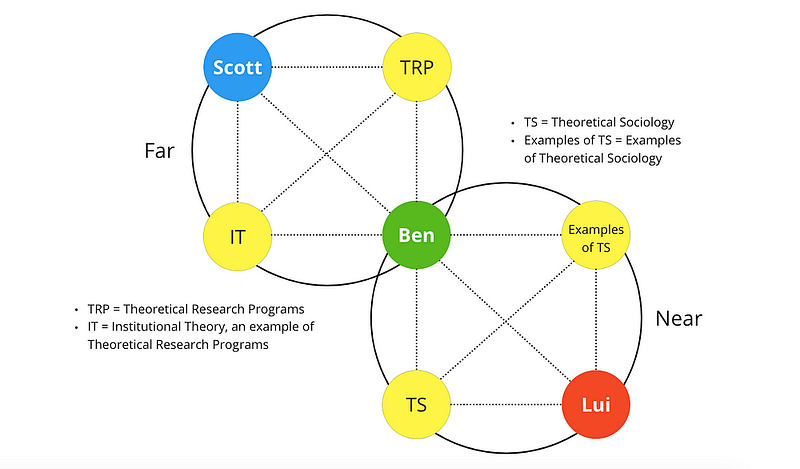
I also used “Knowledge Circle” to name this new model.
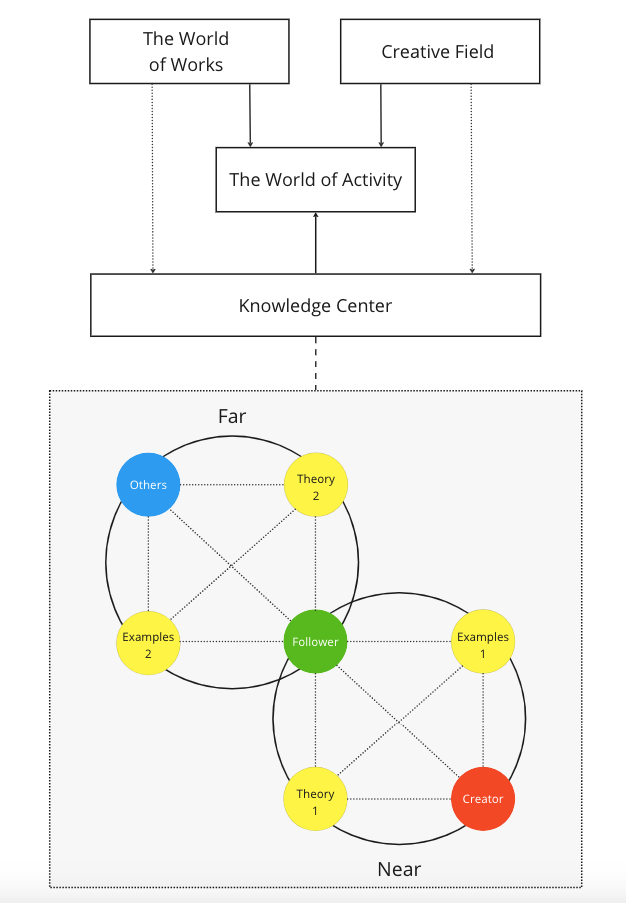
The Knowledge Circle Framework was born from a research project about Lui’s knowledge center. Later, I added to the basic model of the Creative Course framework.
You can find more details in Knowledge Engagement: The Expanded Creative Course Framework.
The “Thematic Zones” Framework
The “Thematic Zones” Framework was developed for the Knowledge Engagement project.
In general, the term “Thematic Zones” refers to interpersonal social interactive spaces.
Based on the Knowledge Discovery Canavs, I found ten thematic zones on Nov 30, 2023. See the diagram below.
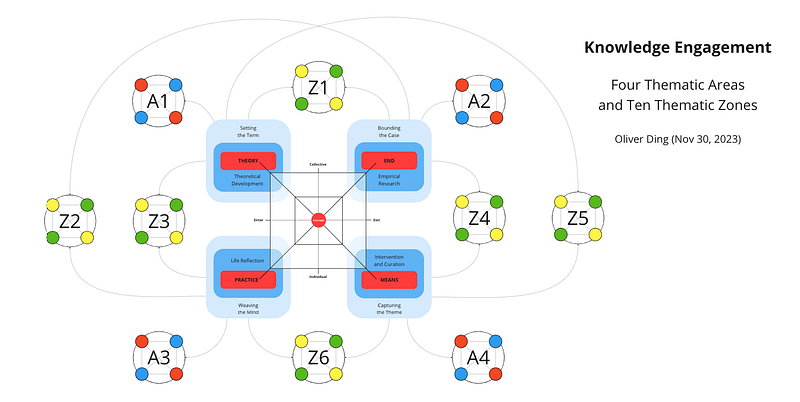
If two members of a thematic zone come from the same Thematic Area, then the thematic zone is an In-area Thematic Zone.
- A1: The “THEORY — THEORY” Thematic Zone
- A2: The “END — END” Thematic Zone
- A3: The “PRACTICE — PRACTICE” Thematic Zone
- A4: The “MEANS — MEANS” Thematic Zone
If two members of a thematic zone come from two different Thematic Areas, then the thematic zone is a Cross-area Thematic Zone.
I discovered six cross-area Thematic Zones.
- Z1: The “THEORY — END” Thematic Zone
- Z3: The “THEORY — PRACTICE” Thematic Zone
- Z4: The “END — MEANS” Thematic Zone
- Z6: The “PRACTICE — MEANS” Thematic Zone
- Z2: The “END — PRACTICE” Thematic Zone
- Z5: The “THEORY — MEANS” Thematic Zone
If we consider three members or more members and they come from different thematic areas, we can discover more thematic spaces. So far, I only paid attention to the above ten thematic zones.
Let’s see an example of the “Thematic Zones” framework. In Dec 2023, I had a thematic conversation with Tony who is a friend of mine.
As a C-suite executive of a public listing company, he is interested in developing and promoting tools of thought to encourage the value of the pursuit of excellence.
He recently worked on a side project about a ranking system that allows people to rank anything with a 7-point scale. One of the reasons behind the project is the tool could help people put the value of the pursuit of excellence into practice. Let’s call it the Likert 7 (LKT7) Project.
Our thematic conversation was located in the “THEORY — MEANS” Thematic Zone. While I came from the THEORY thematic area, he came from the MEANS thematic area. See the diagram below.
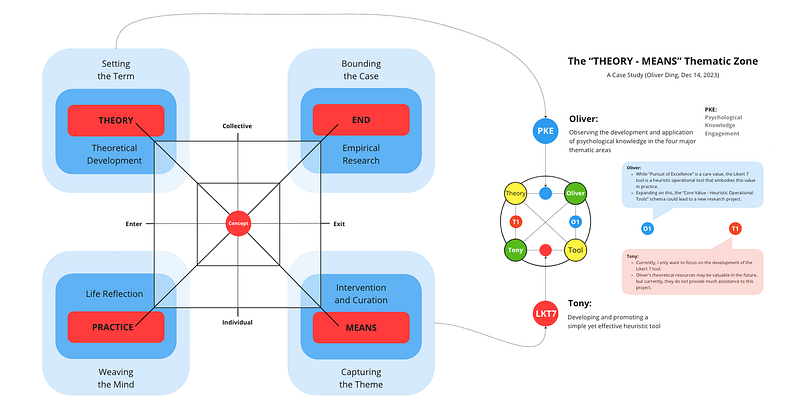
As an Intervenor, Tony had a different goal to develop and promote a simple yet effective heuristic tool without systematic theoretical study.
Our thematic conversation looks like this:
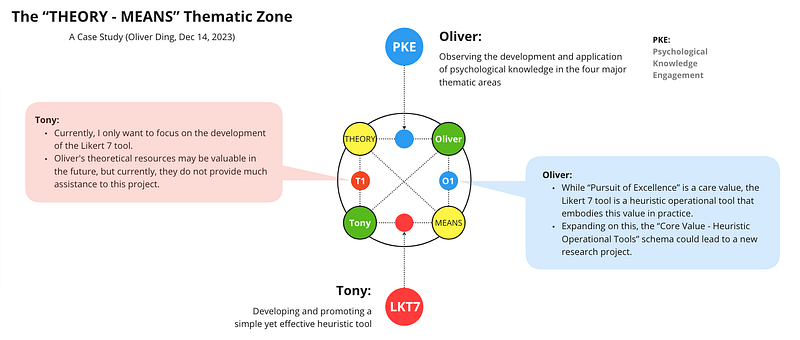
From my perspective, the Likert 7 project is interesting because it offers me an example of the “Core Value — Heuristic Operational Tools” schema. While “Pursuit of Excellence” is a care value, the Likert 7 tool is a heuristic operational tool that embodies this value in practice.
I am wondering if Tony could apply this schema to other core values.
From Tony’s perspective, he only wants to focus on the development of the Likert 7 tool. My theoretical resources may be valuable in the future, but currently, they do not provide much assistance to his project.
The concept of “Thematic Zone” is about interpersonal social interaction. By connecting “Thematic Zone” and Knowledge Discovery Canvas together, we can get a better view of knowledge-related dialogue in everyday life.
You can find more details in Social Moves: Thematic Zones, Thematic Areas, and Social Territory.
A Case Study of “Social Moves”
In Sept 2023, I also used the Activity Circle model to develop a situational framework for a case study of “Social Moves”.
In Sept 2023, I used a Psychological Counseling Platform as an example to conduct a case study about “Social Moves”.
On Sept 29, 2023, I launched the Activity Analysis & Intervention (AAI) Project on the Activity Analysis Center’s website.
Then, I sent it to a friend of mine.
On Sept 30, 2023, I made the following draft visual note and sent it to him.
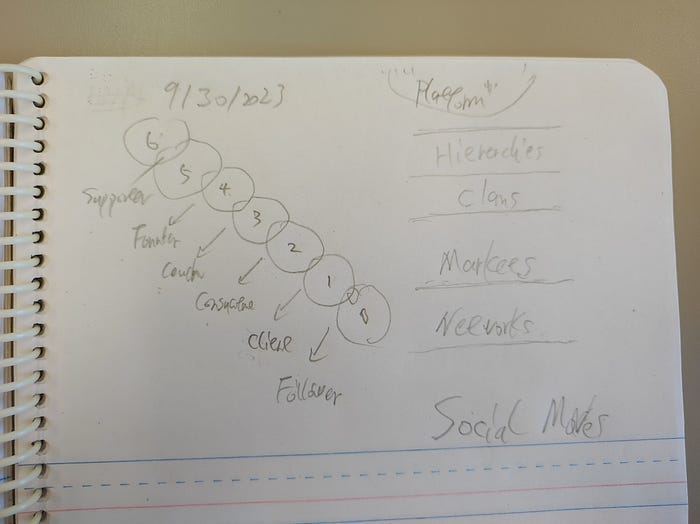
This visual note is about the “Social Moves” project. The theme of Social Moves was inspired by the theme of Mental Moves. While the Mental Moves project is more about knowledge creators’ creative cognition, the Social Moves project is more about their creative social action.
This case study was inspired by two friends of mine. One of them had rich experiences of psychological knowledge engagement. He developed psychological assessment software from 2004 to 2010. From 2014 to the present, he established a successful cognitive scientific education company. Last year, he developed a new theoretical approach to personality psychology. Based on the new theory, he recently launched a brand-new system of psychotherapy.
In contrast, the other one is working on a journey of career transition. In 2022, She left a job at a big tech company and started learning psychological counseling by attending a course offered by a digital psychological knowledge platform. Several months ago, she finished the course and started her new career as a psychological counselor.
I reflected on their creative life stories and realized that there is something called “Psychological Counseling Platforms” in their stories.
On Oct 10, 2023, I made the diagram below to reproduce the visual draft note.
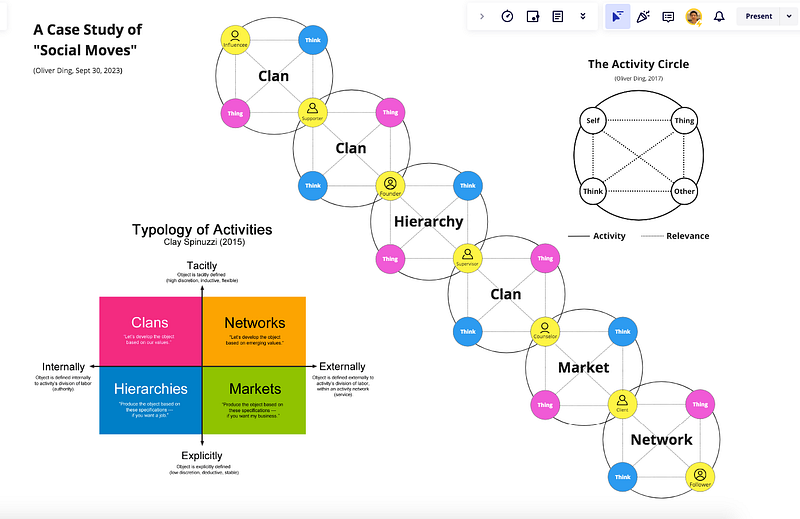
I use a Psychological Counseling Platform as an example to run the case study. There are seven key roles in the platform:
- Influencee
- Supporter
- Founder
- Supervisor
- Counselor
- Client
- Follower
Each Circle refers to an “Activity Circle” which refers to the social structure of “Self, Other, Thing, Think”.
The four types of activities indicate four types of Activity Circles.
- Clan
- Hierarchy
- Market
- Network
People’s social life can be understood as moving between different types of “Activity Circles”.
This case study only features the Chain of Activity Circles. If we return to the NEXT Way (2021), we can find two types of network structures: hub and chain. See the diagram below.
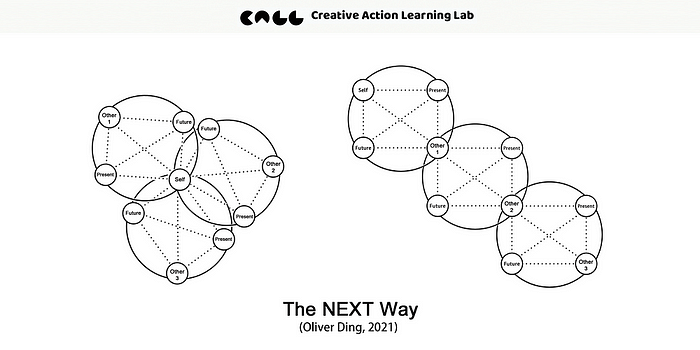
In 2021, I used the iART system to name the social structure of “Self, Other, Present, Future”.
The above left diagram represents the Hub model. A person connects to several other people. The diagram below puts three iART diagrams together:
- Self — Other 1
- Self — Other 2
- Self — Other 3
The Self can adopt different perspectives for these three different iART systems because there are different types of relationships. For example, if the Self is a founder of a startup, Other 1 may be an investor, Other 2 may be a family member, and Other 3 may be a mentor.
The above right diagram represents the Chain model which shows a chain of social relationships:
- Self > Other 1 > Other 2 > Other 3 > …
Each two people form an iART system with a particular relationship. The whole social network is a networked system of many iART systems. This is a very complicated model because each person has his/her own perspective of his/her iART system. Each person has his/her social position. Also, the interpersonal relationship is dynamic.
I named the networked iART Systems The NEXT Way on Sep 5, 2021.
- N: Networked
- E: Expectation
- X: Uncertainty
- T: Trust and Trends
These four keywords are useful for understanding “Social Moves” too.
The above diagram used the Activity Circle model as the basic model. People’s social life can be understood as moving between different types of Activity Circles.
You can find more details in Value Circle #4: From “ARCH” to “Activity Circle”.
Meta-diagrams and Basic Forms
In fact, the Activity Circle was developed in 2017. It was the outcome of my project “Activity as Container” which aims to discuss “Activity as Social Environment”. Later, I used the Activity Circle diagram to generate a meta-diagram for discussing the Thing-People ecological structure. See the diagram below.
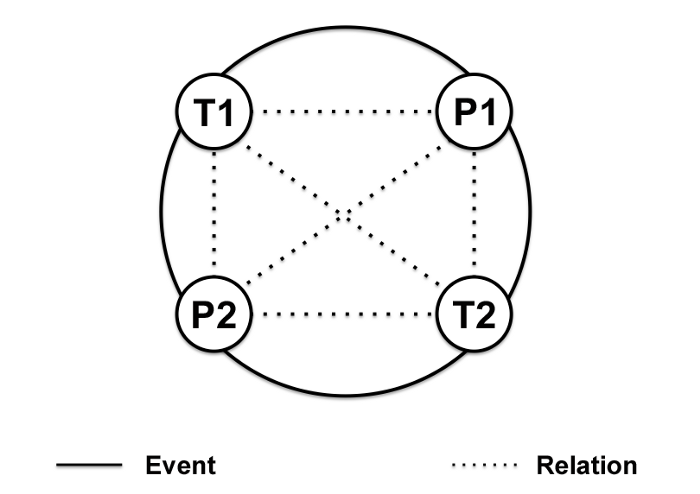
The above diagram is the final model of the Thing-People ecological structure. T means Thing while P means People. 1 means Here while 2 means There. The circle means one event.
I also use another version for this diagram: This (T1), That (T2), Self (P1), Other (P2), and Activity (Event). This version is close to the iART framework.
The Activity Circle uses Thing (T1), Think (T2), Self (P1), Other (P2), and Activity (Event).
These models share the same meta-diagram which presents six types of relations. There are four dimensions behind these six types of relations. The table below offers a full configuration. The pair of “Homogeneous — Heterogeneous” refers to Categorical Difference while the pair of “Close — Remote” refers to Spatial Difference.
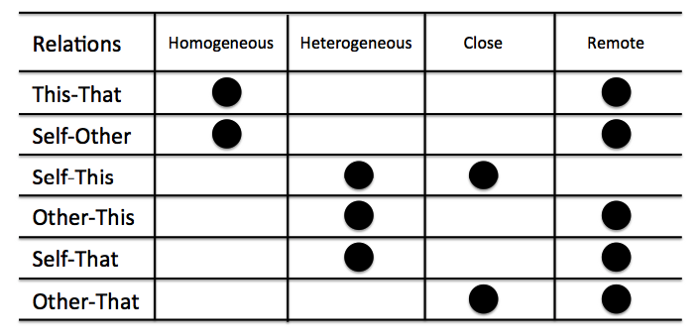
If you find Categorical Differences and Spatial Differences behind a situation or a phenomenon, then you can adopt this meta-diagram to visualize your thinking. You can make a new framework with it too.
The Ecological Formism Framework doesn’t claim the one-to-one correspondence between six levels. For example, a Meta-diagram doesn’t need to match a Basic Form.
However, we could see the correspondence in some interesting cases. For the present discussion, we see the correspondence.
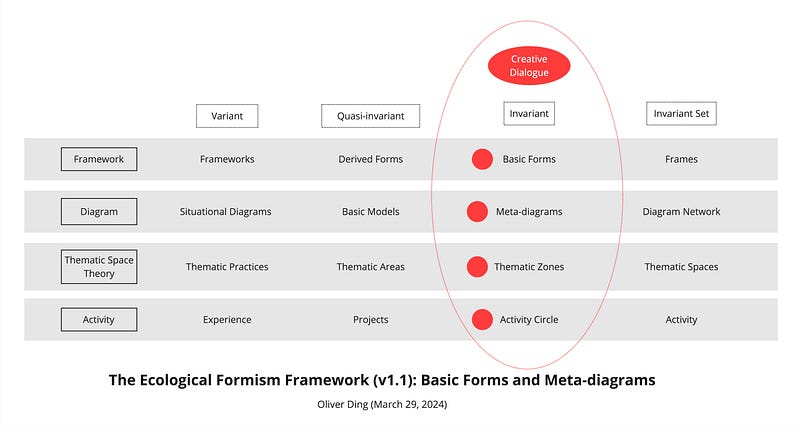
The “Thematic Zones” framework uses the diagram of the Activity Circle model as its basic unit.
The meta-diagram of “Thing-People” echoes the basic form of “Creative Dialogue”.
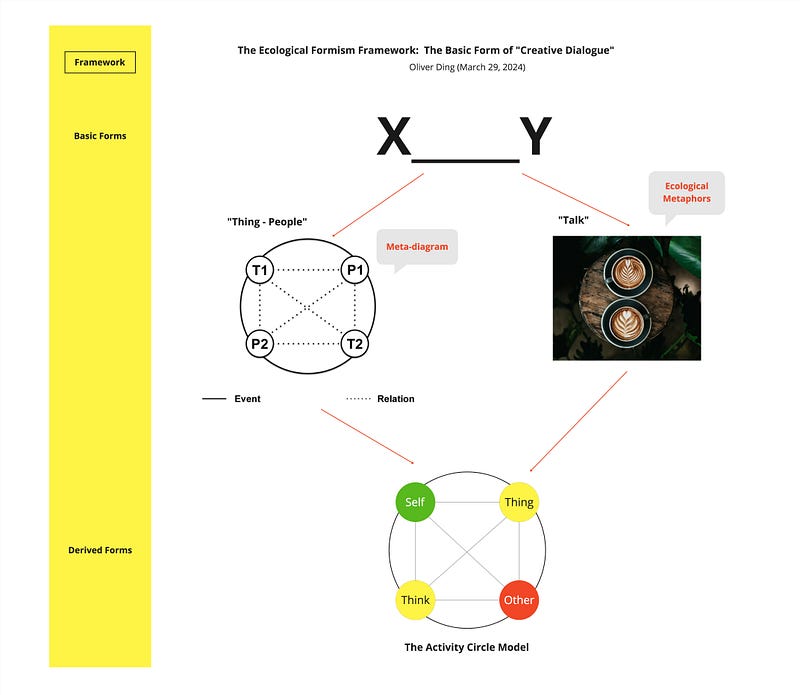
The above diagram shows a new insight: many ways could connect Basic Forms and Derived Forms.
We can use an Ecological Metaphor to turn a Basic Form into a Derived Form.
We can also use a meta-diagram to achieve the same goal.
Related Articles
Activity Circle
- Nov 10, 2022 — The Activity Circle (Oliver Ding, 2017)
- July 21, 2022 — Diagram Blending: “Activity Circle” + “Concept Dynamics”
- Sept 29, 2023 — The Activity Analysis & Intervention (AAI) Project
- Oct 11, 2023 — Value Circle #4: From “ARCH” to “Activity Circle”
Knowledge Circles
- July 25, 2023 — Knowledge Engagement: The Expanded Creative Course Framework
Thematic Zones
Thing and People
- August 21, 2021 — The iART Framework
- August 30, 2021 — The Path of Creative Life
- August 31, 2021 — The iART Diagram Network
- Sept 1, 2021 — iART Diagram Notation
- Sept 3, 2021 — The Defining Zone
- Sept 4, 2021 — Tacit Trends and Shared Transformation
- Sept 5, 2021 — The NEXT Way
- Nov 19, 2021 — An Integrated Framework for Studying Knowledge Diagrams (Part 2): iART Framework for Relevance and Cultural Significance
- Feb 15, 2022 — The “Relevance” Thematic Space