
ARCH: Interpersonal Interactions, Collaborative Projects, and Creative Life
An Ecological Metaphor called “ARCH”

Yesterday I published an article titled The ECHO Way: Waterfall, Bridge, and Creative Life.
The article is part of the Creative Dialogue project which aims to introduce “Creative Dialogue” as a new Unit of Analysis to Creative Life Theory by curating relevant frameworks and articles.
From 2022 to 2023, I worked on developing the Creative Life Curation project and the Knowledge Engagement project. The outcome is a new theoretical approach to knowledge creators’ life course: Creative Life Theory.
In the book (draft) titled Creative Life Curation, I developed Creative Life Theory (v1.0) which considers the following five units of analysis.

1. Creative Actions 2. Creative Projects 3. Creative Journey 4. Creative Landscape 5. Creative Lifescope
The framework also highlights the following three types of “Curativity”:
- Curativity 1: Turning pieces of Projects into a Journey as a meaningful whole
- Curativity 2: Turning pieces of Projects into a Landscape as a meaningful whole
- Curativity 3: Turning pieces of Actions and Projects into a Lifescope as a meaningful whole
It’s an open framework!
If we can discover a new significant aspect of Creative Life and develop a corresponding method, we can add Curativity 4 and related keywords to the diagram.
Or, we can add Curativity 1.5 or Curativity 2.5 to the diagram.
In the past several weeks, I realized that “Creative Dialogue” is a significant aspect of Creative Life. For example, I developed the Mapping Thematic Dialogue method in Sept 2022. From 2020 to 2022, I worked on Activity Theory and Ecological Psychology. I faced the challenge of maintaining a boundary between these two theoretical approaches. However, I found the zone of boundary is a great creative space for developing new ideas. Eventually, I used the WXMY model to develop a thematic dialogue between two theories.
So I decided to add “Creative Dialogue” as a new unit of analysis to Creative Life Theory.
In the past several years, I developed a set of concepts, diagrams, knowledge frameworks, and metaphors to discuss a family of topics such as boundary innovation, opposite themes, thematic conversation, creative dialogue, etc.
The Creative Dialogue project adopts the Ecological Formism Framework as a meta-framework to curate these tools and topics into a meaningful whole.
The Ecological Formism Framework
The Ecological Formism Framework is an epistemological framework that frames six units of analysis from four types of knowing.
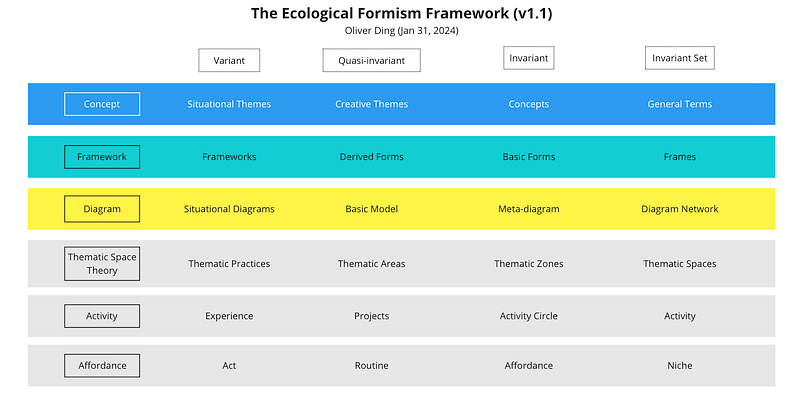
The “Concept” level is about the transformation between themes and concepts.
The “Framework” level is about the emergence of knowledge frameworks.
The “Diagram” level is about the External Visual Representations of knowledge frameworks.
The TST level (the “Thematic Space” level) is a middle level that connects “Activity” and “Framework”.
The “Activity” level is about different patterns of actions.
The “Affordance” level is related to the Operation level of Activity.
The Ecological Formism Framework uses “Variant > Quasi-invariant > Invariant > Invariant Set” as the foundation to define four types of entities for knowing. For example, the “Framework” level could be understood as the following four types of entities:
- Invariant: Basic Forms
- Invariant Set: Frames
- Quasi-invariant: Derived Forms
- Variant: Frameworks
The diagram below uses “Container Thinking” as an example to showcase the differences between “Basic Forms”, “Derived Forms”, and “Frameworks”.
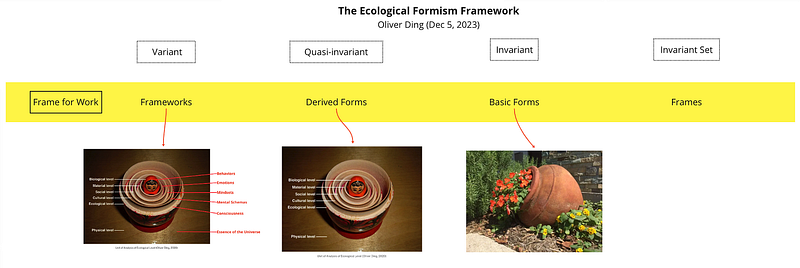
The Basic Form of “Container(Containee)” is the foundation of my theoretical account: the Ecological Practice approach.
In the past several years, I used the Basic Form of “Container(Containee)” to generate many knowledge frameworks for different projects. See the diagram below.
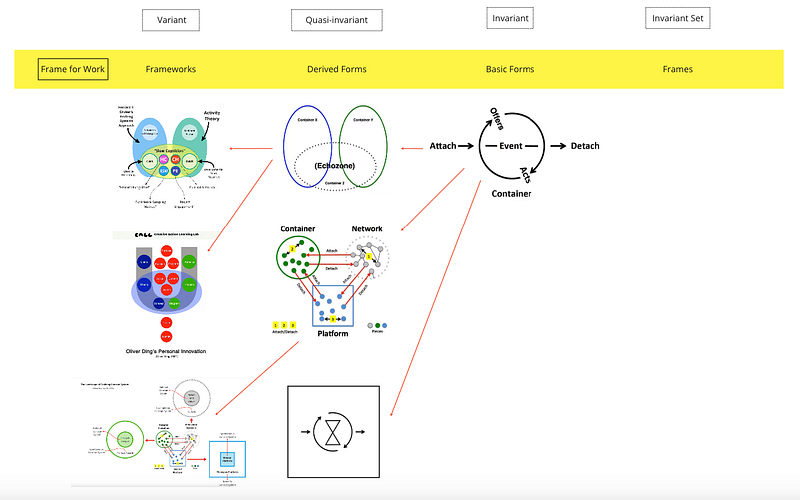
You can find more details in Frame for Work: The Hermeneutics of Knowledge Frameworks and Ecological Formism.
The Basic Form of “Creative Dialogue”
From the perspective of the Ecological Formism Framework, the basic form of “Creative Dialogue” is very simple:
X____Y
What does it mean?
It means 1) there are two objects or entities, and 2) there is a gap or distance between them.
That’s all!
How do we get several derived forms from a basic form? There are many ways to expand a basic form to a derived form. In this article, I’d like to recommend a simple technique:
Ecological Metaphor
In The ECHO Way: Waterfall, Bridge, and Creative Life, I introduced an ecological metaphor called “Bridge+Waterfall” and used it to associate with the ECHO Way framework.
I use the term “ecological metaphor” to refer to a metaphor including two types of meanings: 1) subjective experiences, and 2) objective conditions.
- Bridge: it refers to a gap which is an objective condition
- Waterfall: it refers to an activity which is a subjective experience
The ECHO Way framework was formed with Theme U and Project I.
Bridge can be seen as a metaphor for Theme U while Waterfall can be seen as a metaphor for Project I.
We can start with the basic form of “Creative Dialogue”, discover several ecological metaphors that represent the basic form, and develop abstract models from these ecological metaphors.
The reverse process is also acceptable. In fact, I just started from a set of knowledge frameworks and used ecological metaphors to discover the basic form.
The diagram below shows the map of creative thought.
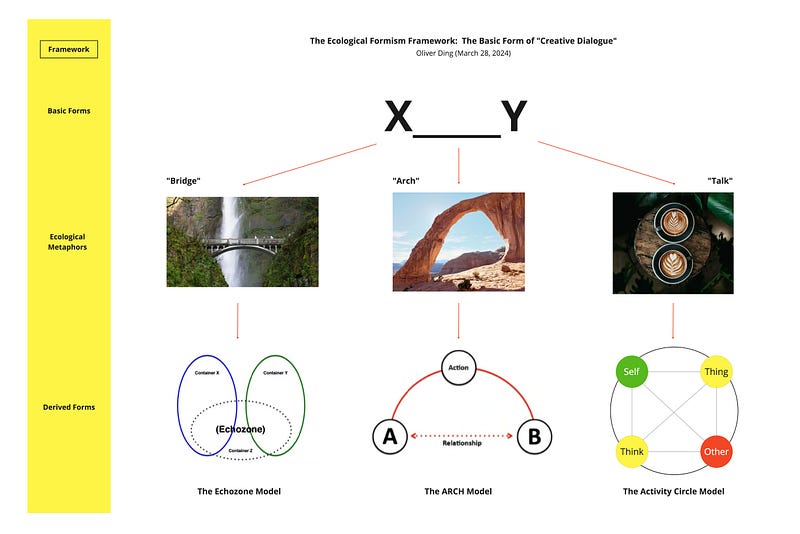
After sorting my tools and articles about the “Creative Dialogue” unit of analysis, I realized there are three categories behind these works:
- Subjects are Objects such as knowledge themes, career themes, etc.
- Subjects are People
- Subjects are Social Entities or People inside a Social Entity
I also found that the three models I developed match these three categories.
- The Echozone model: Subjects are Objects
- The ARCH Model: Subjects are People
- The Activity Circle Model: Subjects are Social Entities
It’s also easy to find three metaphors that represent these models.
- “Bridge”
- “Arch”
- “Talk”
This is not an ideal classification. Some tools and articles are about knowledge themes, but the ECHO Way model does not represent them.
This article focuses on the ARCH model.
The ARCH Model and Related Frameworks
The ARCH diagram was born from my research project about social (interaction) design in 2017. Later, I realized that it can be used for discussing conflict, consensus, and intersubjectivity in general. See the diagram below.
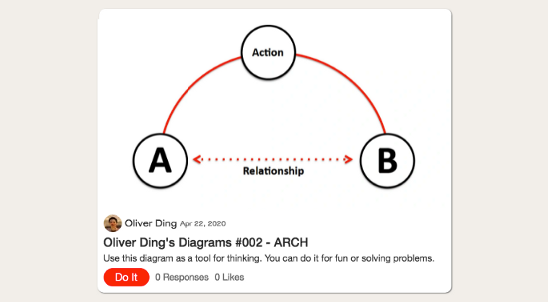
From 2017 to 2023, I worked on different projects and used the ARCH diagram to develop different knowledge frameworks. I moved on to different levels of the hierarchy of Diagrams. See the diagram below.
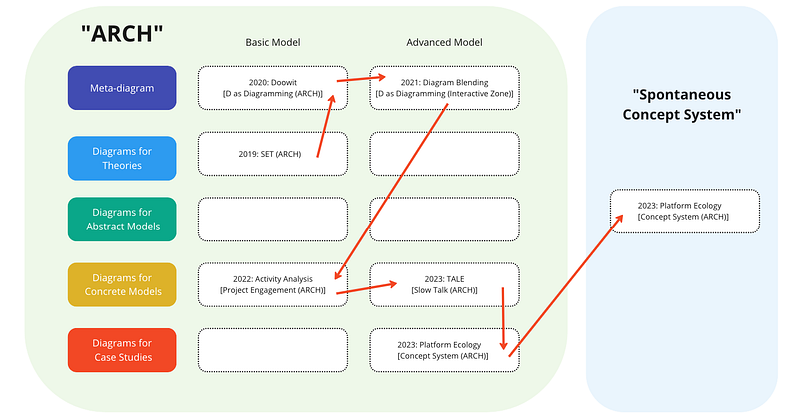
For some projects, the ARCH diagram is a “Main Character”. For other projects, it is a “Side Character”.
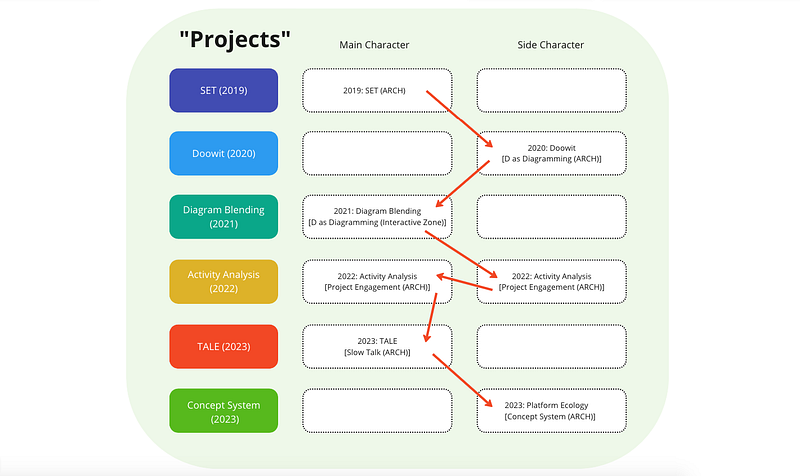
You can find more details in Mental Moves #5: The Attachance of Rediscovery and Diagram Development.
In this article, our focus is not Diagrams, but Frameworks. We use “ARCH” to name a Derived Form that represents the “Subjects are People” category.
The diagram below shows the structure of the Ecological Formism Framework.
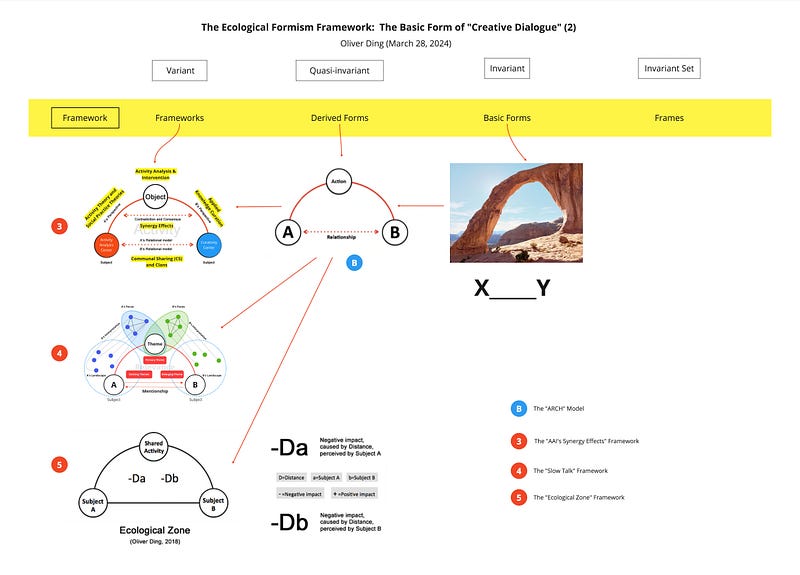
I selected three knowledge frameworks as examples for the present discussion.
- The “AAI’s Synergy Effects” Framework
- The “Slow Talk” Framework
- The “Ecological Zone” Framework
The rest of the article will share more details of these frameworks.
The “AAI’s Synergy Effects” Framework
On Sept 20, 2022, I used the ARCH model to study the Activity Analysis & Intervention (AAI) program.
The AAI program was the first collaborative project between Activity Analysis Center and Curativity Center. I realized that this was a good example of Synergy Effects and adopted the ARCH model to study it.
In 2020, I used the ARCH diagram to curate Alan P. Fiske’s Relational Models Theory and Clay Spinuzzi’s typology of Activity. See the diagram below.
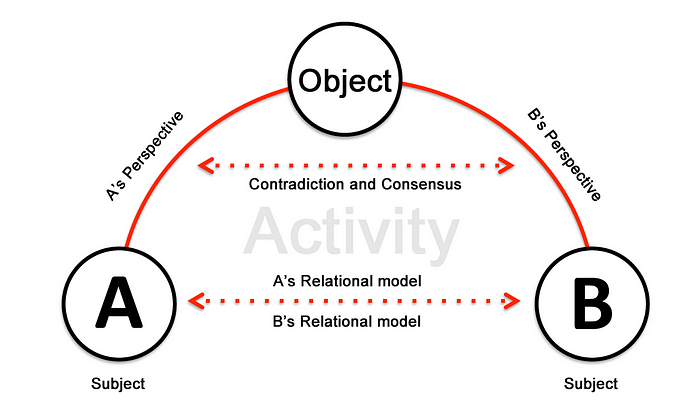
The original version of ARCH model only considers Contradiction and Consensus. The case study expanded its object to Synergy Effects. See the diagram below.
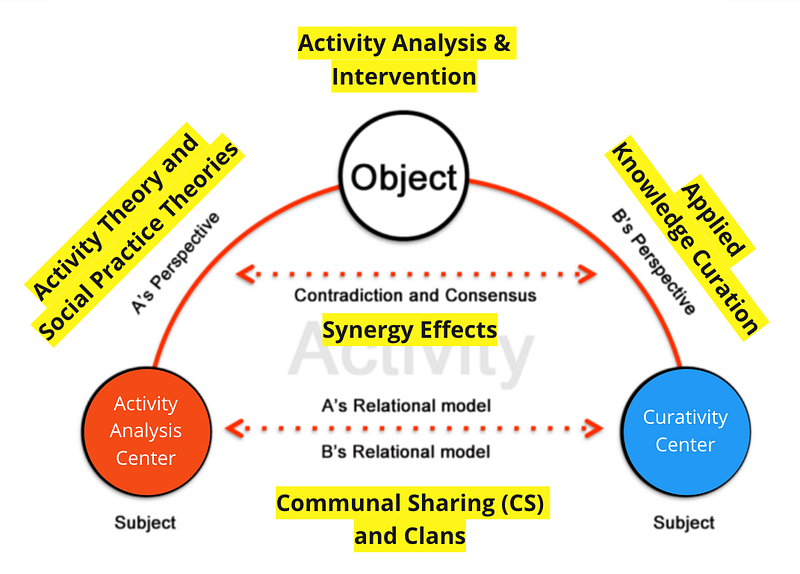
You can find more details in the links below:
- August 19, 2022 — The ARCH Diagram
- Sept 20, 2022 — The ARCH of Synergy Effects
The “Slow Talk” Framework
On Oct 1, 2022, I developed a new framework called “ARCH Visual Framework” as a visual language of interpersonal interactions and collaborative project engagement.
The basic model of the ARCH Visual Framework is a five-stage schema. I roughly considered five stages for building collaborative project engagement.
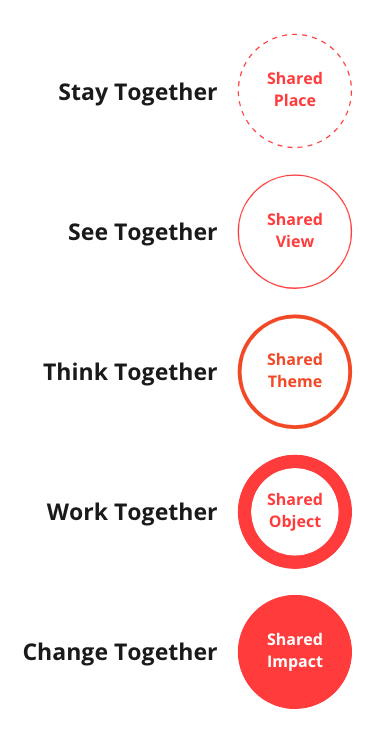
For each stage, I used the ARCH diagram to make a basic model. For example, the third stage is Think Together and its keyword is Relevance. See the diagram below.
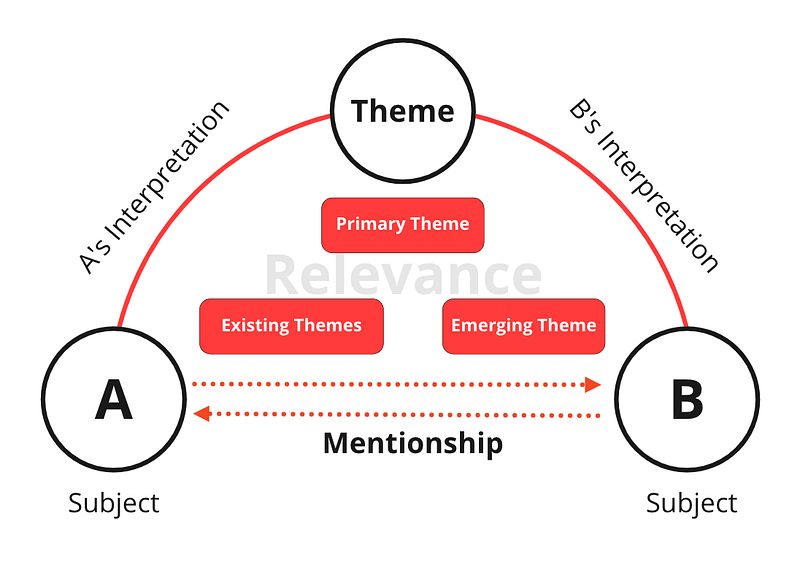
The primary theoretical resource behind the above diagram is “Themes of Practice”. You can find more details in Themes of Practice (2019–2021).
In July 2021, I conducted an empirical study titled Themes of Practice, Social Media, and Interpersonal Communication and wrote a 56-page report. Some ideas are adopted for the present model:
- Primary Theme
- Existing Themes and Emerging Themes
- Interpretation
- Mentionship
I also consider Relevance Theory as a theoretical background.
In Jan 2023, I launched a new project called “Slow Talk”. Inspired by a friend of mine, I decided to use “Slow Talk: From Controversy to Collaboration” to frame a thematic space and run a knowledge curation project in order to achieve “improve communication” and “enhance understanding”.
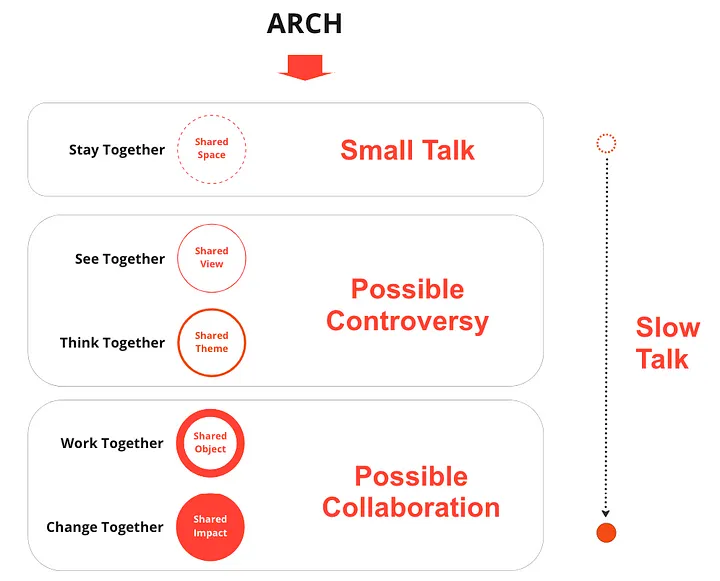
Based on the basic model of “Think Together: Shared Theme”, I developed an advanced version for mapping Slow Talk and Thematic Conversation. See the diagram below.
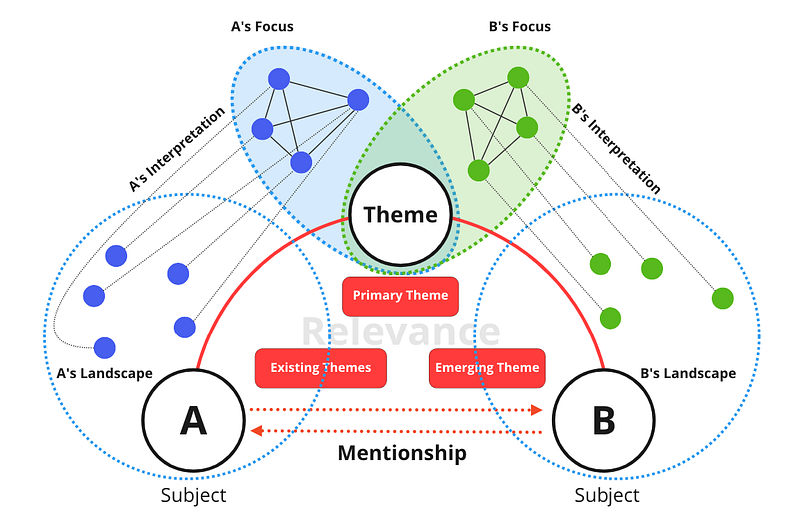
I expanded its unit of analysis from a single theme to a theme network.
In simple words, a theme is a meaningful keyword, and a theme network is a set of connected meaningful keywords.
In order to discuss theme networks, I add two terms to the model.
- Initial Theme: a meaningful keyword that triggers a conversation
- Focus: A person’s Situational Theme Network
- Landscape: A person’s Relevant Theme Network
“Focus” is about situational conversations. For example, a conversation around a post on Linkedin, a discussion around a Twitter thread, an email conversation, etc.
Once a person particulate in a situational conversation, a set of themes from his/her life/work themes would be activated. These themes become a person’s Focus. We can detective a person’s Focus (Situational Theme Network) from comments, messages, etc.
However, it is not easy to see “Landscape” which refers to a person’s Relevant Theme Network. A person can’t say many themes in a situational conversation, but he/she always thinks about more themes than what he/she could say. Landscape (Relevant Theme Network) refers to a set of themes that have a direct connection with the Situational Theme Network.
In other words, we see a person’s thematic thinking and speech as a whole which has two parts:
- Focus (Situational Theme Network): speech in the situation.
- Landscape (Relevant Theme Network): thinking in the mind.
If Landscape (Relevant Theme Network) is in the mind, how can a person know another person’s Landscape?
Social network service platforms share a set of design patterns such as Profiles, Posts, Messages, Streams, etc. These patterns offer various ways to allow a person to know other people.
A deep thematic conversation requires each other to take two moves:
- Move from My Focus to Your Focus
- Move from Focus to Landscape
The first move aims to achieve a good situational thematic conversation on the surface. The second move could build a deep relevant thematic conversation.
Based on a deep thematic conversation, two people can build a great mentionship which refers to mentioning each other relevantly and accurately.
This is a small step to building social capital, at least for professional workers.
You can find more details in the links below:
- Oct 1, 2022 — ARCH: A Visual Language of Interpersonal Interactions and Collaborative Project Engagement
- Jan 23, 2023 — How to develop a framework for a possible theme called “Slow Talk”?
- Feb 22, 2023 — The ARCH of Thematic Engagement
The “Ecological Zone” Framework
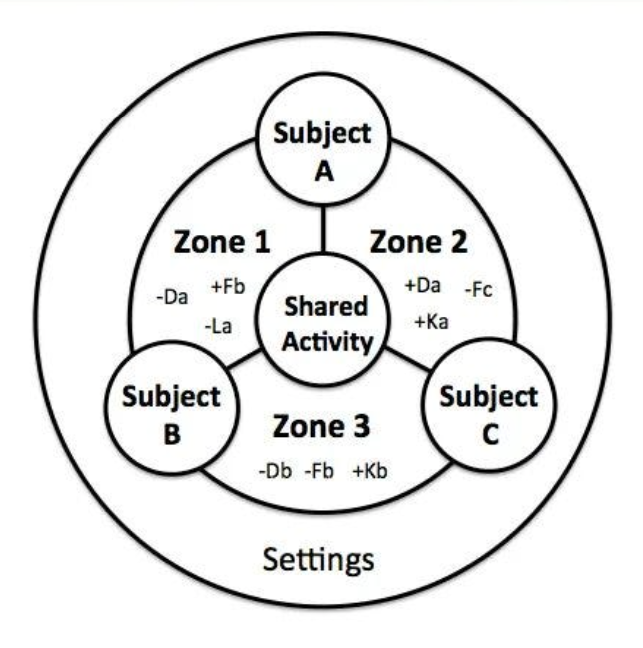
In 2018, I developed the Ecological Zone framework to highlight a new theoretical creative space for an ecological approach to social interaction. The term “Ecological Zone” refers to an interactive space between two subjects with a shared activity for a short duration or long duration. See the diagram below.
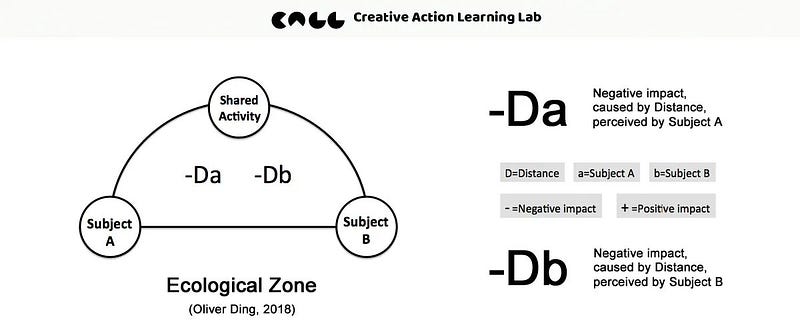
The above diagram is the basic model of the Ecological Zone framework. This is not a normal account of intersubjectivity because my focus is Ecological Aspects. My goal is to add a layer between Gibson’s Affordance Theory and Barker’s Behavior Settings Theory. It is also inspired by Gibson’s idea “Ecological Self”.
One ecological aspect of the Ecological Zone framework is “Ecological Force”. The term “Force” is inspired by Lewin’s topological psychology. However, my term “Ecological Force” highlights the source of force. I pay attention to the ecological source of force. For instance, the above diagram displays two signs:
- - Da
- - Db
D refers to Distance which is claimed to be an ecological force from the perspective of the Ecological Zone. Distance is a fact that exists between two people. If there is only one person, there is no Distance. The fact of Distance doesn’t depend on any person of the two people but on their relative positions.
Let’s say the shard activity is a project of remote work in which Distance is a solid ecological force. Person A perceives a negative impact of remote work due to the Distance. This experience is represented by the sign “-Da”. In like manner, I use the sign “-Db” to represent a negative impact perceived by person B.
Due to the individual difference, person B may perceive a positive impact caused by Distance from the project of remote work. Furthermore, Distance is only one type of ecological force, there are many types of ecological forces in different types of activities.
The above diagram is the basic model. However, the standard model of the Ecological Zone framework is its “Tripartness” version. See the right diagram in the following picture.
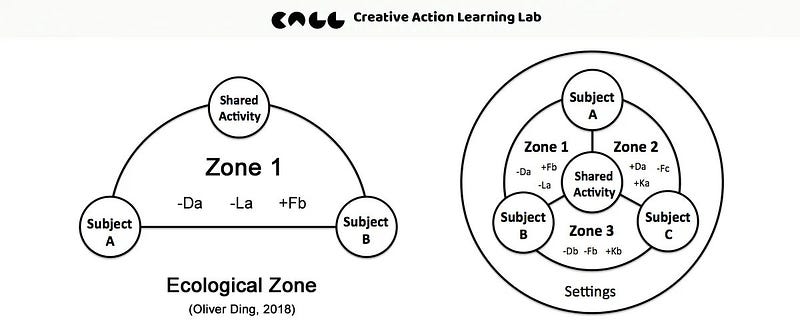
I usually use the Ecological Zone framework with at least three zones together. The tripartness version of the model represents the standard usage and its unique theoretical values.
There are four concepts for understanding ZONE: Structural distinctions, Situational dynamics, Themes of Practice, and Boundaryless Echoes.
- Since the three subjects have their own identities, positions, and motivations, there are Structural Distinctions between the three ZONEs.
- There are personal differences between individual members of each ZONE. Real interactions happen between real people. So, there are Situational Dynamics inside each ZONE.
- In order to curate various experiences of daily interactions, I adopt the concept Themes of Practice from Curativity Theory for ZONE. A Theme of Practice refers to a set of interactions that share a common issue, an agenda, or a theme.
- For each subject/person, they have their own experience of each ZONE. These experiences can be negative or positive. In order to cope with negative experiences at one ZONE, the subject/person can utilize positive experiences from other ZONEs. Also, the subject/person can curate interactions from different ZONEs with similar Themes of Practice. I call this notion Boundaryless Echoes.
In 2021, I applied the Ecological Zone framework to develop the concept of Zone of Project. You can find more details in Activity U (XI): Process, Position, and Zone of Project.
The Ecological Zone Framework echoes the “See Together: Shared View” stage of the ARCH Visual Framework. See the diagram below.
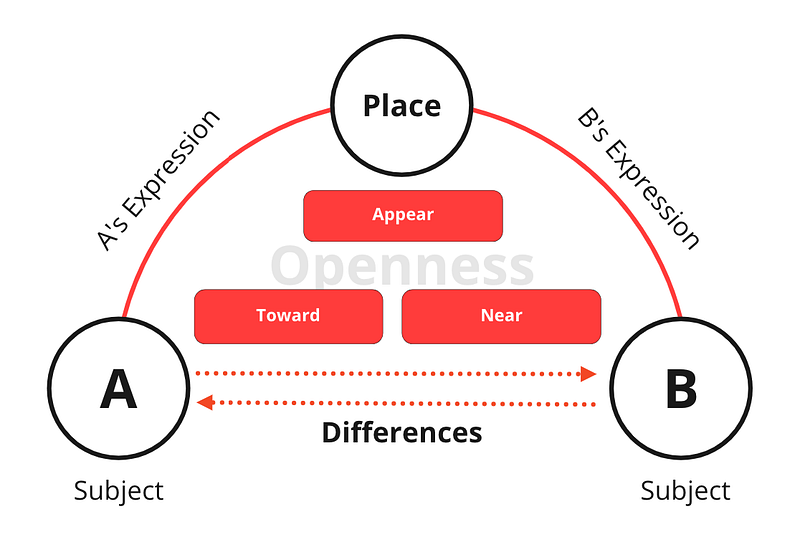
I have to emphasize that the above “Share Place” diagram is not a direct application of the “Ecological Zone” framework. The “Share Place” diagram considers Differences, Share Places, and Expressions. Moreover, the “Share Place” diagram highlights the change in distance between A and B: Appear, Toward, and Near.
You can find more details in the links below:
- Jan 18, 2021 — Activity U (XI): Process, Position, and Zone of Project
- April 24, 2021 — The Infoniche Model (Zone and Offer)
- Sept 3, 2021 — D as Diagramming: The Defining Zone
Variant: Kinds of Frameworks
The above discussion mentions several knowledge frameworks and diagrams.
It seems like the knowledge world is chaotic!
If we use the Ecological Formalism Framework to curate them into a meaningful whole, we see a clear picture and the richness of Variant.
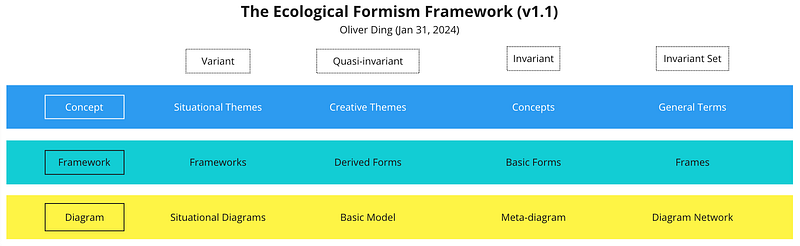
In Diagram Explained: Concept System, Diagram Network, and Knowledge Framework, I used the above diagram to discuss the relationship between the “Concept” level, the “Framework” level, and the “Diagram” level.
What’s the relationship between the “Concept” level and the “Framework” level?
Some “Concept Systems” are developed for understanding some particular activities or social practices, these kinds of “Concept Systems” are called “Knowledge Frameworks”.
All knowledge frameworks are concept systems, but not all concept systems are knowledge frameworks. In other words, Knowledge Frameworks are a sub-set of Concept Systems.
What’s the relationship between the “Framework” level and the “Diagram” level?
Knowledge Diagrams are External Visual Representations of Knowledge Frameworks. There is no strict correspondence between Knowledge Diagrams and Knowledge Frameworks. Some knowledge frameworks can be represented by using tables, not diagrams. Some diagrams such as meta-diagrams are only about spatial structure, not about particular domain knowledge.
In the diagram “The Basic Form of ‘Creative Dialogue’ (2)”, I used three diagrams to represent three knowledge frameworks.
The #3 Diagram is a Situational Diagram because it is the outcome of a case study. What’s its Standard Diagram? See the diagram below.
The #4 Diagram is an Advanced Model of the diagram of “Think Together: Shared Theme”. What’s its Basic Model? See the diagram below.
What’s the Situational Diagram of the #4 diagram? See the example below.
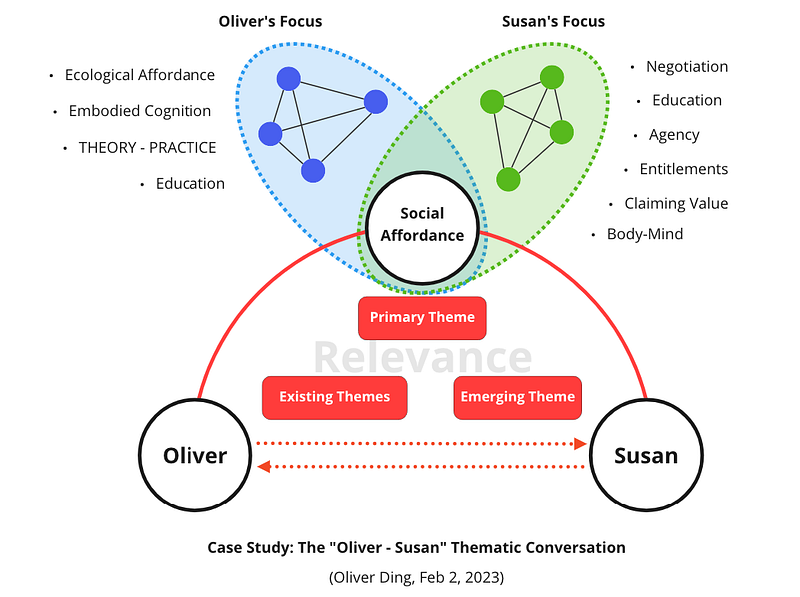
The above diagram is the Case Study of the “Oliver — Susan” Thematic Conversation.
The #5 is the Basic Model of the Ecological Zone framework. What’s its Standard Model? See the diagram below.
We also see three types of knowledge frameworks.
- The “AAI’s Synergy Effects” Framework: A Situational Framework
- The “Slow Talk” Framework: A Practical Framework
- The “Ecological Zone” Framework: A Theoretical Framework
The “AAI’s Synergy Effects” Framework is only about the case study of AAI. So, it is a Situational Framework.
The “Slow Talk” Framework is used as a model for running a project, so, it is a practical framework.
The “Ecological Zone” Framework is part of the Ecological Practice Approach, it emphasizes its unique theoretical perspective. So, it is a theoretical framework.
In April 2022, I developed a typology of knowledge frameworks. I roughly list six purposes for discussion.
- Explanation
- Research
- Intervention
- Exploration
- Reflection
- Remember
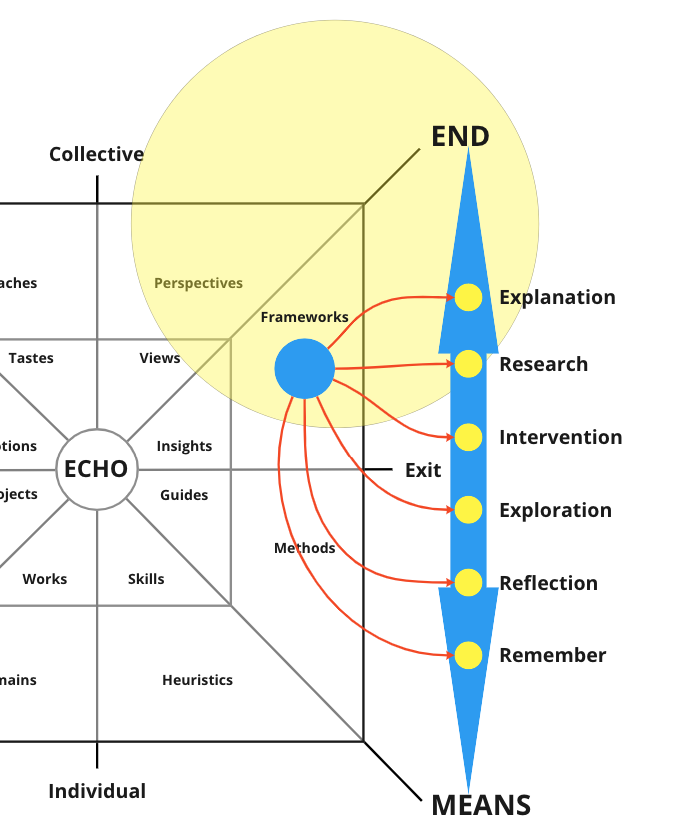
The “Ecological Zone” Framework is for Explanation and Research.
The “Slow Talk” Framework is for Research and Intervention.
The “AAI’s Synergy Effects” Framework is for Exploration and Reflection.
Related Articles
ARCH
- Mental Moves #5: The Attachance of Rediscovery and Diagram Development
- August 19, 2022 — The ARCH Diagram
- Sept 20, 2022 — The ARCH of Synergy Effects
Slow Talk
- Oct 1, 2022 — ARCH: A Visual Language of Interpersonal Interactions and Collaborative Project Engagement
- Jan 23, 2023 — How to develop a framework for a possible theme called “Slow Talk”?
- Feb 22, 2023 — The ARCH of Thematic Engagement
- May 25, 2023 — A Thematic Conversation about “Intellectual Experience”
- June 6, 2023 — The “Oliver — Jung” Thematic Conversation
Ecological Zone
- Jan 18, 2021 — Activity U (XI): Process, Position, and Zone of Project
- April 24, 2021 — The Infoniche Model (Zone and Offer)
- Sept 3, 2021 — D as Diagramming: The Defining Zone


