
Diagram Explained: Concept System, Diagram Network, and Knowledge Frameworks
The complexity of knowledge and its representation
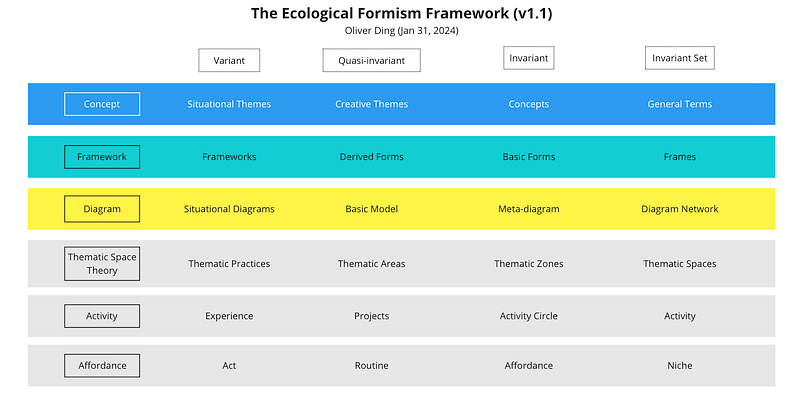
Yesterday I applied the Ecological Formism Framework to explain the “Hierarchy” of knowledge diagrams. Today I will move to the theme of “Network” and discuss the complexity of knowledge.
The above diagram is an example of a “Network” of knowledge. It is very complicated!
Now we see the row of “Diagram” in a 6*4 table. The Ecological Formism framework is an epistemological framework that frames six units of analysis from four types of knowing. Since our primary focus is Diagrams and Diagramming, we could see the 6*4 table as the context of discussion.
What’s the relationship between the row of “Diagram” and other rows?
They both use the “Variant > Quasi-invariant > Invariant > Invariant Set” schema to define four types of knowing. However, there is no strict one-to-one correspondence between each row.
The “Concept” level is about the transformation between themes and concepts.
The “Framework” level is about the emergence of knowledge frameworks.
The “Diagram” level is about the External Visual Representations of knowledge frameworks.
The TST level (the “Thematic Space” level) is a middle level that connects “Activity” and “Framework”.
The “Activity” level is about different patterns of actions.
The “Affordance” level is related to the Operation level of Activity.
You can find more details in Social Moves: An Integrated Ecological Approach to Social Cognition.
This article will focus on the loose connections between Concept System, Diagram Network, and Knowledge Frameworks.
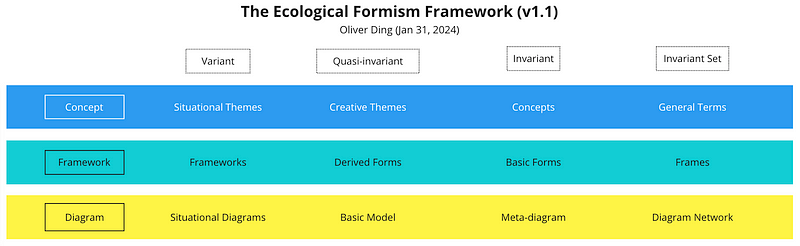
In the Ecological Formism Framework (v1.1), the “Concept” level only talks about the hierarchy of a single theme or a single concept. I use the term “Theme Network” and the term “Concept System” to describe their networks. In this article, I will use “Concept System” for the present discussion.
What’s the relationship between the “Concept” level and the “Framework” level?
Some “Concept Systems” are developed for understanding some particular activities or social practices, these kinds of “Concept Systems” are called “Knowledge Frameworks”.
All knowledge frameworks are concept systems, but not all concept systems are knowledge frameworks. In other words, Knowledge Frameworks are a sub-set of Concept Systems.
What’s the relationship between the “Framework” level and the “Diagram” level?
Knowledge Diagrams are External Visual Representations of Knowledge Frameworks. There is no strict correspondence between Knowledge Diagrams and Knowledge Frameworks. Some knowledge frameworks can be represented by using tables, not diagrams. Some diagrams such as meta-diagrams are only about spatial structure, not about particular domain knowledge.
There is also a loose correspondence between “a network of knowledge frameworks” and a “Diagram Network”. We could use a Diagram Network to develop a Network of Knowledge Frameworks.
Let’s see some examples.
The Concept of “Knowledge Center”
From Jan 2022 to Dec 2023, I worked on developing a concept called “Knowledge Center”.
The notion of “Knowledge Center” was born from a talk about Activity Theory and the Activity Analysis project.
On Jan 2, 2022, I had a 71-minute talk with a friend of mine. He is an active curator of early local TEDx events in China. In recent years, he also curated local Design Sprint events in China. In addition, he often curates innovation workshops for local communities.
A knowledge center is a collective project that aims to develop a certain unique knowledge. A “center” should have its uniqueness to establish its identity and theme. Otherwise, there is no need to build a “center”.
I briefly introduced the development of my studio CALL in 2021. At the end of the talk, we chatted about the future of CALL in 2022. I mentioned the Activity Analysis project. I told him that I’d like to run it as a “Knowledge Center”.
The notion of Knowledge Center is a new spark for me. I didn’t use the term to describe the Activity Analysis project before the talk. As a new spark, it emerged from a conversation.
I considered “Knowledge Center” as a small-scale level. If a “Knowledge Center” establishes a high degree of influence, it becomes a “Knowledge Community”. In other words, the “Knowledge Center” is the seed stage of the “Knowledge Community”.
The Model of Building A Knowledge Enterprise
Later, I developed a model for building a knowledge enterprise. See the diagram below.
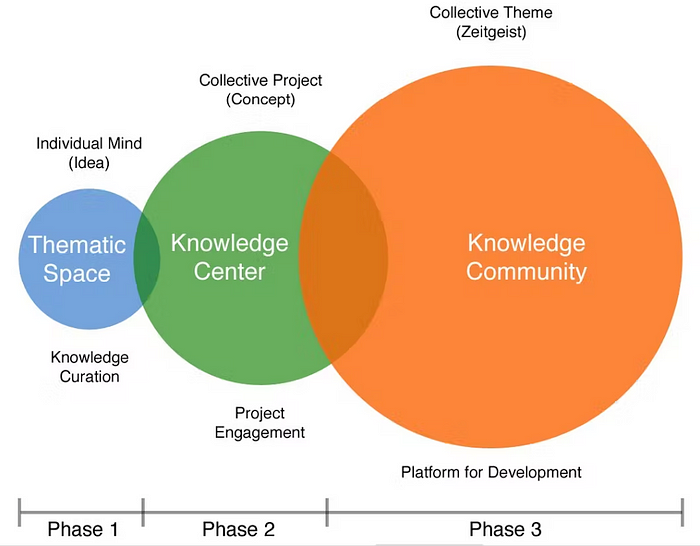
The model is inspired by Project-oriented Activity Theory. Each phase refers to a focus. The three-phase development is inspired by the following diagram which is one of a series of diagrams in the book.
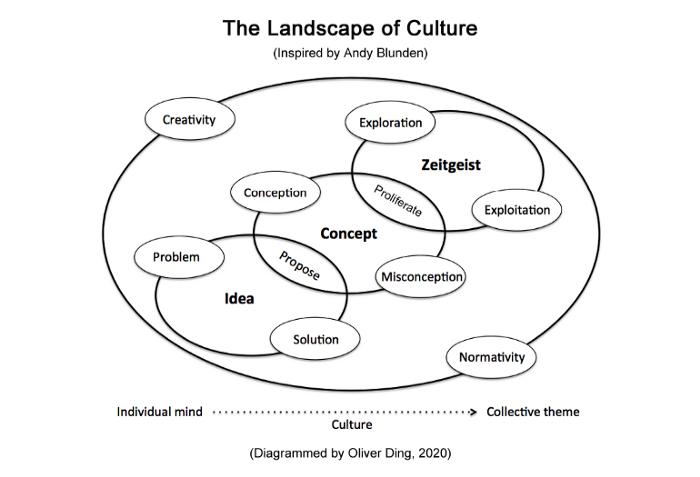
I used the above diagram to explain the concept of “culture” from the perspective of Project-oriented Activity Theory. It zooms out to a large view that connects the Individual mind (Idea) and Collective theme (Zeitgeist) through Collective Projects (Concept).
Each Knowledge Enterprise is defined by a unique theme and it should be developed by its founders with a unique perspective.
While Phase 1 is about an individual mind, Phase 2 is about a collective project.
Phase 3 is building a Knowledge Community. The difference between Knowledge Center and Knowledge Community is Scope and Scale. A knowledge center may only have less than 15 members while a knowledge community may have thousands of members.
We can also see a new version of the above model:
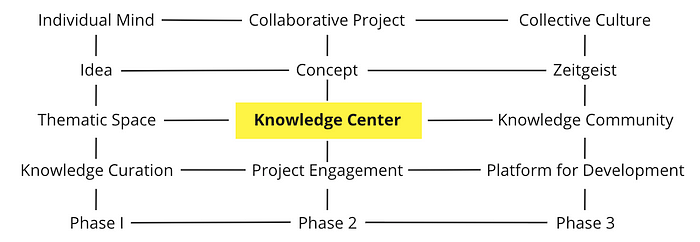
The above model is a Semiotic System Diagram which is a network of themes or concepts. The concept of “Knowledge Center” is part of the network.
the concept of “Knowledge Center” (#6) was derived from the network because its meaning was defined by the network, not its name. See the diagram below.
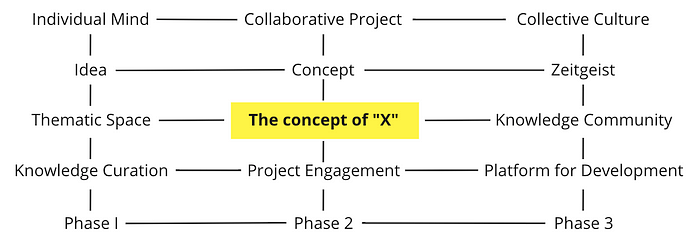
In the above diagram, the meaning of “X” was defined by its surroundings and the whole network. I just used the word “Knowledge Center” to name this meaning.
We have to notice that the above network was inspired by the Landscape of Culture.
So, the concept of “Knowledge Center” is framed by two contexts:
- Activity: My real projects of building a set of knowledge centers
- Knowledge: The Landscape of Culture model and Project-oriented Activity Theory
The diagrams are used to represent the model of Building A Knowledge Enterprise.
You can find more details in the links below:
- CALL: How to Grow A Knowledge Enterprise — May 6, 2022
- TALE: A Possible Theme called “Knowledge Center” — March 22, 2023
- Mental Moves #1: The Transformation of Mental Elements — March 30, 2023
The Creative Course Framework
From Oct 2022 to April 2023, I worked on developing Creative Life Theory. The outcome was curated in a possible book titled Creative Life Theory: Building A Knowledge Enterprise.
A major outcome of Creative Life Theory (v2.0) is a meta-framework called Creative Course framework which is inspired by Ping-keung Lui’s Theoretical Sociology. See the diagram below.
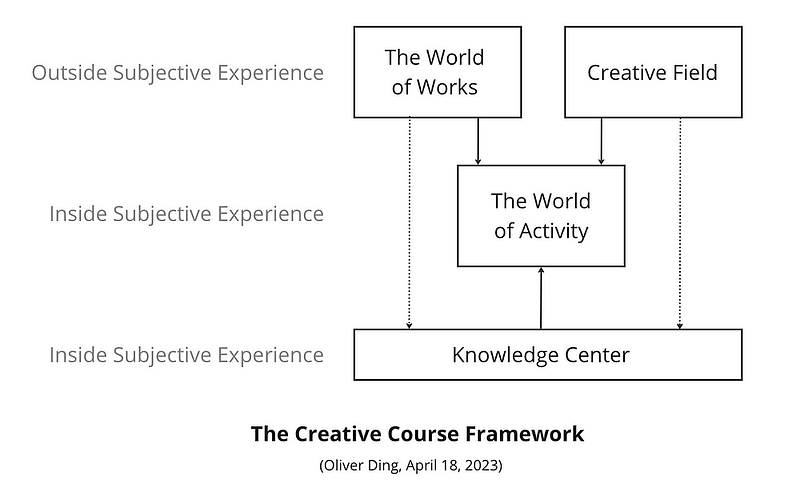
The Creative Course Framework was inspired by Lui’s Subjectivist Structuralism which is part of his theoretical sociology.
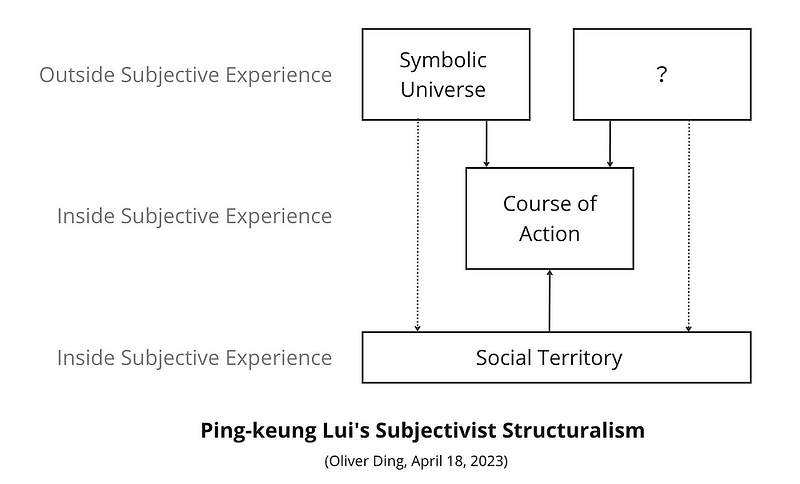
The Creative Life Theory (v2.0) can be seen as a new social theory for understanding knowledge creators’ life course. In this way, I adopted Lui’s subjectivist structuralism to generate the Creative Course framework.
In the Creative Course framework, the concept of “Knowledge Center” is associated with other three concepts.
- I use the “World of Activity” to refer to the course of action of creators. The term was inspired by social phenomenologist Alfred Schutz’s term “The World of Working”.
- I use the “World of Works” to describe knowledge creations such as theories, concepts, frameworks, books, papers, etc.
- The term “Creative Field” was inspired by 1) French social theorist Pierre Bourdieu’s Field theory, and 2) Creativity research scholar Mihaly Csikszentmihalyi’s Social Systems Model of creativity.
A knowledge center is a collective project that aims to develop certain unique knowledge.
Based on the Creative Course framework, I also connect it with other models and frameworks. See the expanded version below.
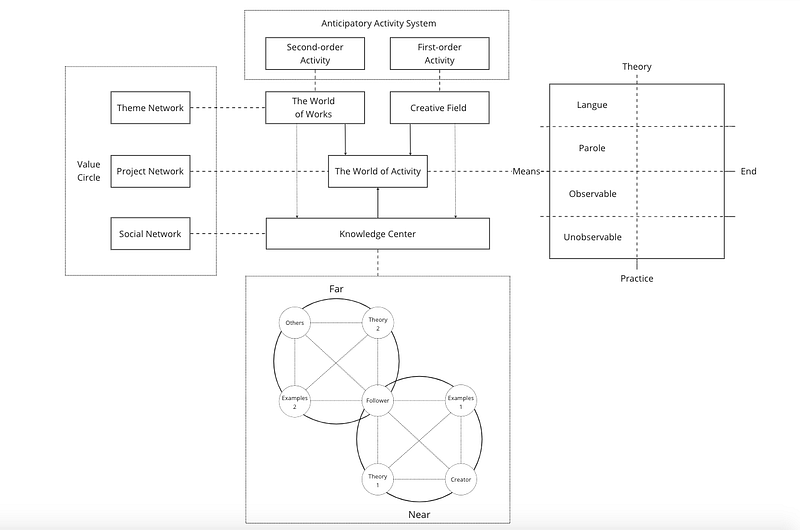
The above large diagram is the outcome of a Diagram Blending process. You can see five sub-diagrams that represent five frameworks.
- Center: The Creative Course Framework
- Left: The Value Circle Framework
- Right: The Universal Reference Framework
- Up: The Anticipatory Activity System Framework
- Down: The Knowledge Circle Framework
The Knowledge Circle Framework was born from a research project about Lui’s knowledge center.
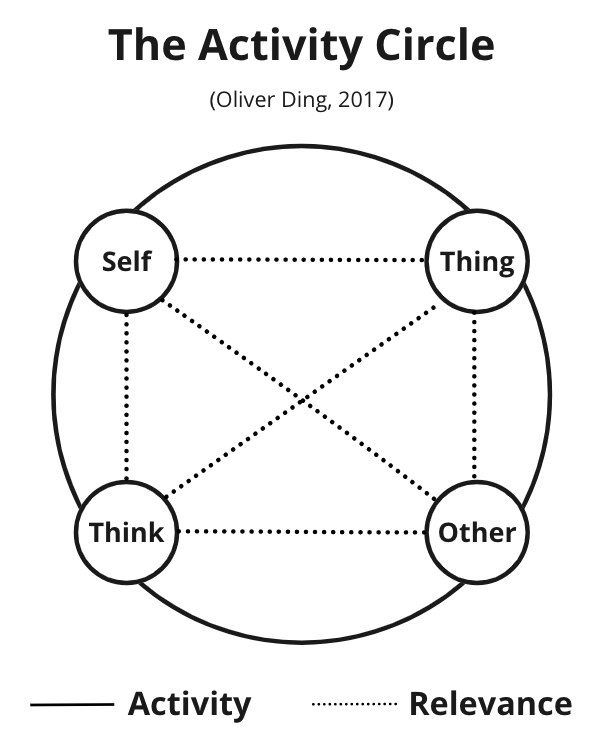
Originally, I applied the Activity Circle model to develop a new model for understanding Knowledge Center in general. The diagram below is the Activity Circle model.
The diagram below is the new model for the Knowledge Center project.
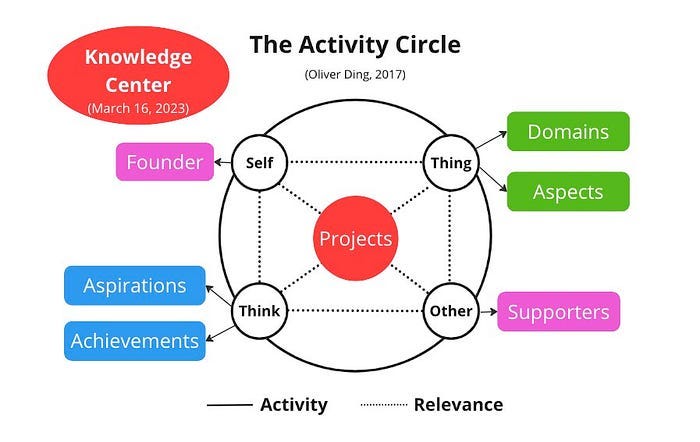
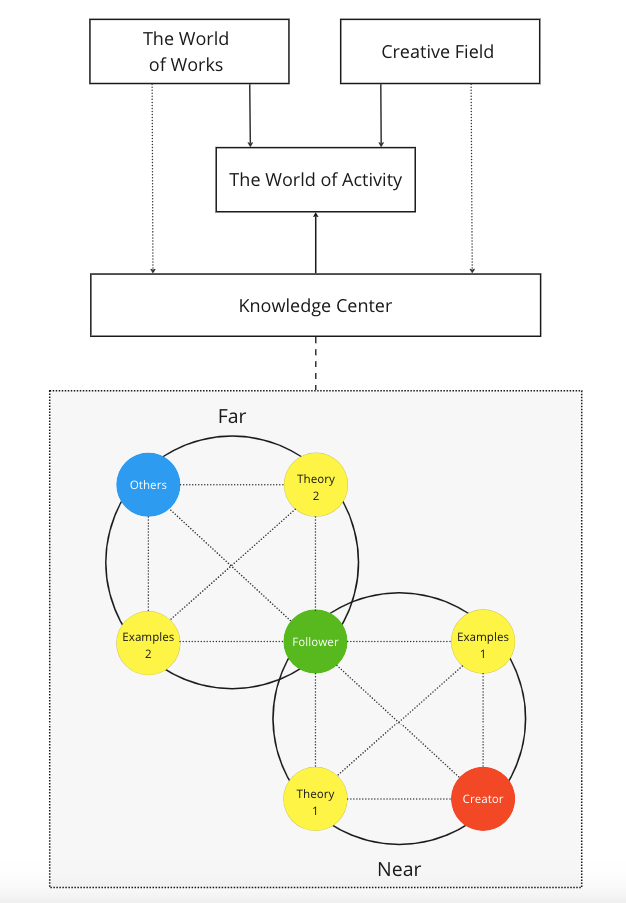
However, I found the above model is not suitable for Lui’s knowledge center’s activities. Thus, I used a different version of the Activity Circle model to make a diagram for studying Lui’s knowledge center.
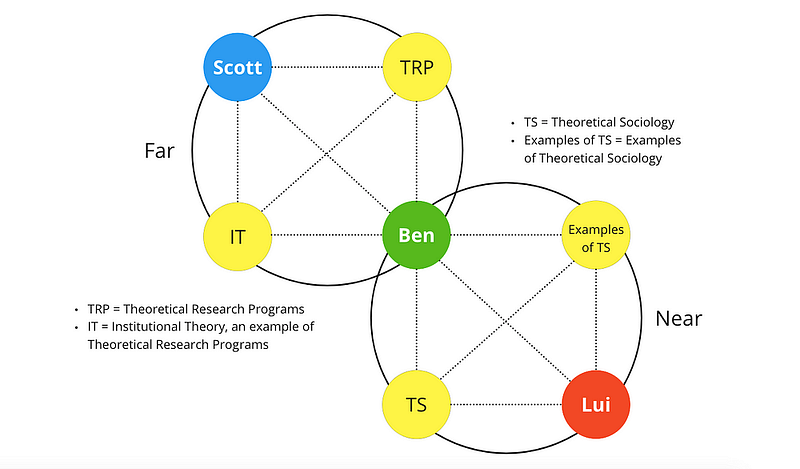
After publishing Gaze, Actions, and the Social World in 2007, Lui continuously develop his account of Theoretical Sociology. We can roughly see his activities about Building Theoretical Sociology as a Knowledge Center.
From 2012 to 2017, Lui used email and WeChat to host a small academic group for discussing his Theoretical Sociology. After reading the archive of their discussions, I used double activity circles to represent a typical pattern of the discussions.
I also used “Knowledge Circle” to name this new model.
In this project, we see two new contexts:
- Activity: My real project of research Lui’s Creative Life and the knowledge center of Theoretical Sociology
- Knowledge: Lui’s Subjectivist Structuralism, his Theoretical Sociology, and the Activity Circle model
You can find more details in the links below:
- A New Possible Book: Knowledge Engagement — April 19, 2023
- Creative Life Theory (v2, book, 2023) — Oct 6, 2023
- Knowledge Engagement: The Creative Course Framework — July 18, 2023
- Knowledge Engagement: The Expanded Creative Course Framework — July 25, 2023
- Value Circle #2: Engaging with Lui’s Theoretical Sociology — August 9, 2023
- The Activity Circle (Oliver Ding, 2017)
- Diagram Blending: “Activity Circle” + “Concept Dynamics” — July 31, 2022
The Hierarchy of Knowledge Centers
In July 2023, I worked on the Menta Moves project that aims to collect related articles about the concept of “Attachance” and more examples about “Moving between Thematic Spaces”.
One case study of the project is “Mental Moves between Knowledge Centers”. In order to conduct the case study, I developed the hierarchy of knowledge centers. See the diagram below.
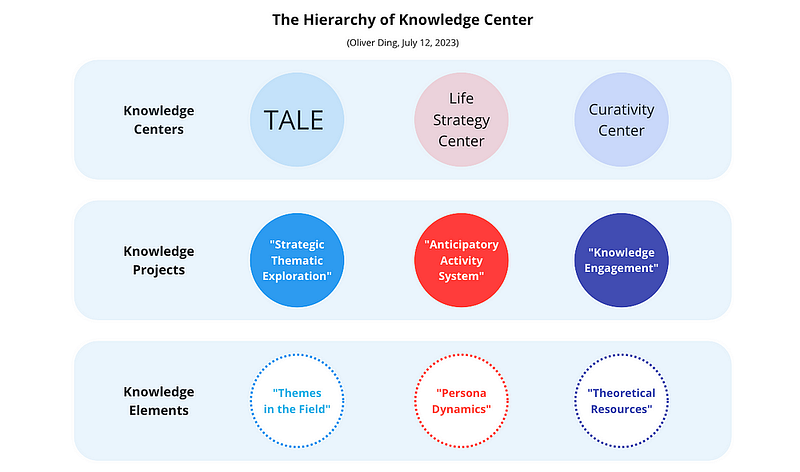
The above three-level hierarchy of knowledge center echoes Activity Theory’s hierarchical model.
The hierarchical structure of activity was originally conceptualized by A. N. Leontiev (1978). We have to notice that the goal of Leontiev was developing a psychological theory at the individual level with the concept of Activity. Thus, we will see three levels of activity correspond to three levels of psychological notions. The three levels of activity are activity, actions, and operations. The three levels of psychological notions are motive, goals, and conditions.
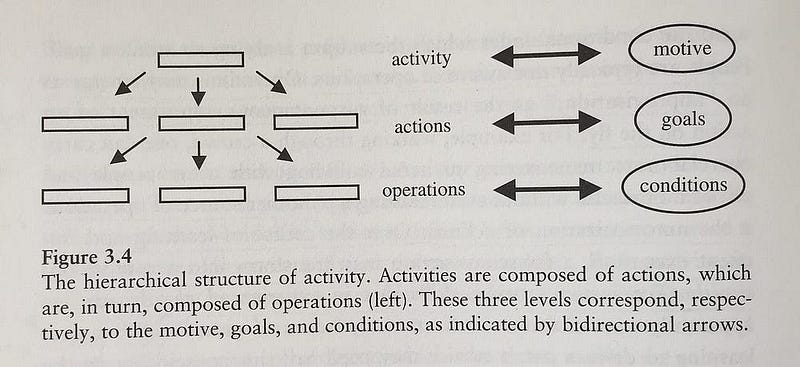
The three levels of knowledge centers roughly correspond to three levels of activity:
- Knowledge Center > Activity (Building Knowledge Enterprise Activity)
- Knowledge Projects > Actions (Develop Knowledge Frameworks)
- Knowledge Elements > Operations (Work on Pieces of Knowledge )
The Project Engagement approach uses “Project” as the unit of analysis of Activity. If we see a knowledge center as a Project, then knowledge projects can be seen as sub-projects.
In this project, we see two new contexts:
- Activity: My real project about “Mental Moves” and the concept of Attachance.
- Knowledge: The hierarchical structure of activity (Activity Theory)
You can find more details in the links below:
- Mental Moves #8: The Hierarchy of Knowledge Centers — July 13, 2023
- Value Circle #3: TALE as A Thematic Transformation Hub — August 31, 2023
Joint Knowledge Center and Value Circle
From Sept 2023 to Dec 2023, I started a new activity: building a joint knowledge center with a friend of mine.
The concept of “Joint Knowledge Center” is a new sub-concept of the concept of “Knowledge Center”.
The new knowledge center has a code name: Mental Engagement Center.
The diagram below represents several significant moments of the journey from Sept 2023 to Dec 2023.
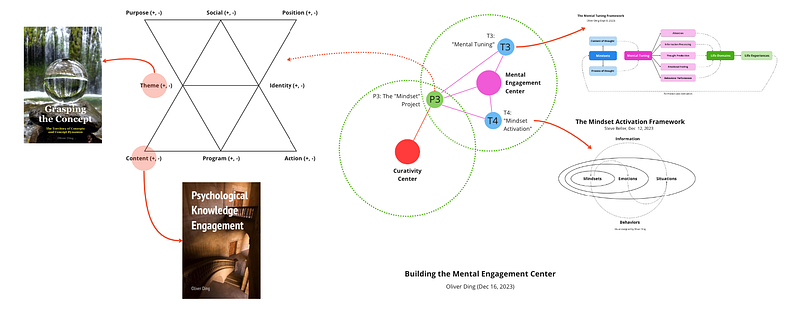
As mentioned above, the “Mental Engagement Center” is a code name. It was not real in Sept 2023. However, I used it as a Possible Knowledge Center and connected it with Activity Analysis Center and Curativity Center.
In this way, we build a Minimal Value Circle:
- Two People
- Three Knowledge Centers
- Two Projects
A Value Circle is a set of networked knowledge centers. While the Value Circle is a Whole, each knowledge center is a Part.
In this project, we see two new contexts:
- Activity: My real project about “Value Circle” and the concept of “Joint Knowledge Center”.
- Knowledge: The Value Circle model and the Developmental Project model
You can find more details in the link below
- Value Circle #5: Building A Joint Knowledge Center — Dec 29, 2023
Concept System and Knowledge Frameworks
What can we learn from the above example?
As mentioned above, a Concept System is a set of connected Concepts. Knowledge Frameworks are a sub-set of Concept Systems.
The concept of “Knowledge Center” was associated with different concepts in different projects:
- The Model of Building A Knowledge Enterprise
- The Creative Course Framework
- The Knowledge Circle Framework
- The Hierarchy of Knowledge Centers
If we use the “Conceptual Elaboration” framework to understand it, we can find different types of connections. In The Theme of “Conceptual Elaboration”, I mentioned three critical challenges in the phase of Conceptual Elaboration:
- Internal Integration: curate our pieces of ideas into a meaningful conceptual framework or concept system, understand the Part — Whole relationship
- External Alignment: compare our ideas with other ideas, understand the Collaboration — Competition relationship
- Cultural Projection: match our ideas with cultural needs, understand the Means-End relationship
What about the Internal Integration challenge? The frameworks below are about the internal dynamics of “Knowledge Center”:
- The Knowledge Circle Framework
- The Hierarchy of Knowledge Centers
What about the External Alignment challenge? The frameworks below are about the external dynamics of “Knowledge Center”:
- The Model of Building A Knowledge Enterprise
- The Creative Course Framework
What about the Cultural Projection challenge? We can pay attention to the following notions:
- 2022: The “Uniqueness” of Knowledge Center
- 2023: The “Wholeness” of a Networked Knowledge Centers
In 2022, I considered Uniqueness as the starting point of a “Knowledge Center”.
A knowledge center is a collective project that aims to develop certain unique knowledge. A “center” should have its uniqueness in order to establish its identity and theme. Otherwise, there is no need to build a “center”.
In 2023, the issue is about the complexity of a network of knowledge centers.
How can we keep the uniqueness of individual knowledge centers while we can build the synergy effects of a network?
Inspired by the Project Engagement approach (v2.1)’s six units of analysis, I realized that I could use “Units of Analysis” to connect the following seven knowledge centers together.
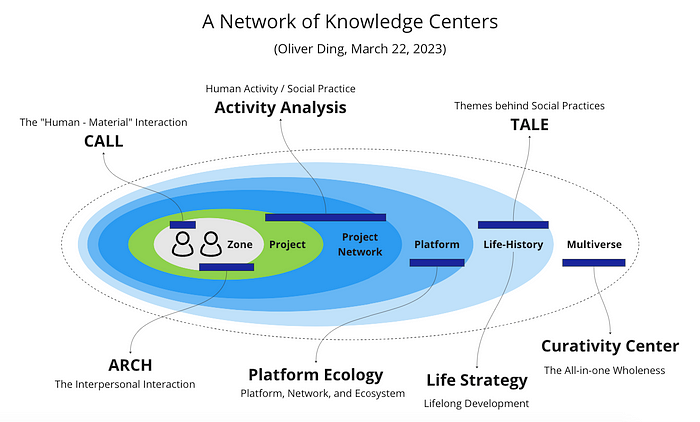
1. CALL(Creative Action Learning Lab) Center The “Human — Material” Interaction
2. ARCH Center The Interpersonal Interaction
3. Activity Analysis Center Human Activity/Social Practice
4. Platform Ecology Center Platform, Network, and Ecosystem
5. Life Strategy Center Lifelong Development
6. TALE (Thematic Analysis Learning Engagement) Center Themes behind Social Practices
7. Curativity Center: The All-in-one Wholeness
What does it mean?
In 2022, I used books/theoretical approaches to frame uniqueness. In 2023, I separated theoretical approaches from the wholeness level.
At the wholeness level, the difference between individual knowledge centers is their units of analysis. In this way, I can build a meaningful whole for a network of knowledge centers.
At the uniqueness level, each knowledge center can focus on its aspects, perspectives, frameworks, tools, etc.
In this way, we use three challenges of “Conceptual Elaboration” to frame the dynamic concept system around the concept of “Knowledge Center”.
We can also use the Landscape of Evolving Concept System to expand the concept system. See the diagram below.
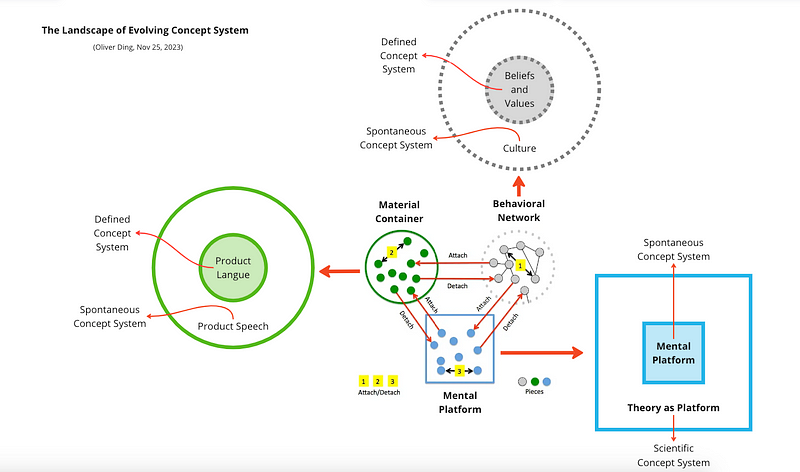
You can find more details in the link below:
- TALE: A Possible Theme called “Knowledge Center” — March 22, 2023
- TALE: The Theme of “Conceptual Elaboration” — Dec 6, 2023
- Mental Platform: The Evolving Concept System — Nov 30, 2023
Diagram Network and Knowledge Frameworks
On Dec 22, 2021, I edited a possible book titled Diagram Blending: Building Diagram Networks.
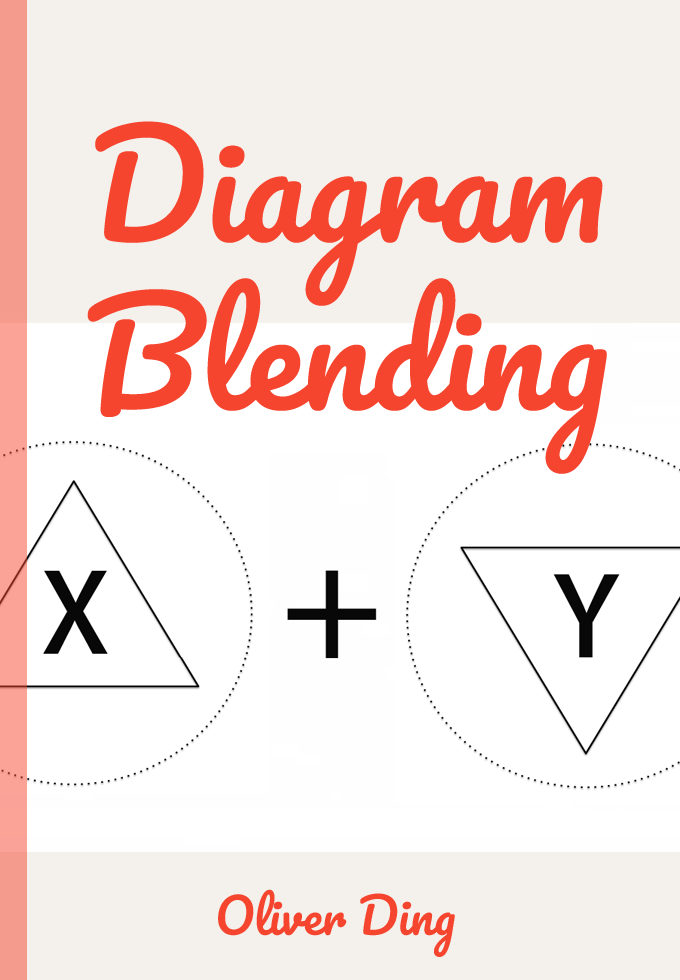
The name “Diagram Blending” is inspired by Conceptual Blending. I want to use the title to pay tribute to Gilles Fauconnier and Mark Turner.
The major difference between Conceptual Blending and Diagram Blending is that instead of using four mental spaces to build the foundation of a theory, I use the Part — Whole Curativity as the foundation. A simple diagram can be considered a part of a complex diagram. By adopting the simple idea of Part and Whole, we can blend diagrams and build a diagram network too. Thus, Diagram Blending is not an application of Conceptual Blending.
Both concepts and diagrams are related to thoughts which is a complicated thing. I wish Diagram Blending could offer a simple method to inspire a new practice of diagramming for thought and expression.
Several diagrams connect and form a network. From the perspective of Activity Theory, the concept of Diagram Network echoes the idea of Activity Network. Each diagram refers to an activity and a Diagram Network refers to an Activity Network. A Diagram Network can be built with the Diagram Blending method or the Diagram Expanding method.
In the above case study, we see the Expanded Creative Course framework. This is a great example of Diagram Blending and Diagram Network.
There are many ways to apply the Diagram Blending approach and build a Diagram Network. For example, I recently explored a new way called “Explore Thematic Spaces”.
The diagram shows the “Perspective — Opportunities — Resources” Thematic Space which is based on the Meaning Discovery Canvas.
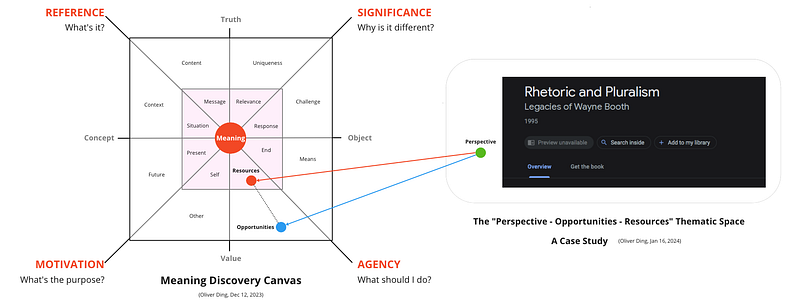
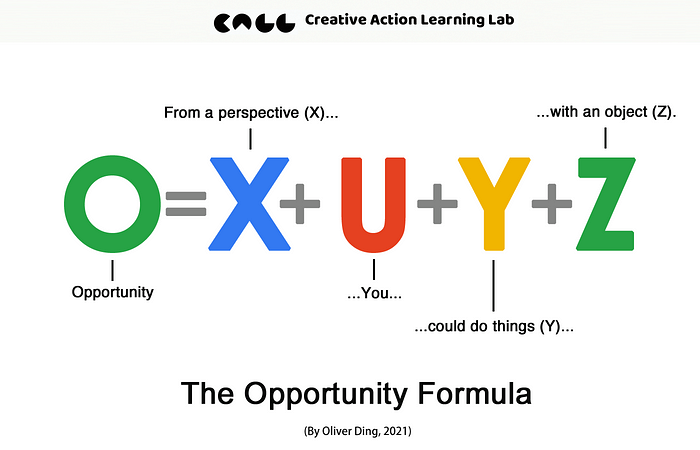
For the “Perspective — Opportunities — Resources” Thematic Space, I adopted the Opportunity Formula as a related Heuristic tool.
You can find more details in the link below:
- Meaning Discovery: The “Perspective — Opportunities — Resources” Thematic Space — Jan 16, 2024
- Diagram Blending: Building Diagram Networks (Introduction) — Dec 22, 2021
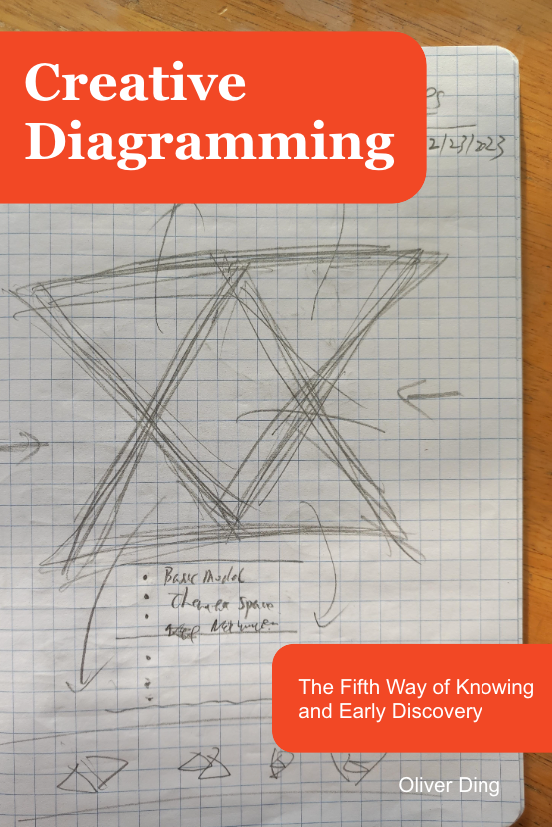
I am going to edit a new possible book about Creative Diagramming and Early Discovery. This post is part of the project.


