avatarPICTURESFROMTHEPAST.NET

Free AI web copilot to create summaries, insights and extended knowledge, download it at here

10472

Abstract

. Plaque on the war memorial, St Ouen, <a href="https://commons.wikimedia.org/wiki/Jersey">Jersey</a>. (Image source: Public Domain).</b></figcaption></figure><h2 id="a2b4">Harold Le Druillenec</h2><p id="8385">Harold’s story, however, continued. While it was never proven that he had listened to the radio broadcast, he was nevertheless convicted and sentenced to<b> </b>five months imprisonment. He had also, in his position as a schoolmaster, refused to teach German to his pupils. (<i>This could easily have given sway in the sentencing</i>).</p><p id="1ec7">Arrested and imprisoned on the 4th of June 1944, and sentenced 22nd of June, an interim of fairly quick transfers followed. From <a href="https://www.frankfallaarchive.org/prisons/st-malo-prison/"><b>St. Malo Prison</b></a> he went to the <a href="https://fr.wikipedia.org/wiki/Prison_Jacques-Cartier"><b>Jacques-Cartier Prison</b></a>, which housed many suspected French resistance members, and on to the third French prison <a href="https://www.frankfallaarchive.org/prisons/fort-hatry-prison/"><b>Fort Hatry — Belfort Gap Prison</b></a> (<i>where his sister was also briefly held, until her final transfer to Ravensbruck</i>). On the 1st of September, he arrived at <a href="https://en.wikipedia.org/wiki/Neuengamme_concentration_camp"><b>Neuengamme Concentration Camp</b></a> in Hamburg.</p><h2 id="900a">Neuengamme</h2><p id="79b2">Neuengamme was one of the largest camps in the Nazi concentration camp system, with more than 85 subcamps.<b> </b>Over 100,000 prisoners came through here during the war and the verified deaths were over 42,900 individuals.</p><p id="9154">Initially built to provide Hamburg with bricks (<i>as Hamburg had been chosen to become one of five<a href="https://en.wikipedia.org/wiki/F%C3%BChrer_city"> <b>Führer cities</b> </a>in the new Reich</i>), it quickly grew and became the center for mainly Russian POWs taken from the Eastern Front.</p><p id="2e78">It was a ruthless regime with daily beatings and arbitrary punishments. The guards and <a href="https://en.wikipedia.org/wiki/Kapo_(Holocaust)">kapos</a> held supreme power with no repercussions nor accountability for the abuse, mistreatment, and subsequent deaths that inevitably followed.</p><figure id="6bc6"><img src="https://cdn-images-1.readmedium.com/v2/resize:fit:800/1*tlNrt-epT_YivVMqLPLOkQ.jpeg"><figcaption><b>Neuengamme Prisoners at forced labor, building the Dove-Elbe canal. </b>The Kapos wear white and black armbands. (Image source: Public Domain).</figcaption></figure><figure id="9cfe"><img src="https://cdn-images-1.readmedium.com/v2/resize:fit:800/1*N4YfNF1o6rydkrrKCVrlMg.jpeg"><figcaption>Prisoners carry large stones up the <b>“Stairs of Death” </b>(<b>Todesstiege</b>) from the Wiener Graben quarry at the <b>Mauthausen</b> concentration camp<b>. Nazi German death camp Mauthausen (after 1940). A photograph taken by the SS of members of the Mauthausen</b> concentration camp’s punishment company being used as “stone carriers” in the camp’s own quarry (the so-called “<b>Wiener Graben</b>”). During this most dangerous work in the Mauthausen concentration camp, they get caught under the wheels of goods lorries or fall over the stairs while working as “stone carriers”, which they often have to <b>climb while running and being beaten. Falling prisoners drag others with them to their deaths.</b> (Image source: <a href="https://en.wikipedia.org/wiki/File:Bundesarchiv_Bild_192-269,_KZ_Mauthausen,_H%C3%A4ftlinge_im_Steinbruch.jpg">Wikimedia Commons</a>). Creative Commons license: <a href="https://creativecommons.org/licenses/by-sa/3.0/de/deed.en">CC BY-SA 3.0. DE DEED</a>.</figcaption></figure><p id="94db">Typhus, tuberculosis, malnutrition, and dehydration were common, with no medication and no health professionals attending to the inmates. If you were taken to the “hospital”, chances were that instead of receiving medicine and care, you would be experimented on, have a lethal injection, or simply be led to the extermination bunkers to be gassed with Zyklon B. As an indication of the severity, the camp’s first commander Otto Thummel was replaced after only 2 months, for being<b> </b>“too humane” to the prisoners.</p><figure id="4581"><img src="https://cdn-images-1.readmedium.com/v2/resize:fit:800/1*lo3CQWWZwE4sNYZ_TBsbMQ.jpeg"><figcaption><b>Zyklon labels from <a href="https://en.wikipedia.org/wiki/Dachau_concentration_camp">Dachau concentration camp</a> used as evidence at the <a href="https://en.wikipedia.org/wiki/Nuremberg_trials">Nuremberg trials</a>.</b> The first and third panels contain manufacturer information and the brand name, and the center panel reads “Poison Gas! Cyanide preparation to be opened and used only by trained personnel”. (Image source: Public Domain).</figcaption></figure><p id="15b5">Harold had only been in Neuengamme 5 days before being sent on “arbeitskommando” (<i>work party</i>) in Wilhelmshaven. Here they were to build what was to become the <a href="https://www.frankfallaarchive.org/prisons/alter-banter-weg-concentration-camp/"><b>Alter Banter Weg Concentration Camp</b></a> — another sub-camp of Neuengamme.</p><p id="5771">By this time Neuengamme had all but become an extermination camp. The inmates were in such poor physical and mental condition that few were able to actually perform any labor.</p><p id="d8d4">Harold worked from 4.30 in the morning until 7.00 at night as an oxy-acetylene welder. He stated about this detail:</p><p id="48d9" type="7">“Banter Weg was a tough camp with torture and punishment the rule day and night. Means of putting inmates to death included beating, drowning, crucifixion, and hanging in various stances … no-one escaped severe corporal punishment”.</p><h2 id="dcce">Bergen-Belsen</h2><p id="b7a3">On the 5th of April 1945, almost 7 months later, he was finally sent to <a href="https://en.wikipedia.org/wiki/Bergen-Belsen_concentration_camp"><b>Bergen-Belsen</b></a> concentration camp. He arrived after 5 days in a cattle wagon and was put in block 13 with 500 other people.</p><figure id="ed73"><img src="https://cdn-images-1.readmedium.com/v2/resize:fit:800/1*ZQSX5KkflNMdiPeWlpNsCg.jpeg"><figcaption><b>Diagram of Bergen-Belsen. Block 13 is within the marked red field, which designates the men’s camp. </b>(Source: Frankfallaarchive.org).</figcaption></figure><p id="c12b">Harold later gave testimony during the <a href="https://en.wikipedia.org/wiki/Belsen_trial"><b>War Crimes Belsen Trials</b></a><b> </b>and stated:</p><p id="186a" type="7">“No food, no water - sleep was impossible. We had to rise at 3.30 am. All my time here was spent heaving dead bodies into the mass graves. Jungle law reigned among the prisoners; at night you killed or were killed; by day cannibalism was rampant”.</p><p id="b342">In an article about the infamous torturer and murderer Irma Grese<b><a href="https://warfarehistorynetwork.com/2018/12/29/irma-grese-the-blonde-beast-of-birkenau-and-belsen/">The Blonde Beast of Birkenau and Belsen</a></b>Harold is mentioned:</p><p id="4b27" type="7">“Harold Osmond le Druillenec, a prisoner at Belsen for its last 10 days, described how a prisoner took a knife and cut out a portion of a corpse’s leg and then ate it. Other prison inmates told the British horrendous tales that the kidneys, livers, and hearts of corpses were being eaten by the starving prisoners”.</p><p id="3ed2">At first, Bergen-Belsen was constructed under the name “Civilian Internment Camp”, but later this was changed to “Detention Camp” (<i>to avoid any interference from international commissions like the Red Cross</i>). It was never originally intended for Belsen to be an extermination camp (<i>like <a href="http://auschwitz.org/en/"><b>Auschwitz-Birkenau</b></a></i>). It was meant for “hostage prisoners”, unique in the way that whole families were sent here, including large numbers of children and adolescents.</p><figure id="08d2"><img src="https://cdn-images-1.readmedium.com/v2/resize:fit:800/1*NKapdFy6BHFEKJQx79RJWQ.jpeg"><figcaption><b>The Liberation of Bergen-Belsen Concentration Camp, April 1945 Dr Fritz Klein, the camp doctor, standing in a mass grave at Belsen</b>. Klein, who was born in Austro-Hungary, was an early member of the Nazi Party and joined the SS in 1943. He worked in Auschwitz-Birkenau for a year from December 1943 where he assisted in the selection of prisoners to be sent to the gas chambers. After a brief period at Neungamme, Klein moved to Belsen in January 1945.<b> Klein was subsequently convicted of two counts of war crimes and executed in December 1945. </b>(Image source: Public Domain).</figcaption></figure><p id="186d">As the Allied forces tightened their grip on Germany, rather than giving up prisoners, the Nazis kept moving them to still-occupied German territories, resulting in massive overpopulations and quickly deteriorating conditions for the inmates, already barely hanging on.</p><p id="ef50">Druillenec “only” spent ten days in Bergen-Belsen, but what he experienced there haunted him until his death.</p> <figure id="e998"> <div> <div> <img class="ratio" src="http://placehold.it/16x9"> <iframe class="" src="https://cdn.embedly.com/widgets/media.html?src=https%3A%2F%2Fwww.youtube.com%2Fembed%2FP5-hLB_SWds&amp;display_name=YouTube&amp;url=https%3A%2F%2Fwww.youtube.com%2Fwatch%3Fv%3DP5-hLB_SWds&amp;image=http%3A%2F%2Fi.ytimg.com%2Fvi%2FP5-hLB_SWds%2Fhqdefault.jpg&amp;key=a19fcc184b9711e1b4764040d3dc5c07&amp;type=text%2Fhtml&amp;schema=youtube" allowfullscreen="" frameborder="0" height="480" width="854"> </div> </div> </figure></iframe></div></div></figure><h2 id="5811">Aftermath</h2><p id="f095">After finally being freed, Druillenec spent five months in the hospital. The following explains the condition of his body and mind:</p><p id="fbef" type="7">“His ailments included food poisoning with septicemia which led to a ‘perturbing unbalance of mind’. He also had acute dysentery, fluid in the lungs, and various skin diseases including scabies and impetigo. Malnutrition meant that his weight was about six stone (38kg) at the time of his liberation. Longer-term, Le Druillenec was left with a weakened constitution, and his heart and lungs were affected (he suffered a coronary thrombosis in 1961). He also suffered a complete loss of memory of his pre-war life”.</p><p id="052e">Harold spent a fu

Options

rther six months in Horton Emergency Hospital in rehabilitation.</p><p id="091a">As mentioned above, he testified in the Bergen-Belsen Trials in October 1945, interrupting his rehabilitation to do so, and in 1946 and 1947 he bravely gave further testimony in the trials of Neuengamme and Banter Weg.</p><figure id="f939"><img src="https://cdn-images-1.readmedium.com/v2/resize:fit:800/1*_5VwRkOu_71hSsoz7tnA0A.jpeg"><figcaption><b>Josef Kramer, Camp Commandant, photographed in irons at Belsen</b> before being removed to the POW cage at Celle. He was tried and executed for war crimes in December 1945. Kramer joined the Nazi Party in 1931 and worked in concentration camps from 1934 onwards. Kramer became Commandant at Belsen in December 1944, following a period in charge of the gas chambers at Auschwitz. (Image source: Public Domain).</figcaption></figure><p id="c359">His story was so important that at Christmas of 1945, he introduced the King’s Speech and an interview about his experiences was broadcast by the BBC.</p><p id="807d">The sleeve for the photo at the beginning of the article states that Harold is “<i>making good headway under the rehabilitation treatment”</i>, and though while he did return to teaching in 1949, he later had a mental breakdown in the 1950s.</p><p id="12e7">He was asked many questions during the trials, but to the question “<i>What was the atmosphere inside the hut?</i>”, his answer truly sums up his inability to convey the true nature of what he had seen :</p><p id="43cd" type="7">“I think I have told you sufficient to make you realize that the smell was abominable; in fact, it was the worst feature of The Belsen Camp. A night in those huts was something that maybe a man like Dante might describe, but I simply cannot put it into words”.</p><p id="6e36">The total testimony of his horrific experiences in Bergen-Belsen is available <a href="http://www.bergenbelsen.co.uk/pages/Trial/Trial/TrialProsecutionCase/Trial_010_Druillenec.html"><b>here in the official Belsen trial transcripts</b></a>.</p><p id="3ff2">One of only two British survivors of the Holocaust and the only British survivor of the Bergen-Belsen camp, he was given 1835 GBP as compensation for Nazi persecution.</p><figure id="e199"><img src="https://cdn-images-1.readmedium.com/v2/resize:fit:800/0*jQXtlN-BEAyH0912.jpg"><figcaption><b>Application for compensation for disablement resulting from nazi persecution (Original document). </b><i>(Source: <a href="https://www.dailymail.co.uk)">https://www.dailymail.co.uk)</a>.</i></figcaption></figure><p id="631d">Harold Druillenec passed away in 1985, at the age of 73. In 2008 a petition was made to call upon the British Prime Minister, to change the laws in the UK, so that under the <a href="https://en.wikipedia.org/wiki/Orders,_decorations,_and_medals_of_the_United_Kingdom"><b>British Honours System</b></a>, an award could be given to a person posthumously. (<i>This was primarily done to honor the legendary Major <a href="https://en.wikipedia.org/wiki/Frank_Foley"><b>Frank Foley</b></a></i><b>)</b>. This petition gained traction and in March 2009, MP Russell Brown secured 135 signatories.</p><p id="67e7">On the 9th of March 2010, the UK government finally presented 27 people with the new award named <b><a href="https://en.wikipedia.org/wiki/British_Hero_of_the_Holocaust">Hero of the Holocaust</a>”.</b> 25 of these awards were presented posthumously.</p><p id="7fd1">Of the only 25 posthumous awards given, one each was bestowed upon Louisa Gould, Ivy Forster, and Harold Le Druillenec.</p><p id="af26">Parts of this fascinating story have now been made into a motion picture named “<a href="https://www.imdb.com/title/tt5193790/"><b>Another Mother’s Son</b></a>”, featuring Ronan Keating as Harold Le Druillenec.</p> <figure id="33f5"> <div> <div> <img class="ratio" src="http://placehold.it/16x9"> <iframe class="" src="https://cdn.embedly.com/widgets/media.html?src=https%3A%2F%2Fwww.youtube.com%2Fembed%2FA69Pi3PcHPo&amp;display_name=YouTube&amp;url=https%3A%2F%2Fwww.youtube.com%2Fwatch%3Fv%3DA69Pi3PcHPo&amp;image=http%3A%2F%2Fi.ytimg.com%2Fvi%2FA69Pi3PcHPo%2Fhqdefault.jpg&amp;key=a19fcc184b9711e1b4764040d3dc5c07&amp;type=text%2Fhtml&amp;schema=youtube" allowfullscreen="" frameborder="0" height="480" width="854"> </div> </div> </figure></iframe></div></div></figure><p id="2136">The young Russian pilot Feodor Polycarpovitch Burriy — aka “Bill” — survived. He ­returned to a heartful reunion with the other survivors on Jersey in 1995, for the 50th ­anniversary of the liberation, and died in 1998 at the age of 80.</p><h1 id="33da">IF YOU LIKED THIS ARTICLE PLEASE FOLLOW, SUBSCRIBE, AND READ MORE ARTICLES FROM PICTURESFROMTHEPAST.NET BELOW!</h1><div id="230f" class="link-block"> <a href="https://medium.com/@peterdeleuran"> <div> <div> <h2>PICTURESFROMTHEPAST.NET - Medium</h2> <div><h3>Read writing from PICTURESFROMTHEPAST.NET on Medium. We tell the history of the world through the Pictures From The…</h3></div> <div><p>medium.com</p></div> </div> <div> <div style="background-image: url(https://miro.readmedium.com/v2/resize:fit:320/0*oPBROl42O7WTuviG)"></div> </div> </div> </a> </div><div id="2ca2" class="link-block"> <a href="https://readmedium.com/wwii-operation-mincemeat-the-bizarre-plot-that-fooled-hitler-392f8d2abe74"> <div> <div> <h2>WWII Operation Mincemeat — The Bizarre Plot That Fooled Hitler</h2> <div><h3>An elaborate deception that ultimately misled the Germans and played a crucial role in the success of the Allied…</h3></div> <div><p>medium.com</p></div> </div> <div> <div style="background-image: url(https://miro.readmedium.com/v2/resize:fit:320/0*pAhbHVTl1WYkZzTV.jpg)"></div> </div> </div> </a> </div><div id="658a" class="link-block"> <a href="https://readmedium.com/top-secret-caves-that-concealed-hollands-most-priceless-art-from-the-nazis-e34b4211729a"> <div> <div> <h2>Top Secret Caves That Concealed Holland’s Most Priceless Art From The Nazis</h2> <div><h3>During WWII, 800 of the most priceless pieces of art and artifacts were hidden in these caves — embodying almost all…</h3></div> <div><p>medium.com</p></div> </div> <div> <div style="background-image: url(https://miro.readmedium.com/v2/resize:fit:320/1*_JiX6P7EbkAutVYYhjaHyA.jpeg)"></div> </div> </div> </a> </div><div id="b8af" class="link-block"> <a href="https://readmedium.com/agent-zigzag-wwii-the-double-agent-who-walked-the-razors-edge-of-espionage-99256eb92079"> <div> <div> <h2>Agent Zigzag: The Most Notorious Double Agent of WWII</h2> <div><h3>The true story of a gangster, traitor, lover, hero, and spy.</h3></div> <div><p>medium.com</p></div> </div> <div> <div style="background-image: url(https://miro.readmedium.com/v2/resize:fit:320/1*F1y3i9o-l5vec9i4mk614w.jpeg)"></div> </div> </div> </a> </div><div id="b263" class="link-block"> <a href="https://readmedium.com/the-nuremberg-trials-of-1945-1946-justice-for-the-victims-of-nazi-atrocities-31fde41602c9"> <div> <div> <h2>The Nuremberg Trials of 1945–1946: Justice for the Victims of Nazi Atrocities</h2> <div><h3>The Nuremberg Trials, held from November 1945 to October 1946, marked the first international attempt to hold…</h3></div> <div><p>medium.com</p></div> </div> <div> <div style="background-image: url(https://miro.readmedium.com/v2/resize:fit:320/0*es_moCvzHA3fncUA.jpg)"></div> </div> </div> </a> </div><div id="877e" class="link-block"> <a href="https://readmedium.com/the-tragic-story-of-sophie-scholl-how-one-woman-defied-the-nazis-and-paid-the-ultimate-price-2620ab1bf104"> <div> <div> <h2>The Tragic Story of Sophie Scholl: How One Woman Defied the Nazis and Paid the Ultimate Price</h2> <div><h3>The Early Life and Activism of Sophie Scholl</h3></div> <div><p>medium.com</p></div> </div> <div> <div style="background-image: url(https://miro.readmedium.com/v2/resize:fit:320/0*Nxk54SbYyRjBzqhI.jpg)"></div> </div> </div> </a> </div><div id="3d3a" class="link-block"> <a href="https://readmedium.com/wwii-operation-valkyrie-the-failed-plot-to-assassinate-hitler-e8853dfe03bd"> <div> <div> <h2>WWII — Operation Valkyrie: The Failed Plot To Assassinate Hitler</h2> <div><h3>In 1944, a group of Nazi officers and civilians secretly conspired to murder Adolf Hitler.</h3></div> <div><p>medium.com</p></div> </div> <div> <div style="background-image: url(https://miro.readmedium.com/v2/resize:fit:320/0*SsPXdMbQuYZP8Dl7.jpg)"></div> </div> </div> </a> </div><div id="883d" class="link-block"> <a href="https://readmedium.com/wwii-operation-anthropoid-the-assassination-of-reinhard-heydrich-ab53e9023222"> <div> <div> <h2>WWII: Operation Anthropoid — The Assassination of Reinhard Heydrich</h2> <div><h3>The riveting story of Operation Anthropoid, the audacious assassination plot that targeted Reinhard Heydrich, a key…</h3></div> <div><p>medium.com</p></div> </div> <div> <div style="background-image: url(https://miro.readmedium.com/v2/resize:fit:320/0*-iuBedzn7spbWzYa.jpg)"></div> </div> </div> </a> </div></article></body>

WWII: Harold Le Druillenec — Only British Survivor Of The Nazi Camp Bergen-Belsen

Innocently imprisoned and exposed to beatings, torture, and rampant cannibalism, he lived to give testimony in the postwar trials
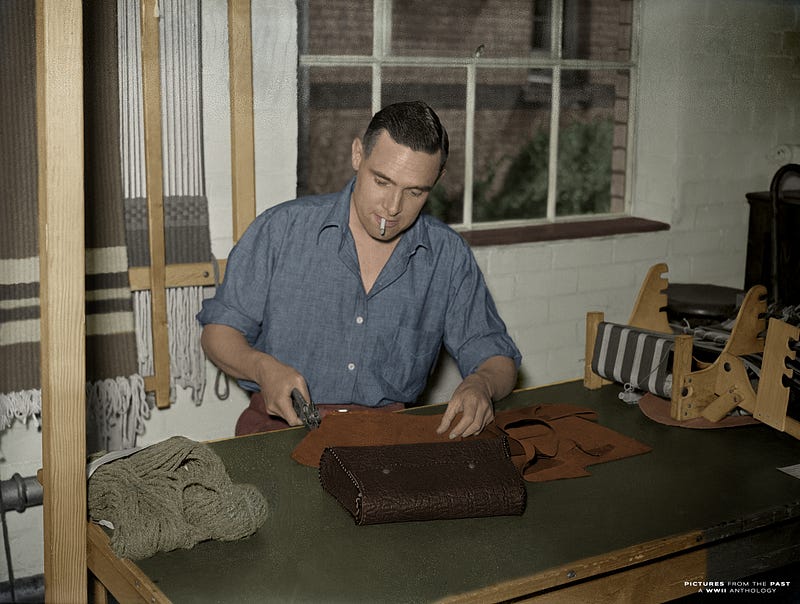
Harold Le Druillenec in rehabilitation after surviving the Death Camps, July 21st, 1945. (Restored/colorized by & courtesy of Peter Deleuran & Topfoto.co.uk. All rights reserved).

“No food, no water, sleep was impossible. We had to rise at 3.30 am. All my time here was spent heaving dead bodies into the mass graves. Jungle law reigned among the prisoners; at night you killed — or were killed; by day cannibalism was rampant”.

Harold Le Druillenec, testimony from War Crimes Belsen Trial

The atrocities committed by the Nazi regime during WWII are arguably some of the most vile war crimes in modern history. Many of the concentration camps were run under the SS practice “Vernichtung Durch Arbeit” — meaning “Extermination Through Labour”.

Between the excruciating 15 hours of daily hard physical labor, the brutal and random beatings by the overseers, and the appalling hygienic conditions, it left little room for interpretation of the German Reich’s intent. These were places you entered but were not intended to leave alive. In fact, only one single British man did.

This is the story of Harold Le Druillenec. One of only two British survivors of the Holocaust and the only British survivor of the Bergen-Belsen camp.

WARNING: THIS ARTICLE CONTAINS GRAPHIC IMAGES WHICH MAY BE DISTURBING TO SOME READERS.
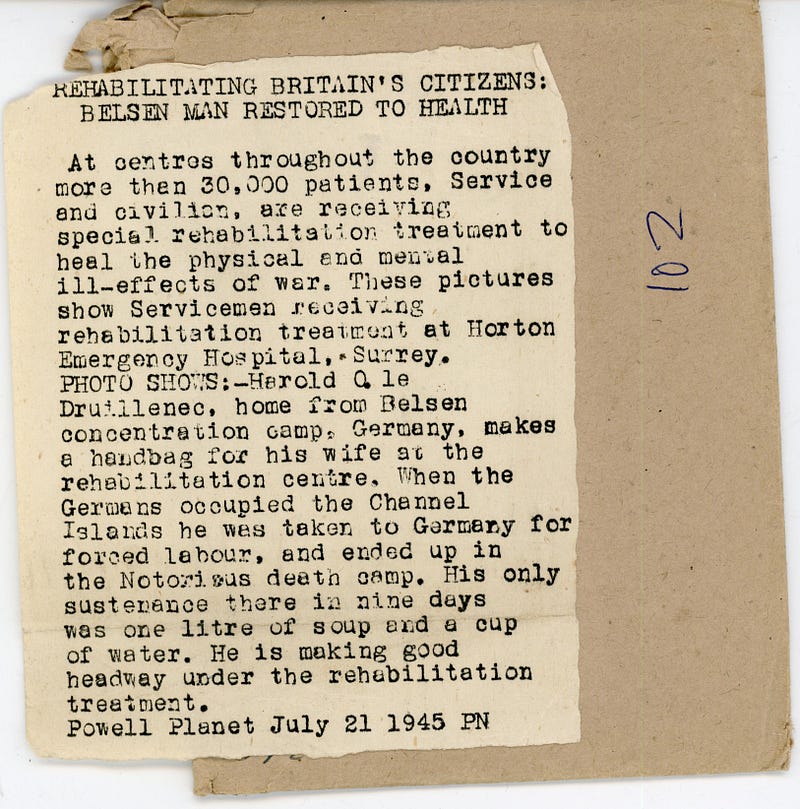
Scan of original press photo sleeve, 1945. “At centres throughout the country more than 30,000 patients, Service and civilian, are receiving special rehabilitation treatment to heal the physical and mental ill-effects of war. These pictures show Servicemen receiving rehabilitation treatment at Horton Emergency Hospital, Surrey. Photo shows: Harold O. Le Druillenec, home from Belsen Concentration Camp, Germany, makes a handbag for his wife at the rehabilitation centre. When the Germans occupied the Channel Islands he was taken to Germany for forced labour, and ended in the Notorious death camp. His only sustenance there in nine days was one litre of soup and a cup of water. He is making good headway under the rehabilitation treatment. Powell Planet July 21 1945 PN”. (Courtesy of Peter Deleuran & Topfoto.co.uk).

Louisa Gould & Channel Islands Resistance

In order to truly understand the circumstances of Harold Le Druillenec, you have to begin with the incredible story of of his sister Louisa Gould and the Russian pilot Feodor Polycarpovitch Burriy.

Louisa Gould was a shopkeeper on the Island of Jersey. During the German occupation, she continued to keep her store open for the people still left behind. She was a part of the Channel Islands Resistance Movement and secretly kept a radio in her house to listen to the Allied news.

In 1942, the Germans ordered all wireless sets owned by the civilian population of Jersey to be handed over, but Louisa kept hers, and every night she and her guests would listen in silence to the BBC news broadcast.
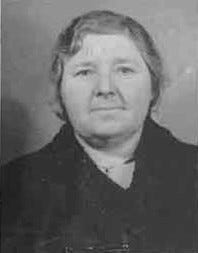
Louisa Mary Gould (1891–1945). (Image source: Wikimedia Commons — Fair Use).

Feodor Polycarpovitch Burriy was a young Russian pilot who was shot down behind enemy lines in October of 1941. He was eventually caught in June of 1942 and was transported to a POW camp in Jersey. He tried to escape twice but was caught and severely beaten. Finally, on the 23rd of September 1942, his third escape attempt succeeded.

”Bill”

For the first 3 months, he stayed with a Rene Le Motte, but informants on the island gave him up and Feodor narrowly escaped the Gestapo again. (The children of Rene Le Motte had by that time adopted Feodor as a brother and named him “Bill”).

Feodor then found Louisa Gould who took him in and kept him hidden for the next 18 months until 1944, claiming he was a friend and also referred to him as “Bill”.

Louisa, herself, had 2 sons fighting for the British. One had died when his ship HMS Bonaventura was torpedoed. Her reasoning for helping Feodor was simple — “She wanted to prevent another mother from losing her son”.
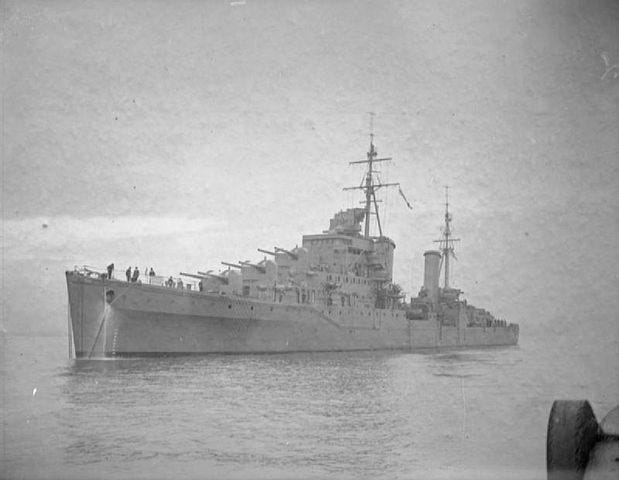
Photograph of British cruiser HMS Bonaventure, 1940. (Image source: Public Domain).

She and her friends, including her sister Ivy, were teaching “Bill” English with a French accent to convince the Germans that he was not Russian.

Unfortunately, a neighbour became suspicious and wrote a letter to the German Secret Field Police (GPF), but luckily addressed it incorrectly. The wrong recipient passed it on to the correct address, but that created a time delay and giving Louisa a warning.

“Bill” was sent to Louisa’s sister Ivy and a frantic cleanup ensued to dispose of all evidence relating to “Bill”. However, they missed a Russian-English dictionary and some papers, so on the 25th of May 1944, Louisa was arrested.

Arrest and Trial

“Bill” fled to Ivy’s, but she had another Russian in hiding, and they knew it was getting dangerous. “Bill” and the other escaped Russian George Koslov were moved again. One week later Ivy was arrested too. The following week Dora and Bertha ( friends of Louisa and mentioned on the following transcript) were also arrested. The last to be arrested was Harold Le Druillenec.

Harold, the younger brother of Louisa, was the Jersey schoolmaster. The informants had not only given Louise and “Bill” up but had also passed on the identity of the frequent guests of Louisa’s to the Germans. It was never proven that Harold had ever listened to the radio, nor done anything else illegal, but that meant little.
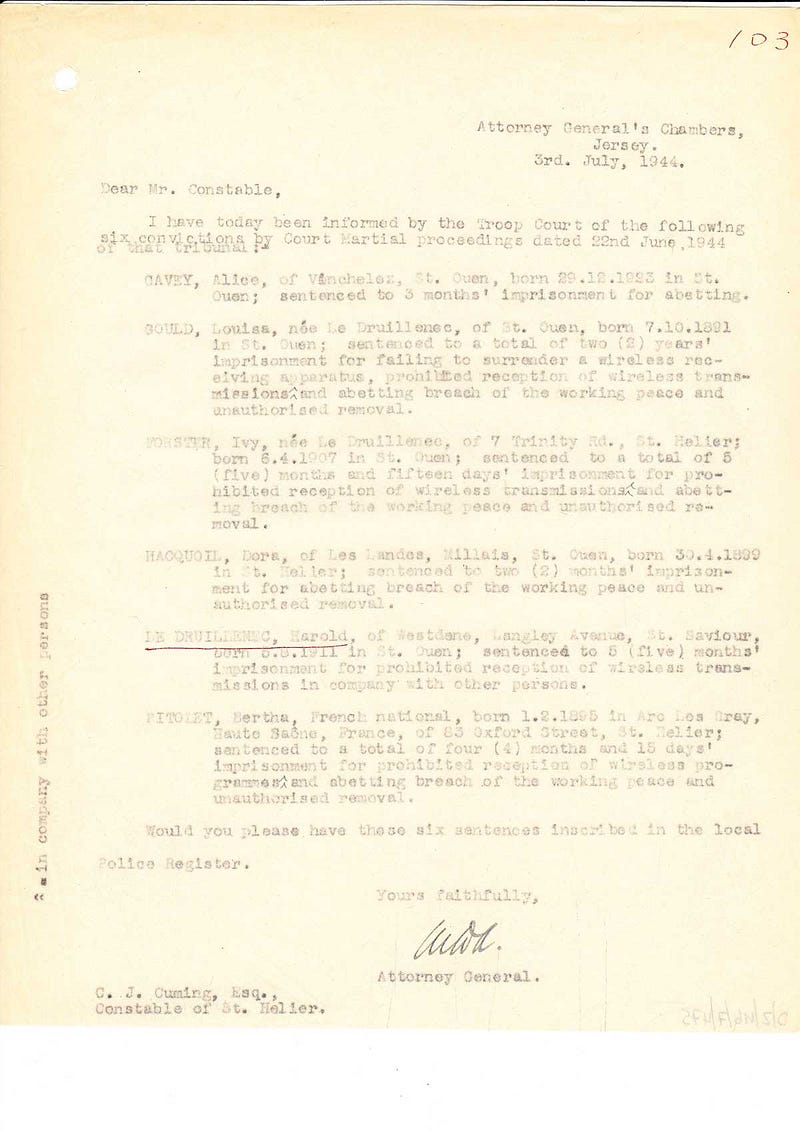
Original sentence document (Courtesy of Jersey Heritage Archives).

Transcript of sentence document:

“Attorney General’s Chambers, Jersey 3rd. July 1944.

Dear Mr. Constable, I have today been informed by the Troop Court of the following six convictions by Court Martial proceedings dated 22nd June 1944 of that tribunal:

CAVEY, Alice, of Vinchelez, St. Ouen, born 29.12.1923 in St. Ouen; sentenced to 3 months imprisonment for abetting.

GOULD, Louisa, Nee Le Druillenec, of St. Ouen born 7.10.1891 in St. Ouen; sentenced to a total of two (2) years imprisonment for failing to surrender a wireless receiving apparatus, prohibited reception of wireless transmissions and abetting breach of the working peace and unauthorized removal.

FORSTER, Ivy, Nee Le Druillenec, of 7 Trinity Rd., St. Helier; born 6.4.1907 in St. Ouen; sentenced to a total of 5 (five) months and fifteen days’ imprisonment for prohibited reception of wireless transmissions and abetting breach of the working peace and unauthorized removal.

HACQUOIL, Dora, of Les Landes, Millais, St. Ouen, born 30.4.1899 in St. Helier; sentenced to 2 (two) months’ imprisonment for abetting breach of the working peace and unauthorized removal.

LE DRUILLENEC, Harold, of Westdene, Langley Avenue, St. Saviour, born 5.8.1911 in St. Ouen; sentenced to 5 (five) months’ imprisonment for prohibited reception of wireless transmissions in company with other persons.

PITOLET, Bertha, French national, born 1.2..1895 in Arc Les Gray, Haute Saone, France, of 83 Oxford Street, St. Helier; sentenced to a total of four (4) months and 15 days’ imprisonment for prohibited reception of wireless transmissions and abetting breach of the working peace and unauthorized removal.

Would you please have these six sentences inscribed in the local police register.

Yours faithfully

Attorney General

C. J. Cuming, Esq.

Constable of St. Helier”.

The trial was completed on the 22nd of June 1944, to the deafening sounds of the battles ensuing in nearby Normandy. All parties were found guilty and sentenced.

Louisa was sent to Ravensbruck Concentration Camp. Here she continued to teach the camp’s inmates English until she was executed in the gas chamber in 1945. Her kindness and generosity were never forgotten.
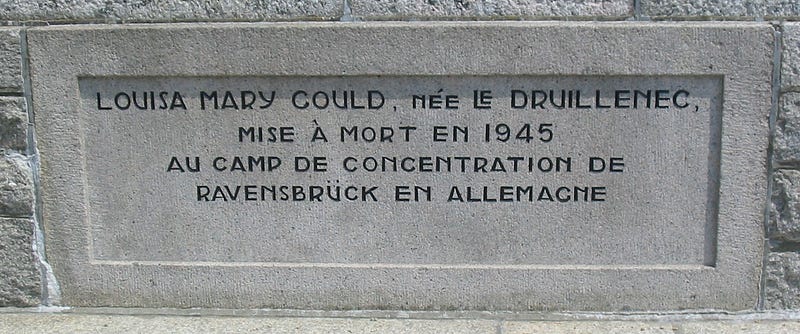
Louisa Mary Gould, a victim of the Nazi concentration camp Ravensbrück. Plaque on the war memorial, St Ouen, Jersey. (Image source: Public Domain).

Harold Le Druillenec

Harold’s story, however, continued. While it was never proven that he had listened to the radio broadcast, he was nevertheless convicted and sentenced to five months imprisonment. He had also, in his position as a schoolmaster, refused to teach German to his pupils. (This could easily have given sway in the sentencing).

Arrested and imprisoned on the 4th of June 1944, and sentenced 22nd of June, an interim of fairly quick transfers followed. From St. Malo Prison he went to the Jacques-Cartier Prison, which housed many suspected French resistance members, and on to the third French prison Fort Hatry — Belfort Gap Prison (where his sister was also briefly held, until her final transfer to Ravensbruck). On the 1st of September, he arrived at Neuengamme Concentration Camp in Hamburg.

Neuengamme

Neuengamme was one of the largest camps in the Nazi concentration camp system, with more than 85 subcamps. Over 100,000 prisoners came through here during the war and the verified deaths were over 42,900 individuals.

Initially built to provide Hamburg with bricks (as Hamburg had been chosen to become one of five Führer cities in the new Reich), it quickly grew and became the center for mainly Russian POWs taken from the Eastern Front.

It was a ruthless regime with daily beatings and arbitrary punishments. The guards and kapos held supreme power with no repercussions nor accountability for the abuse, mistreatment, and subsequent deaths that inevitably followed.
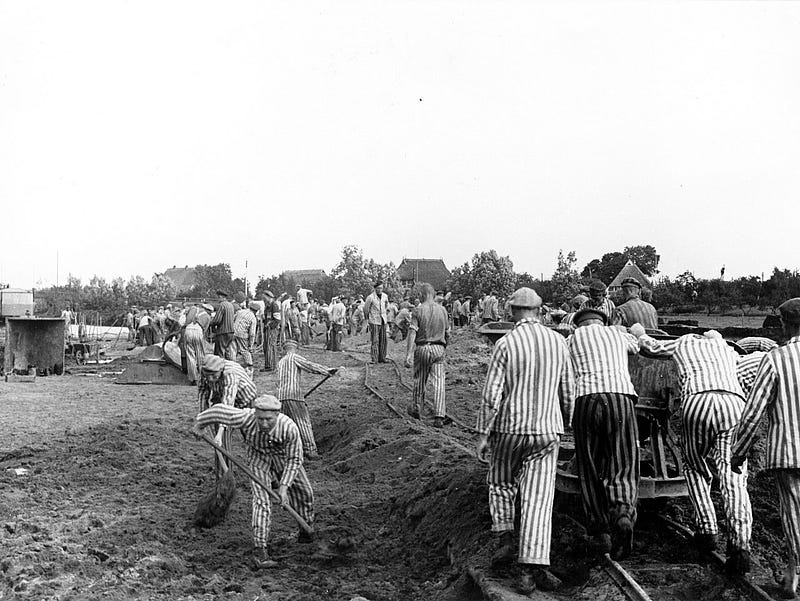
Neuengamme Prisoners at forced labor, building the Dove-Elbe canal. The Kapos wear white and black armbands. (Image source: Public Domain).
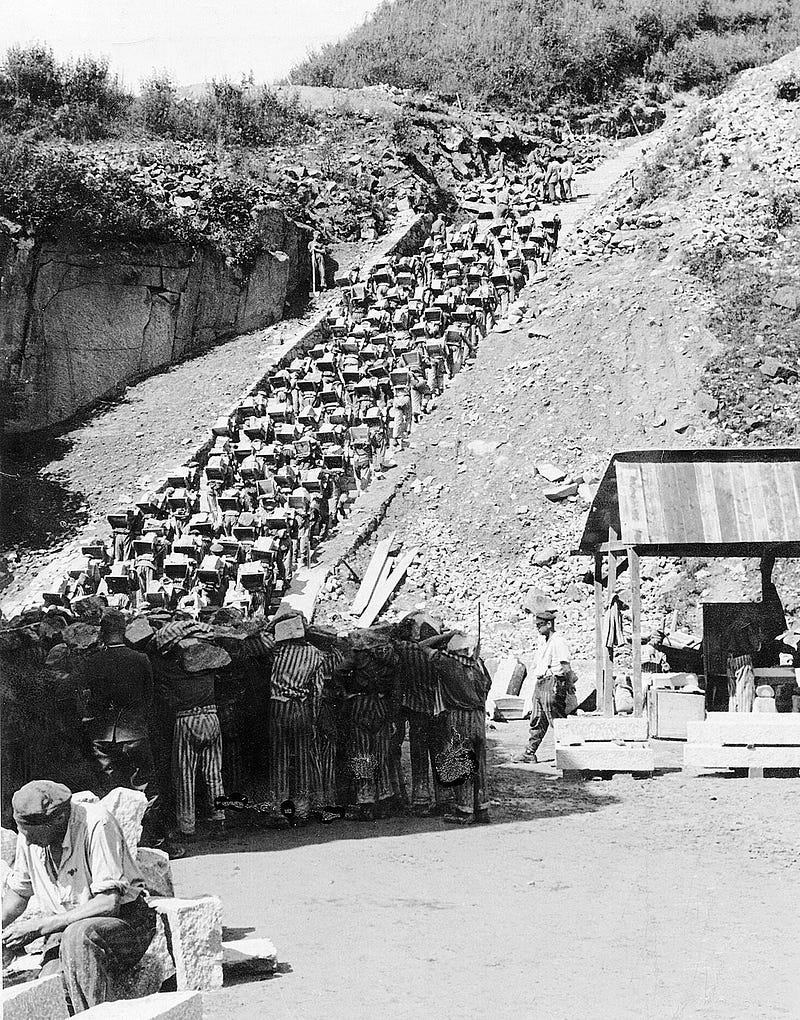
Prisoners carry large stones up the “Stairs of Death” (Todesstiege) from the Wiener Graben quarry at the Mauthausen concentration camp. Nazi German death camp Mauthausen (after 1940). A photograph taken by the SS of members of the Mauthausen concentration camp’s punishment company being used as “stone carriers” in the camp’s own quarry (the so-called “Wiener Graben”). During this most dangerous work in the Mauthausen concentration camp, they get caught under the wheels of goods lorries or fall over the stairs while working as “stone carriers”, which they often have to climb while running and being beaten. Falling prisoners drag others with them to their deaths. (Image source: Wikimedia Commons). Creative Commons license: CC BY-SA 3.0. DE DEED.

Typhus, tuberculosis, malnutrition, and dehydration were common, with no medication and no health professionals attending to the inmates. If you were taken to the “hospital”, chances were that instead of receiving medicine and care, you would be experimented on, have a lethal injection, or simply be led to the extermination bunkers to be gassed with Zyklon B. As an indication of the severity, the camp’s first commander Otto Thummel was replaced after only 2 months, for being “too humane” to the prisoners.
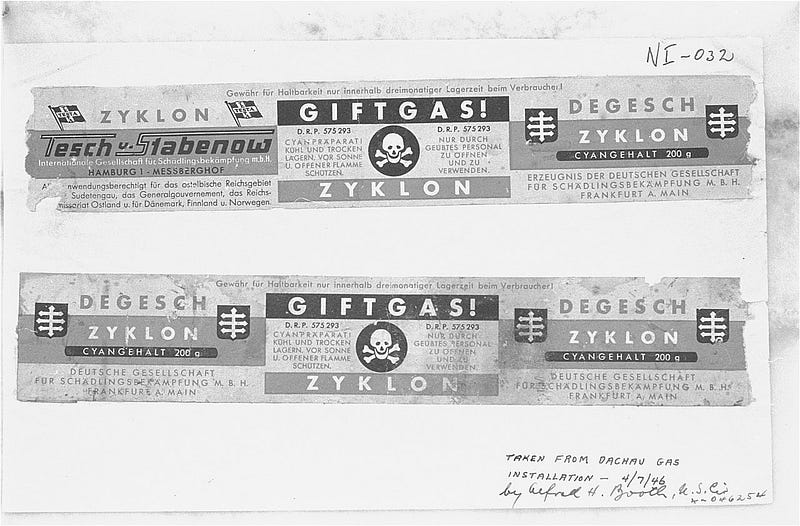
Zyklon labels from Dachau concentration camp used as evidence at the Nuremberg trials. The first and third panels contain manufacturer information and the brand name, and the center panel reads “Poison Gas! Cyanide preparation to be opened and used only by trained personnel”. (Image source: Public Domain).

Harold had only been in Neuengamme 5 days before being sent on “arbeitskommando” (work party) in Wilhelmshaven. Here they were to build what was to become the Alter Banter Weg Concentration Camp — another sub-camp of Neuengamme.

By this time Neuengamme had all but become an extermination camp. The inmates were in such poor physical and mental condition that few were able to actually perform any labor.

Harold worked from 4.30 in the morning until 7.00 at night as an oxy-acetylene welder. He stated about this detail:

“Banter Weg was a tough camp with torture and punishment the rule day and night. Means of putting inmates to death included beating, drowning, crucifixion, and hanging in various stances … no-one escaped severe corporal punishment”.

Bergen-Belsen

On the 5th of April 1945, almost 7 months later, he was finally sent to Bergen-Belsen concentration camp. He arrived after 5 days in a cattle wagon and was put in block 13 with 500 other people.
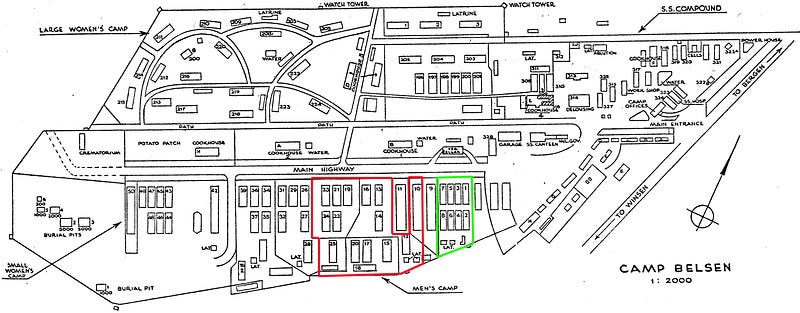
Diagram of Bergen-Belsen. Block 13 is within the marked red field, which designates the men’s camp. (Source: Frankfallaarchive.org).

Harold later gave testimony during the War Crimes Belsen Trials and stated:

“No food, no water - sleep was impossible. We had to rise at 3.30 am. All my time here was spent heaving dead bodies into the mass graves. Jungle law reigned among the prisoners; at night you killed or were killed; by day cannibalism was rampant”.

In an article about the infamous torturer and murderer Irma GreseThe Blonde Beast of Birkenau and BelsenHarold is mentioned:

“Harold Osmond le Druillenec, a prisoner at Belsen for its last 10 days, described how a prisoner took a knife and cut out a portion of a corpse’s leg and then ate it. Other prison inmates told the British horrendous tales that the kidneys, livers, and hearts of corpses were being eaten by the starving prisoners”.

At first, Bergen-Belsen was constructed under the name “Civilian Internment Camp”, but later this was changed to “Detention Camp” (to avoid any interference from international commissions like the Red Cross). It was never originally intended for Belsen to be an extermination camp (like Auschwitz-Birkenau). It was meant for “hostage prisoners”, unique in the way that whole families were sent here, including large numbers of children and adolescents.
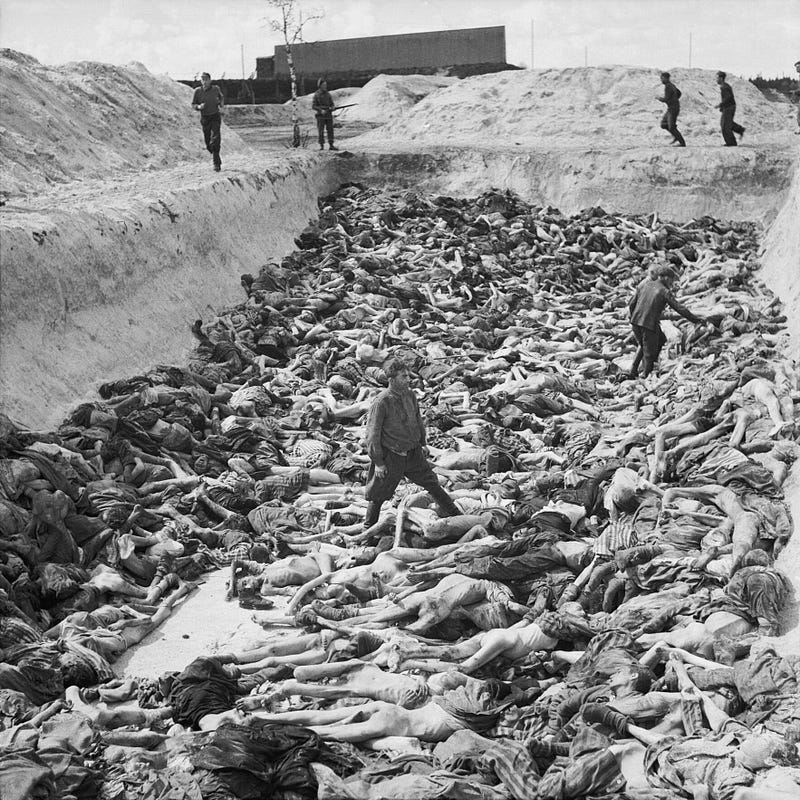
The Liberation of Bergen-Belsen Concentration Camp, April 1945 Dr Fritz Klein, the camp doctor, standing in a mass grave at Belsen. Klein, who was born in Austro-Hungary, was an early member of the Nazi Party and joined the SS in 1943. He worked in Auschwitz-Birkenau for a year from December 1943 where he assisted in the selection of prisoners to be sent to the gas chambers. After a brief period at Neungamme, Klein moved to Belsen in January 1945. Klein was subsequently convicted of two counts of war crimes and executed in December 1945. (Image source: Public Domain).

As the Allied forces tightened their grip on Germany, rather than giving up prisoners, the Nazis kept moving them to still-occupied German territories, resulting in massive overpopulations and quickly deteriorating conditions for the inmates, already barely hanging on.

Druillenec “only” spent ten days in Bergen-Belsen, but what he experienced there haunted him until his death.

Aftermath

After finally being freed, Druillenec spent five months in the hospital. The following explains the condition of his body and mind:

“His ailments included food poisoning with septicemia which led to a ‘perturbing unbalance of mind’. He also had acute dysentery, fluid in the lungs, and various skin diseases including scabies and impetigo. Malnutrition meant that his weight was about six stone (38kg) at the time of his liberation. Longer-term, Le Druillenec was left with a weakened constitution, and his heart and lungs were affected (he suffered a coronary thrombosis in 1961). He also suffered a complete loss of memory of his pre-war life”.

Harold spent a further six months in Horton Emergency Hospital in rehabilitation.

As mentioned above, he testified in the Bergen-Belsen Trials in October 1945, interrupting his rehabilitation to do so, and in 1946 and 1947 he bravely gave further testimony in the trials of Neuengamme and Banter Weg.
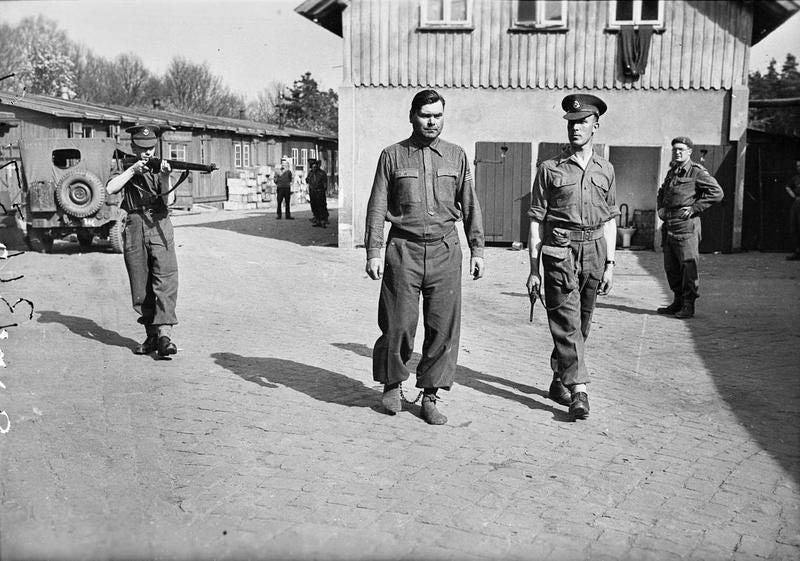
Josef Kramer, Camp Commandant, photographed in irons at Belsen before being removed to the POW cage at Celle. He was tried and executed for war crimes in December 1945. Kramer joined the Nazi Party in 1931 and worked in concentration camps from 1934 onwards. Kramer became Commandant at Belsen in December 1944, following a period in charge of the gas chambers at Auschwitz. (Image source: Public Domain).

His story was so important that at Christmas of 1945, he introduced the King’s Speech and an interview about his experiences was broadcast by the BBC.

The sleeve for the photo at the beginning of the article states that Harold is “making good headway under the rehabilitation treatment”, and though while he did return to teaching in 1949, he later had a mental breakdown in the 1950s.

He was asked many questions during the trials, but to the question “What was the atmosphere inside the hut?”, his answer truly sums up his inability to convey the true nature of what he had seen :

“I think I have told you sufficient to make you realize that the smell was abominable; in fact, it was the worst feature of The Belsen Camp. A night in those huts was something that maybe a man like Dante might describe, but I simply cannot put it into words”.

The total testimony of his horrific experiences in Bergen-Belsen is available here in the official Belsen trial transcripts.

One of only two British survivors of the Holocaust and the only British survivor of the Bergen-Belsen camp, he was given 1835 GBP as compensation for Nazi persecution.
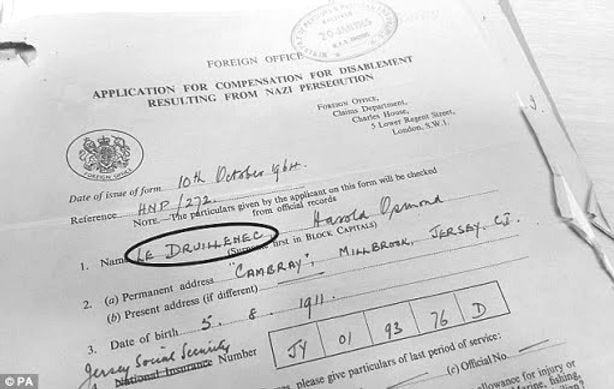
Application for compensation for disablement resulting from nazi persecution (Original document). (Source: https://www.dailymail.co.uk).

Harold Druillenec passed away in 1985, at the age of 73. In 2008 a petition was made to call upon the British Prime Minister, to change the laws in the UK, so that under the British Honours System, an award could be given to a person posthumously. (This was primarily done to honor the legendary Major Frank Foley). This petition gained traction and in March 2009, MP Russell Brown secured 135 signatories.

On the 9th of March 2010, the UK government finally presented 27 people with the new award named Hero of the Holocaust”. 25 of these awards were presented posthumously.

Of the only 25 posthumous awards given, one each was bestowed upon Louisa Gould, Ivy Forster, and Harold Le Druillenec.

Parts of this fascinating story have now been made into a motion picture named “Another Mother’s Son”, featuring Ronan Keating as Harold Le Druillenec.

The young Russian pilot Feodor Polycarpovitch Burriy — aka “Bill” — survived. He ­returned to a heartful reunion with the other survivors on Jersey in 1995, for the 50th ­anniversary of the liberation, and died in 1998 at the age of 80.

IF YOU LIKED THIS ARTICLE PLEASE FOLLOW, SUBSCRIBE, AND READ MORE ARTICLES FROM PICTURESFROMTHEPAST.NET BELOW!

History
War
Wwii
Holocaust
War Crimes
Recommended from ReadMedium