
Women Do Not Think 80 Percent of Men Are Below Average
Nor do they think men are ugly
The 80/20 rule has virtually been accepted as the norm in the world of dating. The idea is the top 80 percent of women compete over the top 20 percent of men, while the remaining 20 percent are left to fight it out over the other 80 percent of men.
So, the idea is that women are too picky and only want the best and as such view the majority of men as below average and undatable.
On many levels, it may seem preposterous that such an idea could gain traction, but gain traction it has and there are several reasons why.
Where this argument has come from
A 2019 study entitled Are men intimidated by highly educated women? Undercover on Tinder found that men swiped right on 61.9% of women on Tinder but women on average only swiped right on 4.5% of men.
To add to this, it’s widely known that in our distant ancestral past, the top males mated with all the women while the rest more often than not simply lost out.
This phenomenon is widely seen throughout the animal kingdom. The males compete for the right to prove their genetics are the best, the ones who succeed then mate with all the females as their reward.
So, all capable females always pass on their genetics but only the most successful males do.
Things did get a bit better for us on the equity front once we started pair bonding, but not that much better, Genghis Khan is probably the best recent example of this — 1 in 200 people are related to him.
It may seem counterintuitive to favour the top men so much at the expense of the others, but in the right environment, the process on many levels is beneficial to evolution and as such is a main staple of sexual reproduction — which by its nature is sexually selective, some say brutally selfish.
Whichever train of thought you wish to take, as it is this way, this is why people attach the Pareto distribution theory to it.
This theory postulates that “80% of outcomes are due to 20% of causes.”
What this means is that the top 20 percent are always the main cause for everything, and this theory has been widely used to explain the wealth distribution of our society i.e. it is believed to explain why the majority of the wealth has always and likely will always be mainly distributed amongst the top 20 percent.
If we attach Pareto distribution to dating, as many do, it would imply that because males can impregnate a lot of females at once, but females can only get impregnated once a year, inevitably, nature will always want the majority of females to try to mate with the top 20 percent of males.
This again further appears to support the 80/20 rule that has become so popular.
What adds further fuel to the fire is the result of a study that was posted on Medium entitled Tinder Experiments II: Guys, unless you are really hot you are probably better off not wasting your time on Tinder — a quantitative socio-economic study.
This study reports that “the bottom 80% of men (in terms of attractiveness) are competing for the bottom 22% of women and the top 78% of women are competing for the top 20% of men.”
This again matches perfectly with the 80/20 rule, and I admit it may seem hard to argue with it considering all this.
It may seem even harder if you consider the widely used graphs from OkCupid.
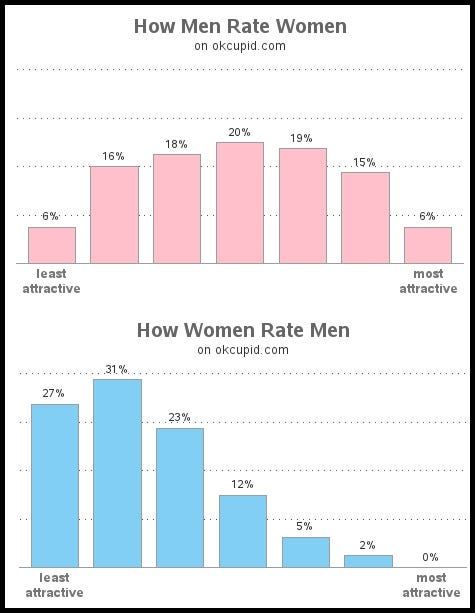
These graphs are especially popular and appear to show that whereas men rate women as attractive and have a normal distribution line from most attractive to least attractive, women appear to think all men are ugly.
However, the devil is in the detail and there is an extremely important factor that is constantly overlooked that shatters the myth of the 80/20 rule.
Why the 80/20 rule when it comes to modern dating is a misrepresentation of data
Women are more sex-selective than men, that is indisputable, but it does not change the fact that every man alive, just as every woman alive, wants to get with the best available option.
Yes, instinctually men have a greater desire to get with all the best women at the same time, but they still have a preference to pick the best one and favour the best one, men wouldn’t so often beg their partners to stay with them after being caught cheating if this was not the case.
So, no matter which way you look at it, men and women both want to get with the best person available to them. What this means is, men are also trying to get with the top women.
This is why the idea that the bottom 80 percent of men are competing over the bottom 20 percent of women is ridiculous, if they were, then those women would be immensely popular and as such would be the most attractive women i.e. the top 20 percent.
They are not, just like the “bottom” 20 percent of men, the “bottom” 20 percent of women struggle to get a date.
As such, dating is just as hard for the vast majority of women as it is for the vast majority of men. The only ones who really succeed are the ones with good social skills.
But there is a difference between men and women when it comes to the dating scene, and this difference does have profound effects on the struggles men and women have when it comes to dating.
Men are more promiscuous by nature
Men are more promiscuous by nature and so — at least when it comes to sex — they are more willing to go down a level than women, and more than just a level.
Women on the other hand rarely have sex with anyone below what you would call their level.
Also, the majority of women don’t want sex hookups, they want to connect with somebody, and even when women do want just sex, most of the time they still want to also connect with that someone. I know I was like this.
The majority of men are not like this — or at least in my experience they are not — the majority of men are happy to just have sex on the way to looking for somebody they connect with.
This in my view is why guys can so easily go down a level when it comes to a person they’re willing to have sex with — they don’t need a connection there to enjoy sex, at least not as much as women do.
This creates a problem because it means that the guys who are willing to go down a level just for sex often mislead women who are not looking for just sex.
So, guys whose intent is just sex have a bad habit of getting it from women whose intent is to connect.
This obviously creates a problem for large numbers of women on dating apps, and this is one of the reasons why so many women shun dating apps in such large numbers.
But only one, there are many many more.
Why dating apps suck for women
Estimates vary but it is widely accepted that somewhere between 70 and 80 percent of Tinder’s close to 80 million users are male — and this is actually an improvement, several years or so back, the male-to-female ratio was believed to have been even higher. In some regions, for example, the UK, 9 in 1 users are believed to be male.
This is consistent across all dating apps — even Bumble — and it represents the real problem, it also helps explains why women appear to favour the top 20 percent of men on dating apps.
If we look back at the data from the first study, which showed that men swiped right on 61.9 percent of women on Tinder, but women only swiped right on 4.5 percent of men, what this actually is showing is that there are a lot more men on Tinder than women.
This matters for debunking the 80/20 rule of dating, because if we accounted for the difference between the numbers of men and women on dating apps, the above figures would actually show that women swipe right on average on approximately 15 percent of the people they are shown, whereas men swipe right on approximately 20 percent of the people they are shown. It’s just because there are a lot more men than women on dating apps, women get a lot more matches.
It’s simple maths. If one person has five options, but those five only have one each, inevitably, that one person is going to get more matches.
So, rather than showing that women are picky, what actually is being shown is that because there are so few women compared to men on dating apps, the women on them get inundated with matches.
This further amplifies a big problem women have with dating apps: how to pick who to progress with.
Women don’t use appearance to judge a person’s dating potential — at least not to the level men do
Never in my life have I looked at a man and thought to myself based on his appearance, that’s the man I am going to date. The majority of the women I know say the same thing.
Don’t get me wrong, I may say that is a man I like the look of, but it doesn’t make me want to have sex with him or enter a relationship with him. I would need to know a lot more about him than just his appearance to feel any inclination for that to happen.
This is because women just do not use appearance to anywhere near the level men do when judging whether to date someone or not, and this is because we don’t have the evolutionary tools to. Nature never gave us them, there was never a need.
Don’t get me wrong, looks matter, but whereas men use looks to select who to date, women only use looks to rule men out.
The below graph perhaps best encapsulates this reality, showing that despite women rating many men very lowly on the attractiveness scale, we still message them back.
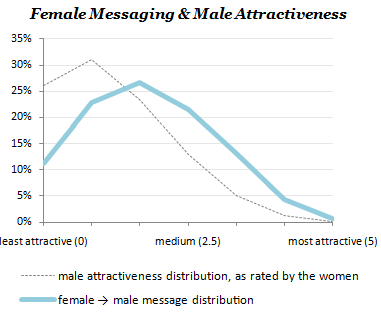
However, you will see that when it comes to men, they greatly favour messaging the best-looking only.
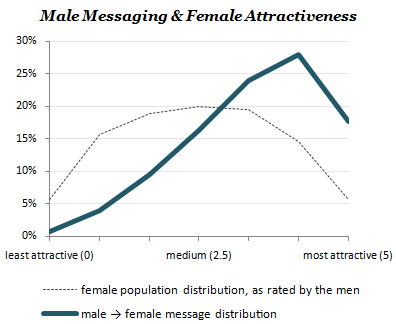
It is basic evolution, men have evolved to use appearance to rate whether a person will make a good mate or not, women have not.
That’s what the OkCupid graphs actually show, they don’t show that women think men are ugly, they show that when it comes to judging a man’s dating potential based on his appearance alone, most of us women are like fish in trees. We can say “no, not him,” but not “yes, him,” all we can say is maybe.
To make a person’s attractiveness go up, we need more than just appearance, and an age and a bio are not enough to constitute more.
What women need to pick a partner
I can only speak for myself here, but what I want to know, and what every woman I know wants to know when it comes to dating, is what is this man’s true intention, then from there, I want to know who he is so I can work out if there is a true connection there. I want to get a real feel for him.
Dating apps do not give me any of this information. They just give me a load of faces but no useful information.
That’s why in truth, when it comes to picking who to progress with out of those I match with, I may as well just pick a name from a hat, my odds would be just as good.
That’s why — when it comes to dating apps — the times I have used them, I often just found myself picking the guy who was the best dressed, or who had the best abs.
It is also why in conversations, I often stopped speaking to a guy for the most innocuous of things. Maybe he kept using the wrong “there”, or he took longer to reply than that other guy, or he always replied quicker than that other guy.
All of these factors are worthless in helping me pick who is best to progress with, but I have to do something to try to select which guy to progress with, to try to work out what his real intentions are, whether he wants to date me, or just f**k me, whether I would even want to date him or just f**k him, and what other options do I have but to use these tactics? None of it is helpful, but what else can I do?
Dating apps are one-sided — but that side is very much on the male side, which is what ruins them for the majority of men as well
Dating apps are suited to men’s mate selection tools in every way but women’s in no way. The irony is, there are those that actually think that we have the power when it comes to dating apps.
We don’t, yes, if we want sex we can get it easily, but the vast majority of us do not just want sex. We want a partner. Even when we do just want sex, the vast vast vast majority of the time we want it with someone we connect with.
Dating apps do not offer the majority of women a path to getting any of this, they actually make it harder for us to get any of this, which is why so many women shun them. The only consistent way I know for women to find a partner is in real life, so we come across a guy or girl in our everyday life, and we just hit it off, and it goes from there.
This could be in a bar, it could be at work, it could be in the gym — where I met my partner — it could be at an event, it could be anywhere.
All I know is that I have met every partner I have ever had through real-life interactions. This is despite the fact that dating apps have given me a gazillion of matches and a lot of dates. I know many women who can say the same thing.
Final words
Dating apps give us access to a lot of faces with ages attached, two factors which men have historically used to select a partner, but not women. As such, when men have matches, they pick the best-looking one to talk to, then the second-best-looking one and so on. When we women have matches, it is a crap shot.
That’s what all the data proves, not that the 80/20 rule is a thing, not that women think men are ugly, not that women are too picky, but that dating apps suck for the majority of women, and they suck so much for the majority of women that inevitably they suck for the majority of men as well, because the majority of women don’t sign up to them. They remain in the real world, hoping that by some miracle they will bump into Mr right.
The problem is, all the men are on dating apps fighting over the few women on them, which means rather than the top 80 percent of women fighting over the top 20 percent of men, it is the top 80 percent of men fighting over the few women on dating apps.
The shit storm that causes women puts many off dating for good both in the digital and real world.
So, it isn’t that women think men are all ugly that is messing up the dating scene, it is that dating apps have made dating ugly.
Thanks for reading! If you enjoyed this, you may also enjoy the following:


