
Why You Need to Reach Boredom in Your Games
The paradox of games enabling you to make your reality engaging and fun

I once discovered a new to me paradox of games, which made complete sense upon closer look.
Games are perfect for learning something new, but they are also supposed to become dull with time. At least if you are not incorporating new elements into them regularly.
Here is a link to a story where I addressed our hunger for new things and experiences, as well as our reluctance to stay with the same activity over and over again, or in other words, to play the same game over and over again.
Around that time when I wrote the excerpt that served as content for the story above, I discovered the following statement by Raph Koster:
“The destiny of games is to become boring, not to be fun. Those of us who want games to be fun are fighting a losing battle against the human brain because fun is a process and routine is its destination.”
— Raph Koster, Theory of Fun for Game Design
This awareness is fantastic, isn’t it? Both the understanding that there are many perfect ways to do the same thing and the realization that games or gamified systems are not a one-off solution for all our troubles and a one-time pill to regain our happiness. They are the stepping stones on our way to identifying what is fun and joyful for us at any given moment.
The same applies to our self-motivational games — the projects, activities, and project management turned into games. They don’t have to and can’t always be fun for us. In various situations, different things are exciting.
Here is what Raph Koster adds to the statement above in an endnote of his acclaimed book Theory of Fun for Game Design:
“The destiny of games: Many games, of course, seem to become more fun as you learn more about them. This has a lot to do with the nature of the challenge presented in those games; they tend to present problems of a certain complexity level that reveals more subtleties the deeper in you go.”
— Raph Koster, Theory of Fun for Game Design
This additional statement might seem like a caveat to the previous one, but it’s not. Some games and projects are multidimensional and have a deeper, changing nature. Real-life projects often have this changing nature. We usually resist it, but seeing and treating them as games can show us how fun they can actually be.
But if you have learned everything you can from your project game (or even if you haven’t but have the definite feeling that you have), then you can either add fun elements to its design to keep you engaged until the end (if you want to finish it), or leave that game and go on to another.
You can come back to playing this project or activity game any time you regain the appetite for it or get a deadline motivating you.
I once asked my then seven-year-old son why he liked Minecraft so much. His first answer was that it’s an “infinitely generated” world where there is always something new, and new rules appear with each new landscape.
Because of these new rules, which you have to read when you enter the new landscape, you must behave differently, to at least some extent, than before.
I asked, “Do these new rules mean you learn something new all the time?”
His answer was, “Yes.”
You can add new types of treasures, adventures, and rules to your real-life project games.
So, when you see anything that comes your way as a game, you have the possibility of learning something, having fun, and being captivated, then, as soon as you notice you are no longer enjoying the game, either adjust its design with new fun elements or switch to another game.
Let me emphasize the central purpose of turning your life into fun games. You are both the designer and the player of your self-motivational games, for the entire time that you are turning your life into games.
It is your responsibility to make and keep your games fun.
Thus never stop improving your games.
Thank you for reading! If you enjoyed this article, then in addition to those quoted above, you might also like these:
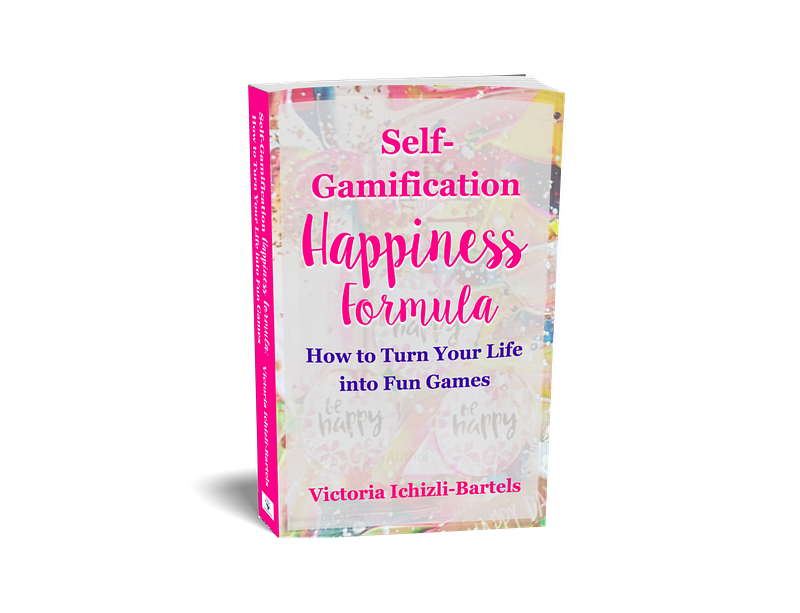
A note to this article: It is a modified excerpt from Self-Gamification Happiness Formula: How to Turn Your Life into Fun Games.
P.S. To stay in touch, join my e-mail list, Optimist Writer.