
2 Reasons Why Gamifying Your Life is a Game of Solitaire
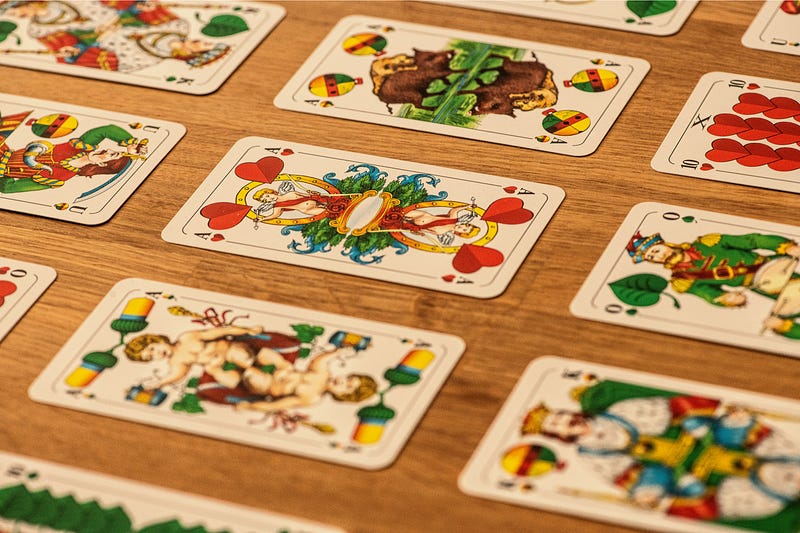
Our lives are full of paradoxes. We, humans, are paradoxical too. We are social beings, but only we, and only for ourselves, can define how our lives unfold with the choices we make and paths we take.
Thus, each of our lives is a “game of solitaire.”
“Solitaire is any tabletop game which one can play by oneself, usually with cards. The term ‘solitaire’ is also used for single-player games of concentration and skill using a set layout tiles, pegs or stones. These games include peg solitaire and mahjong solitaire. Most solitaire games function as a puzzle which, due to a different starting position, may (or may not) be solved in a different fashion each time.” — Wikipedia
There is so much truth and wisdom in this definition when we make a parallel to our lives. Here are these two brilliant and telling bits:
The term ‘solitaire’ is also used for single-player games of concentration and skill.
Most solitaire games function as a puzzle which, due to a different starting position, may (or may not) be solved in a different fashion each time.
Our lives are also single-player games, where we need concentration and skill. We can learn from others and ask for help, but still, we are the sole players in our lives, especially in the way we perceive the world around us and how our lives unfold. Everyone else is busy playing their games.
And yes, our lives are puzzles or rather a vast collection of puzzles. Each moment in them is a starting point offering a new perspective.
If life itself is a “solitaire game,” then gamifying our lives, in other words, turning them into games, is also a single-player game.
There are two reasons for that. They unfold in these two questions:
- Who should be responsible for turning something or anything into games?
- Where should turning of something or anything into games take place?
Here are two excerpts from my book The Who, What, When, Where, Why & How of Turning Life into Fun Games answering these questions.
Who?
Who is responsible for turning projects, activities, and whole lives into games?
The simplest answer is, “You.”
No one else can turn the things in your life into games that you will find fun. You are both the designer and player of your Self-Motivational Games.
Where?
Where should you turn things into games?
Is there a space where the turning of something into games is most appropriate or works best?
Yes. In fact, there is only one possible space for it to happen. Here goes.
The only place to turn anything into a fun game is where you are. I.e., when we are working or doing anything else, we are playing that project or activity game. And the game takes place where the player is. It is where each of us is.
This also means that turning the work of others in a project into a game can only be done where they are, and by them. You can’t do it for them.
So don’t judge others; they are their perfect designers and players too.
Sometimes, when we have success in our life, we might be tempted to judge others who complain about theirs. But remember that you can’t design their games, because your “shoes” won’t necessarily fit them. Only they can develop their own Self-Motivational Games, and create their own experiences.
And also remember that when you judge others, you are complaining too. (I had to chuckle when I observed myself complaining about other people’s as well as my own complaints, for the first time.) And when you are complaining, you aren’t playing your games. So instead of analyzing what others do or don’t do while turning (or not turning) their projects and lives into games, concentrate on playing your games and having fun with them. This is the best way to share Self-Gamification.
A little Self-Gamification glossary:
Self-Gamification: Self-Gamification is the art of turning our own lives into games. It is the application of game design elements to our own lives. Self-Gamification is a self-help approach showing us how to be playful and gameful, and bringing anthropology, kaizen, and gamification-based methods together. In Self-Gamification, we are both the designers and the players of our Self-Motivational Games. Self-Gamification is about creating uplifting emotions for ourselves and keeping ourselves “happily entertained” with whatever comes our way in our lives. Thus, Self-Gamification equals approaching life gamefully.
Self-Motivational Game: A real-life project or activity that you adjust in such a way that it feels like a fun game, with which you are eager and happy to engage, both in terms of its design and the playing of it.
(These definitions are taken from the glossary in Gameful Project Management: Self-Gamification Based Awareness Booster for Your Project Management Success (Gameful Life Book 1))
The answers to the questions “Who?” and “Where” above are the excerpts from my book The Who, What, When, Where, Why & How of Turning Life into Fun Games: A Compressed Version of the Self-Gamification Happiness Formula. I hope you enjoyed this story, and it inspired you to start (or go back to) turning your life into fun games.
Here is another excerpt from this book: