
Why Writers Should Embrace Ebonics Writing Skills More
Assessing the power of language inclusivity
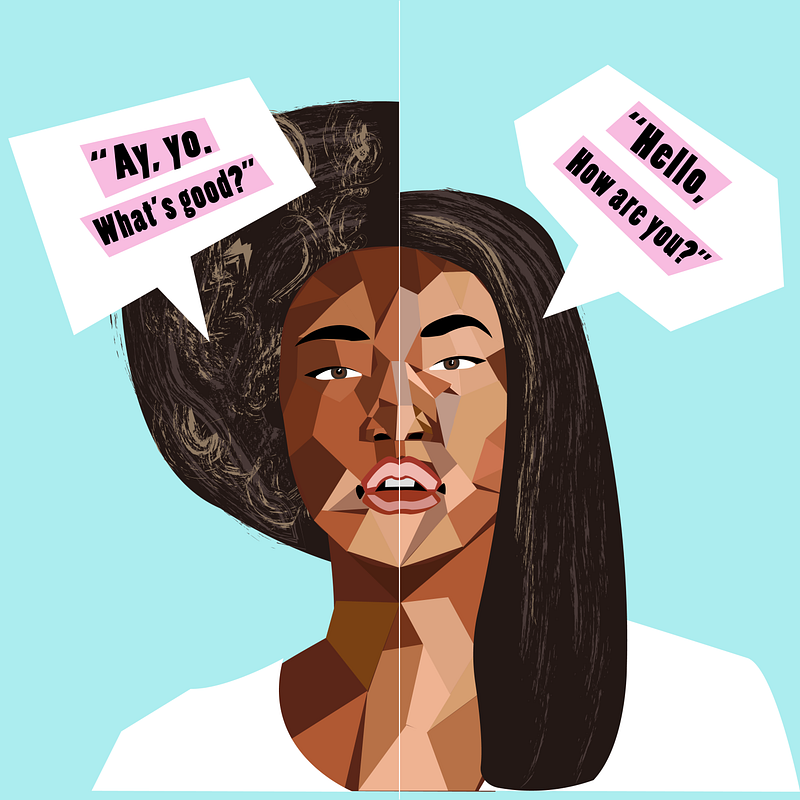
The English language is not a finished product; Americans play the telephone game. Each person whispers a message to the next person. As the game continues, the information develops. Since the late seventeenth century, American English existed in various forms. Most immigrants brought their languages, adding to the rich tapestry of American culture. African Americans are the only group that differs. Because of slavery, they had no power to preserve their indigenous languages.
African Americans developed a circumstantial dialect. Their use of language does not always follow the same rules found in Standard English. There is substantial debate on what scholars call this brand of English variance. Linguists called it Nonstandard Negro English, Black English Vernacular, African-American Vernacular English (AAVE), or Ebonics.
Scholars initially characterized Nonstandard Negro English and Black English as separate from English. However, the variances were not significant enough to justify calling it an entirely new language. In response to this narrative, Black scholars created the terms, African American Vernacular English (AAVE) and Ebonics to characterize the English language variations.
Ebonics may be defined as the linguistic and paralinguistic features which on a concentric continuum represents the communicative competence of West African, Caribbean, and United States slave decent of African origin (Robert Williams, 1997) (PBS, 2005).
The African American social psychologist, Dr. Robert Williams, coined the term “Ebonics” in 1973, which combined the words “ebony” and “phonics” to describe the unique speech used by the descendants of slavery. He identified the term to give formality to the dialect used by Africans living in the diaspora.
Since colonialism deprived African Americans of using their original languages, maintaining a semblance of cultural independence remains essential. Before Dr. Williams coined this term, Black English never explicitly identified slavery as a critical component in understanding the lexicon’s history. In the absence of this historical context, many assume that Africans possess inferior intellect. Writers can learn a lot by embracing the variances within the English language to facilitate inclusive writing.

Benefits of using ebonics
There are many benefits to using Ebonics in writing. When creating non-fiction, writers can adequately capture the dialogue used by African American speakers. Writers who want to create fictional, albeit authentic scenes can use the language to immerse the reader into the content. Poets can also benefit by using a diverse lexicon in capturing the cultural nuance of the speaker. The goal for writers when using Ebonics should be to create genuine dialogue. Some writers, like Zora Neal Hurston, gave voice to unique characters through the use of Ebonics.
Hurston’s transition from her Standard Written English to the early century Southern black dialect provides a clearer understanding of the characters (Malabuyoc 1970).
Hurston’s writing would lose its edge without the proper use of cultural dialect. While her use of Ebonics became well-known amongst Americans, European writers also use English variances to communicate. For example, the famous English writer Charles Dickens often used English variants to capture variances amidst English and Irish speakers. He even coined terms, like “flummox,” which means to confuse or perplex someone.
Just like that, Charles Dickens added to the English language. Every writer should possess the ability to influence and modify their use of language. However, I remain flummoxed that African Americans are not allowed the same contribution.
Grammar rules change over time, and definitions gain additional meanings or lose them as the telephone game continues. In the absence of Ebonics, many representations of African American language remain white-washed. Using Ebonics can improve your writing by adding realism. Similarly, adjectives, similes, metaphors, and onomatopoeia can illustrate your story. Ebonics can add sheets of meaning and cultural relevance.
Discrimination towards AAVE speakers
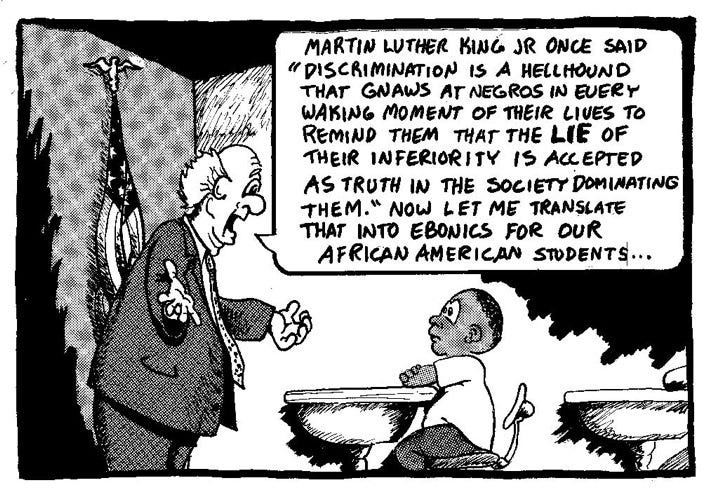
Generations of white citizens maligned or mocked speakers of AAVE casting doubt on their intelligence and making their distinctive speaking patterns the object of racial ridicule (PBS, 2005).
Within public schools, educators teach students Standard English. As a result, many students feel that the use of African American Vernacular English is inappropriate. African American students cannot turn in essays using Ebonics, nor may they speak in that way during oral presentations. If they do, their grades will suffer, and other students may mock them. This ridicule creates code-switching that stays with the student throughout their life. Code-switching derives from African Americans’ conscious efforts to adhere to standard English amidst white people.
My ability to code-switch helped me maintain excellent grades in my English classes, acquire jobs, and enter a prestigious creative writing school. However, it is not always easy to switch back and forth. Sometimes, I would use AAVE at work, and someone would giggle. Likewise, my use of Standard English in my neighborhood granted me the nickname “Oreo,” even though I am not a mixed-race person.
Social acceptability trickles down. Teachers and community leaders play a significant role in determining how we use language in educational and professional settings. My example of tone-policing and micro-aggression shows how scholars codified Standard English as a superior dialect. Both forms of English are acceptable because the point of using any language is communication. As long as I or any other African American can get the reader or listener to understand, we have adequately used our lexicon.
Still, I am not advocating to change English class expectations from Standard English to AAVE. Instead, I am insisting that educators and writers should accept Ebonics as a valid form of communication. English teachers can teach the use of Standard English without diminishing the relevance of AAVE.
Despite the dominance of Standard English in our writing, speaking, and educational settings, African Americans will continue to use Ebonics. Thus, it is society’s perception that must change to provide inclusivity. English teachers who want to increase their students’ exposure to English diversity should add some compelling examples to their reading lists. If teachers do not possess the autonomy to modify their curriculums, they can use excerpts.
Zora Neale Hurston — Their Eyes Were Watching God (1937), Margaret Walker — Jubilee (1966), and Alice Walker — The ColorPurple (1982) are some great examples to start. English teachers and school administrators can play a significant role in changing the stigma of using Ebonics. They can also draw similarities to European writers, like Charles Dickens, to show that English varies even when race is not a factor.
As a New Orleanian, I speak differently than someone from Tennessee or New York. These differences are natural, and we should normalize accepting these variances. Educators should indicate that the English they teach is standardized but does not reflect cultural diversity.
Writers should implement ebonics
This year, America will publish a new census report reflecting increased racial diversity. Information about race-ethnic population estimates that four out of ten Americans identify as non-white. Using only Standard English in writing can reinforce harmful stereotypes about the legitimacy of AAVE. The Hispanic population is one of the fastest-growing communities; writers should also study Spanish English Variances.
The name of the game is exposure. English teachers encourage writers to write about things they know and understand. Writers who do not expose themselves to a variety of cultures will struggle in developing non-white characters. Making all minorities speak in only Standard English makes dialogue seem forced.
While I am not advocating for white people to start chatting using AAVE, it is essential to consider that they may need to apply it into their writing. Otherwise, their stories will never truly reflect inclusive vocabulary. Many white writers already use AAVE terms; they should prioritize using these terms correctly.
Remember, authenticity is the principal goal of using Ebonics. Writers should ensure that the language they use is consistent with African American Vernacular English.
Unfortunately, many view AAVE as a free for all. There are rules to the lexicon, and those rules, like the Standard English rules, have many variations. For example, in Standard English, I may ask someone, “Are you going to the party,” and they may answer, “No, I am not going to the party.” Using the same dialogue in AAVE, I would ask, “You goin to da party,” and they would respond, “I ain’t goin nowhere.”
It may seem unclear at first so let me break it down for you. When I asked the question using AAVE, I left out “are,” because my question had some implications loaded into it. To use a proper subject-verb agreement, we follow “you” with “are.” Thus, when I speak, I do not need to use “are,” since I implied it in asking a question directly to someone. That person is the “you” in the question.
Similarly, I do not need to finish the word “go” with the suffix “ing” because the speaker and I know that “goin” is shorthand for “going,” which follows the same grammar rules of time-related speech. I used “da” instead of “the,” because the African American dialect insists that the “d” is more reflective of how we pronounce the word. In response, I used “I ain’t” instead of “I am not.” This shorthand is similar to the conjunction “I’m not,” which is lengthier but has the same meaning.
The nonstandard use of “ain’t” and other contractions are a crucial function of Ebonics. Using this approach, I simplified my use of language. If you noticed, we usually drop the grammar when it is excessive or adds nothing to the meaning. The history of why we use shorthand is complicated but relates to how slave owners maintained supremacy.
In response to slave rebellions, many Southern states had anti-literacy laws from 1740 to 1834, which prohibited Africans from reading and writing. Thus, African Americans’ first experience with the English language was by world of mouth. Without access to the written word, a unique dialect became widely accepted. The social schism caused by slavery created the Ebonics we still use today.
The variance is valid, but it derives from an ugly history that most educators do not want to discuss. No subject is devoid of history, even though we traditionally learn school subjects separate from one another.
Speaking Ebonics is not an indication of inferior intellect. In shortening the literary devices of some English vernacular, speakers show a clear understanding of the language. Only upon understanding something can you simplify it. Within the use of AAVE, speakers do not always use the rules of the language. Phrases and expressions change, depending on the region. Also, AAVE speakers often code-switch depending on the setting the character speaks in.
If you write an African American character, consider that they will not most likely use contractions like “ain’t” at work, in class, or mixed company. Depending on their personality, they may switch up their use even within the same setting. To create authentic characters, writers need to understand the psychology of AAVE.
So, to review, ebonics is a part of English, not a separate language. Still, you must be sure to catch the nuance here. Some rules govern the dialect even if you do not fully understand it yet. Ask someone with experience to read your work if you feel uncomfortable about using it.
We need to break the social stigma that places Standard English as a superior dialect. The more writers understand the rules and variances, the less likely they are to look down upon others who use it. In many instances, using only Standard English is insufficient in developing dialogue for African American characters.
The goal is not to treat African Americans as incapable of using Standard English properly. Instead, scholars must develop an understanding that Standard English is only one variation.
Psycholinguist Frantz Fanon once asserted that to speak a language is to assume its culture. In order to understand a language, its speakers, and its character, one needs to understand its cultural codes (Khan, 2013).
Throughout history, Black people adapted to use Standard English. It only seems reasonable that white people make an effort to understand African diaspora culture. Educators could make a world of difference by accepting Ebonics into their classrooms.
Initially, some students may laugh upon hearing some different phrases. This microaggression is due to years of social conditioning. It is an attempt to shame everyone into using Standard English. People often chuckle when something makes them feel uncomfortable. However, writers must move past this initial hesitance to create inclusive stories. Exposing students to different cultures will also facilitate a more accepting class environment.
To combat discrimination towards AAVE speakers, writers must appreciate inclusive language as a skill. Skilled writers research different topics to maintain credibility in their writing. To accomplish this feat, writers avoid adding layers of meaning that do not fit.
When using ebonics, tread lightly
As a general rule, if you have to ask whether or not it’s okay to use a word, if there’s any hesitation, then don’t. But also, we should all be aware of where these words come from and what they mean without attributing arbitrary definitions to them (Blay, 2015).
While we should all aspire to add cultural diversity in our writing, non-Black writers should tread lightly. Make sure that when you use AAVE, you do so respectfully. Experienced writers know how to use the proper tone when illustrating a character’s personality. Writers should ensure that when they use Ebonics, it adds to the piece of writing, makes cultural sense, and does not step out of the language’s original intent.
Within American society, white people often misconstrue the true meanings of AAVE words. Mistakes happen, but they will happen less when we stay open-minded about the implications of terms and phrases. There is a thin line between inclusivity and cultural appropriation. We have to accept the context that facilitates linguistic development.
The term “Karen,” which I wrote about extensively, refers to a white woman who abuses her white privilege. However, some white people hijacked the word to call any woman they find annoying “Karen,” coloring it with sexist undertones. This alteration obscures the term, which is what you want to avoid when using Ebonics.
When white people change the term to mean something they want it to mean, they rob African Americans of the opportunity to create and maintain their cultural independence. The goal should be for writers to honor the use of AAVE, not alter it. For a quick reference, scholars defined many of these terms in the urban dictionary. This online tool provides some nuance. It is an excellent accessory for writers attempting to understand inclusive language.
In closing
When writers use Ebonics in their writing, they can add necessary texture, reflecting the linguistic diversity. Using AAVE is a skill that writers develop from personal experience or research. Writers should use Ebonics to fight against the stigma that only Standard English is an acceptable form of communication. African American students benefit when educators understand the cultural value of language inclusivity. When I write prose, I enjoy using inclusive language, and I hope more people find joy in reading and using Ebonics.
Curated Articles about Race, Equality, History, and Beauty:
References:
Blay, Z. (2015, October 19). 12 Words Black People Invented, And White People Killed. Retrieved October 20, 2020, from https://www.huffpost.com/entry/black-slang-white-people-ruined_n_55ccda07e4b064d5910ac8b3
Khan, S. H. (2013, February 3). Ebonics Debunked: Opinion: The Harvard Crimson. Retrieved November 02, 2020, from https://www.thecrimson.com/article/2015/2/3/harvard-ebonics-standard-english-debunk/
Malabuyoc, K. (1970, January 01). Ebonics and the Use of Dialogue. Retrieved October 22, 2020, from http://eyeswatchinggodreading.blogspot.com/2015/11/ebonics-and-use-of-dialogue.html
PBS (Ed.). (2005). Do You Speak American . Sea to Shining Sea . American Varieties . AAVE . Ebonics. Retrieved October 21, 2020, from https://www.pbs.org/speak/seatosea/americanvarieties/AAVE/ebonics/