
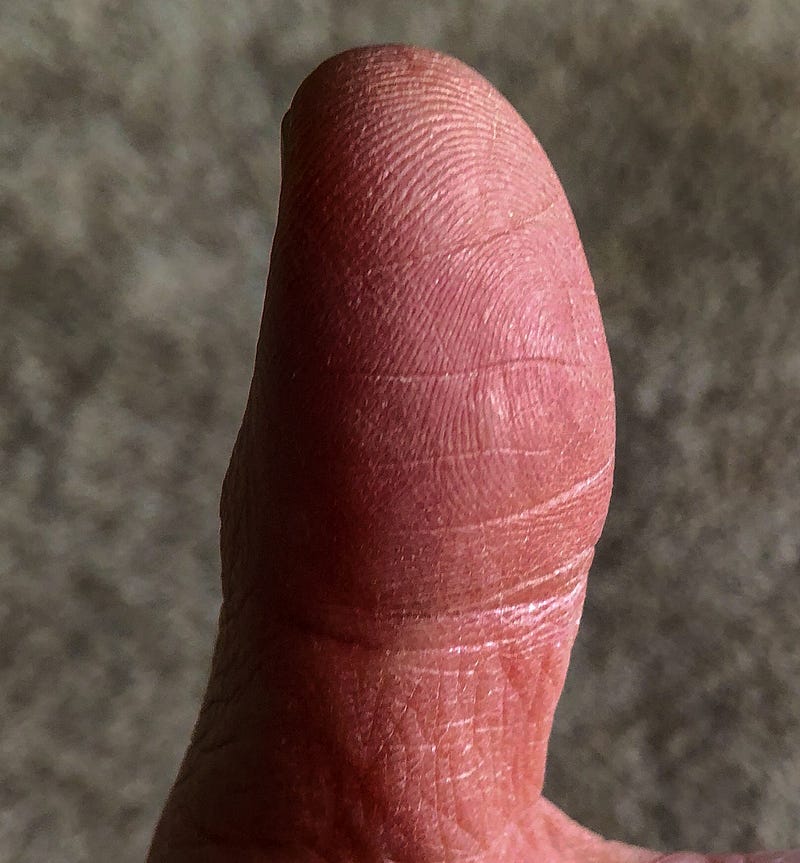
Why We’re All Whorls Apart From Each Other!
How our fingerprints are formed
When I was growing up, there came a time when I and all my young kid friends got interested in our fingerprints. This was long before DNA was being used to find criminals. Everyone knew that if you were going to commit a crime, you better wear gloves so you didn’t leave any fingerprints. I wasn’t planning on committing any crimes, but if I ever wanted to, that was SOP, standard operational protocol.
Don’t leave your fingerprints!
And we all played around with finding ways to make our fingerprints so we could see what they looked like on paper. It was a lot of fun! Messy, but fun!
Then there were the reprimands from your parents for getting fingerprints on the fancy glasses or on the windows or mirrors etc.
So leaving your fingerprints, even if it wasn’t a criminal act, was still not good!
Don’t leave fingerprints!
All right, I got the message. If you left your fingerprints, clean them up.
I was definitely a curious kid so I’m sure at some point I’m sure I would have asked my parents something like “what are all these funny lines on the tips of my fingers?”. “And how did I get them?” “Why do we have them?” “Do you have them?” “Are they the same as mine?” “What about other people?” “They’re not?” “How come?” and on and on…..
Well, you know how kids are. They’re just filled with how and why questions!
Of course, my parents wouldn’t be able to answer those questions.
And that’s where I’m sure I left the whole thing.
Until I was old enough to appreciate that fingerprints were used to identify people who committed crimes. Now that’s pretty cool!
Over the years, I watched lots of TV crime and detective shows and they were always figuring out how to get fingerprints to identify the criminal whodunnit! I loved watching them dust the surfaces and reveal the fingerprints.
Over the years, little by little, DNA forensics got more and more popular and reliable but still, they would look for and collect fingerprints.
So I didn’t think any more about fingerprints other than their use as evidence to identify or link suspects to a crime scene. And the knowledge sitting somewhere in my brain that everyone’s fingerprints were different.
And that’s how it sat for a whole bunch of years.
So imagine my surprise when this morning, one of my “biology” feed emails alerted me to an article where researchers had figured out how our body makes fingerprints!
Hey, this is something people would want to know about, right?!
And it’s pretty cool stuff, but not simple, so let’s take our time and see if I can explain it so that you know how and what they did to figure this out.
Fingerprint Basics
What exactly are fingerprints?
Fingerprints are the unique patterns of ridges, valleys, and friction ridges we see on the surface of our fingertips. Contrary to what some people might think, the current evidence still supports the idea that no two people have the same fingerprints.
Fun fact: the technical name for fingerprints is dermatoglyphs and they are found in humans and other climbing species. Fingerprints are important because they improve our grip and they allow us to distinguish different surface textures.
As an older adult, I can testify to the fact that as my fingerprints wear down and the moisture of my skin lessens, I often have a much harder time gripping smooth, shiny and slippery things than I used to!
So protect those fingers!
Fingerprints are important because they improve our grip and they allow us to distinguish different surface textures.
And not surprisingly, the scientific study of fingerprints is called dermatoglyphics and it has been used in criminal forensic investigations for over a century!
How are fingerprints compared?
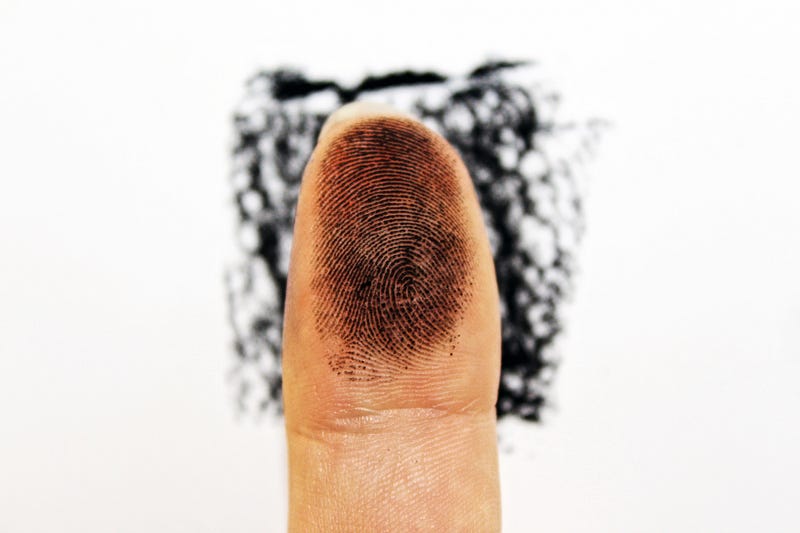
Well, if you look closely at your fingerprints, you can see several different kinds of patterns, such as the shape and number of ridges, and their ridge characteristics, such as ridge endings and where a ridge or whorl splits and becomes two new ones.
You can see that very clearly on the lower left side of the finger shown below
And that brings us to one of those questions we might get from a curious kid; how did my body know how to make these patterns on my fingers?
That’s the kind of simple question that can actually take years of scientific study to answer!
So let’s start at the beginning and make our way through the details.
Forming Fingerprints
First, fingerprints are formed prenatally; while we’re still developing inside our moms. So we already have them when we’re born and unlike lots of other body features that change as we grow, fingerprints remain largely unchanged throughout a person’s life.
So how do they form?
An article published in Cell by James Glover and colleagues in the laboratory of Denis J. Headon at The Roslin Institute at the University of Edinburgh, Edinburgh, UK unravels the details.
Fingerprint patterns can be broken into three separate components; arches, whorls and loops.
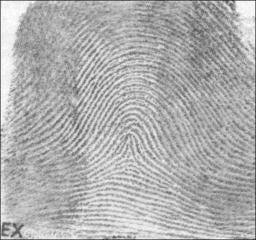
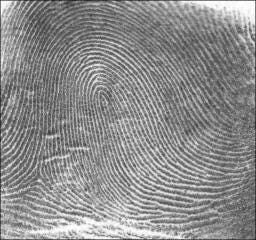
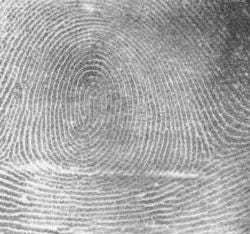
“Arches are the simplest configuration, loops extend to one side of the digit, and whorls have a concentric pattern of ridges at their core. Triradii are Y-shaped formations at which ridges converge at three different angles”
These three formations all start out as ridges that originate in different places on the fingertip. The ridges grow out periodically in waves and when these waves collide with each other, they produce the three patterns.
Fingerprint patterns can be broken into three separate components; arches, whorls and loops
On the molecular level, some very specific genetic pathways are involved but for the moment, let’s just stay with what we can see.
It turns out that the ridges start in 3 different places, the end of the fingertip, the middle and the bottom before the first crease on the finger.
This is shown very nicely in the figure below.
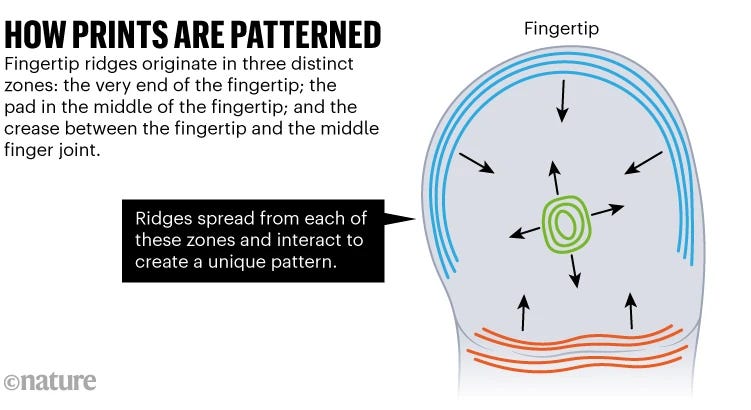
As you can see from the arrows in that figure, as the ridge waves spread they will inevitably collide with each other and these collisions are what eventually form arches, whorls and loops.
The way they discovered this was to study the patterns as they arose on mouse toes and human cells that were grown in 3D cultures. Headon’s team altered the timing, angle and precise location of origin and by doing so, were able to create whorls, loops and arches.
As they examined this in even greater detail, they saw that when two or more waves collided there was turbulence. It’s kinda like when you throw a couple of stones into a pond. When the waves spread out and hit each other, you can see the turbulence that arises.
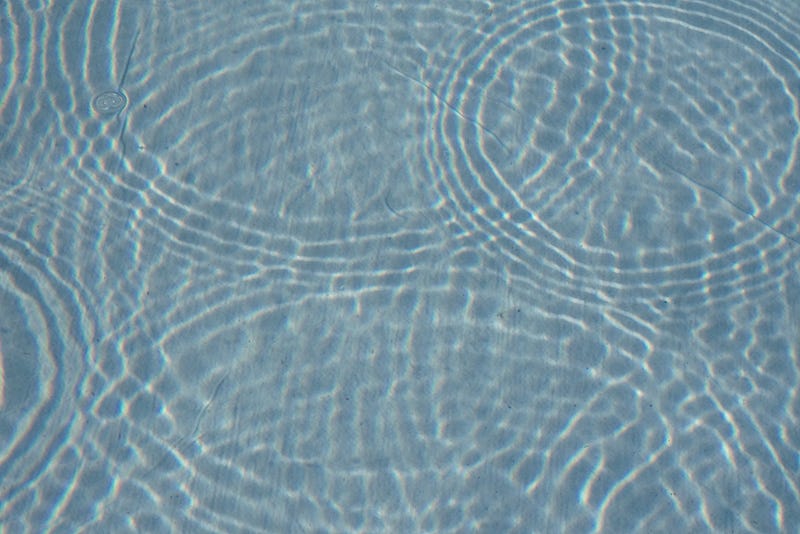
Note: turbulence is defined as a strong or uneven current in air or water.
It’s this turbulence that creates the unique fingerprint patterns that arise.
But how does turbulence do this?
I’m so glad you asked.
And here’s where we get into the real nitty gritty.
It turns out that these results led them to hypothesize that the patterns were formed via a Turing reaction–diffusion system. A reaction-diffusion system arises when two or more chemicals react with each other and diffuse across space. One example is when a molecule that activates a developmental process stimulates both itself and an inhibitory molecule.
Why is it called a Turing reaction-diffusion system?
Back in the early 1950s, mathematician Alan Turing, a pioneer in computer science, published “The chemical basis of morphogenesis”, a seminal paper proposing that reaction-diffusion systems explained the chemistry underlying biological development processes (in biological jargon, these processes are referred to as morphogenesis). It is these reaction-diffusion systems that form patterns such as the remarkable symmetry of leaves on a plant or the one you see on a pufferfish as shown in the figure below.
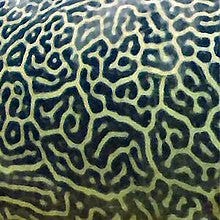
Since then, Turing’s system has been used to explain patterns we see on a number of organisms including bird feathers, patterns, colourful scales on tropical fish and butterfly wings to name just a few.
If you want to learn a lot more about Turing’s fascinating theory, check out this site.
So Headon’s group postulated that fingerprints also arose as a result of a Turing reaction-diffusion system.
Fetal Fingerprints
Now we can take a look at what makes this whole system go.
You know how when you look at your skin, you see all the hairs that grow out of it? And some in places where you don’t want it!
Well, each hair grows out of a structure on the skin called a hair follicle. And of course, there is a lot known about the formation and growth of hair follicles which we won’t get into here. All you need to know is that Headon’s group determined that fingerprint development was actually the result of an interrupted or truncated hair follicle development program.
Huh? Fingerprints are related to hair follicles?
Have you ever heard of volar skin? Well neither had I.
Volar skin is the thick hairless skin that forms on the soles of your feet and the palm side of your hand.
The volar skin comes from volar pads which develop underneath the top layer of fetal skin. Check out the pictures of the developing human fetal hands and feet below. You can see the thick volar pads but in case you’re not sure, the black arrows show representative examples.
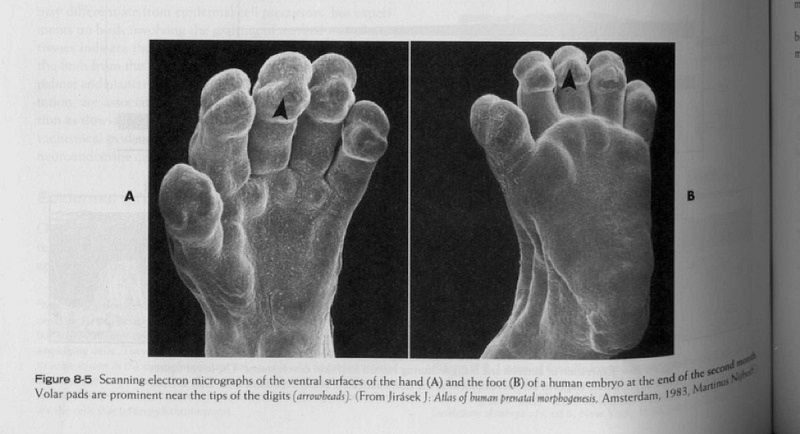
Volar is an interesting word. It comes from the Latin volāre, present active infinitive of volō (“I fly”). The word was first used for the palms of the hands when mimicking a flying bird.
Neato, eh 😄!
Anyhow, back to the subject at hand, pun intended.
Remember above I said that there were also specific molecules known to play a role?
Now, when a hair follicle develops, different molecular pathways are critical. The names are irrelevant to our quick overview. What is important is that these pathways occur in a specific order, A → B → C → D etc.
What Headon’s group found is that as fingerprints develop, the same initial molecular pathways start the program but the last one, D, doesn’t happen.
Thus, when they looked at the development of fingerprints in unborn fetuses, they saw the same initial development of ridges that happen when a hair follicle is formed but it was terminated before it could finish making the follicle.
Here’s the program of fetal fingerprint development summarized in the article by Glover, et al.
The human fingerprint pattern is defined by the arrangement of epithelial primary ridges, which form at approximately gestational week 13 on the raised volar pads at the tips of the digits. Over the following weeks, primary ridges form across the rest of the volar skin and, by week 16, sweat glands emerge from the deepest parts of the ridges. Primary ridge formation is completed by week 17, and smaller secondary ridges then begin to appear between them. The skin surface becomes periodically elevated above the sites of the primary ridges, with each surface corrugation carrying a row of sweat gland pores along its apex.
Primary ridges thus define the overall fingerprint configuration, with the selection of arch, loop, or whorl pattern defined by week 15. This selection is influenced by genes that operate early in limb development to exert an indirect effect on fingerprint pattern through their effects on digit length proportions and on the size and shape of the raised volar pads that are present from gestational weeks 9–15.
[The bolding of quoted text above is mine, not in the original.]
So you have waves that generate primary ridges which become arches, loops and whorls because of Turing reaction-diffusion interactions. The fingerprint patterns they eventually stabilize at are also affected by the genes in you that specify what size and shape your fingers are going to be.
Primary ridges thus define the overall fingerprint configuration, with the selection of arch, loop, or whorl pattern defined by week 15
And that about says it all.
Final Thoughts
As always, there is a ton of information and experimental data in the original paper. I have skimmed off the cream and given that to you. But if you want to delve into it in greater detail, the paper I’ve talked about is open source so anyone can read it.
I think it’s fascinating but if you’re not a biologist, it’s a real slog!
And just to ease your mind, no animals or humans were harmed in their experiments. Much of the actual testing to determine which proteins and chemical messengers were involved used “fetal tissue samples…obtained after elective medical termination of pregnancy from the Royal Infirmary of Edinburgh, UK with informed consent (approved by the Lothian Research Ethics Committee, ref. 08/S1101/1).”
Other experiments were done using cultured human fibroblasts and mice.
And now you know about all kinds of extraordinary things like how hair follicles are related to volar pads and fingerprints.
How cool is that!
Until next time,
Rich
If you enjoyed this article, here’s a few others you might like:
If you’d like to get the email newsletter from Biology4Everyone, sign up here. The updates come out every few weeks and also include short pieces about naturalist topics and what I’m reading.
Sources:
- “The developmental basis of fingerprint pattern formation and variation” by James D. Glover, et al., in Cell (Feb 2023)
- “How fingerprints get their one-of-a-kind swirls” by Heidi Ledford in Nature News (09 Feb 2023)
- “You Inherit Part of Your Fingerprint from Your Parents” by Ada McVean, McGill Office of Science and Society (Jul 2019)


