
Cybersecurity and Mental Health
It’s Time to Fight Against Organized Scams.
Scamming has become an industry itself that threatens society affecting the economy and the mental health of millions of innocent people.

Purpose of the Article
This article defines and introduces organized scams and provides practical tips to deal with them collectively, leveraging reliable sources. This story does not cover health or professional advice. It is for information, inspiration, and awareness purposes.
Introduction
Scamming has become a societal issue associated with cybercrime and organized hacking processes. Organized scams worsened after 2020, most likely due to lifestyle and work rule changes caused by the pandemic.
As a technology professional and consumer, every single day, I hear about scammers causing grief to people in my circles and on social media networks that I observe.
My email inbox and private message sections on social media platforms are full of spam and potential scam messages that I keep reporting. Phishing is a particular concern to me.
In addition, I receive scam alerts from service providers and governments daily. Banks, telcos, government services, tech companies, and insurance organizations keep sending reminders, highlighting the increase in incidents.
I don’t remember having so many scam alerts before the Covid pandemic. Since the pandemic, scamming has skyrocketed. It became a norm. We have been tired of hackers, and now scammers got similar power.
The topic is close to my heart as my relatives and friends over 70 or 80 years old lost their retirement funds to organized scam attempts.
Losing money is undoubtedly a problem for the affected people. However, the feeling of being deceived creates emotional traumas causing mental health issues, especially for the aged population, who are most vulnerable to scams due to their lack of ability in technology.
I recently posted two articles titled Six Tips to Filter Noise and Keep Sanity in These Enigmatic Times and Beware of Scams: I’m Concerned About YouTube Ads Even Though I Marvel the Platform’s Value.
Subscribers who read them requested an article guiding consumers about scams. Almost all readers mentioned that they got scammed since 2020. One reader said when she was scammed recently, she felt as if she was raped and ashamed to discuss it with her family members and friends due to fear of being humiliated.
I assured the reader she was not alone. As a tech-savvy person, I was also scammed like millions of others. I will document my cases in another story.
When I mentioned nothing was safe on the Internet in this artificial intelligence and robotics age, the readers wanted to know more. We are approaching the artificial superintelligence era, which concerns me deeply. Deep fake technologies are prime examples.
I plan to document my decades of cybersecurity concerns in another article, but in this post, I focus on organized scams and provide a high-level perspective with takeaway points.
My goal is to create awareness and inform my readers. I don’t want to scare you, only focusing on the negatives. As a realistic optimist, I believe that with awareness and taking necessary measures individually and collectively, we can significantly lower the effects of organized scams.
What is a scam, and why do organized scams matter?
In short, a scam is a deceptive activity getting value from others without giving any value to them. Dictionaries define scams as dishonest schemes or frauds.
Some people confuse scams with spam. We all dislike spam, but they are not as harmful as scams. I see spam like a person screaming in the street and annoying people. But scam like a murderer with a secret weapon smiling at the face of people in the street.
Organized scams matter because they affect our economy and the mental health of victims. Unfortunately, the most affected group is an aging population who are not technology savvy.
One of the root causes of scams is the Internet, mainly social media, as I touched on in a recent article titled, Six Tips to Filter Noise and Keep Sanity in These Enigmatic Times.
Unfortunately, many established organizations on the Internet seem to pay more attention to spam than scams.
For example, some social media companies can easily detect spam accounts and ban them automatically. However, they allow organized scammers (possibly unknowingly) to use their services to reach out to millions via paid ads.
Governments and experts warn that, ironically, the global scamming situation also created new scams under the scam fund recovery. Some scam recovery companies, like the virus scanners in the 1990s, created more scams. They advertise their services on search engines and social media legally.
Interactions in social media cause identity theft which has significantly increased since 2020. For example, as reported by III, “the Identity Theft Research Center (ITRC) reports a record number of data compromises in the U.S. in 2021, amounting to a 68% increase over 2020.”
Even though our technologies and awareness have increased, paradoxically, our data got more vulnerable. For example, as documented by IBM Security in 2021, “the average data breach cost rose from $3.86 million in 2020 to $4.24 million in 2021.”
Furthermore, according to the FBI’s Internet Crime Report 2021, cybercrimes increased by 7% from 2020. As I documented in 2021, 533,000,000 Facebook records were leaked for free.
With the increase in data breaches and cybercrimes, scams started to skyrocket. Therefore, I am deeply concerned about the increased number of scams globally. I’d like to give a high-level perspective from Australia, where I live. I also observed other countries. Some of them are even worse than Australia.
An Analysis of Stats from Scam Watch in Australia
In addition to reports and lost values, I also analyzed the other stats from the Australian Government Scam Watch portal. My findings are eye-opening and concerning. I won’t go into the details, but I would like to highlight a few points.
When the pandemic started in my country (Australia), as documented by the Government, “Australians lost over $851 million to scams in 2020, a record amount, as scammers took advantage of the pandemic to con unsuspecting people.”
Investment scams top the chart. The next three are dating/romance, remote access, and false billing.
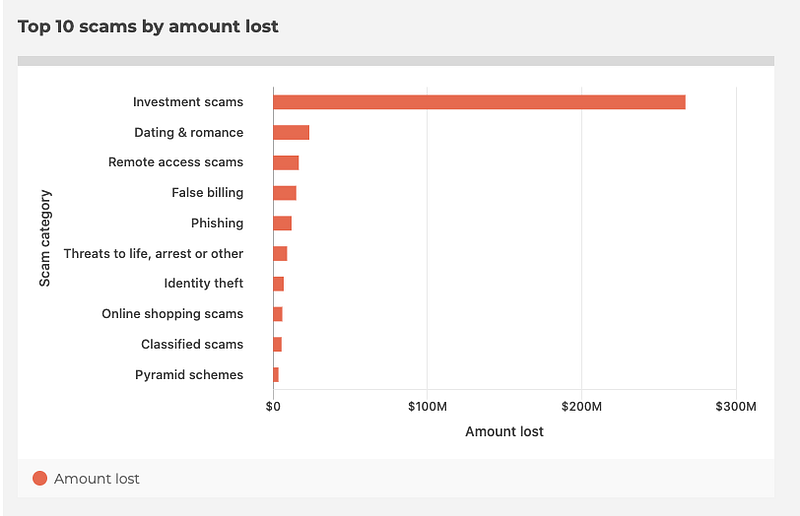
However, each year these stats significantly increased. For example, in the same country, the publicly reported scams were 40,891 with a value of $26 million. In 2022, 146,776 scams were reported costing over $381 million. Remember that thousands of scam incidents are not reported to the government for various reasons.
In addition, last month, we were informed that “losses to imposter bond investment scams have nearly tripled in the first half of 2022, with consumers losing over $20 million to these sophisticated scams.”
Based on reports to the Government, the major scam techniques are phishing, false billing, online shopping, identity theft, pyramid schemes, remote access, hacking, investment, dating, and rebate.
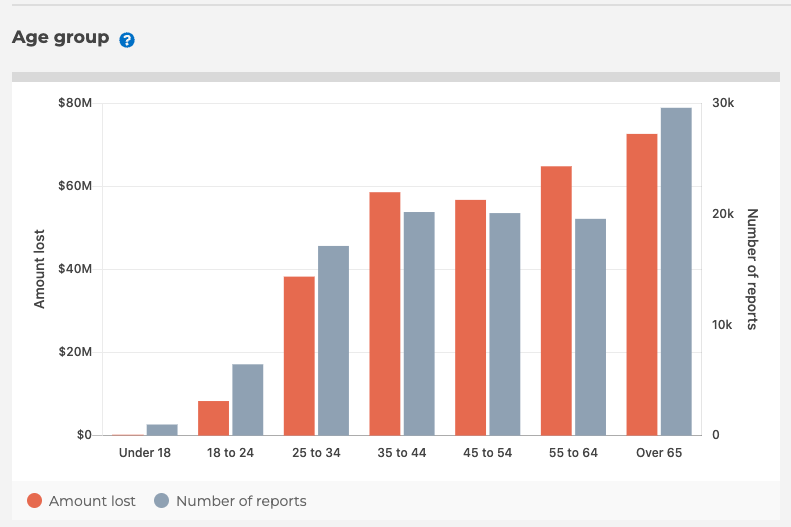
Out of these, phishing tops the list as a means, and financial scams as lost money. As you might guess, the most affected age group is over 65, the second group is 55 to 64, and the least affected group is 18–24.
Here’s why scammers have gained so many powers recently.
When I reviewed the technical literature and technology news and interviewed some cybersecurity experts, I identified some interesting patterns. These are my perspectives with gained insights.
1 — Social media feed scammers.
Prominent social media platforms are aware of cybercrime, but unfortunately, scammers find ways to create multiple accounts to outsmart social media platforms. They leverage paid advertisements to reach out to a broader audience. The ads look legitimate to service providers and seem hard to detect fraud due to complex tricks.
2 — Technology, especially AI, empowers scammers.
As artificial intelligence (AI) grows, software robots become more affordable. For example, on Fiverr, some people design automated bots under $100 that can spam billions of people via social media.
Then, one person can create millions of spam accounts on Twitter, Facebook, LinkedIn, Quora, Pinterest, and many more.
And some intelligent bots create SEO-optimized content that hits the top of search engines, looking legitimate and deceiving people. Smart people don’t open the top 10 entries in search engines.
3 — People are after quick gains.
Since the pandemic, the economies of all countries have been significantly impacted. Many people lost their jobs and started looking for investment opportunities and side hustles.
Scammers started exploiting the desires of innocent people who wanted to earn money quickly.
Experts metaphorically say that there is no free lunch. If something is too good to be true, probably it is, especially in the virtual world.
4 — It has become an organized and professional activity.
Many scams, especially financial ones, are performed by a group of professionals with finance, banking, insurance, and technology backgrounds. Since these professionals have customer management skills, they can quickly get through and erase suspicions.
5 — Scammers leverage names of reputable organizations.
Scammers using phone calls, texts, or emails pretend they represent government agencies, banks, or other reputable organizations such as Google, Amazon, Microsoft, Apple, Facebook, or LinkedIn.
Naturally, people believe their tricks as they mimic those organizations close enough to deceive them.
I’d like to provide some practical tips to consider individually and collectively.
Five Measures to Lower Risks and Alleviate the Pain of Scamming
1 — Public awareness and education are critical.
The most important aspect is creating awareness by educating the public. As mentioned, the Australian Government has a Scam Watch portal educating citizens.
In the United States, the Federal Trade Commission has a portal called Scam Watch. When I reviewed the site, I noticed that most scams are related to Covid-19. Interested readers might check relevant resources at this link.
We should be extra careful with the calls from banks asking for credit card numbers, driver’s licenses, social security numbers, or other personally identifying numbers. Unless you initiate the call, banks usually don’t ask for those sorts of details on the phone.
We must question everything from strangers on the phone or in emails and not take their words at face value. The best approach is to cut connections immediately and report to authorities and take other actions.
2 — Tightening governance with more substantial consequences for offenders.
Governments need to tighten rules for accessing citizens for unsolicited calls. European countries made significant progress under the privacy rule. However, many countries still have a long way to go.
As social media is one of the root causes of organized scams, all service providers must work hard and in a collaborative manner. Cheap and proliferating spam accounts are used for scamming activities.
Some social media sites work really hard. For example, Twitter CEO Parag Agrawal informs in a tweet:
“We suspend over half a million spam accounts every day, usually before any of you even see them on Twitter. We also lock millions of accounts each week that we suspect may be spam — if they can’t pass human verification challenges (captchas or phone verification).”
3 — International collaboration is crucial.
Thanks to the Internet, scammers have no geographic boundaries.
As scamming is an international activity, all countries must collaborate to prevent, detect, and penalize offenders using international law.
For example, creating an international organization watching and dealing with scams can be invaluable. Imagine the United States, the United Kingdom, Australia, Canada, and New Zealand creating a treaty like this. I believe that 80% of organized scams can be prevented or recovered.
I am pleased that the Australian Government proactively works and informs the citizens, and I desire our Government works with others collaboratively.
4 — Leveraging ethical hacking and cybersecurity expertise can be invaluable.
Ethical hacking is a helpful discipline to address cybersecurity issues.
I introduce it in a book chapter titled Why Enterprise Architects Need to Closely Work with Ethical Hackers: A Modern Enterprise Architecture Approach — Chapter 5.
Ethical hackers and cybersecurity experts specializing in forensic discovery can significantly contribute to preventing, eliminating, and recovering scam attempts.
5 — A global recovery and support service for affected people
Lowering the scamming risks with preventative measures is vital. However, recovering the financial loss of affected people is also essential. In addition, supporting their mental health is necessary.
Unfortunately, millions of people are affected by losing their money or identity due to scams. Utilizing the services of ethical hackers and cybersecurity specialists funded by governments can be profitable.
For example, paying 10% of the lost money to these specialists can create a win-win situation. In this scenario, while professionals are paid for the service, victims might get 80% or more of their lost funds.
Currently, the private sector invests in such recovery services, but the service is not reliable and not accessible to citizens of many countries. In addition, as it is not controlled, some of these private companies are even causing more harm under the umbrella of recovery.
Takeaways
We must educate ourselves, loved ones, friends, colleagues, and community members about common scams.
Learning from the experience of others can guide us and prevent us from making the same mistakes.
I’d like to provide helpful links documented by the Australian Government for people affected in Australia. However, principles in these links can also be used by people living in other countries.
It will be helpful for every country to have this type of guidance for their citizens. There might be many that I am not aware of. Please share links from your country if you know of such resources in the comment section of this article.
Final Words
Scamming affect not only the economy but also the mental health and well-being of millions of innocent and vulnerable people. It causes unnecessary tension and anxiety to already stressed people.
I’d like to amplify an article I read about phone scans titled How To Deal With Scam Phone Calls penned by Simon Whaley. As Simon says, “When you have no reason to suspect anything, it’s so easy to take what people tell us at face value. This is exactly what fraudsters want.”
My architectural and design work included substantial cybersecurity tasks. I worked with many ethical hackers and documented my experience and perspectives on ethical hacking within the cybersecurity context.
As scamming is close to my heart, I pass along my tacit knowledge and perspectives to help my readers. Please share the messages of this post with friends so that more people gain awareness and protect themselves from scammers.
Despite all, we should focus on the positives, stay optimistic, and take necessary measures, as articulated in this story titled Six Tips to Filter Noise and Keep Sanity in These Enigmatic Times.
Thank you for reading my perspectives. I wish you a healthy and happy life.
As a new reader, you might check out my holistic health and well-being stories reflecting on my reviews, observations, and decades of sensible experiments. I write about health as it matters. I believe health is all about homeostasis. Here are sample health improvement articles for new readers:
Depression, Anxiety, Brain Health, Brain Atrophy, Dementia, Heart Disease and Strokes, Type II Diabetes, Fatty Liver Disease, Metabolic Syndrome, Liver Cancer, Lungs Health, Pancreas Health, Kidneys Health, NCDs, Infectious Diseases, Cardiovascular Health, Neonatal Disorders, Skin Health, Dental Health, Bone Health, Leaky Gut, Leaky Brain, Brain Fog, Nervous Breakdown, Autoimmune Conditions, Chronic Inflammation, Insulin Resistance, Elevated Cortisol, Leptin Resistance, Anabolic Resistance, Cholesterol, High Triglycerides, Metabolic Disorders, and Major Diseases.
I wrote about valuable nutrients such as:
CoQ10, PQQ, Boron, Urolithin, taurine, citrulline malate, biotin, lithium orotate, alpha-lipoic acid, n-acetyl-cysteine, acetyl-l-carnitine, NADH, TMG, creatine, choline, digestive enzymes, magnesium, hydrolyzed collagen, nootropics, pure nicotine, activated charcoal, Vitamin B12, Vitamin B1, Vitamin D, Vitamin K2, Omega-3 Fatty Acids, N-Acetyl L-Tyrosine, and other nutrients that might help to improve metabolism and mental health.
Disclaimer: Please note that my posts do not include health or professional advice. I document my reviews, observations, experience, and perspectives only to provide information and create awareness.
I publish my lifestyle, health, and well-being stories on EUPHORIA. My focus is on metabolic, cellular, mitochondrial, and mental health. Here is my collection of Insightful Life Lessons from Personal Stories.
You might find more information about my professional background. I write about health as it matters. I believe health is all about homeostasis.
If you are a writer, you can join Medium, Vocal Media, and NewsBreak as a writer and monetize your content while inspiring a large audience. Repurposing your content on these platforms can save you time and increase your income.
You can join my six publications on Medium, contributed by 16K+ writers, as a writer requesting access via this weblink.


