
LETHAL INJECTIONS GONE WRONG
Why Does Alabama Keep Bungling Executions?
My state has botched another attempt to kill an inmate, and some say it’s ‘torturing’ prisoners
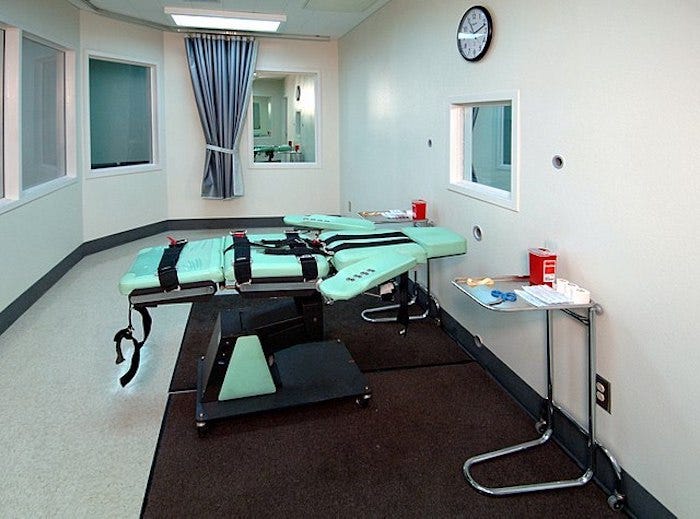
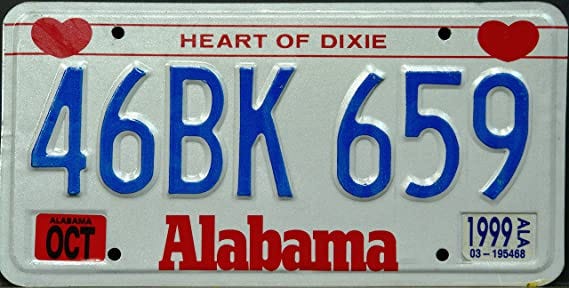
Maybe Alabama should change the slogan on its license plates to: “The state that couldn’t kill straight.”
The plates here usually say “Heart of Dixie,” just in case you’ve forgotten that Montgomery was the first capital of the Confederacy. But the state’s treatment of prisoners is heartless.
Earlier this month Alabama botched the execution of Kenneth Eugene Smith, the third inmate it has tried unsuccessfully to put to death since 2018.¹ In each case an attempted lethal injection went horrifically awry.
The state’s latest mangled execution was so cruel and incompetent it caused an outcry. Smith was strapped to a gurney for hours as officials tried to insert the two intravenous lines needed for the lethal drugs used by Alabama.
A large needle ‘stabbed him like a knife’
Elizabeth Bruenig of the Atlantic spoke to Smith later and learned that his executioners managed to place a needle in his left arm. Afterward they “tortured” him by stabbing his right arm and hand and his feet in vain.
Then an executioner “pushed a large-gauge surgical needle into Smith’s chest, just below his collarbone, searching blindly for his subclavian vein to establish a central line,” Bruenig wrote.²
“Smith could feel the needle stabbing him ‘like a knife,’ and he protested the pain, which the executioners insisted he should not be able to feel, because they had already injected an anesthetic.”
The execution was called off after the hapless team decided that they couldn’t insert the second line before Smith’s death warrant expired at midnight. The disaster eerily resembled a fiasco two months earlier in which Alabama executioners tried to kill Alan Eugene Miller but couldn’t insert an IV line in the time his warrant allowed.³
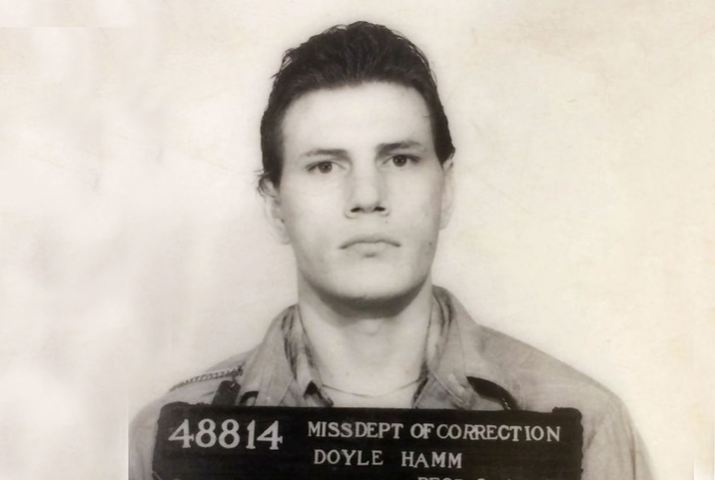
Yet — as incredible as it sounds — such blunders in the state’s death chambers aren’t new. In 2018 Alabama’s death squad spent hours trying to insert an IV line into Doyle Lee Hamm. They gave up about a half hour before his warrant would expire.
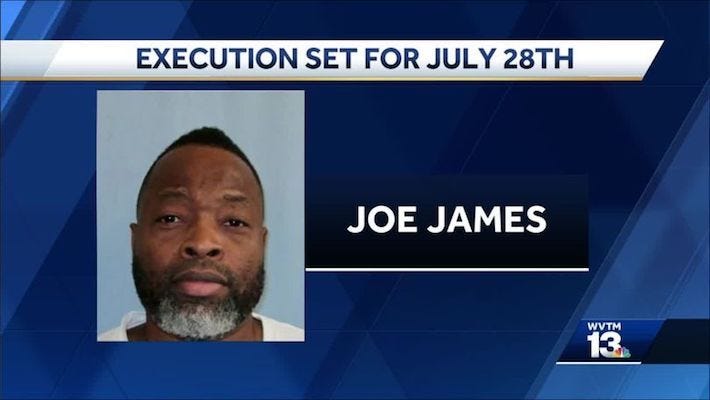
In July 2022, Alabama executioners did manage to kill Joe Nathan James. But they succeeded only after trying for hours to gain access to his veins and apparently performing the medical procedure known as a cutdown. Bruenig spoke to Joel Zivot, an Emory University expert on lethal injections, who examined James’ body.
Zivot’s conclusion was stark.
“In a medical setting, ultrasound has virtually eliminated the need for a cutdown, and the fact that a cutdown was utilized here is further evidence that the IV team was unqualified for the task in a most dramatic way,” Zivot told Bruenig.⁴
Why is Alabama so bad at killing people?
“Why is Alabama so bad at executions?” an al.com headline asked after the failed execution of Doyle Hamm. It was quoting Zivot, the lethal-injections expert, who added, “ ‘They do a terrible job, and they just hide it.’ ” ⁵
“Hide” is the operative word, as the reporter Ivana Hrynkiw discovered in covering executions for the Alabama Media Group.
The details of giving a lethal injection are “a state secret,” she wrote on al.com.
The authorities don’t say who prepares an injection or inserts a central line, she said in a story about the aborted execution of Doyle Hamm. “While the protocol allows for two physicians to be present at the execution, it is not clear if they are usually present.”
A further challenge is that Alabama death row inmates have an average age of 55, and many have poor health undermined by drug abuse or inadequate exercise or nutrition.
Those prisoners may have less healthy veins than others, Robert Dunham, the executive director of the Death Penalty Information Center, told Hrynkiw. That deterioration can make it harder to start an IV line.
When calamities occur, the state can keep them out of the public eye. As Hrynkiw said on al.com: “The process of sticking an inmate about to be executed is closed to media witnesses and to attorneys for the inmate. Only state representatives are allowed to witness the process.”
Systemic failures underlie torturous executions
The failed executions occur within a criminal justice system widely regarded one of the worst in the nation. Alabama prisons are underfunded, severely understaffed, and mismanaged.
All executions in the state take place at the Holman Correctional Facility, which often appears on lists of the nation’s most dangerous prisons along with San Quentin and the Louisiana State Penitentiary known as Angola.
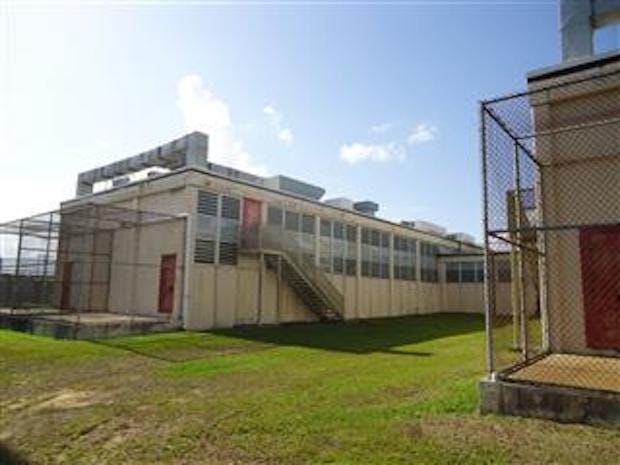
Late last year, Liz Crampton wrote on Politico that the tough-on-crime state imprisons so many people it can’t safely house them all. The abysmal conditions have led to decades of run-ins with the courts.
“In the 1970s, a judge put the state’s Department of Corrections under supervision after finding that the prisons were insect-infested, crumbling, violent and ‘wholly unfit for human habitation,’ ” Crampton wrote.
Little appears to have changed. A recent multiyear U.S. Department of Justice investigation found that Alabama prisons fail to provide safe and sanitary conditions and to protect inmates from abuses including “excessive force at the hands of the staff.”
“The end result: The Department of Justice concluded that the constitutional rights of prisoners were being violated every day, in every men’s prison the state runs,” Crampton said.

In 2020 the DOJ sued Alabama to force it to comply with the law, and a judge has asked the involved lawyers to prepare to go to trial in 2024.
Alabama isn’t the only state that can’t kill straight
It would be comforting to think that death row cruelty exists only in my state, but it isn’t true. As Bruenig wrote in the Atlantic:
“Alabama’s failures in the execution chamber are extreme, but not unique. The week Kenneth Smith was to be killed, three other men were executed via lethal injection in the United States: Stephen Barbee, in Texas; Richard Fairchild, in Oklahoma; and Murray Hooper, in Arizona. The IV team in Hooper’s case struggled with venous access and wound up inserting a catheter into his femoral artery; likewise, in Barbee’s case, executioners failed to properly insert needles into the man’s veins for half an hour before setting a central line in his neck.”
Less than 24 hours after the failed attempt to kill Kenneth Smith, a federal judge ordered Alabama to preserve evidence of the disaster at the Holman prison.⁶
A few days later, Gov. Kay Ivey paused executions until the state can do a “top-to-bottom review” of the process.⁷ She also asked the state’s attorney general to withdraw motions in the Alabama Supreme Court to proceed with the executions of Alan Eugene Miller and James Edward Barber.
Like the DOJ lawsuit, the halt to the killings was urgently needed. But no one should expect it to improve substantially what goes on in Alabama prisons, given the years of inaction after other death-chamber travesties.
Many of us who live in Alabama can only hope for better. One who’s hoped for a long time is John Archibald, a preacher’s son and Pulitzer Prize-winning columnist for the Birmingham News and other papers, who thinks we can’t blame only the state’s redder-than-red politics. He wrote last month:
“We can blame politicians for campaigning on fear and punishment over prevention. We can blame the governor for looking the other way and the attorney general for chasing fame and political points in faraway states. We could blame the prison system for lack of transparency and incompetence.”
But the larger problem, Archibald said, is that too many people don’t care, or don’t live by their deepest beliefs.
“According to Pew Research from 2014, nine out of 10 Alabama grownups believe in God with some certainty, nearly eight out of 10 say religion is important in their lives, and almost nine out of 10 identify as Christians.
“They follow that man from Galilee who said concern for those in prison is key to the salvation he promised. That book in which he is protagonist cautions over and over to love and comfort and visit those behind bars, to treat them as what they are: People.
“That’s all I ask. That we treat people as people.”⁸
Archibald is right that there’s a contradiction here. Alabama is the only state in which I’ve seen crosses on the walls of the offices of good doctors, graduates of well-regarded medical schools, and discreet stacks of tracts next to the potted plants. Many of those physicians might refuse on religious grounds to assist with lethal injections. Yet they don’t seem to mind if others give them.
You don’t have to oppose all forms of capital punishment to agree with Archibald that Alabama isn’t treating inmates as people. You might say instead that the state’s “barbaric” practices are “torturing” them, as the former public defender Stephen Cooper did in the Montgomery Advertiser.
Nor do you have to share Archibald’s religious background to agree that the state treats inmates cruelly. It shouldn’t take the Department of Justice lawsuit that’s headed for trial to correct that.
As the DOJ seeks a remedy, I don’t regret that my federal income taxes are helping to pay for the fight for justice. I regret only that my Alabama income taxes are paying for the fight against it.
Jan Harayda is an award-winning journalist in Alabama whose has written for many major media. She is a former book editor of the Plain Dealer in Cleveland who also covered local government for the Home News Tribune in New Jersey.
Sources: 1 Nicholas Bogel-Burroughs, “Alabama Again Cancels an Execution Over Delays Inserting IV Lines,” The New York Times, Nov. 17, 2022. 2 Elizabeth Bruenig, “A History of Violence: Why Does Alabama Keep Botching Executions?” The Atlantic, November 2022. 3 Darryl Coote, “Alabama Halts Execution of Alan Miller Over Inability to Access Veins for Injection,” UPI, Sept. 23, 2022. 4 Elizabeth Bruenig, “Dead to Rights: What Did the State of Alabama Do to Joe Nathan James in the Three Hours Before His Execution?” The Atlantic, August, 2022. 5 Ivana Hrynkiw, “Why Is Alabama So Bad at Executions?” al.com, Oct. 4, 2022. 6 Ivana Hrynkiw, “Judge Orders Alabama to Preserve All Evidence From Failed Execution Attempt of Kenneth Smith,” al.com, Nov. 18, 2022. 7 Jay Reeves, “Alabama Pausing Executions After 3rd Failed Lethal Injection,” AP, Nov. 21, 2022. 8 John Archibald, “Who’s to Blame for Alabama’s Torture, Miserable Treatment of Prisoners?” al.com, Oct. 4, 2022.
You might like my other stories:


