
Alabama Says An Inmate’s Execution Will Be ‘Painless and Humane’
Here’s what ‘painless and humane’ means in my state

Alabama’s last Ku Klux Klan murder took place more than four decades ago, when a black teenager went out one night to buy a pack of cigarettes and ended up hanging from a tree 20 miles from where I live.
But organized executions haven’t gone away here. They’re just committed by the state now.
If that sounds harsh, consider the case of Kenneth Eugene Smith.
Alabama plans to kill Smith on Jan. 25 by a method its attorney general calls “the most painless and humane method of execution known to man.”
Unless the governor or the Supreme Court intervenes, Smith will die by suffocation after prison officials place a gas mask over his face. The mask is supposed to replace the oxygen in the air with a fatal dose of pure nitrogen, which will cause nitrogen hypoxia.
The state of Alabama has said in court filings that the nitrogen gas will “cause unconsciousness within seconds, and cause death within minutes.”
But there’s a problem with that prediction. Killing people by delivering pure nitrogen has never been tested and critics of the method call it “experimental.”

Alabama will be the first state to try. And if you were Smith, you’d have a few reasons to wonder how “painless and humane” your death would be be.
One is that the American Veterinary Medical Association says nitrogen hypoxia isn’t an acceptable way to euthanize most mammals because it can cause “distress” for the animals and observers.
A method not recommended for dogs apparently doesn’t trouble the authorities in Alabama. Two other states, Mississippi and Oklahoma, also allow it, though neither has tried it.
If you were Smith, you might also worry about a warning from the U.N. office for human rights. It said Alabama’s execution method could amount to torture under international law. As the Associated Press reported:
“Dr. Joel Zivot, an anesthesiologist who was one of four professionals who filed the U.N. complaint that led to the warning, said Smith is at risk for seizures and choking to death on his own vomit. He said any leak under the mask could prolong the execution.”
Zivot told the AP:
“A leak will do two things. It will potentially endanger people around.…Air could then get under the mask as well. And so the execution could be prolonged or maybe he might never die, he just could get injured.”
But if you were Smith, you might worry above all about your past experiences in Alabama’s death chamber. They’re why he’s set to become a guinea pig for testing a method of execution not approved for guinea pigs.
‘Why is Alabama so bad at executions?’
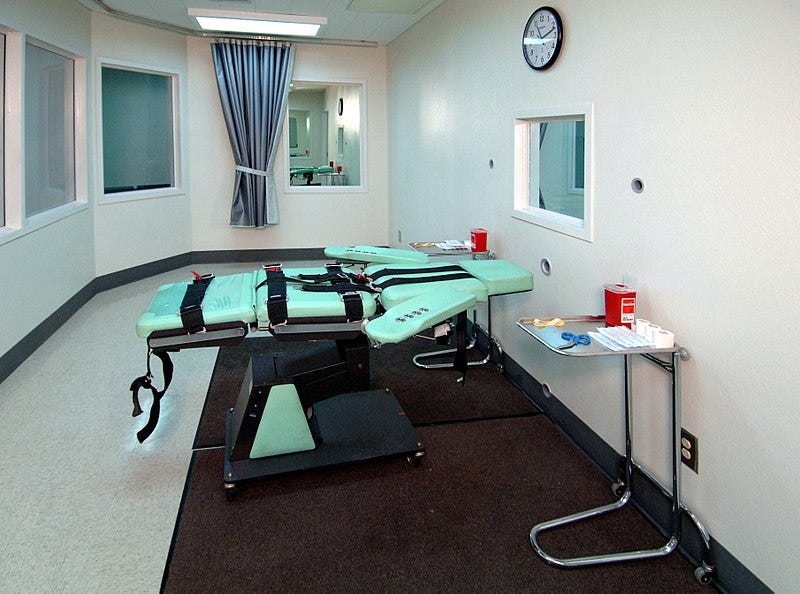
In 2022, Alabama botched an attempt to execute Smith, the third inmate it had tried unsuccessfully to put to death since 2018. In each case its attempt to kill by a lethal injection went horrifically awry.
The bungled execution of Smith was so cruel and incompetent, it caused an uproar. Smith spent hours strapped to a gurney as prison officials tried to insert the two IV lines needed for the lethal drugs.
Alabama called off the execution after the team decided it couldn’t kill him before his death warrant expired. Two months earlier, Alabama executioners had tried to kill Alan Eugene Miller but couldn’t insert an IV line in the time his warrant allowed.
“Why is Alabama so bad at executions?” a headline asked after another had gone wrong. It was quoting the anesthesiologist Zivot, a lethal-injections expert, who added:
“ ‘They do a terrible job, and they just hide it.’ ”
After the botched attempt to kill on Smith, Alabama Gov. Kay Ivey ordered a pause in executions, which resumed in July 2023. The state has since killed two prisoners by lethal injection without the kind of disasters that occurred before the halt.
Then why will it start gassing the condemned? State officials say it’s painless because it causes someone to lose consciousness fast. And Smith’s lawyers preferred it to another attempted lethal injection.
But few people know what a nitrogen-hypoxia execution might involve, the the New York Times says. One who does is the assisted suicide pioneer Philip Nitschke, who told the newspaper that he could envision outcomes ranging from “a quick and painless death to one involving substantial suffering” if things went wrong.
A jury thought he should get life in prison, not death
Smith is on death row for the fatal 1988 stabbing of the wife of a pastor who offered him and two other men $1,000 each to kill her. A jury voted 11 to 1 that he should get life in prison, but a judge overruled the verdict and sentenced him to death. Alabama has since stopped allowing judges to overrule juries in death-penalty cases.
It’s perhaps hard for most people to imagine what death by suffocation feels like, but it’s easy if you’ve had an asthma attack, as I have. During my first, I was the most frightened I’ve ever been. It was the only time when it seemed I couldn’t breathe — at all — and I believed I could die in seconds.
That experience lends credibility to the words of Smith’s spiritual adviser, an Arkansas pastor.
“This is not going to be a peaceful experiment,” he told the Times, adding: “I think it’s important for people to realize, when you strap someone down like that, you can’t expect someone who’s choking to death — suffocating to death — to not resist.”
Update: On Jan. 24, after this story was posted, the U.S. Supreme Court declined to halt Smith’s execution. He died after appearing to “shake and writhe” on a gurney.
@JaniceHarayda is an award-winning journalist in Alabama. She has written for many major print and online media, including the New York Times, the Wall Street Journal, the Washington Post, Salon, and Newsweek.
You’ll find more on Alabama’s botched executions in my 2022 story on them: