
NUTRITION | STRESS | ANXIETY
What’s the Link Between Some Comfort Foods, Cortisol, and Stress?
Hint: A cellular burning flame wreaking havoc on our health
How appealing it is, after an endless working day, to finally sit on the couch and wind down with:
- Wine, cheese, and beef jerky,
- Tex-Mex and a couple of beers,
- Honey salted peanuts — or peanut butter- with chips or crackers and a glass of wine/beer,
- Grilled ribs dipped in barbecue sauce plus 2 or 3 beers while watching the match and shouting in front of the screen,
- A half-package of Oreos while scrolling the Instagram feed and thinking about what you are going to prepare for dinner,
- A whole ice cream tub when you feel lonely — honoring Bridget Jones-,
- A grease-leaking “Combo Meal”- resembling the stressed Shrek’s Fairy Godmother ruining her diet at the “Friar’s Fat Boy”…
- …
The above are just a few examples of the brilliantly coined as “comfort foods.”
Almost magically, they truly comfort our distress symptoms in a matter of minutes.
At that point, our always eager-to-learn “Pavlov’s dog” immediately takes mental note:
“Mmmmm, that was good… Next time, I will reach for these foods again!
The paradox is that the same foods that we use to downregulate the distressful symptoms will contribute to perpetuating the stress levels in the long run.
How is that possible?
I explained this concept in this article, listing the 5 food groups that primarily exert this effect.
What is the link between these foods and stress/anxiety?
They are all HIGHLY INFLAMMATORY.
Just a minute. Wait a minute.
“What does inflammation have to do with stress and anxiety, if I don’t suffer from arthritis, tendinitis, pancreatitis, colitis, bursitis, dermatitis, gastritis, rhinitis or any other ‘-itis’ that qualifies as an inflammatory condition?”
It has to do with EVERYTHING.
Excessive consumption of these foods triggers an inflammatory response at the cellular level, whose immediate reaction involves summoning up cortisol from our adrenal cortex in an attempt to resolve the inflammatory response ASAP.
How do cortisol and inflammation relate?
Most of us have experienced a nasty inflammatory reaction at some point in life: otitis, laryngitis, a finger slashed while cutting bread, wasp stings the size of ping pong balls…
Probably, we end up at the physician’s seeking immediate relief from this acute inflammatory process.
And what do doctors/physicians usually prescribe in these situations?
Corticoids as anti-inflammatory agents.
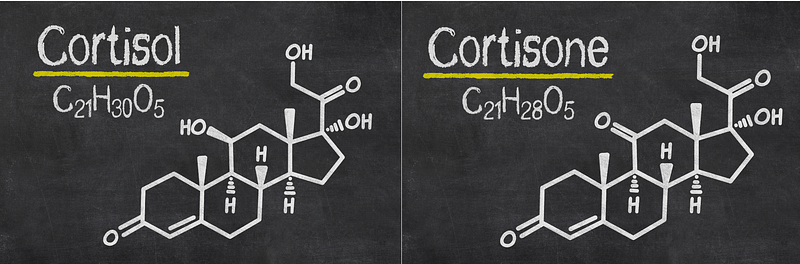
Corticoids are a derivative of the molecule cortisol.
And the latter, i.e., cortisol, is precisely the one freely riding in our blood like ‘Crazy Horse’ in situations of stress and anxiety.
In other words, with our food choices, we can add fuel to the fire.
Can you see the “perfect storm” that those foods trigger?
“Stress is multifaceted at several layers. It has physical, mental, and emotional facets”
In this article, “For a Healthy & Satisfying Life, Five Ways to Beating Chronic Stress,” Dr. Mehmet Yildiz clearly stated the multifaceted aspect of stress:
“Stress is multifaceted at several layers. It has physical, mental, and emotional facets. Physical and emotional stressors can change our hormonal balance and re-wire the brain negatively and positively based on our responses.”
Regardless of the original cause/s of our stress -i.e., emotional, physical, mental, psychological-, by adopting these eating patterns as a coping mechanism to deal with the symptoms, we are eventually adding another layer to the burning fire of stress: the physiological one.
You know that feeling when you don’t feel in your body, you sense that something is off, you don’t rest well despite spending seven or eight hours in bed, and yet you can’t figure out what it is?
That, is the physiological stress I am referring to.
How to start leaving the food-stress spiral
Observe the prevalence of these foods on your plate throughout the week.
Do not judge.
Just wear your curiosity lenses and take note of:
- which kind of food,
- what time of the day,
- the triggers, i.e., what’s going on in your life right before you reach for them.
Bringing to light those automatic mechanisms is the very first step- sometimes, a leap- towards a healthier, more balanced, and nourishing way to deal with our life stressors.
Take-home message: connecting the dots
👉 Many of us tend to overconsume some -or several- of the so-called ‘comfort foods’ on a regular basis as the way-to-go food to ease our stress discomfort.
👉 Many of these foods are highly inflammatory, especially when they are part of our daily or weekly menu.
👉 This will keep blood cortisol levels elevated: it’s our body’s attempt to counterbalance the inflammatory storm.
👉 As a result, these exact same foods that initially calm the wild horses of distress may contribute to keeping the stress cycle in perpetuum mobile by keeping the inflammation signals activated.
👉 Thus, by not addressing the cause of our psychological, emotional, and mental stress, we add another component: physiological stress.
If you would like to read more articles like this about nutrition, emotions, hormones, and making peace with your food, you can connect with me here 👇:
● Subscribe to my MEDIUM Email List
● Connect with me on LinkedIn
● Follow me on Twitter
I’d love to connect with you!


