
NUTRITION | STRESS | ANXIETY
Can comfort foods temporarily reduce our stress levels?
Yes, but paradoxically, they can also worsen the symptoms

Meditating 30 min a day, yoga class, mindfulness, hitting the gym 4 days a week, morning pages, including more veggies in my diet, dropping off half of my caffeine intake, drinking more water and green smoothies…
Who did not start the year with some of these resolutions or even the SMART written form of them?
And how many of them are still kept after three months?
As if it was not hard enough to build new habits, the endeavor becomes almost an ordeal when we spend most of the day spinning the wheel of our stressful life.
When symptoms of stress and anxiety surface in our daily lives, we usually become discouraged from our initial resolutions and automatically return to our old habits.
In addition to this, and as a way of alleviating the unpleasant sensations that stress causes in our bodies, we may turn to certain foods to seek comfort.
In other words, we often end up eating up our stress.
I guess we are all fully aware of the health consequences of overeating on a regular basis. So, I am not going to list them here.
However, one aspect of food and anxiety is not commonly addressed: The effect that certain foods exert on the stress level.
Can food actually worsen the stress symptoms?
The short answer is ‘yes, indeed.’
Regardless of the original cause of our stress or anxiety, sustaining certain eating habits over time causes, in itself, a significant strain on the body and can substantially contribute to perpetuating the imbalanced state we are already experiencing.
The situation is complex and operates in a vicious cycle:
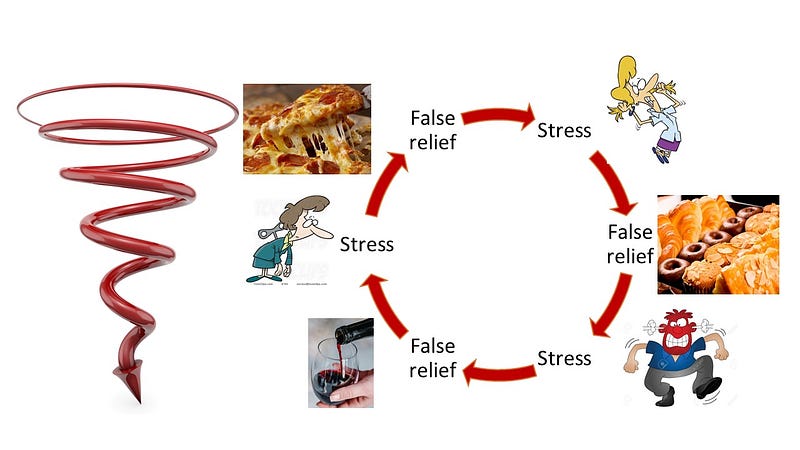
1. We have stress (or anxiety) for “X” reasons.
X= work, children, health, boss, partner, taxes, neighbor, pre-COVID COVID, post-COVID, traffic, worl insanity, lack of sleep… [fill the blank]
2. This leads us to put our eating habits on autopilot, guided by the symptoms of stress and the urgent need to ease them.
3. As a result, our food choices are often not ‘ideal’ to bring our bodies back into balance, but rather the opposite:
They perpetuate a cycle of “stress/false relief/stress/false relief” that may end up seriously affecting both our physical and mental well-being.
All of this without mentioning Mr. Frustration and Mrs. Guilt, who will likely pay us an unwelcome visit right afterward…
Not only did we not solve anything, but the scenario even worsened.
In Spanish, we have a saying to describe situations like this:
“Éramos pocos y parió la abuela”…
Something close to: “As if we were not enough, grandmom gave birth…”
In English, it would be something along the lines:
“Out of the frying pan and into the fire.”
”… and that was the last straw.”
or
“When the **** hits the fan!”
You get the picture.
Five foods that heighten our stress and anxiety symptoms
There are certain foods that, when over-consumed, can jeopardize any attempt of our nervous system to self-regulate.
The goal is neither blaming nor putting these foods in the spotlight per se, but to understand how they may affect our physiology and what role each of these items currently plays in our daily diet.
So, which are those foods that interfere with our body’s physiological response to stress?
Yes, your ‘guestimation’ is right: broccoli and kale are not on the list.
Without considering specific food sensitivities or allergies, five food groups exert this “power”:
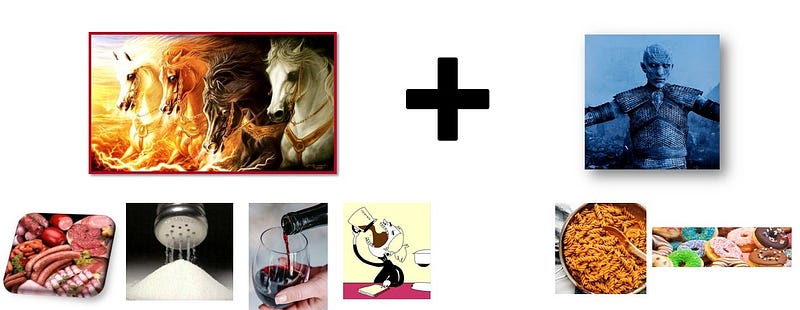
1. Low-quality fats and excess saturated fats.
2. Excess salt
3. Caffeine and other stimulating drinks
4. Alcohol
5. Excess sugar
I cannot emphasize enough the word “EXCESS.”
Nowadays, we are used to thinking of these foods as the “Four Horsemen of the Apocalypse” — i.e., fats, salt, caffeine, and alcohol, plus “The Night King” -i.e., sugar-.
We live in a culture in which we tend to blame and condemn certain foods as the sole culprit of all our health struggles.
For this reason, I want to make a plea for most of them, as there are many subtleties and nuances within each category that we may disregard and dismiss when we sentence a whole food group to ostracism.
What’s the missing link that connects these foods to stress and anxiety?
One word: INFLAMMATION
What’s the underlying mechanism?
It is a hormonal and metabolic cascade that adds fuel to the stress fire at a physiological level.
I explained it in this article.
TAKE-HOME MESSAGES
❀ It is key to understand how our body works to meet its physiological needs.
❀ If our body could speak when feeling stressed and anxious, it would scream out loud: “I need your attention!”.
❀ However, it expresses its needs for counterbalancing the wrenching stress sensations with other types of signals: seeking certain foods that instantly comfort and ease these uncomfortable symptoms
❀ Fats, salt, caffeine, alcohol, and sugar are the body’s go-to foods to appease the physical stress manifestation
❀ The catch 22 is that some of these foods may prolong the stress cycle through another physiological mechanism: inflammation.
If you would like to read more articles like this about nutrition, emotions, hormones, and making peace with your food, you can connect with me here 👇:
● Subscribe to my MEDIUM Email List
● Connect with me on LinkedIn
● Follow me on Twitter
I’d love to connect with you!


