
What’s Behind Germany’s ChatGPT Ban?
Will Italy’s Ban on ChatGPT Lead to EU-wide Restrictions?
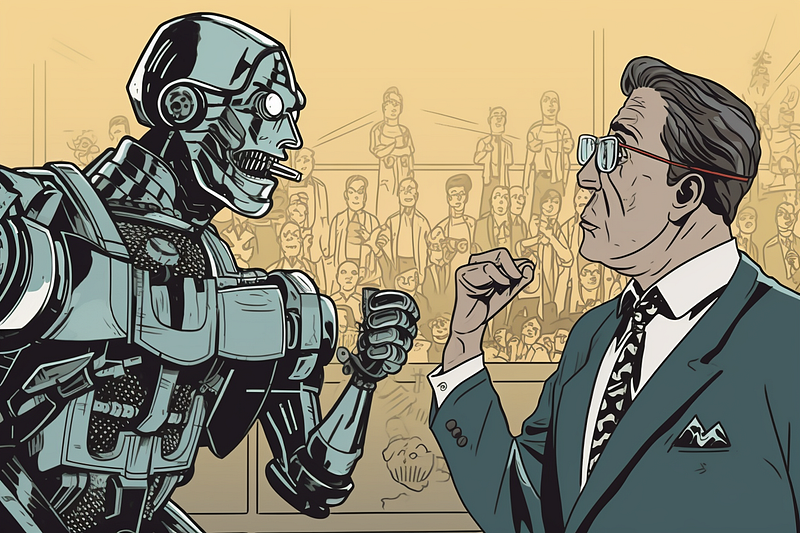
I saw a whole bunch of tweets yesterday announcing that “Germany is preparing to ban ChatGPT." Living in Germany, a country not known for making quick decisions when it comes to digitalization, this Twitter alert obviously made me curious, and I decided to dig a little deeper to see what was going on.
Here’s what I found out.
Germany and a possible ChatGPT ban
First of all, Germany is NOT preparing for a ban on ChatGPT.
There have been discussions about how to deal with the recent ChatGPT ban in Italy, that’s true, but nothing concrete has been decided yet by the usually very slow-moving German government's digital experts.
The fact that this was portrayed very differently on Twitter says a lot about how hyped the topic of AI and ChatGPT has become and why it’s always a good idea to be careful with headlines that seem to exaggerate the situation.
The key point is that the EU is currently working on a more general AI law, and Italy’s decision came somewhat abruptly. So now the EU countries have to take a stand. It’s going to be very interesting to see how this unfolds, not only in the EU (e.g. did you know that South Korea’s Ministry of Science has announced to create courses for prompt engineering?)
What if Germany actually bans ChatGPT?
In my opinion, even if Germany banned ChatGPT for whatever reason, I don’t think it would work as expected at all.
First, there are already too many open-source alternatives, e.g., Alpaca, which means that people would still have access to AI text-generation tools without relying on ChatGPT. Those open-source alternatives may not yet be as powerful as GPT-4, but I guess that’s just a matter of time. In a way, banning ChatGPT could even “backfire” and encourage the use and development of more open-source AI tools in the European AI community so that more people can benefit from them.
Another reason I think a ban would not work is that people could easily get around it by using VPNs and credit cards from outside the EU to access the OpenAI website since the ban has to be put into effect on the OpenAI server side. So if someone really wanted to use ChatGPT, they would surely find a way.
What’s next?
When banning ChatGPT, Italy argued for the protection of minors and privacy. This sounds a bit odd to me coming from the country where Pornhub ran a campaign for free premium accounts during the COVID lockdowns, and everyone was like, “Bravissimo!”
Data privacy is an issue that needs to be addressed, but wouldn’t it be more effective to actually address the issue instead of banning ChatGPT?
To my surprise, that’s exactly what the German Federal Ministry of Digital Affairs is doing right now: emphasizing the need to ensure democratic values and transparency in AI applications.
The German Federal Commissioner for Data Protection, Ulrich Kelber, said he could imagine a scenario where ChatGPT could be banned (you guessed it, that was the one sentence that set off the alarm on Twitter), and I think it’s actually a good thing to have a different opinion like this on the subject. This only shows that there is a need for discussion and that policies are needed to prepare for a future that will be heavily influenced by AI technology in almost every aspect of our lives.
In summary, although the hype surrounding the rumored ban of ChatGPT in Germany has turned out to be exaggerated, the discussions that have arisen from it are still important (similar to the “open letter” case and Elon).
I would be really interested in your thoughts on the issue. Do you think banning ChatGPT would be effective? Or should we focus on other ways to ensure the responsible use of AI? Let me know in the comments. 🙏
➡️ For more information about AI & Creativity, follow me on Twitter or Medium (use my referral link to get full access to all my articles and those of thousands of other writers).
➡️ If you like my content, why not leave a “clap” at the end of this article, so more people can see it?
Stay up to date with the latest news and updates in the creative AI space — follow the Generative AI publication.