What Will Happen if the Bitcoin ETF Is Rejected?
90% certainty means 10% uncertainty
The Bitcoin ETF (Exchange Traded Fund) has been a long time coming.
A very long time coming.
In fact, it’s been over a decade since the Winklevoss twins filed the first application with the SEC way back in 2013. The SEC denied that one, and every one since, but Grayscale's 2023 legal victory against the organization changed all that.
It’s now a question of ‘when’ and not ‘if’ a Bitcoin ETF will be approved, but that doesn’t necessarily mean that January 10th will be the magic date as many — including myself for these reasons — predict.
So, despite the relentless meetings between the SEC and ETF applicants, detailed guidance by the former to the latter, constant filing (and then refiling) of amended paperwork over the holiday period and early into the new year, what would happen if it didn’t come to fruition in the next few days?
In other words, the unthinkable happened and the ETF was denied at the very last minute?
Well, we probably already have enough information to make some solid, educated guesses at what might happen next, so let’s examine the impact.
Market Price
We can be pretty certain here because, like the Cointelegraph “ETF approved” debacle in October that I wrote about in detail here, we now have an insight into price movement due to another (also erroneous) report that dropped earlier this week.
This report was released by Matrixport (an ‘all in one crypto services platform’ according to the blurb on its website) and contained these words:
The current five-person voting Commissioners leadership critical for the ETF approval of the SEC is dominated by Democrats. SEC Chair Gensler is not embracing crypto in the U.S., and it might even be a very long shot to expect that he would vote to approve Bitcoin Spot ETFs
Somehow, despite all the bullish commentary and reasonably strong evidence of an actual, real approval happening, this single report gained enormous traction on Twitter and via media coverage. This resulted in an immediate price drop of around 6% as soft hands sold and triggered a cascade of leveraged positions.
Of course, the point that the decision could be made purely on political bias is preposterous since that would lead to all sorts of legal issues for the organization, so, eventually the selling stopped and the price stabilized once again.
Interestingly, as of three days later, the price has only recovered about half of what was lost and has remained broadly stable since. The market has essentially moved to a ‘holding pattern’, wanting to know, finally, what is actually going to happen before making any more decisions.
But this does show us quite clearly that should the SEC reject on Wednesday 10th — i.e., an actual confirmation of fact — we should expect an immediate and aggressive drop in Bitcoin price which will almost certainly lead to an oversold position just as quickly. The way forward after that will be unclear, but it’ll be messy, possibly for weeks.
But, in my view, the long term trend upwards to much higher numbers will simply resume eventually due to other factors that I talk about in detail in this article.
There’s one caveat to this; it depends how the SEC rejects the applications and what wording they use.
If it’s a straight out rejection with solid reasoning that requires a full resubmission, we’ll likely see the above scenario. If there is any deviation from this, such as some sort of ‘special case’ extension simply to allow for amended paperwork to be filed (not technically allowed, but also not impossible as all parties would have a vested interest to agree) or anything that shows the SEC will, in fact, approve next time round with the smallest amendments, then the outcome will be different.
Market prices are always about confidence, after all.
Wall Street Reaction
Some of America’s biggest names, funds and players now have serious skin in the game, both financially and reputationally.
We can argue about whether they truly understand Bitcoin itself or are entirely fixated on the dollar signs in their eyes from fees and possible significant fund returns, but in this context, it doesn’t really matter.
The bottom line is that they will NOT take a rejection lightly or quietly.
This point was put across very succinctly by US securities lawyer James Murphy and then picked up by Bitcoin news on January 4th.
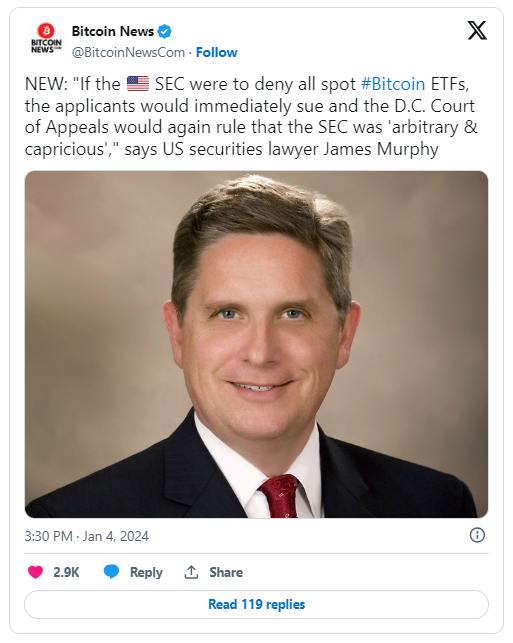
In reality, it’s now actually quite hard for the SEC to reject these spot ETFs.
First, they’ve already approved Bitcoin futures ETFs, which operate on reasonably similar principles, and, second, they’ve already been told in no uncertain terms by a very senior court that they cannot reject on the basis they did so before, since this was ‘arbitrary and capricious.’
This means they have to come up with something completely new as a reason for rejection, which must also be something that couldn't have applied before, since they’d be exposing themselves as having not assessed it properly for the last decade.
This is important because that, in turn, could lead to a whole world of hurt for the SEC in terms of dereliction of duty and, theoretically, enormous damages that could result from legal cases.
So, if they do manage to think of a reason why the current ETF applications should be rejected, it will be untested in legal terms.
And that means all the biggest fund managers in America, with some $17 trillion under management, will want to ‘test’ it for them, aggressively, quickly and with as much prejudice as possible.
The SEC also knows it will need a watertight case because, if they lose against this massive co-ordinated onslaught, the damages these organizations will seek in reparations will likely be unprecedented.
The shockwave could last years and set the US back even longer in terms of financial services.
At the very least, it won’t be pretty and the SEC would be wise to not underestimate the wrath of Wall Street.
The SEC and Gary Gensler
As can be seen from above, it would take a very brave, very certain or very stupid SEC to block the ETF applications at this point. Even delaying those which have dates past January 10th would likely be a risky strategy.
But, apart from the next few months, or even years, being locked in legal battles, it would also likely be the end of not only Gary Gensler’s tenure as Chair of the SEC, but quite likely his career in general. Who would touch him?
The SEC has already been constantly and heavily criticized for failing in its duty of care to the American investor and Gensler has looked increasingly uncomfortable in front of whatever oversight committee he is hauled in to speak to, many of whom have publicly shown their frustration that a Bitcoin spot ETF has not been approved already.
Could this even be catalyst for a shake up of the SEC itself or even a complete overhaul of objectives and responsibilities? Is it even conceivable that despite the short-to-medium term pain, the USA may actually come out of it with a new, more forward looking and progressive organization that actually defines, rather than simply enforce, legislation?
Perhaps we’re in the realm of fantasy now, but it’s not an impossible outcome, albeit coming at a very high price.
Bitcoin itself
Put simply:
Honey badger don’t care.
Bitcoin is entirely uncaring about us mere humans and our tendency to do stupid stuff all the time. It transcends us and the influence we think we might have. ETF or no ETF makes zero difference and, as Bitcoiners themselves say, it’s a case of ‘tick tock, next block.’
Sure, they may well be some price movement, but Bitcoin is still young and volatility is expected for some time yet, probably years.
But the asset, network, global computing power that supports it and those who build on it will, in the end, be entirely unaffected by Wall Street’s involvement or non-involvement.
And, in reality, how often do we get to say that?