What Will Happen When the Bitcoin ETF Is Approved?
Thanks to Cointelegraph, we now know for sure
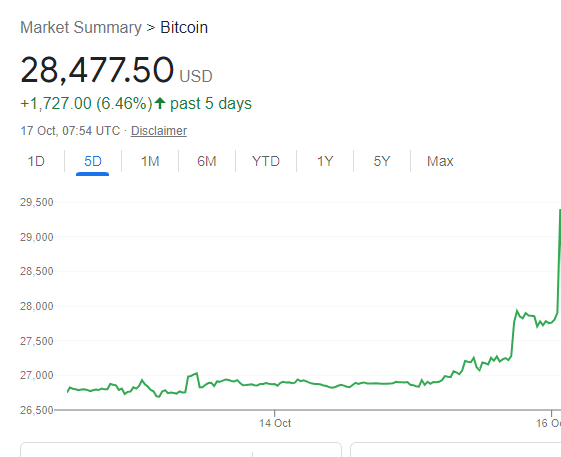
Yesterday afternoon, I was busily tapping away at my much-loved (and, after many millions of mostly misspelled words, now slightly tatty) keyboard when a sudden movement in my peripheral vision caught my eye and forced me to look over at my left-most monitor.
That monitor constantly displays the current Bitcoin price in chart form, more specifically in what’s known as ‘one minute candles’.
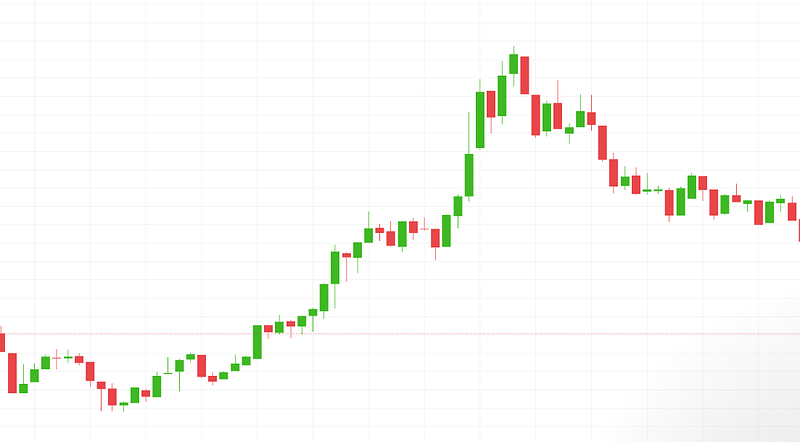
A candle is the range in which the Bitcoin price trades at the beginning and end of the time range selected — in this case that measly sixty second snapshot — and its colour denotes whether it ended at a higher or lower price than when it started. It also uses a simple colour code; green for ending at a higher price than the one at opening and red for the ending at a lower price.
At the same time, the ‘wicks’, visible in the image below, denote the range that the selected asset traded at within the selected time period and the size of the candle itself covers the range in which the price moved.
Therefore, the combination of all these factors allows a very simple and visually pleasing ‘at-a-glance’ view of what’s going on in the market.
Historically, Bitcoin is no stranger to large moves, but in recent weeks and months it has been relatively stable with no large breakout on either side.
But yesterday afternoon was different. Very different.
As I watched, open mouthed, the candle just kept getting bigger, forcing the graph scale to automatically readjust in real time: +$500, +$1000, +$1500, +$2000 and then +$2500 spread over two to three one-minute candles, almost instantly adding around 10% in total market price and, just as instantly, wiping out over $70m in leveraged short positions.
That scale of move in such a small timescale meant that something was happening. Something very major. So, what was it?
Well, I could talk about the fact that the supply of Bitcoin readily available on exchanges had been dropping steadily for months, the capacity of the Lightning network, and adoption itself, had been increasing, or the fact that there was now less than 200 days away from the next halving (where, as the name implies, the amount of new Bitcoin minted drops by 50%) but these pale into insignificance against one, enormous factor that has been in the minds of many Bitcoiners around the world for many years now; the legendary, if not mythical, Bitcoin ETF.
The Bitcoin Exchange Traded Fund, defined
An ETF — Exchange Traded Fund — is a basket of securities that trades on an exchange just like a stock does. In short, it makes it very easy for anyone, but especially large institutions, to invest in certain things using a tried and tested and, most importantly, fully legitimised and approved instrument that can easily be traded with other investors.
ETFs exist for almost any asset, commodity, product, market sector or even entire country you can think of and they are now and indisputable part of the trading and investment ecosystem across the planet.
But there isn’t one for Bitcoin.
Well, OK, that’s not exactly true, but I need to qualify that statement a bit to make it clear why the mere possibility this will happen is such a big deal.
To be more precise, there are already seven Bitcoin ETFs in the US that are fully approved by the SEC (Securities and Exchange Commission), but they are all based on derivatives of some sort, usually futures contracts. This means that, in simple terms, they trade pieces of paper betting on what the future price of Bitcoin will be, NOT the asset itself. That’s an over-simplification perhaps, but the bottom line is that none of these products, or companies behind them, actually need to hold any Bitcoin to do this — an important point that we’ll come back to shortly.
There’s also another product, known as the Grayscale Bitcoin Trust, a sort of ETF/derivative hybrid concept that is fully approved and created as a way for people, including institutions, to invest in Bitcoin itself more or less directly, rather than through a pure derivative. This fund DID require the purchase and safe storage of Bitcoin and, of course, Grayscale has been applying to fully convert their product to a more investment friendly ETF format going forward, a matter that ended up in high level court and ultimately paved the way for a possible approval in the future.
But, importantly for this article, not yet.
So, if that’s the case, what happened here?
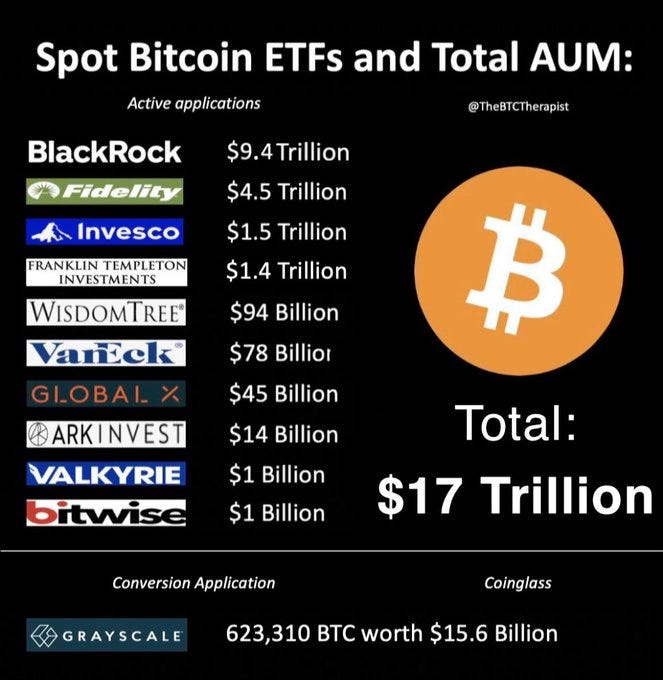
Well, this is where types of ETF become important. Grayscale had applied to turn its product into a ‘spot’ ETF rather than the ‘derivative’ based ETFs that already exist. So, in fact, have several other organizations, some of them very, very large, who want to do the same thing. The names of these organizations include behemoths like Blackrock, Fidelity and Invesco, all of who have very significant Assets Under Management (AUM) as you can see below.
Interestingly, to further disprove my earlier comment about ‘no Bitcoin ETFs’ (I did say it wasn’t exactly true, remember?) some spot Bitcoin ETFs do actually already exist in various parts of the world, with one being approved as recently as September 2023 in Europe.
It’s a bold step forward, but these existing ETFs are minnows with limited global reach compared to what we’re looking at in terms of the organizations above.
In other words, this story is really about the sheer purchasing power that is currently coiled up in America’s giant institutions waiting to be unleashed on a scale never seen before. And, to compound this, it will be the first time in history that an ETF will be approved for an asset that is strictly limited in supply.
ETFs are the responsibility, primarily, of the SEC. This overseeing body needs to ensure that the investor is protected, the underlying asset is not subject to manipulation, the issuer has the backing and credibility to manage and run it as well as a whole host of other considerations. Getting an ETF, especially in a brand new asset class, is not easy.
In fact, people have been trying for over a decade to get a Bitcoin ETF approved, with Gemini’s first attempt coming in 2013. In those days, there probably were grounds for concern as the the market resembled more of a Wild West trading outpost than anything else, but the industry has moved on very significantly since then and an approval - that’s a Bitcoin spot ETF approval — is now almost certain.
So, since there are only 21,000,000 Bitcoin that can exist, with around four million lost forever and, as at time of writing, about 1.5 million yet to be bought into existence, the effect of even a single spot ETF being approved would be very significant.
Not only would the the issuer need to acquire the needed Bitcoin and hold it securely, the sheer volume of money that would pour into the market sector would lead to very significant price rises under the most basic laws of supply and demand.
At least that’s how it plays out on paper, and, until yesterday, we only had that paper version to make our theoretical assessment.
But on October 16th 2023, we got a sneak preview of what would happen if just one ETF was approved.
Blackrock’s Bitcoin ETF approved!
A soon as those ridiculous sized green candles started spiking on my chart, I knew something big was happening and immediately jumped on Twitter to be confronted with this (now deleted) tweet from Cointelegraph, one of the industry's leading publications:
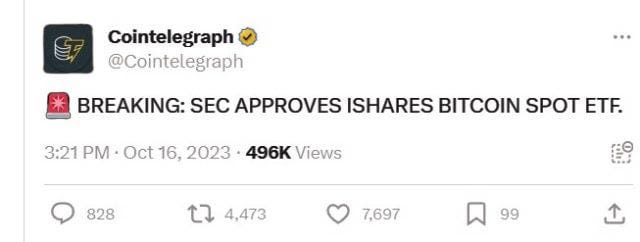
This was quite the surprise because even though it was already expected by the market that an ETF was almost certainly going to be approved by early 2024, nobody — including myself — expected it now.
Something tingled my Spidey-sense and I started searching frantically across all other outlets and sources. Within minutes, I was already convinced this was ‘fake news’ and began tweeting that this was the case.
At the same time, the green candles first slowed, then reversed into equally big red candles as the market also realized this was unfounded.
Within roughly an hour, the whole thing was over and, two hours after that, a formal statement from Cointelegraph confirmed what, by then, everybody knew.
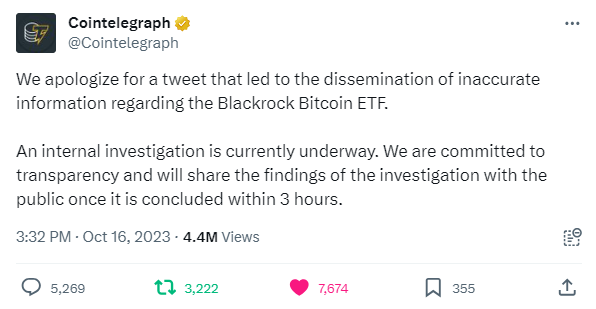
It was ridiculous, public debacle, extremely embarrassing to Coin telegraph and expensive to leveraged short investors.
But it also gave us, for the very first time, a tiny glimpse of what lay ahead with real, practical data.
And it’s far, far bigger than even I ever imagined.
What will happen when a Bitcoin ETF is approved?
Well, we can now be reasonably certain that the theoretical flow of money is not so theoretical after all.
According to data from CoinMarketCap, Bitcoin's daily trading volumes went from between $7bn and $15bn a day in the week or so leading up to this event to $27bn on the 16th October, with most of that spike happening in the few minutes immediately after the tweet appeared.
That’s just enough data to draw some important conclusions and consider some other important factors that will also occur when this happens for real.
First, the reality is that only a small group of traders and investors had time to react to the news before it started to unravel. It would have been a tiny percentage of global trading activity and many people, like myself, held off from doing anything at all until there was something more solid confirming the story.
What we saw, therefore, was a tiny, tiny fraction of possible capital inflow, yet that was still enough to move Bitcoin’s price by approximately 5.8% ($27,584 to $29,174) in the first four minutes alone.
In the ‘real deal’ this would be sustained and would probably last for hours, days and weeks, with pauses for profit taking by traders on the way up to new highs.
Second, this was the move by a small number of speculative traders on an unconfirmed rumour of just one ETF being approved, and did not even include institutional purchases of the asset itself, though it’s worth noting that these purchases would be done in different ways to how you and I would acquire Bitcoin.
In reality, it’s unlikely the SEC will approve just a single ETF since that would hand a very unfair ‘first to market’ advantage to that issuer. Instead, they will simultaneously approve some or all of them and allow it to be a marketing battle between brands, giving freedom of choice to the markets.
In other words, this will have a very significant multiple effect on the action we saw on October 16th, both in size and longevity of inflow.
Third, the mathematics is staggering. Bitcoin’s market cap is small, somewhere around $550bn at time of writing. The total AUM of all applicants is around $17 TRILLION. It is not unreasonable to assume that around 1% of all assets will be allocated, but even if we use a number of 0.5%, we are still talking about a capital inflow of around $85bn.
It is tempting to simply add that number to existing market cap of Bitcoin giving a new market cap of $635Bn, but that’s not a correct comparison. In reality, each dollar spend on acquiring Bitcoin has a disproportionate and leveraged effect on the price due to the way the mathematics and laws of supply and demand work.
The actual multiplier is subject to debate and, in reality, would be taken to extreme in this example anyway rendering any estimates next to useless, but we can say for certain that an $85bn investment — which excludes retail, speculative trading pressure and money from outside the US remember — would be considerably higher than the initial sum.
In fact, in 2021, the Bank of America's research unit estimated that it would take only $93m to move the Bitcoin an entire % point. There are 914 $93millions in the 0.5% allocation of $85bn. So, on that single — and extremely unreliable — basis, we’d be looking at a Bitcoin price of at least $255,920.
That’s a number that seems as impossible as $28,000 appeared to be at the time Bitcoin was at just a few cents. But then, those who bought Berkshire Hathaway stock at $28,000 a unit probably couldn’t imagine it one day reaching $526,000 where it sits today.
This, by the way, is why Michael Saylor has gone on record with his extremely bullish predictions about the ETFs catapulting Bitcoin's price to levels that are 10 to 100 times larger than now.
It’s a big range because he can't be sure of the dollar leverage value anymore than any of us can, but he does know it will be significant. Saylor seems to imply that will happen over years, maybe decades, and he’s using the impact of the gold ETF, finally approved in 2004 that led to a decade long growth in gold’s price as a viable precedent.
However, based on what we saw yesterday, I'm now wondering if we’ll see a peak close to those highs very, very soon after the buying frenzy begins. Bitcoin is not gold, it is far, far scarcer and no amount of money can ever produce more.
And speaking of which, let’s not forget we also have the halving happening at, most likely, the same time as the ETF approval, reducing the amount of Bitcoin being created by 50% at a time when there is that enormous increased demand.
The Bottom Line
Of course, no-one can predict the future, but we were lucky enough to have a sneak preview of cold, hard data and it was just enough to confirm beyond any real doubt what the impact is likely to be.
Money WILL flow in, very, very quickly, creating a demand shock and FOMO across the board. Speculators will try and trade into it and many will get it wrong. The Bitcoin that will change hands here may never see the market place again, leading to an incredible shortage of the asset in years to come.
So, in many ways, nothing has changed. After all, there’s still no US approved Bitcoin ETF.
Yet, in other ways, everything has changed.
With the near certainty of enormous inflows — even at a tiny percentage allocation — combined with the near certainty of an imminent ETF approval, further combined with a strictly limited supply, the possible outputs of the formula are eye watering no matter which variables you chose to apply.
We need to be ready. For me, that means making sure my Bitcoin is safe and, if possible, acquiring a little more for the long term.
But that’s just me.
You can draw your own conclusions.
Epilogue: After writing this article I was contacted by some readers asking when I thought the ETF would be approved. So I spent a day or two looking at data and collating anecdotal testimonies and opinions and wrote a follow up article with my view on when and why. You can check it out out by clicking on the link above.