When Will the Bitcoin ETF Be Approved?
It’s now a question of when, not if, so when, exactly, is this likely to be?
Recently, I published an article discussing what might happen when a Bitcoin ETF is approved by the Securities and Exchange Commission (SEC) in the US.
The article was fairly comprehensive, but one question it didn’t answer (as I was reminded by several people who got in touch) was when this momentous event might occur.
Good question.
So, while we can’t be sure what is in the minds of the decision makers at the SEC, we might be able to get a good idea by looking at key dates and the anecdotal feedback we’re getting from players involved with the applications.
In fact, over the 24 hours preceding the writing of this article — and actually as I started putting it together — things are definitely happening.
So let’s dive in.
How we got here
The SEC has been busy denying claims for spot ETFs for over a decade now when the the Winklevoss twins put in their very first application back in 2013. Since then, it’s been the same old story.
Delay, delay, delay and deny at the last minute, thereby extending the process for as long as possible.
The SEC can do this because of the way the application process is set up.
Essentially, the applicant completes a large stack of quite complex paperwork which outlines their proposal and basically demonstrates how they will be compliant and adhere to best market practices. This application is known as the ‘prospectus’ and is quite a major undertaking in itself, so we can be sure that those who apply really mean for it to happen.
But there is also a second part to this process, which is the filing of the 19b-4, a regulatory requirement under the Securities Exchange Act 1934 which informs the SEC of a proposed rule change. It also must be completed before the process can begin in earnest. If form filling and legal requirements float your boat, you can read about this process in more detail here.
Once all this is done, it’s over to the SEC to deliberate and make their determination according to a timetable.
Of course, this being the SEC, there isn't a single deadline to adhere to, but four, all of which are self imposed and can be extended at any time, at least up to a point. The SEC cannot move the final deadline and must provide a response by the end of it.
Traditionally, the SEC has announced a deferment to the second deadline date on the first deadline date, then announced another deferment to the third deadline date on the second, then yet another deferment on the day of the third deadline to the final then and then denied it on the last possible day of the whole process for pretty much all spot Bitcoin ETFs decisions to date.
For market makers, providers and consumers themselves, this is an enormously frustrating process and often begs the question “why not simply refuse at the first deadline and speed the whole thing up?”
Which is another fair point.
In theory, the SEC is supposed to engage with the applicants and work with them — at least to some extent — to ensure that everything is in order, but the internet is rife with anecdotal examples of the SEC not really engaging on any meaningful level or even being evasive and non-committal.
It’s almost been as if there has been a concerted effort to stop it happening for a reason we may not be party to, but I’ll leave that one for the conspiracy theorists.
The SEC has, however, approved derivative based ETFs (that is, using futures, rather than actual underlying Bitcoin) and it was the relative ease of getting these approved that was ultimately one of the key reasons we find ourselves in a much more positive situation in terms of a spot ETF approval.
We’ll come back to those reasons later on, because they will provide us with some clues as to timescale, but first we need to see what applications are open and what their formal deadlines are.
Applications in play
According to Bloomberg Intelligence, there are, right now, a total of twelve applications under consideration. Between them, these companies have many trillions of dollars of Assets Under Management (AUM).
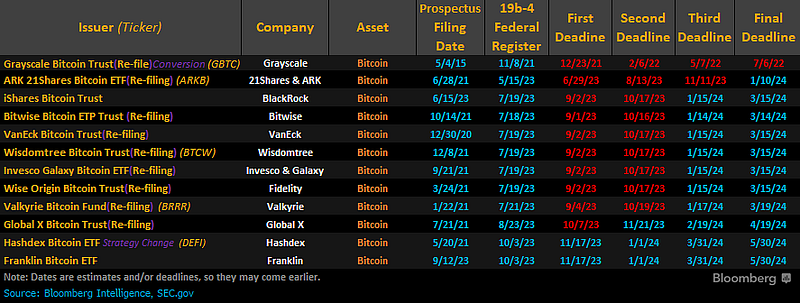
There are several immediate observations we can make from this chart.
First, it appears that Grayscale's application — which was actually a conversion of it’s existing pseudo-ETF product — has been and gone and, of course, it was originally denied by the SEC as is de rigueur for the commission.
However, it was Grayscale’s actions here that were the catalyst for change. Grayscale challenged the SEC’s decision arguing that since both the spot ETF and the future ETF fundamentally use the same markets and mechanisms, how can one be denied if the other one is approved?
Not only did the courts agree with Grayscale, they were ultimately very critical of the SEC and ordered them to re-evaluate the entire application.
Now, this didn't mean they had to approve it, it just meant they could no longer reject it on the basis indicated, since that basis had been perfectly acceptable for almost identical products in the markets. Now, the SEC had to come up with a completely new reason to reject it whilst still appearing to remain objective and compliant with the regulations.
This is a task that is trickier than it sounds if your agenda is to deny it at all costs, but relatively simple if you intend to play by the rules.
The SEC had until Friday October 13th to submit their appeal. In true SEC style, they simply refused to comment until the last possible minute and let the clock run out, adding as much time as possible to the process.
While this was frustrating for all, it did mean that after that date the way ahead was much clearer for a new review of Grayscale’s ETF application to convert their product to an ETF. This is why Grayscale’s final deadline date of 6th July 2023 is marked in red in the table, even though the application is now active again.
The next thing that is clear form the table is how may of the ETFs are re-filings, a total of ten out of the entire table, with only Blackrock and Franklin as being — technically speaking — new applications. Blackrock, however, probably carries more weight than all the rest combined.
The dates are also significant. The SEC lost its right to challenge the Circuit Court of Appeals on 13th October, but the next batch of decisions, seven in total, were due between the 16th and 19th October. Although some people were wildly optimistic about these being approved there and then, the SEC announced they would delay them all to the next deadline date.
In my view, this was entirely expected. There was no way Gary Gensler, head of the SEC, was going to respond that quickly.
In fact, the table tells us that there are only three more ETF decisions to be made this year, between the 17th and 21st of November for Global, Hashdex and Franklin.
Valkyrie's CIO, Steven McClurg, at least thinks there’s a chance that the ETFs will be approved on or around those dates in an interview that went to press as I was literally writing this paragraph, but my personal view is that all three will be delayed for reasons we will go into shortly.
In short, my opinion is that its unlikely there will be an approval this month, ie November 2023.
Of course, history will judge me accordingly, and, to be honest, I can live with being wrong.
Pressure mounts for approval
That said, the case for approval is moving very quickly now and evidence of preparation is everywhere if you look for it.
The mere fact that BlackRock applied is sufficient enough; these guys have serious power and influence across most legislative bodies. We all know they’re not supposed to, of course, but we also know that many decisions are made on handshake deals.
What Larry Fink wants, Larry Fink tends to get. BlackRock's’ ETF approval rate is a record breaking 99.82%, with 575 approved and one denied to date. And that one, in October 2014, was almost certainly never going to get approved by anyone.
There has also been a marked change in the SEC’s approach to dealing with at least some of the major applicants. Larry Fink, Cathie Wood (head of Ark) and Steven McClurg have all reported much more proactive, constructive and open discussions with the SEC recently, and several firms have already started tentative promotion for their products.
In addition, some of the applicants, including BlackRock, have acquired and registered their ETF tickers, publicly announced custodians and started seeding their products with their own money (which translates here as ‘acquiring Bitcoin.’)
None of this means that an approval is guaranteed, of course, and some of it is merely procedural, but it does lend credence to the idea that someone high up is now pretty certain they need to be ready to move quickly in the near future.
There’s also a human element to this.
There’s no doubt Gary Gensler will be thinking about his future career when his stint at the SEC is over and that will almost certainly be back in the private sector. Put it this way, I wouldn't be surprised if positions became available at certain large fund managers.
Call me cynical, but it wouldn't be the first time. His predecessor, Walter Joseph “Jay” Clayton III, did exactly that in 2020.
Gensler’s tenure has not been an easy one and he has not made many friends, largely due to his own doing.
He is now under pressure from not only the courts to review the Grayscale ETF thoroughly, but from very senior members of the house who have been laying into him mercilessly at recent oversight committee meetings and more or less demanded he approve a Bitcoin ETF immediately.
This is probably why an SEC insider recently revealed that Gensler himself refers to the Bitcoin ETF saga as his “personal Vietnam” and appears to be looking for a way out.
The path of least resistance, of course, is approval.
And Bloomberg puts the chances of this happening in the next 58 days, ie before the end of the year, at 75%, rising to 95% before the end of 2024.
So how does that stack up?
Bottom line — when is “when”?
All of this explains why most of us are so certain that a Bitcoin ETF approval is now imminent. The rest of this article is merely my opinion as an analyst who has looked at market actions and serious amount of anecdotal commentary and shouldn't be taken as any more than that.
Of course, there’s a non-zero chance that Gensler will carry out the ultimate ‘rug-pull’ and deny all of them at the last minute, more than likely sending the markets into a short term tail spin and wiping out billions of dollars of value. But I don’t think this is likely. They will get approved.
So, it all comes down to timing. Assuming the ETF applications are, in fact in order and follow all the guidelines that have successfully resulted in futures ETFs being approved there is, logically, no reason to delay any further.
The next batch of decisions is due in roughly two weeks. My personal view is that these will be delayed until the next round of approvals due in early January.
Gensler has to be careful here; whoever is first to market has a serious advantage so he needs to make sure he a) doesn't hand that advantage to a smaller player inviting the wrath of the mighty BlackRock but also b) doesn’t appear to be playing favourites by awarding the first one to his BlackRock chums which will create a different sort of fallout.
The simple solution, of course, is to approve as many of them as he can at once and provide some seriously good reasons why the others are not approved. Or, he’ll back in court with another lawsuit that might be harder to fight this time round.
All the applications, bar one, have their next round of decision making between the 1st and 17th of January 2024. It seems entirely logical to me that this would be the time to do it. The exception, Global X, could also be approved at the same time since the SEC doesn’t actually have to wait for the next date to approve it.
This is actually rather dull as it falls in line with most other analysts, but there is an another line of thinking.
Just as I was writing this article, a piece by DL News has indicated that the activity of futures traders may imply another date in mind, specifically, the month of December. There doesn’t appear to be any solid basis for this, other than general optimism, but there's no doubt that the futures markets are placing bets on significantly higher Bitcoin values before the end of the year, driven, it appears, on the belief of an ETF approval before then.
In any case, there's one thing we all universally agree on — we’re going to find out for sure very, very soon.
And either way, you can bet it’s going to move the market.