Bitcoin Is Going to Hundreds of Thousands Of Dollars.
It’s a bold claim. Here’s why we should take it seriously.

Claims that Bitcoin will change hands for thousands or even millions of dollars have been made almost since the day of its inception and, so far at least, it hasn’t happened.
In other words, we have a 100% failure rate of these claims coming true.
But Bitcoin has been the world’s best performing asset for some ten years now, with an average compound annual growth return of 67.91% since 2013 (source: lazyportolioetf.com) far surpassing literally every other asset on the planet.
Go back to Bitcoin's beginning and that average annual return jumps to around 200% a year — numbers that are almost too incredible to believe.
Yet, as unlikely as it sounds, it’s true.
So does past performance allow us to open our minds to the possibilities that lay ahead or does it simply mean that Bitcoin’s best days are behind it in terms of dollar returns?
As incredible as it seems, I would argue that we’ve barely begun.
A word of warning
Of course, as a long term Bitcoiner, the actual dollar price is largely irrelevant to me, but if you’re looking to measure your net worth in dollars, or convert some or all of it back to fiat cash at some point, you will almost certainly find this point of view interesting.
You’ll not find here any discussion as to whether the conclusions mean you should sell or buy at any point. This is not trading advice, after all, but more an extrapolation of current thinking, trends, macro economics and data that neatly align to point to a conclusion that is extremely hard to argue against on any purely factual basis
In short, the evidence shows that Bitcoin will continue to increase in value, probably quite significantly, for a very long time to come.
But why?
What the experts say
‘Experts’ are generally classed as experts because they have spent hundreds, sometimes thousands, of hours working with, learning and understanding their craft. On a purely technical definition, therefore, I am also classed as an expert, though I happily concede that I remain a student of Bitcoin and probably will forever.
But in this age of social media, the value of expert opinion has been diluted by a myriad pseudo experts, people with their own agendas rather than actual knowledge and, worst of all, the influencer wannabes who are relying on production value and sensationalism over substance to make their name.
It’s ironic that in a time where we have more access to more information than ever before in human history, it’s actually harder than ever before to get a clear answer on, well, anything. The onus has shifted to the user to question, double check and verify literally everything that is presented in even the most basic google search.
Yet the information is there if you invest the time to find it.
There is a new Twitter account that monitors and collates price forecasts as they are made by genuine experts in either the Bitcoin or financial industries called, quite appropriately, Bitcoin Price Forecasts, that is worth looking at.
According to the data provided by this account as well as other commentary made elsewhere, the following is a range of recent forecasts made over the last few months that I have simply collated into a spreadsheet as follows:
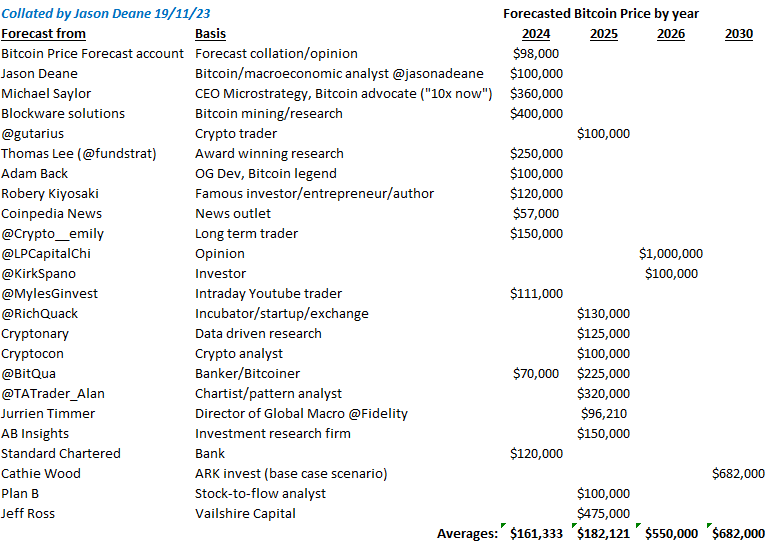
Now obviously there are more forecasts than are listed here, but I have tried to include only forecasts where people have some form of credibility in the space. Bitcoin critics, such as Peter Schiff, for example, would put all future forecasts at zero, but because he has absolutely no credibility in the space and has been consistently and wildly wrong for well over decade, it doesn't make sense to include his views.
Also, conspicuously absent is highly credible Bitcoin perma-bull Jack Mallers, who has given a forecast of $1m+, but has not stipulated a date, meaning that adding it in to the spreadsheet might unnecessarily skew the results positively if it’s in the wrong place.
Of course, nobody who has taken the time to properly study Bitcoin is ever bearish on it, which is an interesting point in itself, but a couple of other things struck me once this simple spreadsheet has been collated.
First, the people listed have very different methodologies. Some arrived at their forecast with purely data driven analytical approach, others with a macro economics focus (myself included), some from a business, trading or investment perspective and others from a ‘balance of probabilities’ angle. Yes, interestingly, all outcomes are considerably higher than the current market price.
Second, there is a phenomenon known as the ‘wisdom of the crowd’ that may be playing out here. This is where the combination of multiple, independent judgments is often more accurate than a single expert’s individual judgment.
Of course, this is a small sample which can skew the results under that methodology and there are specific rules about knowledge levels of opinions that can have a similar effect, but it’s an interesting possibility nonetheless.
But while this is all interesting, the bigger question still remains:
How can we, they, or anyone, come to these conclusions in the first place?
Well, as it turns out, there are some very solid arguments.
Part 1: Bitcoin as an asset
The most obvious argument in favour is also one of its simplest and, in my view, the most compelling. That is, the fact that Bitcoin is an almost perfect, if not actually perfect, demonstration of the most basic economic fundamental — the law of supply and demand.
The impact of this law is disproportionately high because we’ve never actually had a situation in human history before where there has been a strictly limited supply of anything. That simple fact alone is an incredible thought. We’re truly dealing with something totally unique.
Fiat money, for example, is effectively unlimited and even scarce physical assets such as gold and other precious metals not only have an unknown total quantity, they actually have elastic supply curves which are closely linked with price.
In other words, as price goes up, more companies will seek to profit by opening more mines and processing plants. When price goes down, the reverse happens. None of this is true for Bitcoin whose supply is entirely fixed, now and always, regardless of price and demand. There will only be 21 million coins produced in a very precise schedule until around 2140 and there’s nothing you, I or even the most powerful government or individual on the planet can do about it.
This means we have an absolute in terms of the supply side of the equation. The only other part of the equation is demand and that’s harder to quantify.
Of course, I could go into enormous detail about how Bitcoin’s total users are increasing, sovereign level adoption, understanding and education is already happening or how things like the now inevitable ETF will change things, but the bottom line is that there can be no logical argument against the overall requirement for Bitcoin increasing over time.
This means, of course, that at a very basic level we have a situation where supply is constantly reducing and demand is constantly increasing. Even if we disagree about just how quickly that demand is increasing, it is absolutely certain that those lines will cross at some point.
And the law of supply and demand dictates that this will create an increase in price. It really is that simple.
Put another way, Bitcoin's current rate of inflation is currently around 1.8% a year, meaning that net investment into the asset must stay at at least this level to maintain price. After April next year when the next halving happens, this drops to 0.9%.
In dollar terms, at current prices, that’s a net investment requirement of around $12bn a year right now, dropping to $6bn in 2024. This is purely indicative, rather than absolute, but let’s use these numbers to make the point.
Do we really think net investment will stay below these levels in the coming years? Is a 50% drop in dollar terms in 2024 really likely?
Further, as prices have risen we can safely say, mathematically speaking, that net investment must currently be above $12bn a year. After April, is it viable to think that demand will suddenly drop by half at the exact time new products, such as ETFs, come on line?
Even if these new products were not there and demand only stayed the same as it is now, it’s a logical conclusion to state that price must double since the supply quantity has halved.
Of course, the real world always has something to say about nice neat models, but there’s no way round the mathematics of the asset itself.
Part 2: Proof of Work (PoW) and the Environment
Bitcoin’s PoW protocol is essential to create real, hard money with an issuance model based on mathematics and one of the laws of thermodynamics.
It is one of the fundamental reasons why Bitcoin is the most likely candidate for a global financial system going forward and removes the human element that so often defeats even the most well intentioned banker, politician or president.
But, originally at least, it came under heavy scrutiny for its power use, leading to significant nay-saying about its future.
Not only has this now been disproved, but it turns out there was a significant twist in the whole affair; it’s now more likely than ever that Bitcoin mining will actually be a key part of the environmental solution going forward rather than part of the problem.
In practical terms, it was probably never really part of the problem anyway since the amount of power consumed is so minor in the grand scheme of things, but you’d be forgiven for thinking otherwise due to the disproportionately large amount of negative press coverage it receives.
Instead, something none of us ever expected — myself included — happened. It turned out that Bitcoin mining was a perfect mechanism to use stranded power, balance grids, reduce methane emissions and drive investment in renewable energy. It can even do this at a level that is disproportionately high compared to the meagre amount of global energy it actually consumes.
How this works is not a subject for discussion here (although I've written about it in broad terms in the past) but the pertinent point is that this has opened doors for significant investment from companies who are looking to enhance their green credentials both into the network (already happening) and the asset itself (soon to happen).
Again, with a very limited supply, this will have a positive effect on Bitcoin price.
Part 3: Market Maturity
Bitcoin is barely a decade and half old, but already it is becoming more and more entrenched into our financial systems, a trend that is about to accelerate significantly.
A few years ago it wasn't easy to buy Bitcoin, and it was next to impossible for institutional money to be involved. Whilst retail solutions, in general, have become easier, Michael Saylor of Microstrategy changed everything when it came to corporate or institutional money for reasons I went into great detail about at the time.
Whilst we certainly can't say that the market has fully matured (there is a very, very long way to go) it has definitely started to take shape in a positive way.
While there was good reason to reject an ETF back in 2013 when the first application was made, the market has now matured enough to make it a viable proposition and a logical next step. Why this is important and what impact it’s likely to have is covered here in some detail, but this is a good indicator of just how far the thinking has changed.
Not only does institutional money now have a safe, proven and approved direction to flow from a regulatory point of view, but this means that Bitcoin is now quite likely to form a key part of our pension and long term investment plans going forward.
In addition, hundreds of companies have come into existence offering custody, loans, security, advice, exchange services and consultancy to businesses, each looking to build their customer base and further driving awareness and adoption, especially using the Lightning Network which has itself also seen an increased capacity over time.
Now, while all these things are unquantifiable in many ways, the trend is undeniable and, once set against the backdrop of fixed supply, can only lead to one outcome — a significant increase in dollar value of Bitcoin.
Part 4: Macroeconomics
If the arguments above aren’t enough to convince you, there is one more very important aspect — the macro economic outlook.
The bottom line is that most, if not, all countries have been printing money at at unprecedent rate to get out of various financial situations. This might — and often does — solve those short term issues, but it comes at a cost; devaluation through inflation.
This is where the rule of supply and demand works in reverse, since constantly increasing the supply side of the equation will lead to a lower price (or value in this case) where there is not a corresponding increase in demand, which there isn’t. Not in real terms anyway.
We have already seen hyperinflation in weaker economies around the world and it would not be wise to think that this will not eventually happen to richer, developed nations. In fact, failure of fiat is inevitable, mathematically speaking, and probably within a much shorter timescale that we would have predicted, say, a decade ago.
In short, fiat is doomed and there’s very little, in practical terms, that we can do about it, at least not without making drastic decisions over an extended period that will not go down well with the voting populations it affects.
This means that, increasingly, people will have to find ‘hard’ alternatives, such as real estate, precious metals and, of course, Bitcoin. Out of all of these, the latter is the easiest to access, buy and store for the common man, all that’s missing is the education needed to do it. It’s happening slowly, but it’s coming.
However, not only is there the distinct possibility of an increased demand, the constantly reducing purchasing power means that all assets will ultimately appreciate as a natural consequence of this devaluation happening. That means assigned dollar values of those assets will increase as the value of that dollar decreases.
This process has already happened numerous times in history but is most clearly explained in the book ‘When Money Dies’ by Adam Fergusson. It’s worth reading to understand what we’ll almost certainly see in the near future.
Wealthy individuals have already started protecting their positions by moving into Bitcoin, including some of the world’s richest men, but now so have some countries, especially El Salvador which is blazing the trail needed to get there. Just yesterday, a pro-Bitcoin candidate, Javier Milei, was elected president of Argentina, a country rife with economic problems and a worthless currency.
While changes won't happen overnight and may go via the route of initially dollarizing the nation, it’s clear that Milei has one eye on a Bitcoin future for his country. And, of course, he’s far from the only one. Other countries are already examining how it can be done and, at some point, one of them will figure out that they can print their own currency to secure the asset for their treasury reserves at little to no cost to themselves.
When they do, the demand for the world’s scarcest asset will go parabolic.
The arguments against
The arguments for this happening are clear, easily researchable and based on fact, whereas the arguments against are really about perception, understanding and protectionism.
Perception is linked to education and the fact that we still, even in 2023, see press articles about Bitcoin only being used by criminals (it isn't) or being bad for the environment (nope) shows just how far behind the curve the public narrative still is.
Of course, ‘The Man’ will want to keep the status quo and retain control over populations and their money by trying to stop it, so there’s an obvious incentive to perpetuate the myths, even though it’s the disadvantage of the very people they are supposed to be serving.
But since Bitcoin is so incredibly decentralized and has no central point of attack, this can only be done by cutting off on and off ramps with the traditional banking system. However, this won't work since it’ll either force people to a Bitcoin standard entirely OR force people to look for other services and jurisdictions where access is allowed. After all, with Bitcoin, it doesn’t really matter where they are actually located most of the time.
In truth, there is probably only one way that Bitcoin will become worthless at this point; self destruction. Should an error be introduced to the code, for example a BIP implementation going wrong, the result would be catastrophic.
Fortunately, this is very unlikely, though it must be acknowledged it is a non-zero chance.
The bottom line
This is very much a summary article due to the necessity of being of manageable length. In reality, each of these categories could easily be enough for an entire book by themselves and further, independent investigation by the reader is strongly encouraged.
But the facts, and even very top line summarized trends are clearly pointing to an ongoing increase in demand at the very time supply is about to cut by 50% in production terms. In addition, liquid supply continues to fall by a certain, less quantifiable, amount, as more and more long term holders move their coins to deep storage off the market either for a very long time, or for good.
All of which leads to a different question:
Is six figures the top for Bitcoin?
In my view, almost certainly not.