
What to Say to Your Inner Child: Heal Her with Vitamin Validation
Find out what nourishing words you can use to validate the feelings and thoughts of your inner child.

Validating our inner child is one of the best things we can do, especially if she (he) has suffered from emotional neglect for the longest time. In fact, from what I have discovered after helping others heal, the more neglect we have experienced as a child, the more our inner child would need Vitamin Validation. Validation meets her needs where she is deficient in love and care.
Just think about how understood we feel when someone else validate our feelings. I know I do. I often find it a nourishing experience even though the friend that I am in conversation with, may not have actually offered a solution to my problem.
The opposite happens when our thoughts and feelings are ignored, denied and rejected. We feel rather alone and may even feel as if they are not valid due to having a lack of response. In fact, we may get badly triggered when we believe that we are not being listened to.
It’s no different for our inner child. When we validate her, she feels cared for. Our assurance helps to support her especially where she is feeling lost, confused and helpless at her age. When she feels better nourished, she is much able to tap into her inner resources for strength and courage.
As someone who holds space for women in releasing their emotional blocks, I have observed how applying healthy validation supports healing and recovery. Validating our inner child with love and gentleness often brings about immeasurable benefits. Validation is definitely a key step in my self-love healing protocol!
Let’s break down the process of what it means to validate.
What Happens When We Validate Someone Else
In general, when we validate someone’s feelings, we are showing that we acknowledge his or her emotional experience. The opposite is true of invalidation when we ignore, reject or judge the other person.
Validation doesn’t mean that we have to agree with the reactions or choices of others. We are simply saying that we can understand why they would feel a certain way based on what happened. Also, we are demonstrating acceptance of who they are — regardless of how they feel or think.
When we validate, we give them a safe space for them to safely share their thoughts and feelings. We don’t apply judgment while actively listening and we are open to hearing their side of the story. Most people I know just want to be heard. They don’t necessarily want us to solve their problems. Validating others is certainly a skill that I’d like to continue to practice and be mindful of.
With validating feelings, we are assuring them that it is okay not to feel okay. Our task is to let others feel heard, understood, acknowledged and accepted. I’d like to suggest that validation involves an extra step to just feeling empathy for another person. Other than words we use to create a connection, it helps to convey it through some sort of action. Sometimes, it can be a hug or a gentle touch. At other times, it can be giving a nod of understanding.
In the absence of validation, the other person may feel as if it is wrong for her to feel what she feels or that there is something wrong with her. It can result in misunderstanding and problems in relationships. In fact, emotional invalidation has been suggested as a contributor to mental issues such as inflicting harm to oneself.
Many children have been taught from an early age that expressing their feelings were bad and wrong. They were not allowed to feel a certain way. Some were even severely punished for expressing their thoughts and feelings. In households where parents don’t model how to deal with feelings, there could also be an implicit sense of invalidation since no one talks about them.
In fact, according to this article, a few dominant psychological theories of borderline personality disorder (BPD) assert that many people with BPD did not receive sufficient emotional validation over the course of their development. It goes to show that validating feelings can go a long way in building well-being. Let’s get to the root of helping our inner child, especially where her feelings have never been acknowledged previously.
How to Validate Your Inner Child
Many of the principles for validating others apply when we work with our inner child.
To begin with, we start by being present and curious about what our inner child is going through. She may be unable to articulate what she feels at the start. However, we are patient and we allow her to feel safe to experience what she feels.
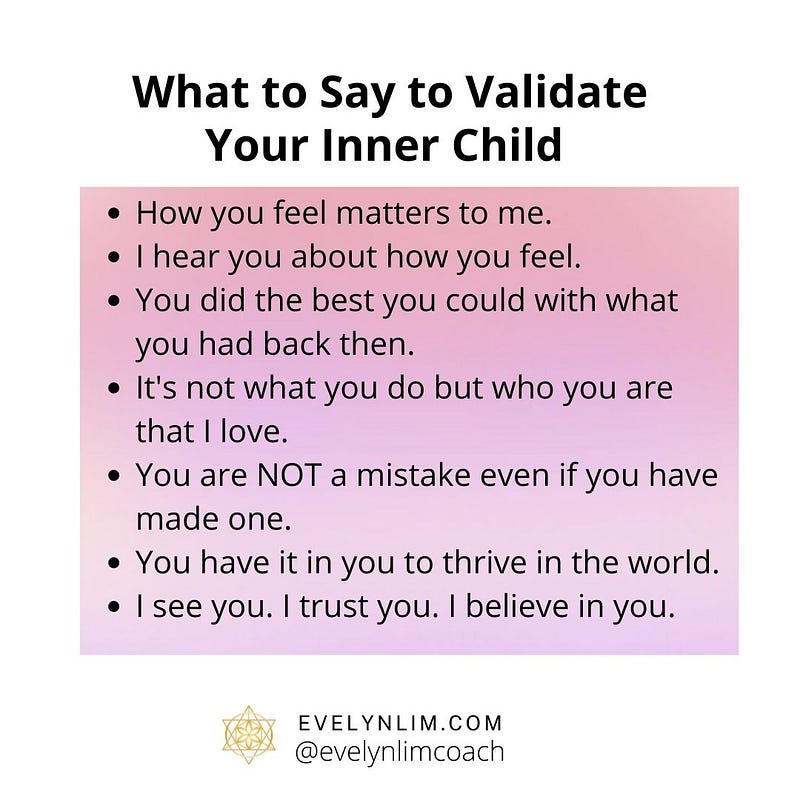
Next, we nurture her by responding with certain comforting and assuring words or actions that validate her experience. An example of an action is the butterfly hug that we can apply. Some examples of words that we can use are as follows…
Hmm…I hear you.
It does sound hurtful.
It sure seems like you have a lot to deal with.
I know just what you mean.
Based on what you’ve described, am I right that you are feeling this _______?
How you feel matters to me.
I acknowledge how you feel.
You did the best you could with what you had back then.
It’s not what you do but who you are that I love.
You are NOT a mistake even if you have made one.
You have it in you to thrive in the world.
I see you. I trust you. I believe in you.
Vitamin Validation for Recovery
Vitamins are supplements that we take to meet any diet deficiency. Apply Vitamin Validation for your inner child daily, if needed. Or, as part of a self-love practice, I suggest validating her as often as you can.
Create a sacred space to hold her. Visualise your inner child in front of you, connect with her and validate how she feels. Watch out for signs that things have improved: she is going to feel lighter, more at ease and confident!
On your (adult) end, you will discover that you are less triggered by situations that would have previously led you to believe that you don’t matter. You are also less likely to be craving for approval from others when you are able to nourish and validate yourself. Being empathetic inwards helps you to manage your emotions more effectively.
Indeed, recovery and restoration through validating your inner child leads you to create better self-acceptance, greater well-being and to also, improve your relationships with others.
Subscribe for more of Evelyn’s writings on emotional healing.


