
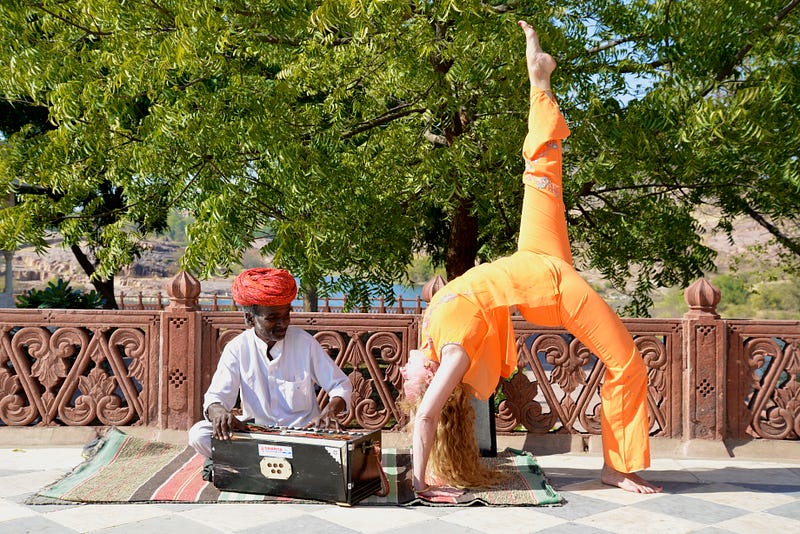
What is Yoga?
From Ancient Sources to Modern Times
“Bees prepare honey by collecting the essence of many flowers and trees, but then distill them into one essence. The juices themselves might think they are the essence of this or that tree, although they become one. And tigers, lions, wolves and worms, flies, gnats and mosquitos all become these forms, without knowing from whence they came. But this subtle essence pervades the whole world. That is the truth. That is the Self.” — Chandogya Upaniṣad (8.16)
“A knowledge of the existence of something we cannot penetrate, of the manifestations of the profoundest reason and the most radiant beauty, which are accessible to our reason in their most elementary forms — it is this knowledge and this emotion that constitute the truly religious attitude.” — Albert Einstein
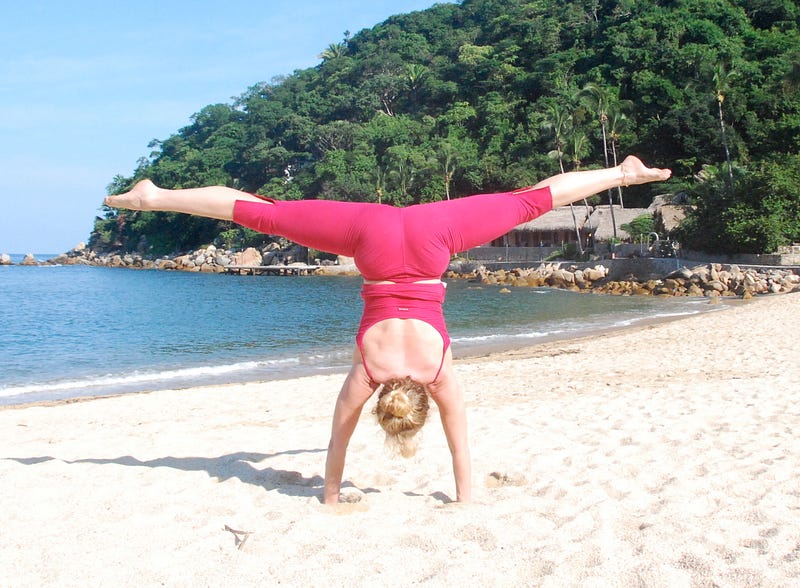
In modern times, when we mention yoga, the first thing that often comes to mind is a limber young woman in spandex. But yoga is so very much older and more complex than that. For most of its history, yoga had nothing at all to do with physical postures, unless they were seated poses used for meditation.
The word yoga is derived from the Sanskrit yug, which means to yoke. And it refers to yoking the senses and the mind in order to be able to peer inside of ourselves in order to see our own internal light, and also to see how that light connects us to every shimmering particle of the universe around us.
The 5th century B.C.E. Kaṭha Upaniṣad, describes our true inner “Self” as being a charioteer, a driver of chariot (which represents the body). The mind is described as being the reins, clutched tightly in the charioteer’s hands. Our senses are the horses. And the terrain the horses run wild over is said to be the objects of the senses — the physical and mental world in which we live.
We are advised that when our mind does not have control over our senses, that those senses then run free, like “wicked horses are for a charioteer.”
The earliest mention of āsana, or posture, in yoga comes from the Svetāśvatara Upaniṣad 2.8 (around the 3rd century B.C.E.). It does not describe the sun salutations you might be so familiar with. Nor does it describe backbends or handstands, or anything even remotely like that!
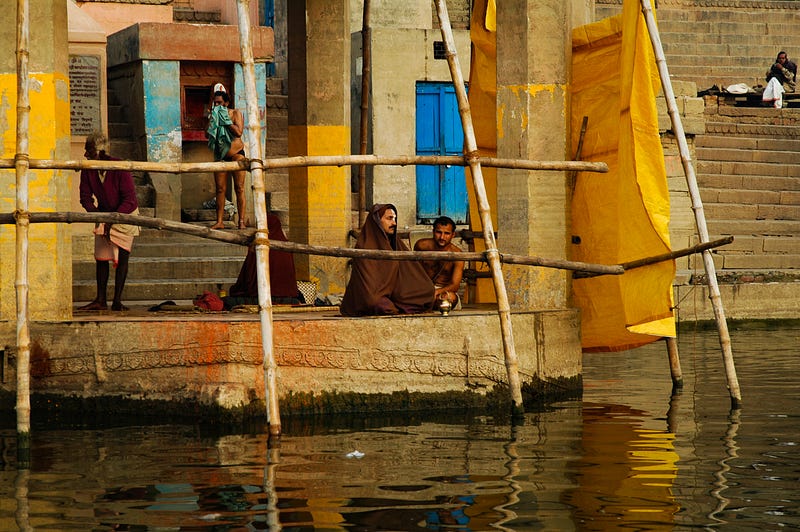
Rather, it describes sitting in an upright meditational position and “causing the senses and mind to enter the heart.” We’re then advised that by “repressing his breathings (here) in the body, let him who has controlled all movements breathe through his nostrils, with diminished breath; let the wise man restrain his mind vigilantly, as he would a chariot yoked with vicious horses.” In other words, we are told to still the body, quiet the breath, and that the mind will then drop into meditation.
Much later in time, somewhere around the 10th century C.E., haṭha yoga was born. The word haṭha, in Sanskrit, means force, and it refers to forcing energy through the body by means of mudrās (hand and body positions) and bandhas (energy locks in the body). If you have ever taken an ashtanga yoga class, you’ve probably heard of uḍḍīyana bandha (or the abdominal lock), mūla bandha (the root lock), or jālandhara bandha (the chin lock).
What might surprise you though was that these mūdras and bandhas were not intended back then to make your handstands lighter or your pull-throughs easier. They were used to manipulate the flow of energy through your nāḍīs (energetic pathways carrying the life-force through your body).
Two of the major pathways, the idā and the pingala, or the sun and the moon channels, are conceptualized as criss-crossing back and forth up from the base of the spine to the crown of the forehead around a main, central, nādi called the sushumna nādi.
Idā is associated with a moonlike nature, feminine energy, and is thought to have a cooling effect. Pingala is associated with the sun, warmth and masculine nature.
The idā nadi is associated with the breath flow in the left nostril, while the pingala nādi is associated with the flow of the breath through the right nostril. The yogis believed that the balance between these two flows was a constant dance, a tipping of the scales towards intuition or towards action.
What the yogis did not know, but seem to have intuitively understood, is that we actually do have a natural rhythm of alternating between one dominant nostril and then the other. And which nostril is dominant is correlated with all sorts of mental states and learning abilities.
Dr. D.S. Shannahoff-Khalsa, a yogi and a brain scientist has examined this shifting rhythm and how manipulating it through the use of yogic breathing techniques can impact our language and mathematical abilities, our state of calmness, and even be used to treat obsessive compulsive disorder and depression.
So, today, although we often associate yoga with acrobatic body postures, we must realize that these are only superficial expressions of something deeper, a connection to something much bigger than ourselves — a link, perhaps, to something un-nameable, something which permeates the stardust and the sunshine and the breath which moves in both you and in me.
A swāmī in Rishikesh once told me a story about a young boy and his beloved buffalo. The boy had been sent to study with a famous teacher. The teacher asked him to focus his meditations on Viṣnu, but all that the boy could see when he closed his eyes was his herd of buffalo. Frustrated, he told the teacher he just wasn’t “getting it,” and was going to leave the ashram. The teacher told him to shift the focus of his meditation to his buffalo instead. And the boy instantly saw that the same essence that was in his buffalo was inside of every other part of the universe. He achieved instant enlightenment.
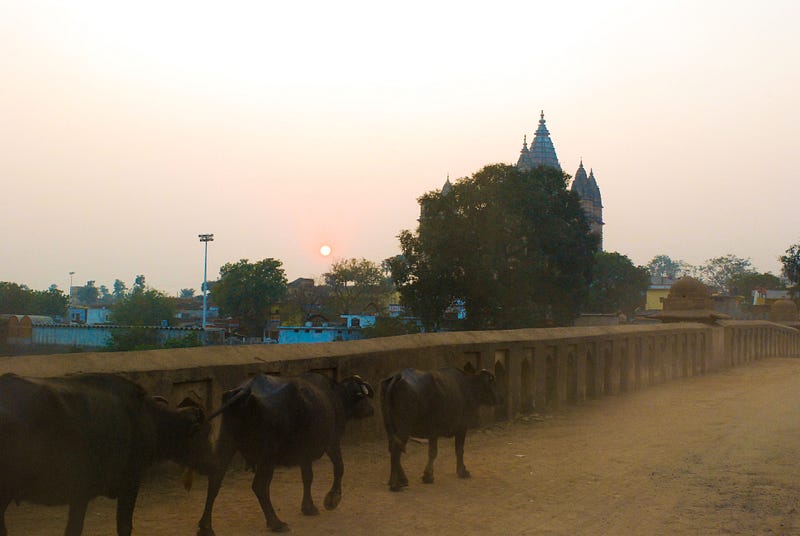
“Now the light which shines above this heaven, above all, above everything, in the highest worlds beyond which there are no higher, verily, that is the same as this light which is here within the person.”Chāndogya Upaniṣad (3.13.7)
Yoga is like this. There is no one path to enlightenment in yoga.
In fact, the ancient sage, Patanjali, in the classic text, The Yoga Sūtra (literally the thread of yoga) from around 300 C.E. offers a myriad of objects of meditation ranging from “a deity of one’s choice (sutra 2.44),” to “knowledge derived from dream or sleep (1.38),” to breath control (1.34), to the expression of oṃ (the resonation of the universe), or to “meditation as desired (1.39).”
Yoga is old. And yoga is new. It is impossible to look back at any point in time and say, “that’s yoga.” It is a living, breathing tradition with roots and wings. It has morphed and traveled down many paths, paths which have twined together like the roots of a great tree and which have come together to form one solid trunk.
And, like a flock of doves, lifting to the air from the branches of that tree, yoga has blossomed into a myriad of practices, inspired countless souls and offered a glimpse of an internal light which shines inside every one of us.
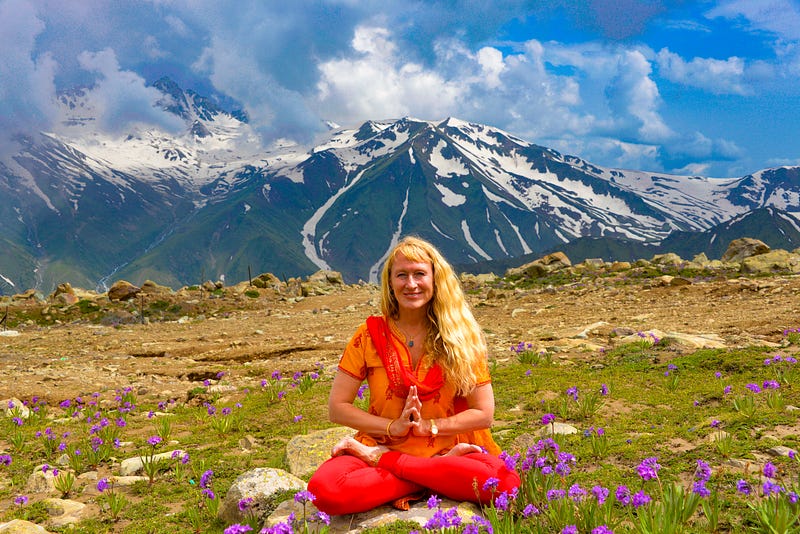
Erika Burkhalter is a yogi, neurophilosopher, cat-mom, photographer, and a lover of nature and travel. She has been studying and teaching the ancient yogic texts for many years and holds an MA in Yoga Studies as well as a MS in Neuropsychology. She has been teaching yoga for twenty years. Erika teaches yoga philosophy for Loyola Marymount University’s extension program and has traveled within India seven times to study yoga, to see the ancient sites, for graduate school study, and to take her yoga students on retreats to see the land where yoga originated. Erika is also an editor for Mindfully Speaking, a medium publication.
I hope that you enjoyed this piece about the Origins of Yoga.
You might also enjoy this story about Ramprasad, an 18th century Bengali poet:
Or this poem and essay about the yogic practice of Pratipaksha Bhavana, or “cultivating the opposite:”
Or this Goddess tale from the Kena Upaniṣad:
Essay and photos ©Erika Burkhalter. All rights reserved.