
The Purple Haze
Don’t look with your eyes — a yogic lesson of pratipaksha bhavana
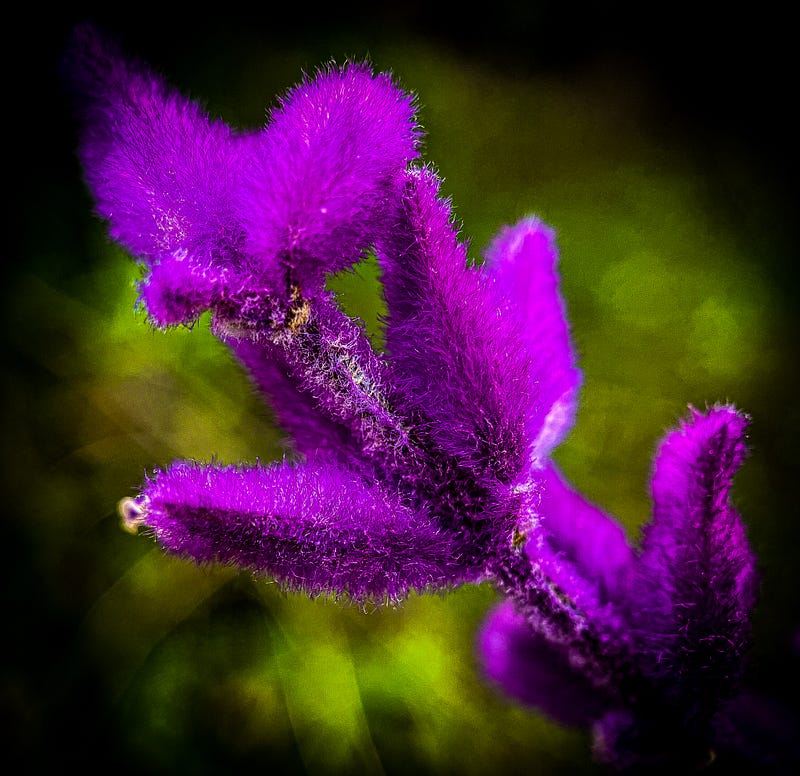
Have you ever gotten down onto your knees to see the purple haze lingering over the Mexican Lavender? Have you ever watched it morph into focus when you truly look, not just with your eyes, but with your soul?
I know that birds can see, more than we do, into the realms of violet and into the long, dark night, when the owl takes flight, swooping low, gliding on the breeze. There is no doubt that she sees that skittering mouse hiding in the bush.
Or what about the blue grosbeaks, whose iridescence flashes boldly for their mates, but is fated to be lost to our eyes?
And, what about the theory that migratory birds can actually see magnetic fields?
The pigeon doesn’t know she is different. But those cryptochromatic receptors get awfully excited, perhaps delighted, when they sense the lines of energy dancing into infinity.
Does it ever make you wonder if what we perceive is truth?
Or if we possibly should look a little harder, not with our eyes, but with that eternal part of our being which sees all?
All I know, really, is that there are lessons to be learned, whole worlds to be seen, in the fuzz of the lavender.
I believe that we often move through the world, unaware that others perceive it differently than we do. It is so easy to get caught up in our own perspective that we forget that everything we encounter is viewed through the lens of our own past experiences, preferences and personal senses.
In my yoga classes, I often talk about the concept of Pratipaksha Bhavana. In Saṇskrit, Pratipaksha literally means “opposite” and bhavana means “cultivation.” This practice reminds us to open ourselves up to ideas and perceptions that we would ordinarily not see.
For example, if we were late to our yoga class and were speeding down the 55 Freeway, we might get very irritated at a slow car in front of us. We might even honk at the driver, or drive erratically to get around the car.
But what if you knew that the driver was trying to get his wife, who was in labor to the hospital? Or if it was somebody’s grandmother, sitting on a phone book to be able to see over wheel, terrified to be on the freeway, but needing to visit her husband in the nursing home?
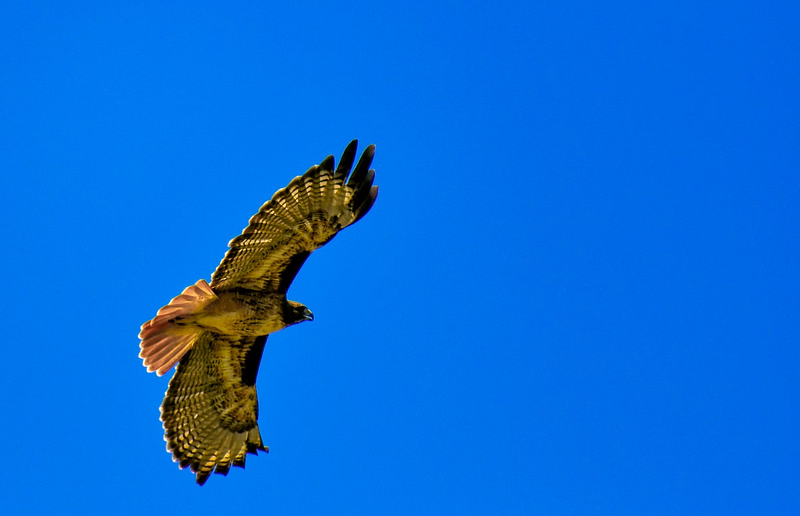
Birds have always struck me as a perfect example of another lens into the world. They, literally, do see so much more than us.
The male blue grosbeaks lucky enough to be adorned with the brightest and most UV-shifted blue in their plumage (very visible to them, but invisible to us) tend to be larger than their brethren. They hold the most extensive territories with abundant prey, and feed their offspring more frequently than other males. And male blue tits are crowned with an ultraviolet reflective patch which is displayed in courtship by posturing and raising of their nape feathers.
All of that happens without our ever being able to actually see it. And yet, the birds see it. It is their reality. Our reality is not more real than theirs is, although we might go through life assuming we are seeing the same thing as the birds.
Incredibly, migratory birds might actually be able to “see” magnetic fields. The right eye of a migratory bird contains photoreceptive proteins called cryptochromes. When light enters the eye, it excites these molecules to produce unpaired electrons that interact with the Earth’s magnetic field, thus providing directional information.*
So, the next time you look at a flower (like the Mexican Lavender), or that iridescent crow, I would ask you to take a moment and think about what this might look like from a bird’s perspective, or from a person who is color-blind’s perspective.
In the end, it is all reality. And we are just seeing a tiny part of it.
Erika Burkhalter is a yogi, neurophilosopher, cat-mom, photographer, and lover of travel and nature, spreading her love and amazement for Mother Earth’s glories, one photo, poem or story at a time. (MS Neuropsychology, MA Yoga Studies).
If you enjoyed this piece, you might also like:
To truly understand a poem, I feel that it needs to be heard. To hear the rhythm, the cadence, the emphasis, please listen to my recording of “The Purple Haze.”
Poem, story and photos ©Erika Burkhalter. All rights reserved.
* Heyers D, Manns M, Luksch H, Güntürkün O, Mouritsen H (2007). Iwaniuk A (ed.). “A Visual Pathway Links Brain Structures Active during Magnetic Compass Orientation in Migratory Birds”. PLoS ONE. 2 (9): e937. doi:10.1371/journal.pone.0000937. PMC 1976598. PMID 17895978.
*Shanor, Karen; Kanwal, Jagmeet (2009). Bats sing, mice giggle: revealing the secret lives of animals. Icon Books. p. 25. ISBN 978–1–84831–071–1.(Despite its title, this is written by professional scientists with many references)
Erika Burkhalter is a yogi, cat-mom, photographer, and lover of travel and nature, spreading her love and amazement for Mother Earth’s glories, one photo, poem or story at a time. (MS Neuropsychology, MA Yoga Studies).
Poem, story and photos ©Erika Burkhalter. All rights reserved.


