
Poetry, Yoga, Indian Philosophy
Visions
Insights from the 18th century Bengali poet, Rāmprasād
You think you understand the Goddess? Even philosophers can not explain her. The scriptures say that she, herself, is the essence of us all. It is she, herself, who brings life through her sweet will.
You think you understand her? I can only smile, you think that you can truly know her? I can only laugh! But what our minds accept, our hearts do not. Ants try to grasp the moon, we the goddess. — Rāmprasād
Rāmprasād wakened in his small hut. The sun filtered in through the window overhead, spilling her light across the hard-packed dirt floor. He arose with a start, throwing off his threadbare blanket. He had slept too long. But he had had a dream. A whole new poem resonated through the very fibers of his being.
His heart throbbed with the memory of her divine love that had enveloped him in that land of sleep, of cosmic consciousness where fields of lotuses swayed across still waters of latent potency.
Perhaps today, she would grant him a vision of her…. He longed with all his being to see his beloved Goddess.
Throwing on his dhoti and sandals, he half-trotted through the winding streets, on his way to the banks of the Ganges. He would sing his new song, his words of adoration during his morning pūjā at the river.
He brushed through a narrow alley and was about to duck through a low passage that spilled out onto the river banks when a young girl, radiant with the nimbus of Sūrya’s* grace framing her, stepped into his path.
Turning his face away, he tried to rush past her, but she blocked his way.
“Rāmprasād,” she said, “I know who you are. Would you please sing to me one of your devotional songs to the Divine Mother?”
“Girl,” he replied, “I am on my way to make my morning pūjā. “I don’t have time now.”
Her eyes, unfathomably dark, pupils blending into irises as black as the midnight sky, glinted with a sheen of tears. “But I so long to hear one, to have you fill my ears and my heart with your love for her.”
He knew that pang, that intense desire to be one with her.
Placing his hands on her shoulders, he told her. “Wait here for me. When I return I will sing one for you.”
She bowed her head and allowed him to pass. He hurried to the river, performed his pūjās, his song echoing over the waters. But, he felt strangely empty. The words did not seem to resonate with the same clarity, that same intensity as they had in his dream. And the Goddess did not grant him even a flicker of a vision of her beauteous form.
His eyes downcast, he shuffled back towards home, almost despondent, but then he remembered the girl from earlier in the morning. He knew he had promised her a song. Retracing his steps, he found the spot where they had nearly collided earlier. And there, scrawled in chalk on the wall, was a note.
My darling Rāmprasād, you have been yearning for a vision of me for so long and with such heartfelt devotion that today I finally appeared before you. But you were too busy to stop and see me.
Rāmprasād closed his eyes, realizing his error, an error he knew he would never make again.
He had been so devout in his pūjās, his rituals, that he had forgotten how to be receptive, how to see infinite grace in everything and everyone.
Tears streaming down his face, he returned to the river, songs of love spilling from his lips and his soul, his heart thrown wide open to the shimmering waves of bliss undulating through the fabric of the universe.
- Sūrya is the sun god.
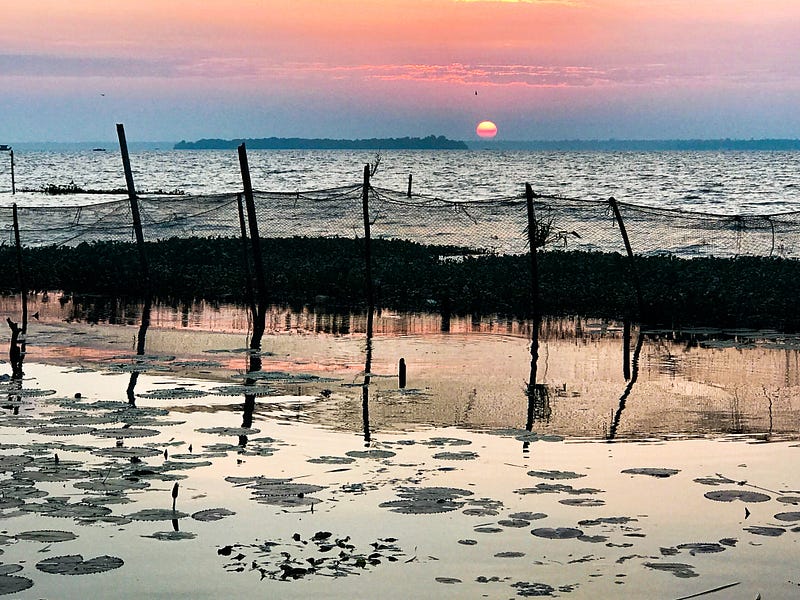
Sadhak Rāmprasād Sen (c. 1718 or c. 1723 — c. 1775) the 18th century Bengali poet devoted to Shakta (the Goddess), has been likened to William Blake. Devoted to the manifestation of the Goddess as Kali, in particular, he set his works to music, which is still sung on the streets of Calcutta and set to music on the radio today.
The story above is about his encounter with the Goddess Annapurna, of Varanasi. She is said to have told him, in another encounter, “Varanasi is not the only place where I live; I pervade the whole universe.”
You’ll find Mother In any house. Do I dare say it in public? She is Bhairavi with Shiva, Durga with Her children, Sita with Lakshmana. She’s mother, daughter, wife, sister — Every woman close to you. What more can Ramprasad say? You work the rest out from these hints. — Rāmprasād
Erika Burkhalter is a yogi, neurophilosopher, cat-mom, photographer, and a lover of nature and travel. She has been studying and teaching the ancient yogic texts for many years and holds an MA in Yoga Studies as well as a MS in Neuropsychology. Erika has traveled within India seven times to study yoga, to see the ancient sites, for graduate school study, and to take her yoga students on retreats to see the land where yoga originated.
If you enjoyed this piece, you might also like:
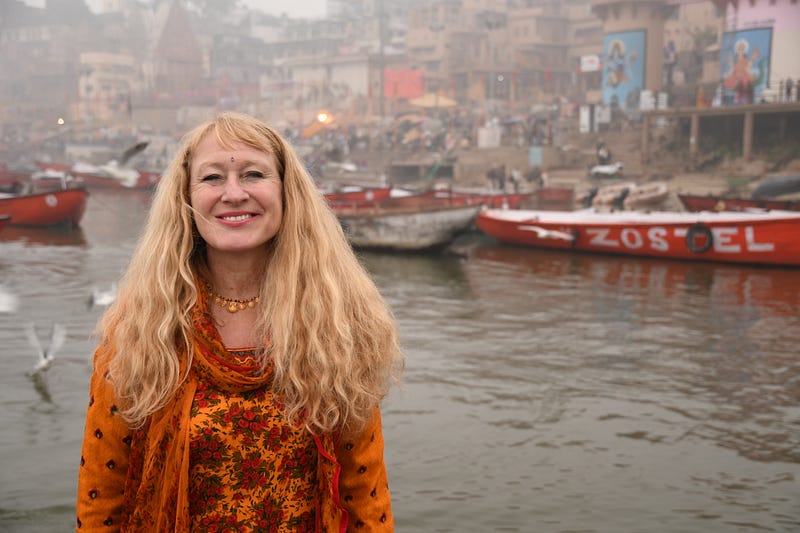
Photo and story ©Erika Burkhalter. All rights reserved.


