What is RAG in AI? Explained in Everyday Language for AI Beginners
Updates: AI for Absolute Beginners is an ongoing series that now covers:
If you’ve been following the recent AI hype, you must have heard “RAG” quite a bit. RAG stands for Retrieval-Augmented Generation, a critical step in enhancing the power of AI chatbots. However, this term isn’t as popular as phrases like ‘prompt engineering’, probably because abbreviations are generally less intuitive to understand and remember :) So in this article, let’s demystify the fascinating AI concept of Retrieval-Augmented Generation, or RAG.
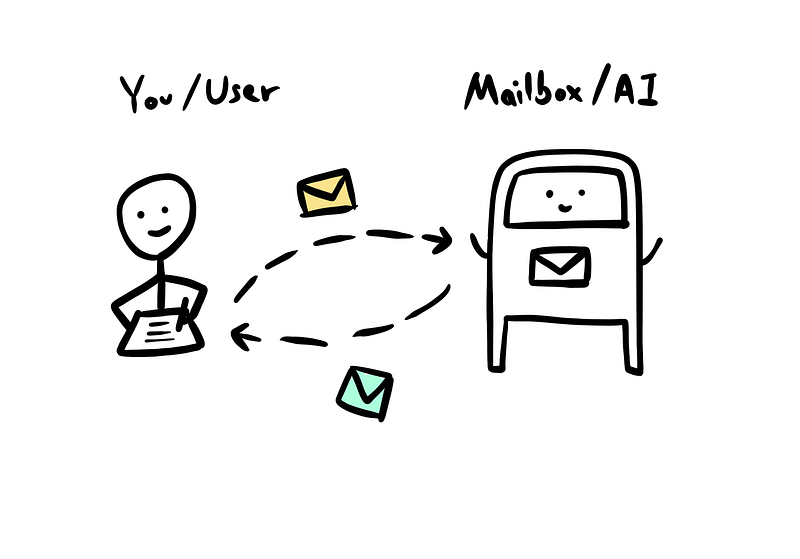
What is RAG? At its core, RAG is a method used in AI to enhance the way machines understand and generate information (https://ai.meta.com/blog/retrieval-augmented-generation-streamlining-the-creation-of-intelligent-natural-language-processing-models/) While Large Language Models are good at summarizing and forming sentences like natural language, RAG gives its extended capabilities to provide additional information.
Let’s say you are writing a letter, and there’s a magical mailbox that can write back to you. This mailbox contains all the letters people have written in the world (i.e., it’s a large language model), so it can generate responses based on the learnings from those letters, almost like magic. This is how traditional LLMs or AI chatbots work, utilizing their “existing knowledge.”
But sometimes, you might want to ask about something more specific, like a recipe for a cake, a math problem, or “What’s the weather tomorrow?” These queries require specific knowledge or data sources that people might not have written about in the mailbox — and this is where RAG comes in.
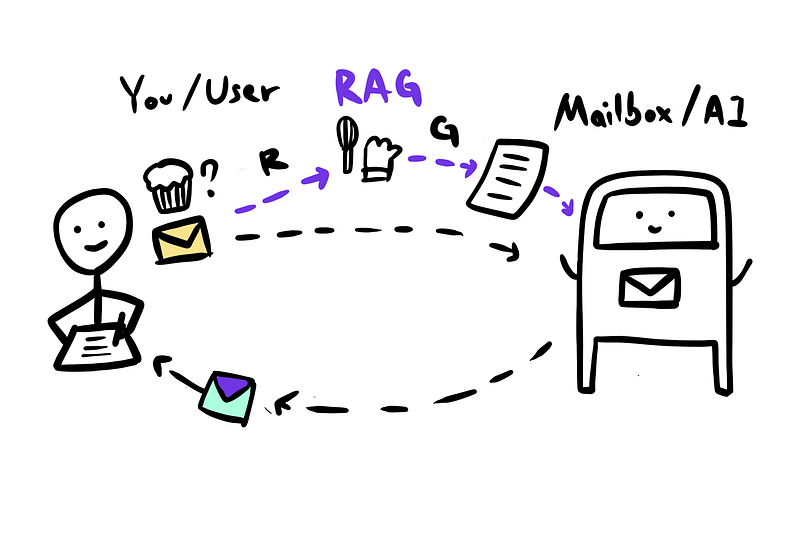
Imagine there’s a cake shop nearby the mailbox that it can consult for help. So, every time you ask baking-related questions, the magic mailbox sends these queries to the cake shop to get relevant information. After some searching, the shop owner notes: “You can find these in my recipe library helpful: on shelves 4 and 3, rows A and D, lines 10 and 12.” This is the Retrieval part.
Then, the RAG model tries to generate a prompt — similar to a summary, as an “additional note” on your letter. This is the Generation part. So when the magical mailbox compiles everything, it has information from both the user and the cake shop, without losing any context on either side.
This method of using retrieved information to augment generative answers is what RAG is all about.
Hereby, now you will also notice that RAG is not required everywhere. For AI to chat, RAG is not a must-have. You also don't need it in translating, summarization, or sentence completion.
Why Is RAG Important? RAG is like giving AI a research assistant. It allows AI to provide more accurate, detailed, and reliable answers. For instance, when using a chatbot, RAG can help it provide responses that are not just based on pre-fed information but also the latest, most relevant data retrieved from various sources.
Applications of RAG:
- In Customer Service: Chatbots can provide more detailed and up-to-date information.
- In Research: Helps in gathering and synthesizing information quickly.
- In Everyday Life: Virtual assistants like Siri or Alexa become more helpful and informative.
Conclusion: RAG is a step forward in making AI more helpful, knowledgeable, and reliable. It’s like equipping AI with a super-charged internet browser, ready to search and gather information to answer our questions more efficiently.