
What is Database Per Microservices Pattern? What Problem does it solve?
Breaking Down Monoliths: How the Database Per Microservice Pattern Can Transform Your Architecture
Hello folks, as the demand for microservices architecture continues to grow mainly due to increased adoption of cloud, developers and architects are constantly seeking ways to optimize their implementation. One approach gaining popularity is the Database per Microservice design pattern.
As the name suggests, this pattern recommends that instead of sharing a common database with other microservices, each microservice should has its own database.
This approach has several benefits, including better isolation and scalability, reduced complexity and coupling, improved performance, and easier maintenance. However, implementing this pattern requires careful consideration of the data access and management strategies, such as data synchronization and consistency, database schema design, and deployment strategies.
In the last few articles I have explained popular Microservice design patterns like Event Sourcing, SAGA, API Gateway, Circuit-Breaker, and CQRS and also shared best practices to design Microservices and In this article, we will explore the Database per Microservice design pattern and its implementation in different scenarios.
We will discuss the advantages and disadvantages of this pattern, and how it fits with other microservice architecture patterns.
Additionally, we will provide best practices and practical tips for designing and deploying microservices with separate databases, using popular tools and frameworks like Spring Boot, Docker, and Kubernetes, which is also quite important from Microservice interview perspective.
Whether you are a Java Developer, a Microservice architecture enthusiast, a system design expert, or a senior developer seeking to optimize your microservices implementation, this article will provide you with valuable insights and practical guidance on adopting the Database per Microservice design pattern.
By the way, if you are new to Microservice architecture or just want to revise key Microservice concepts and looking for resources then here are few online courses you can join:
- Master Microservices with Spring Boot and Spring Cloud [Udemy]
- Building Scalable Java Microservices with Spring Boot [Coursera]
- Developing Microservices with Spring Boot [Educative]
- Master Microservices with Java, Spring, Docker, Kubernetes [Udemy]
This list includes both video and text-based courses as well as project based courses for hands-on learning, you can join one or a couple of them to revise Microservices concepts. If you need more choices, you can see the below articles:
And, if you need more choices, you can also checkout following resources:
What is Database Per Microservice Pattern? How does it work?
The Database per Microservice pattern is a Microservices architecture pattern that involves creating a separate database for each microservice. In this pattern, each microservice has its own database, which allows for greater scalability, flexibility, and autonomy.
With this pattern, each Microservice has full control over its own data, which allows it to make independent decisions about how to store, retrieve, and manage its data.
Each microservice can choose the best database technology for its specific needs, rather than being forced to use a single database technology for the entire system.
The pattern also helps to reduce the risk of failure in the system by removing single point dependency. Since each microservice has its own database, a failure in one microservice will not necessarily affect the rest of the system.
This also allows for easier maintenance, upgrades, and changes, as well as greater fault tolerance and resilience, one of the 10 things developer should keep in mind while designing microservices.
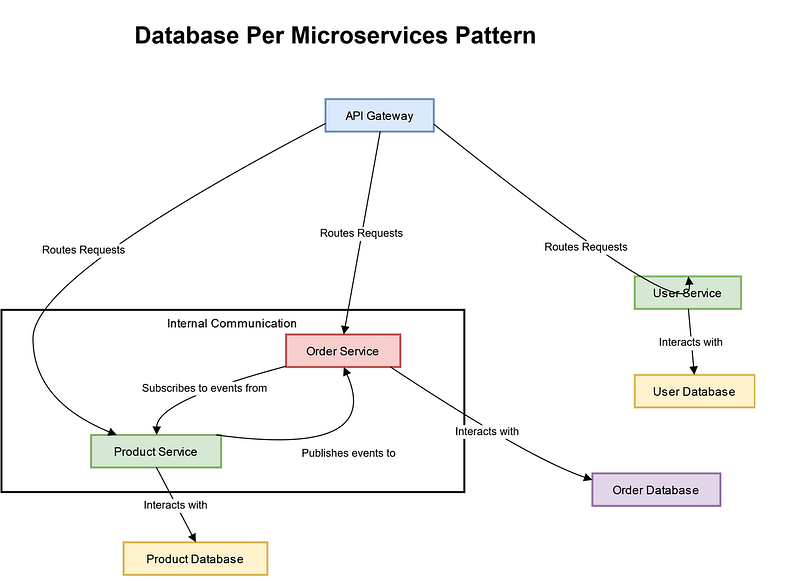
Here is how this pattern looks in practice, you can see that each service has its own database, OrderService is interacting with order database, User service has user database and Product Service also has product database.
Overall, the Database per Microservice pattern offers many benefits for microservices architecture, including scalability, flexibility, autonomy, and resilience. However, it also requires careful planning and coordination to ensure that data is properly managed and shared between microservices when necessary.
Now that we know what is Database Per Microservice Pattern, let’s deep dive into it to understand it better.
What Problem does Database per Microservice Pattern Solve?
The Database per Microservice design pattern solves the problem of managing data storage for microservices in a distributed system. In a microservices architecture, each microservice is responsible for a specific business capability and has its own data storage requirements.
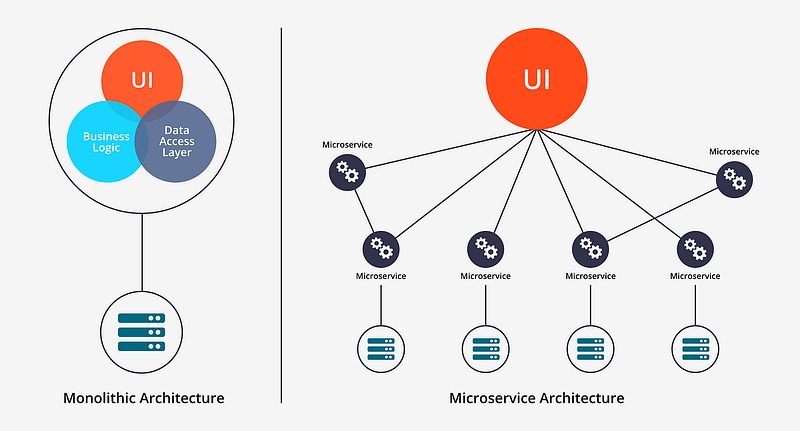
Traditional monolithic applications usually have a single database that manages all data, but in a microservices architecture, managing data for multiple microservices in a single database can become complex and can cause issues such as tight coupling between microservices, difficulty in scaling and maintaining the database, and potential data integrity issues.
The Database per Microservice design pattern addresses these issues by allowing each microservice to have its own dedicated database, which provides better scalability, maintainability, and flexibility.
When to use Database Per Microservice Pattern? A real world example
Suppose there is an e-commerce platform like Amazon.com with multiple microservices that handle various functionalities such as user authentication, order management, and inventory management. Each of these microservices requires its own database to store and manage the relevant data.
With the Database per Microservice Pattern, the e-commerce platform can ensure that each microservice has its own database, which helps to isolate data concerns, reduces coupling between services, and provides greater flexibility in scaling and deployment.
For instance, if the order management microservice experiences a surge in traffic, it can be scaled independently of the other services, since it has its own database.
Additionally, with the Database per Microservice Pattern, each microservice can choose the best-suited database technology for its specific needs.
For example, the inventory management microservice might use a NoSQL database for its high scalability and performance, while the user authentication microservice might use a relational database for its data consistency and transaction support.
Overall, the Database per Microservice Pattern can be a valuable approach to microservice architecture, particularly for complex applications that require multiple services to function.
Here is a diagram which shows how this pattern look like in a Microservice architecture:
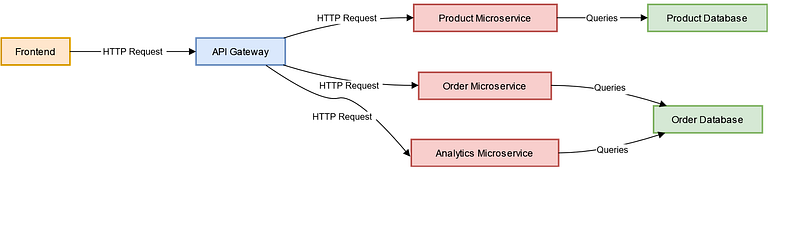
In this scenario, an API Gateway sits at the front of the system and routes HTTP requests from the front-end to the appropriate microservices. The Product and Order microservices handle requests related to products and orders, respectively.
Each microservice has its own database (Product Database and Order Database), and the microservices make queries to their respective databases. An Analytics microservice also exists, which queries the Order Database to generate reports, which may seem counter intuitive but if Analytics Microservices is just reading from database then its still fine.
What are Pros and Cons of Database Per Microservice Pattern?
Here are some of the pros and cons of using the Database per Microservice pattern:
Pros:
- Improved scalability By having a separate database for each microservice, it becomes easier to scale individual services as per demand, without affecting others.
- Increased autonomy Each microservice is responsible for its own data, which means teams can work autonomously and independently.
- Better performance Since each microservice has its own database, it can use a database technology optimized for its specific needs, resulting in better performance.
- Easier to maintain Since each microservice has its own database, changes to one microservice won’t affect others, making it easier to maintain and modify the system.
Cons:
- Increased complexity Managing multiple databases can be complex, and require a lot of effort to set up and maintain.
- Data consistency issues Having multiple databases means that ensuring data consistency across all microservices can be challenging, and requires additional effort.
- Higher cost Having multiple databases can lead to higher costs, both in terms of hardware and software licenses.
- Potential data duplication Storing data in multiple databases can lead to data duplication, which can lead to inconsistencies and confusion.
It’s important to note that the suitability of this pattern depends on the specific requirements of the system being designed, and should be evaluated carefully before implementation.
Java and Spring Interview Preparation Material
Before any Java and Spring Developer interview, I always use to read the below resources
Grokking the Java Interview
Grokking the Java Interview: click here
I have personally bought these books to speed up my preparation.
You can get your sample copy here, check the content of it and go for it
Grokking the Java Interview [Free Sample Copy]: click here

If you want to prepare for the Spring Boot interview you follow this consolidated ebook, it also contains microservice questions from spring boot interviews.
Grokking the Spring Boot Interview
You can get your copy here — Grokking the Spring Boot Interview

Conclusion
The Database per Microservice pattern offers several benefits, including increased scalability, flexibility, and fault tolerance. However, it also comes with some drawbacks, such as increased complexity and potential data inconsistency across microservices. Therefore, it is essential to carefully evaluate the needs of your system and consider the trade-offs before adopting this pattern.
The database per microservice pattern is particularly suitable for large and complex systems with a high degree of data isolation requirements. It is also an excellent choice for organizations that need to scale their applications quickly and frequently. However, smaller and less complex systems may not benefit from this pattern and may find it overly complex and costly to implement.
In summary, the Database per Microservice pattern is a powerful tool in the microservices architecture toolbox, but it should be used thoughtfully and with careful consideration of the system’s requirements and constraints.
Microservices Learning Resources
If you are new to Microservice architecture or just want to revise key Microservice concepts and looking for resources then here are few online courses you can join:
- Master Microservices with Spring Boot and Spring Cloud [Udemy]
- Building Scalable Java Microservices with Spring Boot [Coursera]
- Developing Microservices with Spring Boot [Educative]
- Master Microservices with Java, Spring, Docker, Kubernetes [Udemy]
This list includes both video and text-based courses as well as project based courses for hands-on learning, you can join one or a couple of them to revise Microservices concepts. If you need more choices, you can see the below articles:
And, if you need more choices, you can also checkout following resources:
Also, other Microservices articles you may like to explore:


