
What I Learned from Writing 100 Days Straight and Why I’ll Never Stop
How I turned a writing habit into a healthy, daily obsession
There’s this thing about writing — if you want to call yourself a writer you’ve actually got to do it. It’s easy enough to talk about writing — maybe even have an opinion about it.
But if you want to hang your writing shingle you better make sure you’re writing.
We don’t get better by talking about writing — or getting prepared to write. Just like we don’t get better by talking about basketball, or plumbing. Eventually, we’ve got to shoot the ball or turn the wrench.
I knew all this stuff. But I was terrible at applying it.
I tried to develop a daily writing habit for years, but something would always derail my progress… until I gamified my journey. A daily habit app, coupled with a writing ritual and instant feedback (through article stats), I turned myself into a writing maniac.
Getting paid, albeit a small amount, to write articles was a huge win for habit-building. When you can watch your stats grow over time, it’s much easier to commit to something daily.
Towards the tail end of the 100 days, the journey collided with NaNoWriMo, which was another great reason to continue daily writing. I throttled-down my article production and forced myself to write at least 2,000 words a day (most days).
Every day I wrote I checked a red X in my tracker app (just like Jerry Seinfeld).
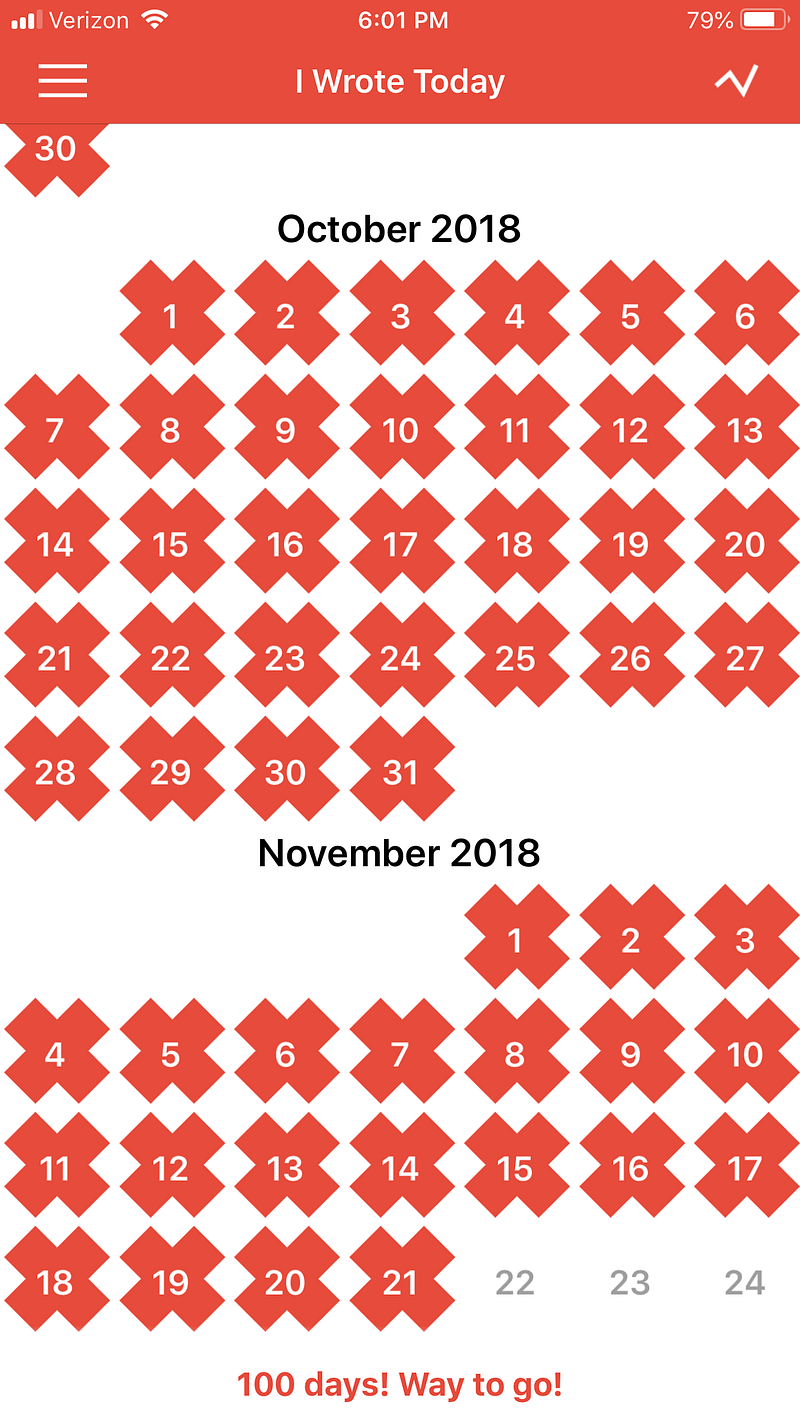
Once I broke the 50-day mark I didn’t want to have any missing spots. Once I hit 100 I can’t imagine missing a day. I’ve come too far. As long as I write at least one sentence, I’ve written for the day.
What I learned
I’m a few days beyond 100 and it feels great. The daily writing is far beyond habit-building. It’s now a healthy addiction. Whether I’m writing part of a manuscript, a short story, or an article, I don’t feel I’ve finished my day until I get my words in. Now I can’t go to bed until I get a few words in. Most days it’s a few thousand.
When you’re a prolific writer you get better by force.
Sure, you can try not to get better, but who does that? If you write every day and you pay attention to your craft — even smaller things like word choice for next time — you’ll grow whether you want to or not.
When you write every day you’ve got a lot more to draw from.
There isn’t a better profession alive. I mean, we get to pound little plastic squares and print money. Who else does that ? Save for the counterfeiters. Not only will I finish a book in November, but I also plan to turn around and finish one in December… and January…
It wasn’t that bad — writing a book in a month.
But there’s no way I could say that hadn’t I built the daily writing habit as the backbone. Sure, I’ve got to get creative. I now spend most of my writing time on my phone. I’ve got it with me a lot more than I do my laptop.
You’ll never remove the self-doubt, but it’s much easier to overcome when you write every day. The goal becomes the work. I no longer worry if the work is good enough, because it’s not done yet.
We get so wrapped-up in our self-loathing we forget we haven’t finished the project to hate it yet. Our readers are the ones who get to judge whether or not a piece works.
As writers we’re the delivery drivers of story.
Writing is a vocation — not something fancy. Once we realize the work isn’t going to write itself we get out butts back in the seat and get to work.
It’s time to grow the obsession
Whether your turn your writing habit into a game, you get small wins from writing profitable, smaller pieces, or you try to write a novel in a month — you need a writing goal for the first leg of your daily writing journey.
If you want to write an entire novel as your daily end-game, I’d recommend the NaNoWriMo model. This really helped me. When you’re forced to write 1,700–2,000 words per day your perspective changes.
Daily writing goals turn the process into a vocation (got to hit the word count) versus some cerebral hurdle you’ve got to overcome (I’m such a terrible writer. Everything I do isn’t worth reading.
When you’ve got a daily quota your brain gives you a break with the flagellation.
The first seven days were easy — this was the exciting time. Nothing could stop me.
Days 8–14 were accomplished by brute force — not my favorite days, but this was my brain fighting against me for building a new habit.
Days 15–25 were forced but easier — I had more Xs on the calendar. I could see the progress growing. The daily writing still didn’t feel like a habit, but it wasn’t as tough as the last block of days.
Days 25–50 were awesome — The daily habit was built. I had to remind myself to sit and write, but I looked forward to hitting my word count every day. The habit was there, but it was still fragile and easy to break at any time.
Days 51–100 — Once I got closer to the 100-day mark something magic happened. I had forced myself to write daily for so long, my brain stopped fighting me and became my sidekick instead. Once I reached this stage the daily writing had become an obsession.
You know how you feel when you’re obsessed with an activity you love? You don’t feel like your day is complete until you get to complete your task. Well, this happened to me once I got close to the 100-day mark.
Sure, you can also build bad habits this way, but when you’ve made writing an obsession, not only is it easier to hit your word count, but the inner, negative voice is dampened.
100 days of writing also brought an added benefit — mental health.
Before, if I missed a few days of writing I’d feel pretty bad about myself. I’m a writer dammit. Why can’t I get myself to write? Once the daily habit was built, all that inner-chatter disappeared.
It’s time for you to try.
Think of how much writing you can accomplish by writing daily.
We’re waiting for you.
August Birch (AKA the Book Mechanic) is both a fiction and non-fiction author from Michigan, USA. A self-proclaimed guardian of writers and creators, August teaches indie authors how to write books that sell and how to sell more of those books once they’re written. When he’s not writing or thinking about writing August carries a pocket knife and shaves his head with a safety razor.
(Enroll in My Free Email Masterclass: Get Your First 1,000 Subscribers)


